
Mitchum, Stewart classics and an animated ‘Kung Fu Kid’
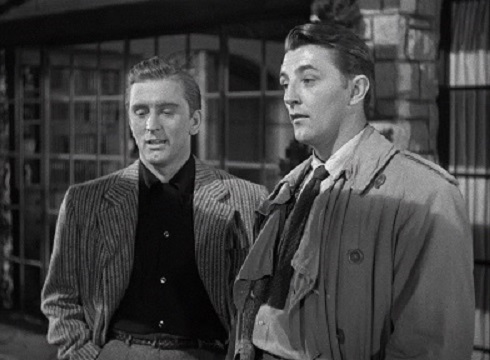 Kirk Douglas, left, and Robert Mitchum in RKO Radio Pictures’ “Out of the Past.”
Out of the Past (1947, Warner Archive Collection, 4K Ultra HD + Blu-ray, NR, 96 min.). This stylish, classic film noir, directed by Jacques Tourneur (“Cat People,” “I Walked with a Zombie”), is filled with double-crosses and saw Robert Mitchum solidify his tough-guy persona. The film was wonderfully lensed by cinematographer Nicholas Musuraca (“Cat People,” “The Spiral Staircase”). The film, named to the National Film Registry in 1991, has been restored and remastered from its original camera negative.
Mitchum (“Cape Fear,” “The Longest Day,” “The Night of the Hunter”) plays retired private eye Jeff Markham, now going by the name of Jeff Bailey and running a gas station in the small town of Bridgeport, California, with the help of a deaf-mute teenager (Dickie Moore of “Oliver Twist,” “Sergeant York”). Then one day his past, in the form of Joe Stefanos (Paul Valentine of “Against All Odds”), shows up, re-involving him with an old client, wealthy gangster Whit Sterling (Kirk Douglas of “Spartacus,” “Lust for Life” in only his third film), who lives near Lake Tahoe.
Jeff currently is dating Ann (Virginia Huston of “Flamingo Road,” “Tarzan’s Peril”) and taking afternoons off to go fishing with her. However, there is another love in his past – Kathie Moffat (Jane Greer of “The Big Steal,” “The Prisoner of Zenda”) – who was associated with Sterling.
In a lengthy flashback, we learn that Kathie was Sterling’s girlfriend, who allegedly took off with $40,000. Jeff, then in a detective partnership with Fisher (Steve Brodie of “The Caine Mutiny”), was hired by Sterling to bring Kathie back. Jeff traces Kathie to Acapulco, Mexico, but falls in love with her and lies to Sterling about not finding her. After a fatal incident, Kathie takes off and Jeff takes up the gas station business.
Now, Sterling wants Jeff to recover tax records held by accountant Leonard Eels (Ken Niles of “Hollywood Hotel”) in San Francisco, records that could prove tax evasion and earn a lengthy imprisonment.
Things get further muddied as Katie is back with Sterling but wants to reignite with Jeff, and Eels has a duplicitous secretary in Meta Carson (Rhonda Fleming of “Spellbound,” “A Connecticut Yankee in King Arthur’s Court”). The film proves that women are the equally deadly species.
Extras include audio commentary by film noir author James Ursini; an introduction by Turner Classic Movies “Noir Alley” host Eddie Muller (5;24); and four 1947 audio shows, starring Mitchum in both “We Were Expecting You at Dakar” (30:07) and “Death at Live Oak” (29:59) and Douglas in both “The Story of Markham’s Death” (29:54) and “Community Property” (29:32). Grade: film 3.75 stars; extras 3 stars
Rating guide: 5 stars = classic; 4 stars = excellent; 3 stars = good; 2 stars = fair; dog = skip it
Purchase link for some titles: https://moviezyng.com?bg_ref=ApLKdWV51k
Thunder Bay (1953, Universal Pictures, Blu-ray, NR, 102 min.). James Stewart (“Vertigo,” “It’s a Wonderful Life,” “Mr. Smith Goes to Washington”) stars as oil seeker Steve Martin, alongside partner Johnny Gambi (Dan Duryea of “Sahara,” “Scarlet Street”), in this clash of Louisiana shrimpers and oilmen. Both men fall in love with a daughter of shrimper Dominique Rigaud (Antonio Moreno of “It,” “Creature from the Black Lagoon”). Steve falls for the older Stella (Joanne Dru of “Red River,” “All the King’s Men”), who obviously has been hurt in the past, and Johnny falls for Francesca (Marcia Henderson of “All I Desire,” TV’s “Matinee Theatre”), who is engaged to shrimper Phillipe Bayard (Robert Monet).
No one has successfully drilled for oil in the Gulf of Mexico due to hurricanes and insurance worries, but Steve has developed a new method of stabilizing an oil drilling platform and he gets Kermit MacDonald (Jay C. Flippen of “They Live by Night,” “Oklahoma!”), whose company already has an offshore drilling lease that expires in three months, to fund the $1 million project.
Everything appears to be going OK, except between Steve and Stella, until Steve uses dynamite to help discover the best location to drill. Because of Stella’s objection, Steve had to switch from using her father’s boat to that of Teche Bossier (Gilbert Roland of “The Sea Hawk,” “Cheyenne Autumn”). During a hurricane, Bayard tries to dynamite the oil platform in the film’s most exciting sequence.
In addition to the expected conclusion, there is a deus ex machina involving the shrimp. Grade: film 3.25 stars
The Kung Fu Kid, aka I Am What I Am 2 (China, 2024, Well Go USA, Blu-ray, NR, 133 min.). In this well-made CG-animated film,Liu “A-Juan” Jiajuan, a young man who came to Shanghai to work and does lion dances among other jobs, agrees to participate in the "Shanghai Fight Night" broadcast martial arts competition on behalf of the declining Chuanwu Boxing Gym, aka the Truth-Seeker Combat Club, owned by Wang Zhaoyu. He needs 100,000 yuan to pay for the hospital expenses from his uninsured father’s leg injury. The top prize is 300,000 yuan.
A-Juan usually works with two friends, A-Mao and A-Gou. The three are giving temporary lodging, meals and jobs at a street restaurant by Master Zhang Wate, Wang’s friend who reluctantly agrees to train A-Juan for the Fight Night competition.
The Truth-Seeker Club has an ongoing bad relationship with the next-door JinXin Club, whose owner wants to buy their property for expansion. Its lead fighter is Xiao Zhangyang, a very aggressive fighter, whom A-Juan will eventually have to fight.
There is a slew of backroom skullduggery at the hands of the devious fight promoter who manages Xiao, including an online video release of an earlier rumble when A-Juan tried to protect Wang against several attacking JinXin Club members.
The fight sequences, directed by Peng Zhang (“Spider-Man: Brave New World”), feature an array of style-focused fights and characters that show A-Juan’s malleability as a martial artist. A-Juan truly is a character to root for.
The film comes in the original Chinese, with an English dub option. Grade: film 3.5 stars
Are You There God? It’s Me, Margaret. (2023, Lionsgate, 4K Ultra HD, PG-13, 106 min.). Based on the book by Judy Blume (“Tiger Eyes,” TV’s “Forever”) and directed by Kelly Fremon Craig (“The Edge of Seventeen”), the film is the story of 11-year-old Margaret Simon (Abby Ryder Fortson of TV’s “Scooby-Doo: Origins,” “The Pitt”) who moves from New York City to the New Jersey suburbs. With a trio of new female friends, she starts to contemplate everything about life, friendship and adolescence. She relies on her mother, Barbara (Rachel McAdams of “The Notebook,” “Spotlight”), who offers loving support, and her paternal grandmother, Sylvia (Kathy Bates of “Misery,” “Dolores Claiborne,” TV’s “Matlock”), left back in New York City.
A ticking emotional timebomb is the fact that her mother is Christian and her father Herb (Benny Safdie of “Oppenheimer”) is Jewish. Barbara’s parents disowned her for marrying a Jew, so Barbara and Herb decided they would not raise Margaret in a religion, letting her choose herself when of age. Encouraged to explore her feelings toward religion for a school project by her teacher (Echo Kellum as Mr. Benedict), she attends a Jewish service with Sylvia and Christian ones with her friends. Then, Barbara’s parents decide to visit with little warning.
Once at the new home, Margaret is immediately approached by fellow sixth-grader Nancy Wheeler (Elle Graham of “The Hunger Games: Mockingjay – Part 2”), who has formed a club with classmates Gretchen Potter (Katherine Mallen Kupferer) and Janie Loomis (Amari Alexis Price). The quartet become obsessed over when they will have their first periods. Margaret does start to become interested in fellow student Moose Freed (Aidan Wojtak-Hissong of TV’s “I Am Not Okay with This,” “Playdate”), but this is mostly a girls’ movie.
Maragaret frequently prays to God, saying initially: “I’ve heard a lot of good things about you.”
Extras include deleted scenes (1:35); six featurettes, covering making the film, with interviews (19:55), a talk with Blume (8 min.), the young girls in the cast (7:58), adapting the book (8:19), creating the costumes (7:15) and designing the film (10:07); and a roundtable discussion with Blume, James L. Brooks, Forston, Craig, McAdams and Julie Ansell (6:12). There also is Blume reading from the book (4:46). Grade: film 3.5 stars; extras 3.25 stars
Wicked Priest Collection (Japan, 1968-1971, Arrow Films, 3 Blu-rays, NR, 453 min.). The first four films in this five-film series are set during the early Taisho Era (1917-1926). It was a time when a monastery of warrior monks was split into two factions. One of these factions was led by the Chief Abbot and his protégé Shinkai (Tomisaburō Wakayama, who went on to star in the “Lone Wolf and Cub” film series).
In the first film, “Wicked Priest” (1968, 89 min.), Shinkai intercedes in a fight between a rival priest and some ruffians, trying to quiet things, but he is exiled from his monastery for a probationary year due to perceived bad behavior. The rival priest was Ryotatsu (Bunta Sugawara of voice work in “Spirited Away,” “Tales from Eathsea”), who becomes a recurring revenge figure in the subsequent films.
When the film jumps forward five years, we see Shinkai getting into a fight in a brothel and then gambling, in the process noting that the dice handler was cheating, as someone under the table poked the dice. It seems Shinkai has become a vigilante of sorts, one with a rather active libido – often played for laughs throughout the films -- and without restrictions on his behavior. In one scene, a woman rides him like a horse.
Shinkai ends up helping locals in various ways, including Kentaro and his forced-prostitute girlfriend Kogiku. Kentaro, who has a surprise parentage (the best part of the story), is a reluctant part of a yakuza organization that is trying to take over the brothel and remove the Chief Abbot.
Eventually – spoiler alert – Shinkai fights Ryotatsu, blinding him in the process. He also fights the whole yakuza gang in a fast-paced one-versus-all fight. Both the blinding of an opponent and a big closing fight become staples of the following four films. In each film, Ryotatsu eventually shows up to fight Shinkai, although in the final two films he also helps Shinkai by fighting some of the wicked priest’s opponents.
In “Wicked Priest II: Ballad of Murder” (1968, 89 min.), Shinkai rescues Rentaro, who killed his gambling boss during an altercation. Before going off to turn himself in to the police, Rentaro asks Shinkai to bring his young son Seibo to his grandfather Seisuke Iwai’s jujutsu club in Kawachi. Iwai has long cut off any ties to Rentaro.
Kawachi is being threatened by the Goda Family gang, which is trying to take over the lucrative cockfighting business (two disgusting fight scenes are shown). Iwai decides to protect the town, but Shinkai also helps. On the amorous side, Shinkai is active both in a brothel and a convent. At one point, the Goda leader grabs Seibo and uses the boy to force Rentaro to betray Iwai.
For one battle sequence, a green tint is used. Blind Ryotatsu shows up, but his fight with Shinkai is postponed as Shinkai is arrested (not sure why).
The third film, “Wicked Priest 3: A Killer’s Pilgrimage,” aka “Wicked Priest 3: Pilgrimage of Death” (1969, 91 min.), has Shinkai joining the fight to save a Tokushima Bay village against dynamite-wielding Kessei Group pirate revolutionaries. Shinkai also is invited to a local’s home, as his daughter is to be married and the local custom is to have a stranger deflower the bride-to-be first. There also is some underwater groping when Shinkai comes across eight maidens on a beach. When Ryotatsu shows up, his battle with Shinkai appears to take place in the same locale as a previous film, rather than near the village.
This is the weakest of the five films, followed by the best in “Wicked Priest IV: Killer Priest Comes Back (1970, 94 min.). Here, Shinkai returns to his snowy hometown of Nogata in Northern Kyushu to perform his mother’s memorial. There are flashbacks to Shinkai’s youth. There also is a yakuza plot and a thrown stick of dynamite temporarily has Shinkai seeing double when fighting the bad guys and during partial rematch with Ryotatsu.
A friendly nun helps Shinkai train for fighting while his eyesight is impaired, and Ryotatsu has a good fight against several of the bad guys.
The final film is “Wicked Priest V: Blood on the Commandments” (1971, 89 min.). Weirdly, the film is set earlier than the previous four – in the Mid-Meiji Era (1890s) – yet Ryotatsu already has been blinded and most of the plot elements follow the fourth film, set 30 years later.
Shinkai opens the film having fun in a brothel, before being interrupted and defeating five men downstairs. Trying to help a couple, he holds a fake love suicide ceremony. He has been taken temporarily to Dunghill Mansion, abandoned but where the homeless live. The Buso Company wants to tear down the building for loading docks.
Blind Ryotatsu shows up earlier this time and once again attacks those fighting Shinkai. Their final fight, lasting less than three minutes, closes the film. This ties for the least involving of the series.
Extras include two video essays: In “Composing the Gospel,” music supervisor James Balmont discusses composer Isao Tomita, who composed the second and third films and was later a name in the West for his electronic versions of classical music (20:56), while the second has Japanese cinema expert Jonathan Clements discussing the films’ depictions of historical Japan (20:26). Offscreen battles in the turbulent landscape of 1960s Japanese cinema are discussed in an interview with James Mudge (31:32). Patrick Macias and Matt Alt of the Pure TokyoScope podcast discuss both star Tomisaburō Wakayama, who also sang the opening theme song in each film, in an interesting piece (35:02) and give a primer on Buddhism (15:28). A collector’s booklet contains new writing on the films by Camille Zaurin. Grade: 3.25 stars for No. 4; 3 stars for Nos. 1 and 2; 2.5 stars for Nos. 3 and 5; 3.75 stars for extras
Man of War (2026, Well Go USA, Blu-ray, R, 110 min.). The action film, which seems to have the sound of thousands of bullets being shot, stars LaMonica Garrett (TV’s “Designated Survivor,” “The Lioness,” “1883”) as Mike Connor, an elite American Special Forces veteran who goes to Ukraine during the opening days of Russia’s invasion because his adopted niece Riley (Rosmary Yaneva), an orphanage worker, has been kidnapped by Russian mercenaries. Forced to navigate a brutal landscape of weapons, he risks his life on the rescue mission in Kharkiv.
Connor is aided by Ukrainian Dany Cherchenko (Andrew Howard of “The Odyssey,” “I Spit on Your Grave”) as Charlie Lewis has promised to evacuate his wife and two children from the country. Lewis (Jason Patric of “Narc,” “The Lost Boys”) is Connor’s military logistic help back in the United States. The head kidnapper is Stanislav Koniev (Daniel Bernhardt of “John Wick,” “The Matrix Reloaded”), a former officer in GRU, the Main Directorate of the General Staff of the Armed Forces of the Russian Federation.
The best parts of the film are when Connor and Cherchenko cut through the woods and encounter Russian forces, and the final extraction of Riley through an enemy-filled multi-story building. The latter had as much shooting and grenade throwing that I imagine a modern war video game has. Grade: film 2.75 stars
Person of Interest: The Complete First Season (2011, Warner Bros., 4 Blu-rays, NR, 1,007 min.). This is the first of five seasons for the show that has an off-the-grid and presumed-dead former CIA agent, John Reese (Jim Caviezel of “Frequency,” “The Passion of the Christ”), be hired by a mysterious tech billionaire software genius, Harold Finch (Michael Emerson of TV’s “Lost,” “Evil”), to prevent violent crimes before they happen in New York City via an advanced surveillance software. “The Machine” analyzes data patterns to identify impending acts of terrorism. It also can identify ordinary people who are about to be involved in violent crimes.
At the same time, two New York Police Department detectives -- Jocelyn 'Joss' Carter (Taraji P. Henson of “Hidden Figures,” “The Karate Kid”) and Lionel Fusco (Kevin Chapman of “Mystic River,” TV’s “Brotherhood”) – are drawn into the cases and the mystery of the covert crime fighters.
The set includes 23 episodes of the series created by Jonathan Nolan and J.J. Abrams’ Bad Robot Productions (“Fringe,” “Lost”). Extras include the original broadcast pilot and the unaired extended pilot episode, both with audio commentary by executive producers Jonathan Nolan and Gregg Plageman; the featurette “Living in an Age of Surveillance” (15 min.); and a gag reel (3 min.). Grade: season 3.5 stars; extras 2.5 stars
Endeavour: Series 2 (Great Britain, 2014, PBS Masterpiece Mystery!, 2 DVDs, NR, 6 hours). Set from 1965 to the 1970s, this prequel series to “Inspector Morse” follows Endeavour Morse (Shaun Evans of “Being Julia”) in his early years as a police constable. Working alongside his senior partner DI Fred Thursday (Roger Allam of “V for Vendetta,” “Speed Racer”), Morse engages in a number of investigations around Oxford.
In this season, Morse wrestles with physical and mental trauma, while finding a love interest. There are four episodes of roughly 90 minutes each. One involves a school for girls, where a series of murders took place almost 100 years ago. Grade: season 3.5 stars
Vienna Blood: Season 2 (Great Britain-Austria, 2021, PBS, 2 DVDs, TV-MA, 270 min.). The procedural drama is set in Vienna, Austria in the early 1900s. It is based on the Liebermann novels by Frank Tallis and follows Max Liebermann (Matthew Beard of “The Imitation Game,” “Johnny English Strikes Again”), a medical student of Sigmund Freud, as he assists Police Detective Oskar Reinhardt (Jürgen Maurer of TV’s “Perfume,” “Vorstadtweiber”) by providing psychological insights into the subjects’ motives as they investigate disturbing murders.
A continuing theme is the growing antisemitism against the Liebermann family. Max is a member of a liberal British Jewish family in Leopoldstadt, a traditional Jewish district, while Oskar, a lapsed Catholic, is based at that district's police precinct. The season has three cases, including the drowning death of a Hungarian countess in a hotel bathtub, the discovery of a mutilated corpse in the slums, and the brutal murder of a monk in his monastery. Grade: season 3.25 stars
Kirk Douglas, left, and Robert Mitchum in RKO Radio Pictures’ “Out of the Past.”
About this blog:

My music review column, Playback, first ran in February 1972 in The Herald newspapers of Paddock Publications in Arlington Heights, IL. It moved to The Camden Herald in 1977 and to The Courier Gazette in 1978, where it was joined by my home video reviews in 1993. The columns ran on VillageSoup for awhile, but now have this new home. I worked at the Courier Gazette for 29 years, half that time as Sports Editor. Recently, I was a selectman in Owls Head for nine years.