
Two Ken Burns documentaries
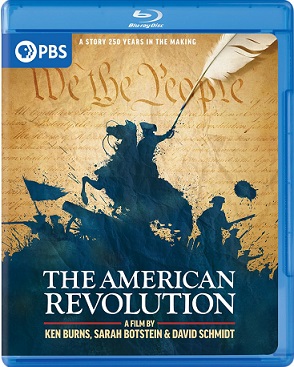 The cover of "The American Revolution" set from PBS.
The American Revolution (2025, PBS, 6 Blu-rays, NR, 12 hours). Directors Ken Burns, Sarah Botstein and David Schmidt examine the formation of the United States in this six-part documentary. Each two-hour episode walks viewers through the years of conflict, taking the development of war one step at a time, while examining rising tensions between the colonists and British occupation. The result was a prolonged and bloody battle, which is much more detailed than anything I learned in public school.
As with previous projects from Burns, the documentary, as usual narrated by Peter Coyote, pores over the details of the era and its personalities, making for a richer understanding of motivations. The series uses paintings, documents and brief reenactments to bring to life its subject.
The series starts with the familiar. In the aftermath of the Seven Years' War, the British Empire acquired control of the 13 colonies, eliminating French occupation. However, the expansion brought significant war debts, triggering rises in taxes, including The Stamp Act of 1765, which inspires talk of rebellion by the colonists. Opposition begins to take form, including the creation of the Sons of Liberty and the Minutemen; then a heavy tax on tea triggers revolt in Boston, culminating in the Boston Massacre.
Britian looks to tighten control over the colonies, which increasers communication among the colonists and the first Continental Congress in 1774. In 1775, a bloody showdown between colonial militiamen and British Redcoats on the Lexington Green provides the spark for revolution. Another early conflict covered is on Boston’s Breed's Hill (often erroneously referred to as nearby Bunker Hill).
Among the many stories covered is the career of eventual traitor Benedict Arnold, who led colonist forces for many years, including an early attempt to conquer Canada. George Washington was pulled out of civilian life to lead the early formation of the Continental Army, trying to make sense of his generally untrained soldiers and dealing with the rising issue of slavery, especially as British leaders offered slaves freedom if they would fight alongside the Redcoats.
In 1776, New York became a target for British troops, who defeat American forces, including at the Battle of Long Island. British war efforts are boosted by the arrival of the German Hessians, mercenaries who could overwhelm the enemy. Meanwhile, the following year, Washington's Continental Army manages issues with recruitment and drafting, and a choice to inoculate against smallpox saves lives. Major defeats at Brandywine and Germantown threaten American morale, while a victory at Saratoga restores momentum for Washington. Then, in 1778, the Treaty of Alliance is created between the Americans and the French, helping boost funding for the war.
The series is lengthy, but never boring. Grade: series 4.5 stars
Rating guide: 5 stars = classic; 4 stars = excellent; 3 stars = good; 2 stars = fair; dog = skip it
Purchase link for some titles: https://moviezyng.com?bg_ref=ApLKdWV51k
The American Buffalo (2023, PBS, 2 Blu-rays, NR, 4 hours). This Ken Burns documentary tells how the buffalo, or bison, was driven to near extinction in the 19th century and its comeback through the 20th century. The shaggy mammals’ story goes through more than 10,000 years of North American history and across some of the continent’s most iconic landscapes, as the series traces the mammal’s evolution, its significance to the Great Plains and its relationship to the continent’s Indigenous People.
When Captain Meriwether Lewis and William Clark and the Corps of Discovery reached what is today Montana in April 1805, they found thousands of buffalo – of the millions on the continent roaming free – and ate nine pounds of buffalo meat per man per day. However, in 1887, a three-month search for buffalo in Montana found none of the animals, as wanton killing of the beasts, especially for use of their hides for clothing and their heads as trophies, had led to almost extinction of the bison. Even their bones proved useful.
Before the pressure of white men killing the bison and the encroachment of railroads through their grazing territories, the buffalo was sacred to the Indigenous People, who used every part of each buffalo they killed, as well as honoring the buffalo in their sacred rituals. The Cheyenne even had more than 20 names for buffalo. The Spanish introduction of horses on the continent was harmful too, as horses eased hunting buffalo.
Buffalo could run up to 35 miles per hour, jump six-foot fences and leap seven feet, while weighing a ton. Their fondness for dirt baths created wallows in the plains, which helped gather rain water and propagate vegetation.
By 1878, most of the bison were gone, except for where there were no railroads, like the Black Hills, but then gold was found there. By 1880, the Canadian herds were gone too and, five years later, there were less than 1,000, mostly living in Yellowstone Park.
The second half of the documentary focuses of 10 individuals who worked to preserve the buffalo from their threatened extinction. These include future president Teddy Roosevelt, a former hunter, and William T. Hornaday, a zoologist who was chief taxidermist of the U.S. National Museum. Small individual herds of bison were kept, including by Charlie and Mary Ann Goodnight in Texas (the descendants of which survive in Caprock Canyons State Park). Also key to saving the buffalo was George Bird Grinnell, publisher of Forest and Stream magazine, who befriended Roosevelt and played a pivotal role in the U.S. conservation movement. When the documentary was made, the buffalo population stood at 350,000.
A bonus featurette, “Homecoming” by Julianna Brannum, shows the reintroduction of some buffalo to an existing herd. Grade: documentary 4 stars; extra 2 stars
Why We Fight (2005, Sony Pictures Classics, Blu-ray, PG-13, 99 min.). Another timely documentary is this one by Eugene Jarecki that shows the growth of the military industrial complex, which outgoing President Dwight D. Eisenhower warned against in his 1961 farewell speech, including how it has grown to include Congress, whose members vote for its funding as that means jobs, and therefore votes, back home, and to include present day think tanks.
The documentary was produced during the second Iraq War, and we currently are in a similar situation with President Donald J. Trump’s war in Iran. Winner of the 2005 Grand Jury Prize at Sundance, Jarecki's documentary dissects the political, economic and historic reasons behind America’s increasingly aggressive military strategy since the end of World War II. Expanding upon Eisenhower's warning, Jarecki uses interviews with American soldiers, government officials, military insiders, defense industry personnel, congressman, scholars, ordinary Iraqis and others to provide analysis of 50 years of U.S. military expansion, wars and interventions.
It is a chilling tale of how political, corporate and military interests have become progressively entangled through the business of war.
Five people are followed somewhat during the documentary, including a 23-year-old recruit as he prepares to go off to boot camp.
The film comes with audio commentary by Jarecki and Col. Lawrence Wilkerson; a look at the five “characters” (13:58 total); Jarecki appearing on The Daily Show with Jon Stewart (7:05) and on the Charlie Rose Show (9:01); and a 4-question audience Q&A with Jarecki (13:31 total). Grade: documentary 3.75 stars; extras 2.75 stars
The A-Team (2010, 20th Century Fox, Blu-ray, PG-13, NR, 119/133 min.). Based on the 1983-87 TV series, created by Stephen J. Cannell, who serves as a producer here, and Frank Lupo, the film is a very entertaining update, directed and co-written by Joe Carnahan (“Copshop,” “Smokin’ Aces”). The disc contains both the theatrical version and the unrated, 14-minute-longer version, which is what is reviewed here.
The film begins by showing how the four ex-Iraq War veterans first came together as the Alpha Team. Col. Hannibal Smith (Liam Neeson, fresh off “Clash of the Titans” and two years after “Taken,” the film that opened up his second-half career as an action hero) is a prisoner who escapes and then carjacks the van of B.A. Baracus (Quinton “Rampage” Jackson, later of “Boss Level”) so he can rescue Lt. Faceman “Face” Peck (Bradley Cooper of “A Star Is Born,” “American Sniper”) from certain death in the Mexican desert. To further their escape a bit later, they enlist certified crazy helicopter pilot Capt. H.M. Murdock (Sharlto Copley, fresh off “District 9”).
The film then jumps forward eight years, during which the quartet has had a successful career as the A-Team and are part of the U.S. forces final pullout from Iran. (Well, at least until President Donald J. Trump has involved the country in war with Iran again.) Now, the team gets involved with Capt. Charissa Sosa (Jessica Biel of “Total Recall,” “The Texas Chainsaw Massacre”), Peck’s ex-girlfriend from three years ago and a Lynch (Patrick Wilson of “The Phantom of the Opera,” the “Insidious” franchise) of the CIA.
Both Sosa and Lynch – the running joke is almost every CIA operative is named Lynch – are after the recovery of U.S. Mint $100 plates stolen by the Shah of Iran and a large sum of already-printed cash. However, Gen. Russ Morrison (Gerald McRaney of “Focus,” TV’s “Simon & Simon”) warns the team not to go after the plates.
In an exciting sequence, the team grabs the plates, but Morrison’s car is blown up and the Black Forest private force blow up Peck’s vehicles with the plates. Leader of the Black Forest is Pike (Brian Bloom, who co-wrote the film). These results lead to the four being court-martialed and sentenced up to 10 years of hard labor. However, Lynch still wants the stolen plates and helps Smith escape, who then springs the other three from separate prisons and steals a C-130 plane. A wrinkle is that Baracus has taken a pledge of non-violence. Believing the plates are in Germany, the quartet ends up parachuting a tank into Germany.
The team learns the plates will be all together for the first time in the Konisbank Tower. This leads to a lot of shooting and falling outside the tall structure. The solid action finale occurs at a California port that is partially destroyed.
Extras include a visual audio commentary by Carnahan, with behind-the-scenes segments and information on vehicles on the theatrical version. There also are six deleted scenes, one of which is worked into the expended version (9:05); a fun gag reel with lots of Jackson laughing (7:19); an A-Team theme mashup-up montage (1:36); behind-the-scenes stuff with Carnahan (28:39); character chronicles with behind-the-scenes stuff (23:11); and visual effects supervisor James E. Price showing before and after visual effects (6:11). Grade: film 3.75 stars; extras 3.5 stars
Battle of Jangsari (South Korea, 2019, Well Go USA, Blu-ray, NR, 103 min.). This affecting and effective war film tells the long-hidden true tale of 772 student volunteer South Korean soldiers who were to land at Jangsari Beach and fight the North Koreans in one of the four diversionary attacks for Gen. Douglas MacArthur’s planned retake of Incheon during the Korean War. The student soldiers, with an average age of 17, had only 10 days of training before deployment by ship and were equipped with limited ammunition, low food supplies and second-hand weapons.
Directed by Kim Tae-hun (visual effects for “The Chaser,” “The Yellow Sea,” TV’s “Iris”) and Kwak Kyung-taek (“The Classified File,” “Friend”), the film presents visceral footage of what it is like to step off of a boat into swirling ocean waters, then attempt to make it to land under a barrage of enemy fire. Plus, the boat first had to sail through a typhoon, which made many of the young soldiers seasick.
Once the remnants of the students do take the high ground, they learn North Korean troops with four tanks are inbound and decide to attack them guerilla-style where the road goes through two tunnels.
The film also highlights a handful of soldiers, including a woman posing as her brother and former North Korean Choi Sung-Pil (Choi Min-ho of TV’s “Medical Top Team,” “To the Beautiful You”) who relocated to the South, but saw the rest of his family killed in the process. Leading the young soldiers is Lee Myeong-joon (Kim Myung-min of TV’s “Six Flying Dragons,” “Beethoven Virus”). The film had me crying by its end.
Recurring back at headquarters are Maggie (Megan Fox of “Transformers,” the “Teenage Mutant Ninja Turtles” franchise), an American news reporter covering the war, and Gen. Stevens (George Eads of TV’s “CSI: Crime Scene Investigation”), her source.
The extra is a brief making-of look, revealing it was shot in winter (3:20). Grade: film 4 stars; extra 1 star
Red Sun (France-Italy-Spain, 1971, Arrow Video, 4K Ultra HD or Blu-ray, PG, 115 min.). This hybrid spaghetti western/samurai classic unites four international superstars under director Terence Young (“Dr. No,” “Thunderball”) in the rugged Almería region of Spain. The limited-edition release features a new 4K restoration, hours of special features and newly commissioned extras.
Outlaw Link Stuart (Charles Bronson of “The Magnificent Seven,” “Death Wish,” “The Great Escape”) has to team up with samurai bodyguard Kuroda Jubei (Toshirō Mifune of “Seven Samurai,” “Yojimbo,” “Throne of Blood”) to track down gang leader Gauche (Alain Delon of “Le Samouraï,” “Purple Noon,” “The Swimming Pool,” “Rocco and His Brothers”). Link wants revenge after being double-crossed during a train robbery by Gauche, his former partner, while Kuroda must recover a gold-handled tachi sword stolen by Gauche. It is 1870 and the newly appointed Japanese ambassador Sakaguchi (Tetsu Nakamura of “Madame Butterfly,” “Mothra”) was to present the ceremonial sword to the U.S. President.
Link and Kuroda form an uneasy alliance as the samurai way meets cowboy survival, but only after Link tries to leave Kuroda behind several times. To make it through the harsh desert and its deadly surprises, the two men have to learn from each other, trust each other and stay one step ahead of Gauche. Towards the film’s end, the pair keep encountering hostile Comanches.
The movie also stars Ursula Andress (“Dr. No,” “Casino Royale,” “Clash of the Titans”) as Cristina, Gauche’s girlfriend, and Capucine (“Walk on the Wild Side,” three “Pink Panther” films) as Pepita, a whorehouse manager.
The train robbery sequence is a highlight, including using a herd of sheep on the tracks to stop the train.
New extras include an audio commentary by critics C. Courtney Joyner and Henry Parke; an appreciation of the film by scholar Jose Arroyo (31:54); a visual essay by scholar Daisuke Miyao on the historical background and samurai (31:12); and an appreciation of actor Delon by film scholar Mark Gallagher. It was Delon’s second Western and second film with Bronson. Archival French TV extras are a behind-the-scenes look at the film (8:27) and an interview with director Young and actor Mifune (2:03). There is an image gallery, plus a collectors’ booklet with new writing by Paul Talbot and Moya Luckett. Grade: film 3.5 stars; extras 3.75 stars
Captain Horatio Hornblower (1950, Warner Archive Collection, Blu-ray, NR, 117 min.). Three terrific sea battles highlight this film, set around 1807 during the Napoleonic Wars. The film is based on C.S. Forester novel series. Forester also wrote “The African Queen” screenplay.
Capt. Horatio Hornblower (Gregory Peck of “To Kill a Mockingbird,” “Spellbound,” “Roman Holiday”) is sent on a secret seven-month journey around Cape Horn to deliver arms to Central America’s Don Julian Alvarado, aka El Supremo (Alec Mango of “The 7th Voyage of Sinbad”), who is revolting against Spain. The British wanted to draw Spain’s attention from helping Napoleon fight the British to defending its colonies in the Americas.
Hornblower successfully captures the Spanish warship Natividad and turns it over to Alvarado to use to attack El Salvador, while Hornblower is about to block Panama. However, the engaged Lady Barbara Wellesley (Virginia Mayo of “White Heat,” “The Best Years of Our Life”) and her maid Hebe (Ingeborg von Kusserow) come aboard, seeking passage back to England. At the same time, Hornblower learns that Spain has recently signed a peace treaty with Great Britain, and thus he must defeat Alvarado, now in the more heavily-armed Natividad.
On the trip back home, Lady Barbara falls for Hornblower, only to learn that he is married. She marries Sir Rodney Leighton (Denis O’Dea of “Treasure Island,” “The Fallen Idol”), not knowing that Hornblower’s wife had recently died during childbirth.
Look for Christopher Lee as a Spanish ship captain who loses a swordfight with Hornblower.
Extras are a story of America and immigrants (20 min.); the Lux Radio Theater audio version of the story with Peck and Mayo (59:27); and the Bugs Bunny cartoon “Captain Hareblower (6:58). Grade: film 3.5 stars; extras 2 stars
Nine Demons (Taiwan-Hong Kong, 1984, Visual Vengeance, Blu-ray, NR, 98 min.). Directed by Chang Cheh (“Marco Polo,” “Vengeance!”) after he left Shaw Brothers, the film still retains some of his signature style, down to a lead character continuing to fight while a blade is stuck in his stomach. It is one of the latter films to use the Venom Mob, the five actors Chang originally assembled.
After striking a deal with the devil, fighter Zou Qi, aka Joey (Cheng Tien-Chi of “Five Elements Ninjas”), is able to summon nine demon spirits from a chain of skulls that unleashes flesh-hungry minions, who often appear as children. Joey sets out to settle a bloody score. Escaping after battles that led to the deaths of his and Gary’s fathers, Zou Qi had fallen into hell through portal that opens once every 500 years.
Much of the film makes little sense, but some of the fight scenes are interesting, including one that takes place on water, which then turns to ice and finally resumes on scaffolding created above the lake. Also, Gary jumps around a lot when fighting.
The film can be watched in original Chinese or dubbed English. Extras include an audio commentary by martial arts film historians Justin DeCloux and Dylan Cheung; a video essay on director Chang’s late period by DeCloux (20:29); a video essay on cinematographer James Wu Kuo-Ren by DeCloux (10:27); an interview with actor Yu Tai-ping (10:02); the “Unsung Horrors” podcast on the film (53:41); a 93-minute “dirty VHS” version of the film as “The Nine Venoms”; and an image gallery (32 secs.). There are a folded mini-poster and an 8-page booklet of liner notes by CJ Lines on the Venom Mob. Grade: film 2.5 stars; extras 3.25 stars
The cover of "The American Revolution" set from PBS.
About this blog:

My music review column, Playback, first ran in February 1972 in The Herald newspapers of Paddock Publications in Arlington Heights, IL. It moved to The Camden Herald in 1977 and to The Courier Gazette in 1978, where it was joined by my home video reviews in 1993. The columns ran on VillageSoup for awhile, but now have this new home. I worked at the Courier Gazette for 29 years, half that time as Sports Editor. Recently, I was a selectman in Owls Head for nine years.