
Preliminary work begins to rebuild head of Camden Harbor shoreline, Megunticook River outlet
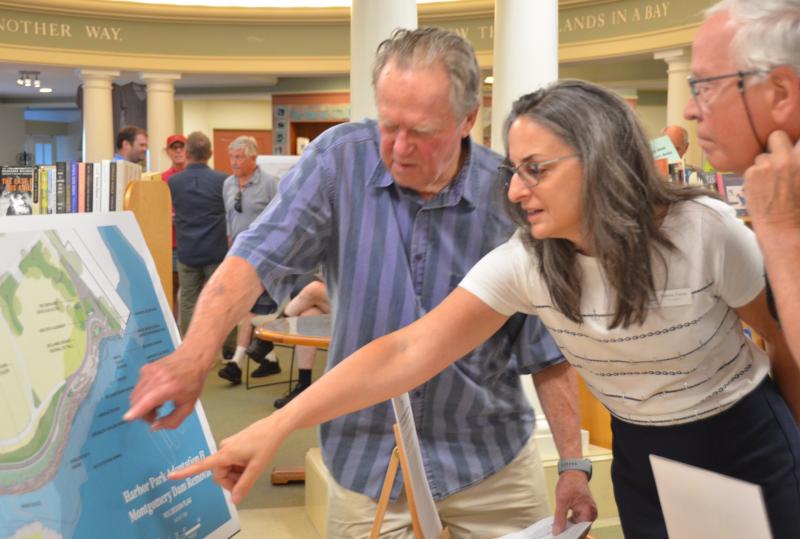 Camden resident Ben Ellison and Natalie Travia, Camden Public Library Trustee and Board President, with the "90 percent plan" to rebuild the Camden Harbor Park shoreline, Aug. 11 at the library's Harbor Park Revitalization and Dam Removal Public Engagement meeting. (Photo by Lynda Clancy)
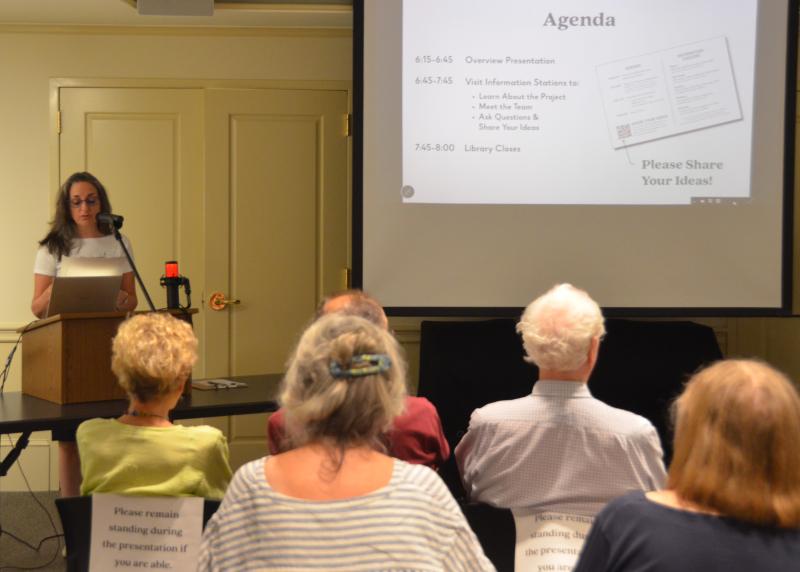 Natalie Travia, Camden Public Library Trustee and Board President, introduces the evening to the gathered citizens Aug. 11 at the Camden Public Library.
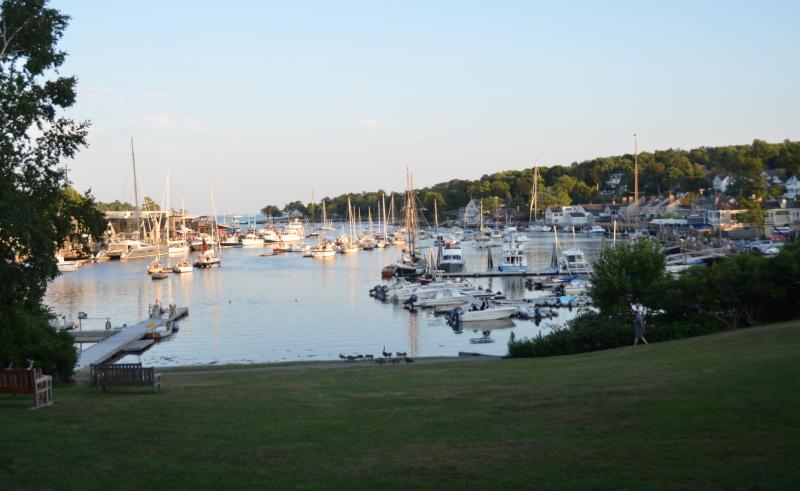 Camden Harbor, with a viewshed over Harbor Park, Aug. 11. (Photo by Lynda Clancy)
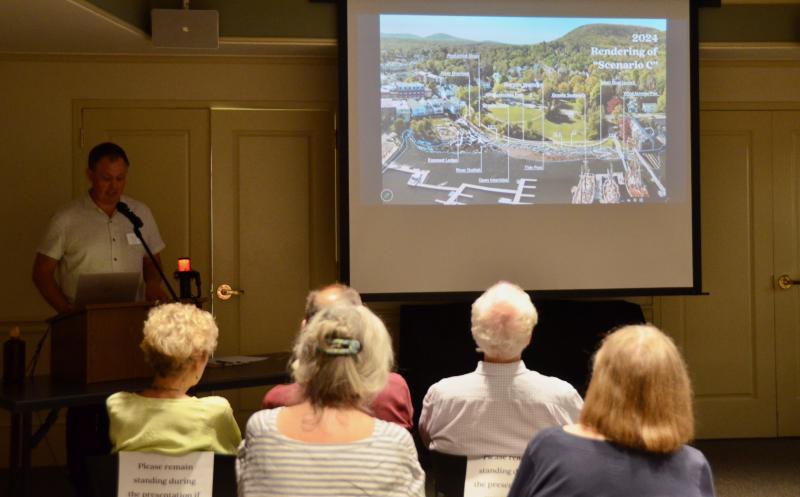 Eamonn Hutton references a 2024 image as a vision for the reshaped Harbor Park and head of Camden Harbor.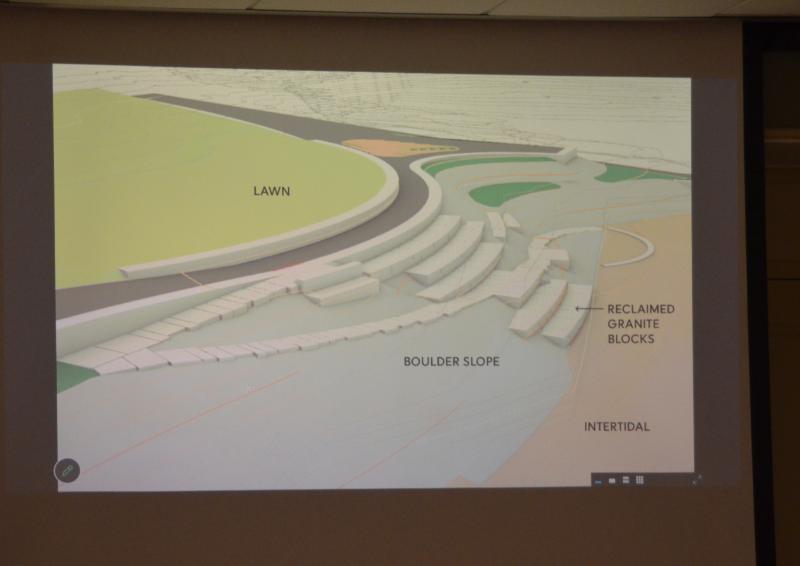

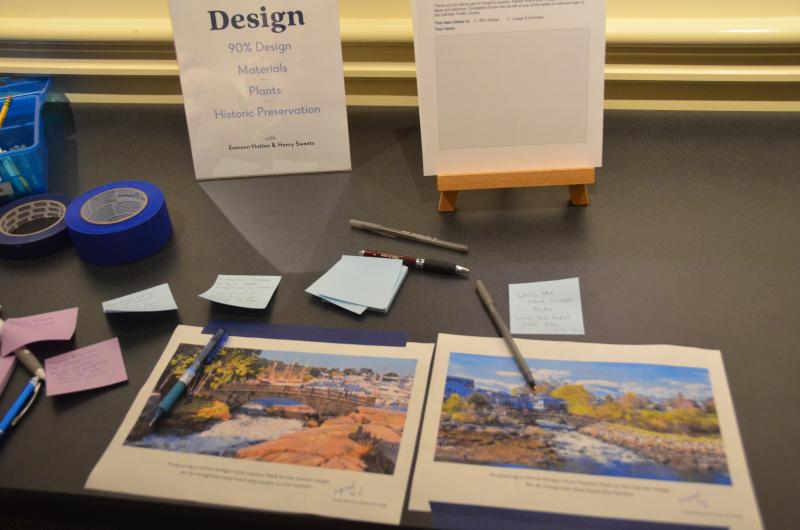

 Camden resident Ben Ellison and Natalie Travia, Camden Public Library Trustee and Board President, with the "90 percent plan" to rebuild the Camden Harbor Park shoreline, Aug. 11 at the library's Harbor Park Revitalization and Dam Removal Public Engagement meeting. (Photo by Lynda Clancy)
Natalie Travia, Camden Public Library Trustee and Board President, introduces the evening to the gathered citizens Aug. 11 at the Camden Public Library.
Camden Harbor, with a viewshed over Harbor Park, Aug. 11. (Photo by Lynda Clancy)
Eamonn Hutton references a 2024 image as a vision for the reshaped Harbor Park and head of Camden Harbor.
Camden resident Ben Ellison and Natalie Travia, Camden Public Library Trustee and Board President, with the "90 percent plan" to rebuild the Camden Harbor Park shoreline, Aug. 11 at the library's Harbor Park Revitalization and Dam Removal Public Engagement meeting. (Photo by Lynda Clancy)
Natalie Travia, Camden Public Library Trustee and Board President, introduces the evening to the gathered citizens Aug. 11 at the Camden Public Library.
Camden Harbor, with a viewshed over Harbor Park, Aug. 11. (Photo by Lynda Clancy)
Eamonn Hutton references a 2024 image as a vision for the reshaped Harbor Park and head of Camden Harbor.
CAMDEN — Design work for a revamped Camden Harbor Park shoreline got a full public airing Aug. 11, complete with maps, diagrams, and a chance to comment on various features of next steps for how the harbor will be landscaped, and used by future generations.
The project is part of a larger effort to implement a voter-approved project that includes removal of the Montgomery Dam, restoration of the Megunticook River channel, and conversion of approximately 500 linear feet of Harbor Park seawall to a hybrid living shoreline.
Camden voters had voted 1,391 to 995 in June 2025 to remove the dam and spillway at the head of Camden Harbor, with the caveat that the project's fiscal responsibility would not fall on property owners through local taxation.
With funding subsequently ensured in late 2025 by a $5.933 million grant from the National Fish and Wildlife Foundation’s Coastal Resilience Fund, a timeline now includes construction to begin after Labor Day 2027, and a revitalized landscape for the head of Camden Harbor and the outlet for Megunticook River to be finished by the 2028 summer season. The Select Board had approved receipt of that grant in April 2026.
The Aug. 11 meeting at the Camden Public Library was labeled the, "Harbor Park Revitalization and Dam Removal Public Engagement meeting" and residents filled the downstairs lobby area and Jean Picker Room to learn more about the process to implement the grant, with a special focus on the Camden Public Library's Harbor Park portion of the project.
Landscape architect Eamonn Hutton, a principal of Tandem Landscape Architects, presented the "90 Percent complete design" of the park shoreline as it extends from Main Street down to the property border of the privately owned American Boathouse.
The design is considered 90 percent finished, leaving such details as horticulture plantings, pathway, historic interpretations and community input on how to further enhance public use of the green space yet to be finalized.
"We know you are here because you care deeply about the Harbor Park, the Megunticook River and the waterfall at the head of the harbor," said Natalie Travia, Camden Library Board of Trustees president.
"These are important gathering places, places of beauty, and are treasured by the Camden community and its visitors," she said. "The people of Camden feel strongly about the history and the future of these places. That's why we're so pleased to have so many of you here today. Tonight is an opportunity to show you where the project stands and answer your questions."
She said, "tonight, we want to know what you like, and what concerns do you have?"
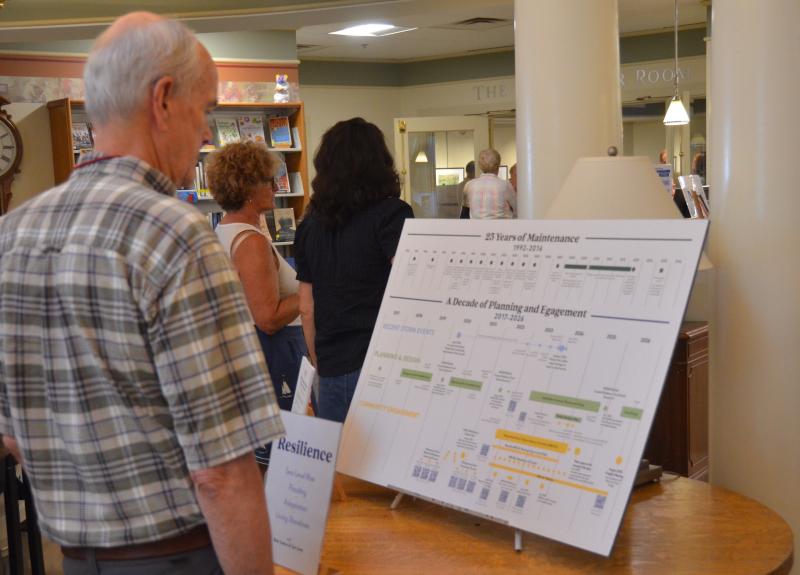
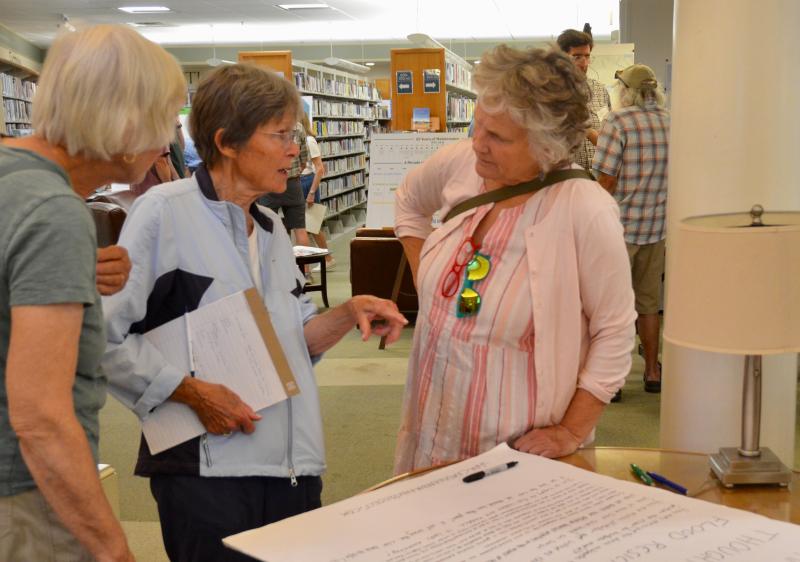
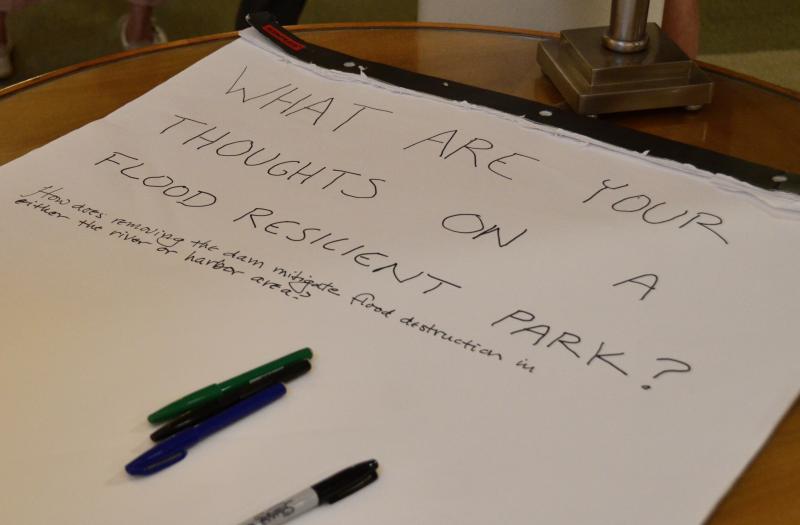
The two-hour meeting included Hutton's 30-minute presentation, and then conversations at five desktop stations set up throughout the library downstairs that addressed design, history, the Megunticook River, flooding and resilience planning, and park activities.
Those station were staffed by:
• Jennifer Gromada, chair of the Harbor Park Revitalization and Dam Removal Working Group;
• Blake Sanborn, Landscape Architect, Richardson and Associates;
• Tyler Smith, Engineer, local property owner, and Megunticook River Citizen's Advisory Committee member;
• Alison McKellar, Volunteer with Downeast Salmon Federation;
• Henry Sweets, Camden Public Library Parks Director;
• Kristy Kilfoyle, Executive Director of the Camden Public Library;
• Larry Ward, Camden Public Library Trustee;
• Paul Karoff, Camden Public Library Trustee; and
• Natalie Travia, Camden Public Library Trustee and Board President.
"Our role on this team has been to help translate the complex engineering, ecological, historic, and community considerations into a physical experience at Harbor Park," said Hutton.
He described three forces shaping the design — the history of landscape, the return of the Megunticook River to a free-flowing channel, and the need to make Harbor Park more resilient in the face of rising sea levels.
"This is a site with a rich and layered history," said Hutton. "Long before Camden existed, the mouth of Megunticook River was part of a landscape used and inhabited by indigenous peoples. In fact, just this year, Camden-Rockport Middle School students explored that history in collaboration with James Eric Francis Sr., the director of cultural and historic preservation for the Penobscot Nation, and Gabe Paul, a Penobscot linguist. I strongly encourage you all to check out their work [interpretive signage at Harbor Park]."
He cited the work of Frederick Law Olmsted, Jr., the landscape architect who helped to create the park in 1928-1931, with a vision that entailed, he said: "open, grassy grounds meant to evoke the New England Common. Simple curving paths, rugged native vegetation, unadorned spaces, carefully framed views of the park, and screening that would create a sense of respite from the surrounding town."
Hutton said: "Our goal is not to reinvent that identity. It's to preserve the qualities that make Harbor Park unmistakable while adapting it to the conditions that its original designers could not have anticipated."
The Megunticook River extends three and a half miles from Megunticook Lake before spilling into the harbor and Penobscot Bay through a 32-square-mile watershed. Hutton said the seven dams on the river built in the 18th and 19th centuries have altered the river, fragmenting its course, "interrupting natural processes, and largely preventing sea run fish from migrating upstream from the harbor."
With the removal of the Montgomery Dam, the river will become a, "visible, dynamic, and accessible part of the park."
The third force, or "leg of the stool", is resilience, said Hutton. The park is vulnerable to storm damage and rising sea levels, and with projections anticipating higher storm surges and tidal heights over the next 75 years, he said the, "clear message was to adapt the shoreline now for conditions through the end of the century."
"How do we make the park more resilient without turning its waterfront into a fortress," he asked. "How do we protect this landscape while preserving openness, beauty, and the direct relationship of the water that makes it so special? That question is at the center of the design we're going to show you tonight."
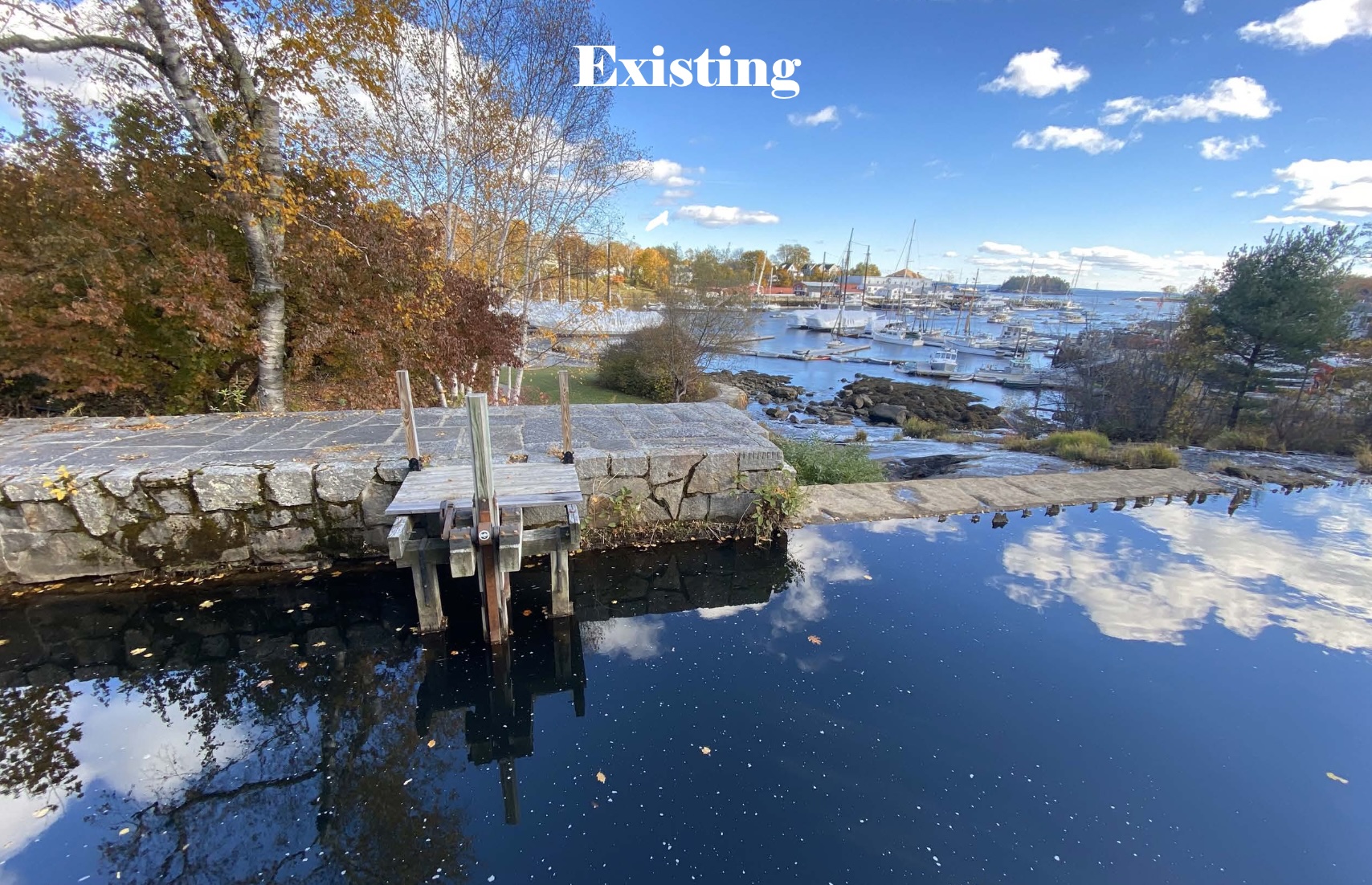
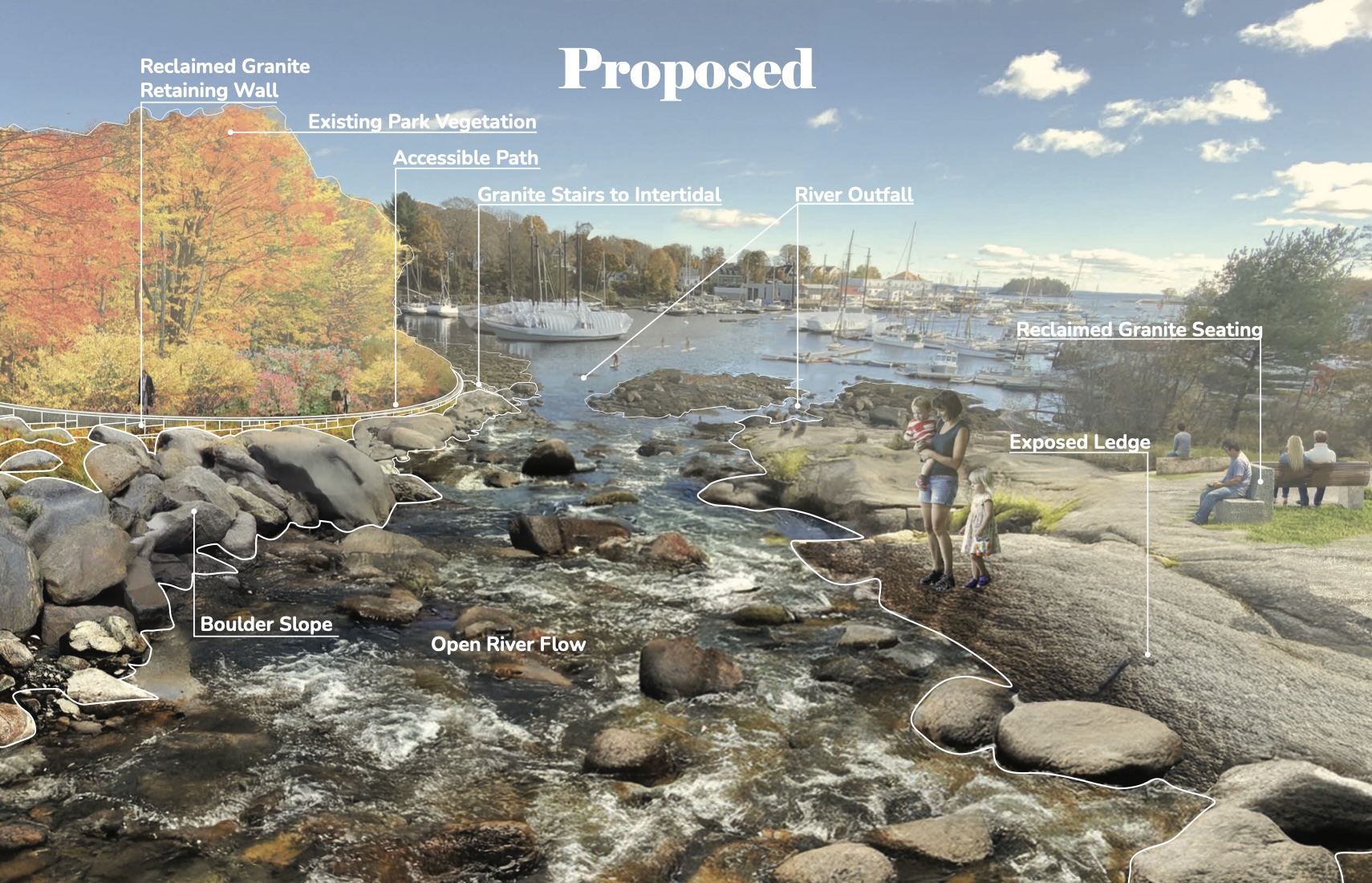
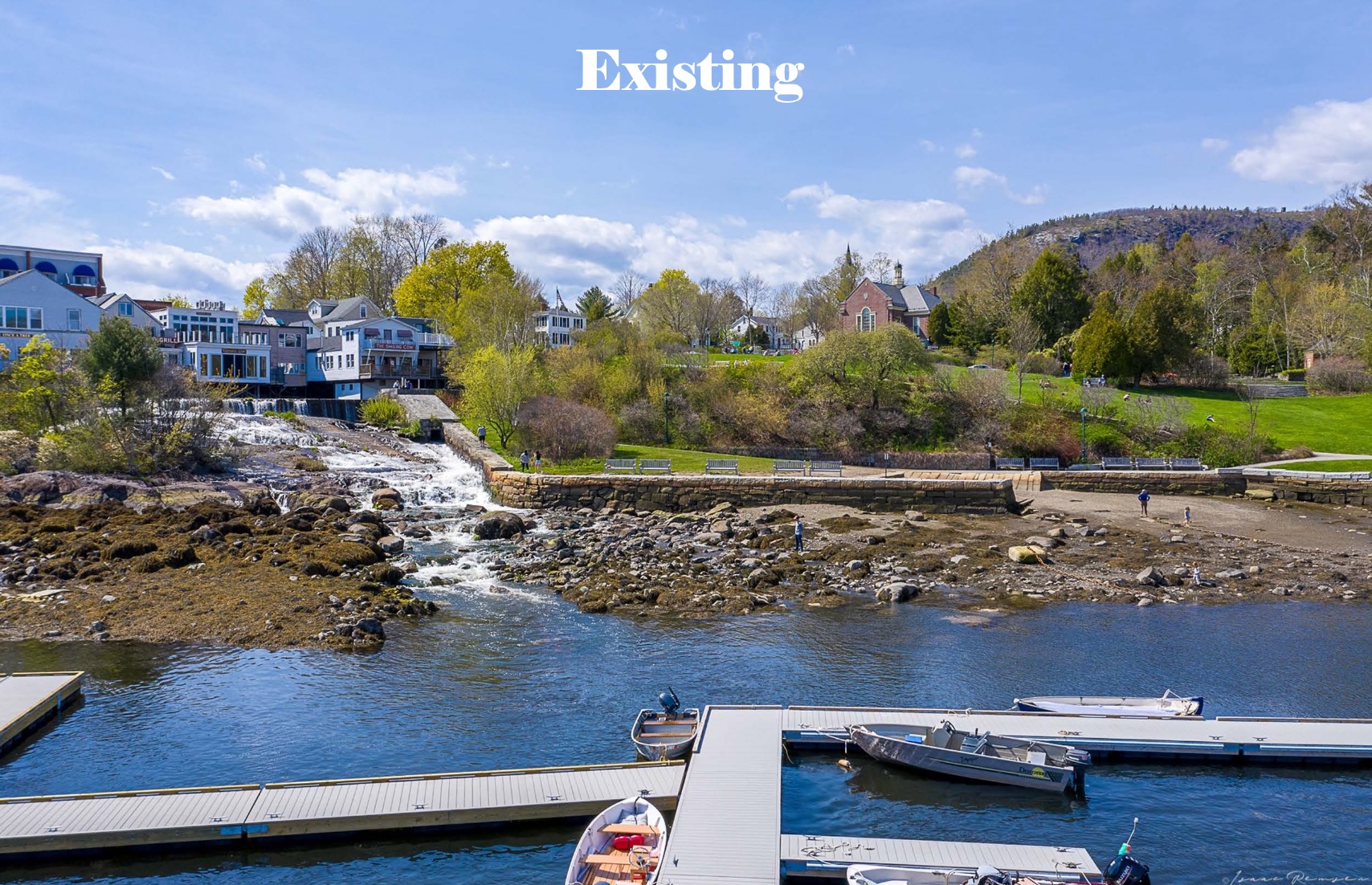
The images above contrast what exists today, with the Montgomery Dam intact, and what landscape designers anticipate will be over the the same viewshed of Camden Harbor. For more renderings of "Existing" and "Proposed" visit the Megunticook River Citizens Advisory Committee page. (Images courtesy Tandem Landscape Architects)
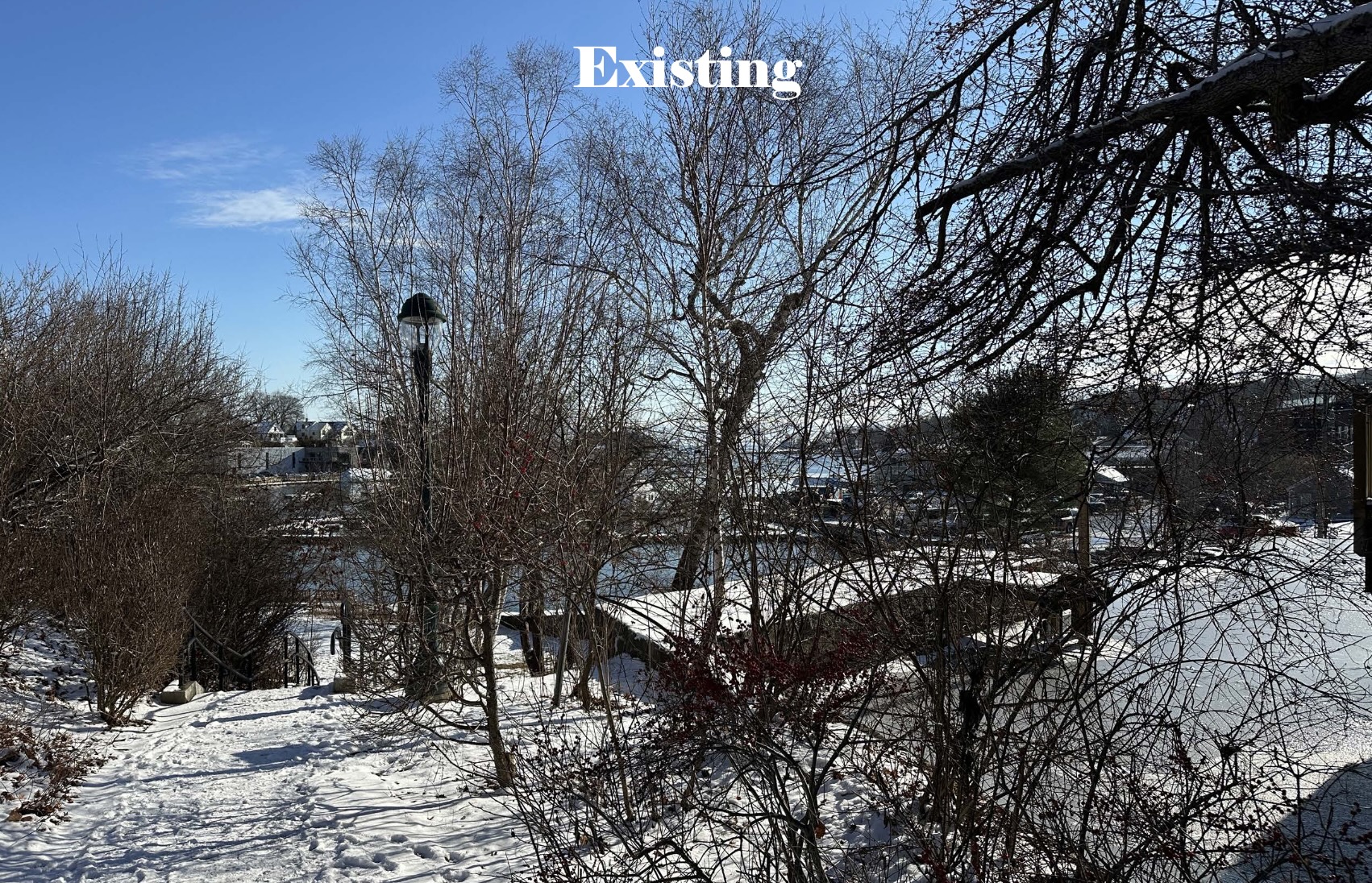
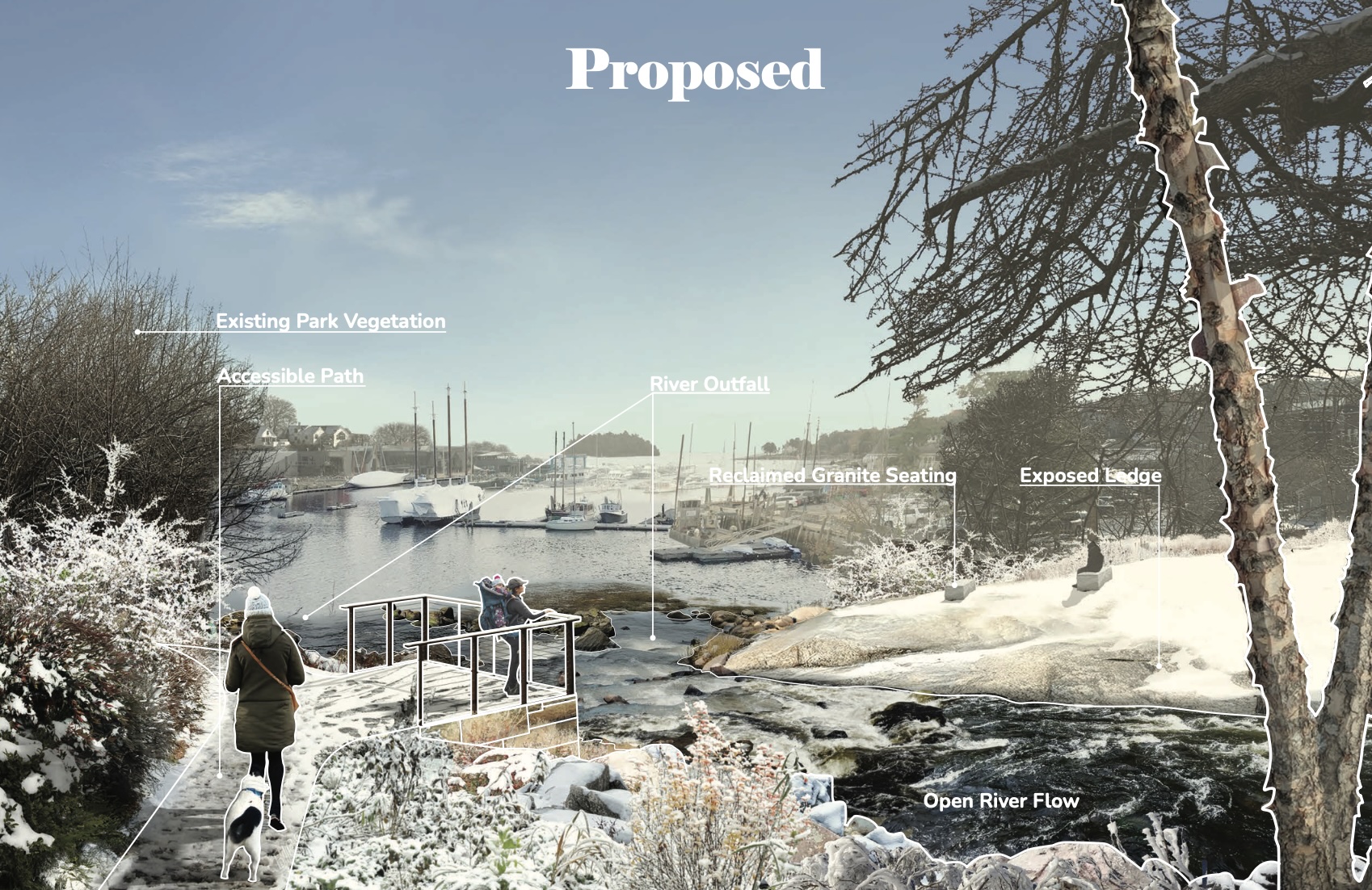
Contrasting images of existing conditions and future landscapes, as proposed in current plans. Above, the path along the west side of the park originating near Main Street. Below, the view from the harbor looking up toward the outlet of the Megunticook River. (Images courtesy Tandem Landscape Architects)
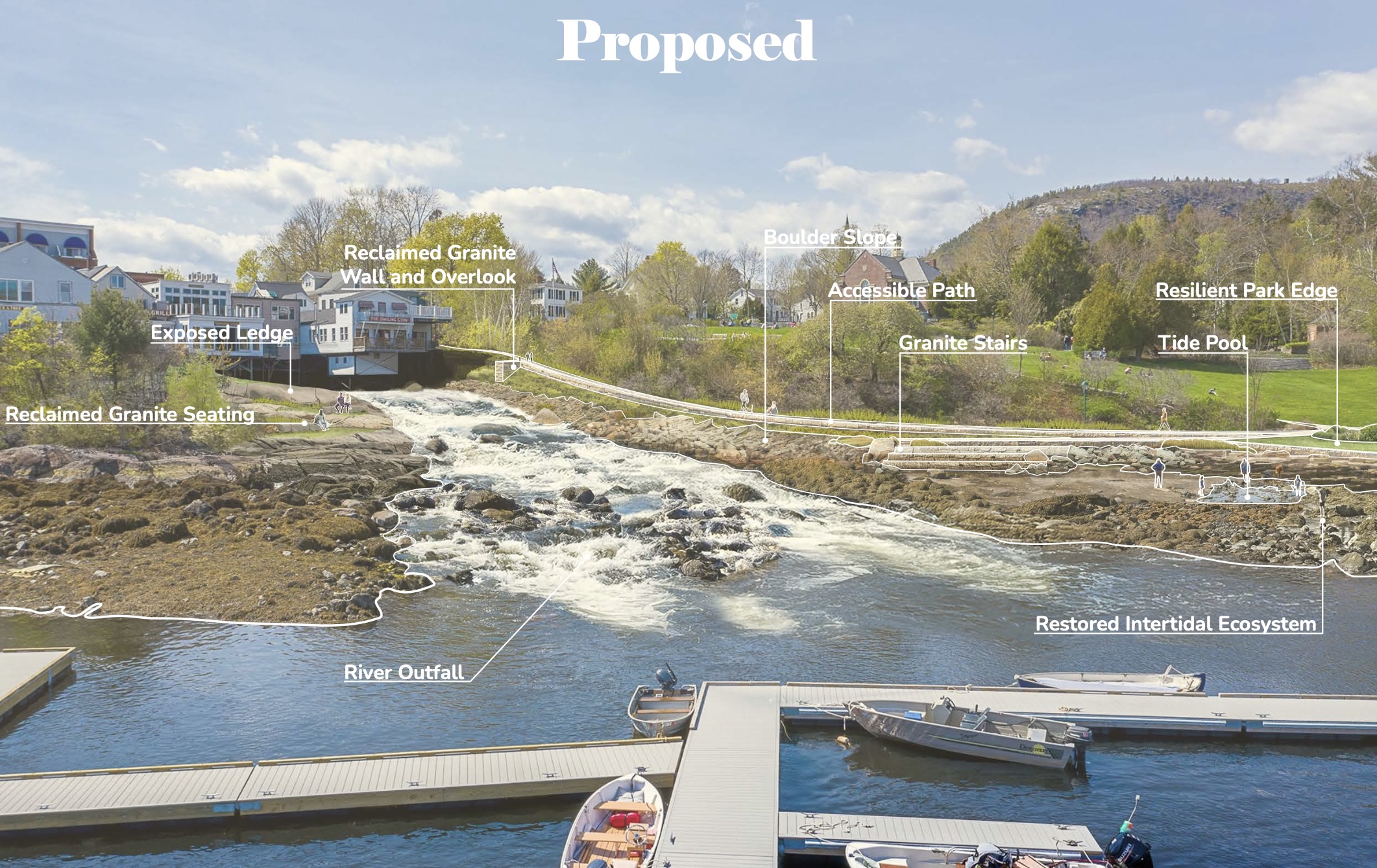
Hutton then unveiled the 90 percent design, which includes two parts of the shorefront, a gradual descent to the water reusing stone and granite blocks from the site, as well as native coastal plants to create habitat.
"They'll also allow us to meet the edge of the park with a softer condition, not a hard line," he said. "We're after a gradient here, not a crisp wall or a crisp line. The design also substantially improves public access to the water. We're creating multiple pedestrian routes, including a barrier-free route."
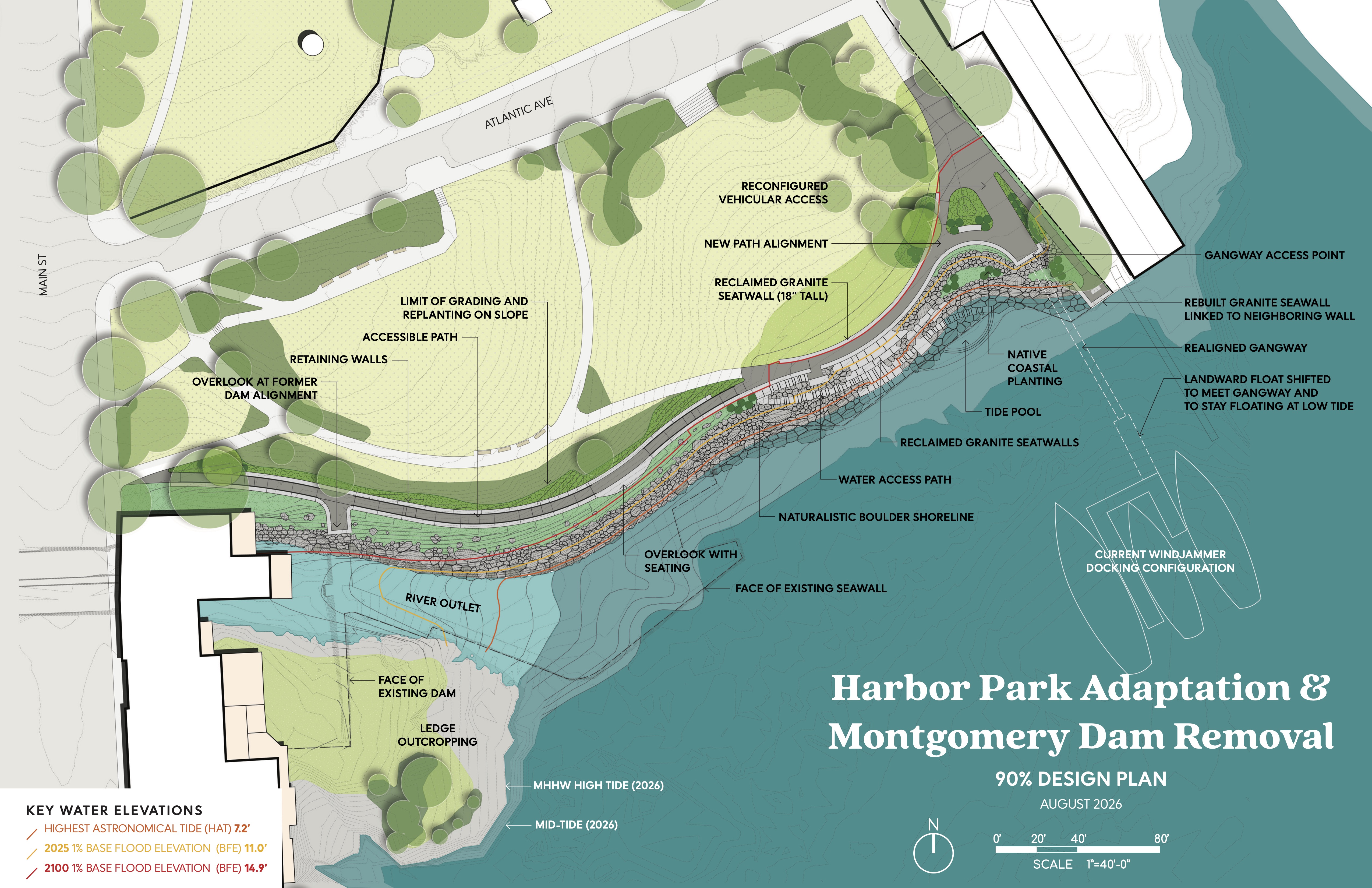
The pathway will have no steps and be ADA compliant along its entire stretch. That path, which extends down along the park edge where it meets the harbor will follow a sweeping geometry, said Hutton, where: "you'll encounter overlooks and a continuous relationship to the river and the harbor. As you move through the landscape, you'll see the river below, you'll see exposed ledges, vegetation, changing tides, and the harbor beyond."
In the area of the park closer to Main Street, the design allows for expanded views of the river and the harbor.
"Today, walls, vegetation, fill, topography largely conceal the river from your view along the path," said Hutton. "With the dam removed and fill removed, the river will once again occupy its original alignment and be much more connected to and visible from the park."
With the new design, the intent, "is for it to read as a coherent river landscape rather than just a piece of rip-rap infrastructure," he said. "The look and feel of that is very important to this team, something we spend a lot of time discussing already, and we'll continue to do that."
He said: "Harbor Park should still feel historic, it should still feel calm, green, and familiar with its lawn, mature trees, framed views, and the role as Camden's front yard. But at the same time, the river will become more present, something to walk beside, investigate, learn from, and touch. The shoreline will be more resilient, and more accessible, allowing a park created nearly a century ago to continue serving Camden under very different and changing conditions. That's what excites me the most about this project."
Organizers of the Aug. 11 meeting encouraged attendees to visit the five stations and submit or make comments on the plans, either that night or sometime before the end of August.
"And we would love to hear from everyone," said Blake Sanborn, landscape architect with the Saco-based Richardson and Associates, a subcontractor for the project.
He directed the public to visit the project website at the Camden Public Library, "because that's a living platform where we can keep you all informed as this is progressing and you'll be able to see how we're moving from where we are now, toward design refinement. and eventually implementation."
Burke said Aug. 11 that the $5.93 million grant will be spent on the portion of the river and harbor from Montgomery Dam through the town-owned shoreline.
The Town of Camden will be responsible for circulating a request for bids for the construction contract work and the Select Board will choose the contractor following that bid process. The design work appropriates approximately 20 percent of the grant, said Burke.
"The lion's share, by and large, of the grant is the construction money" — approximately $5 million, he said.
The other grant application that had been submitted in February 2025 to the National Oceanic and Atmospheric Administration's (NOAA) Restoring Fish Passage through Barrier Removal program by the Town of Camden for the project, as well as the $4 million grant application submitted to NOAA by the Downeast Salmon Federation with the National Fisheries and Wildlife Foundation's Transformational Habitat Restoration fund to remove the privately owned Knox and Knowlton dams have stalled out, Burke said.
Reach Editorial Director Lynda Clancy at lyndaclancy@penbaypilot.com; 207-70-66657