Ocean algae bloom spreads into Western Penobscot Bay, waters off of Owls Head, Northport, Islesboro
 "Harmful algal blooms (HABs) occur when algae—simple plants that live in the sea and freshwater—grow out of control and sometimes produce toxins harmful to people and animals. Only a small number of species have the capacity to form harmful blooms, but when they do, the effects can be severe for coastal resources, local economies, and public health. HABs occur in every state, and new HABs have emerged in recent years, adding new threats to regions already impacted. NCCOS conducts and funds research that helps communities protect the public and combat blooms in cost-effective ways, and we are breaking new ground in the science of stopping blooms before they occur." — National Centers for Coastal Ocean Science (coastalscience.noaa.gov/science-areas/habs)
"Harmful algal blooms (HABs) occur when algae—simple plants that live in the sea and freshwater—grow out of control and sometimes produce toxins harmful to people and animals. Only a small number of species have the capacity to form harmful blooms, but when they do, the effects can be severe for coastal resources, local economies, and public health. HABs occur in every state, and new HABs have emerged in recent years, adding new threats to regions already impacted. NCCOS conducts and funds research that helps communities protect the public and combat blooms in cost-effective ways, and we are breaking new ground in the science of stopping blooms before they occur." — National Centers for Coastal Ocean Science (coastalscience.noaa.gov/science-areas/habs)
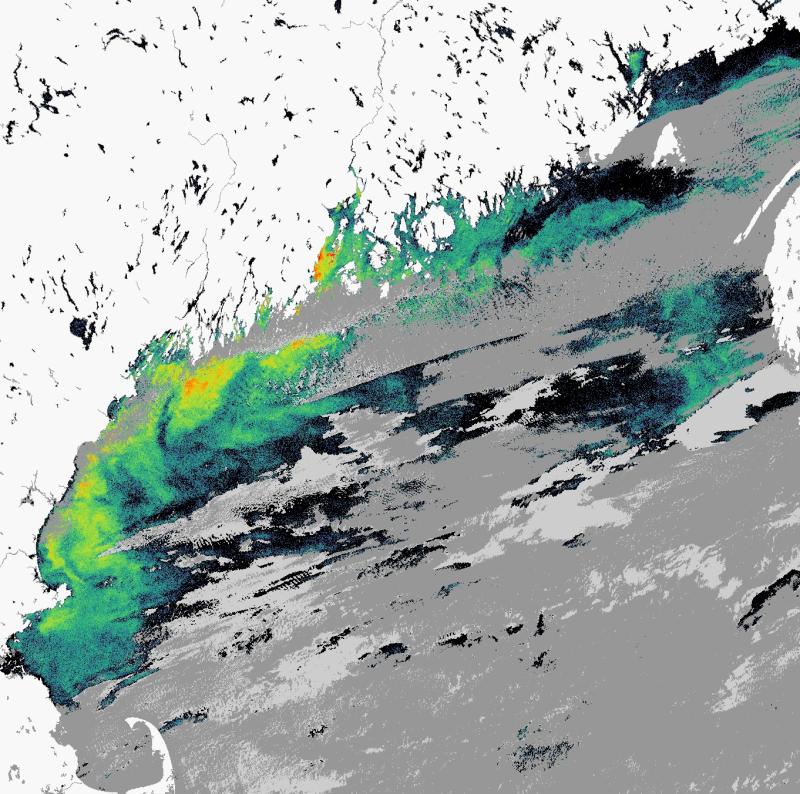
"Harmful algal blooms (HABs) occur when algae—simple plants that live in the sea and freshwater—grow out of control and sometimes produce toxins harmful to people and animals. Only a small number of species have the capacity to form harmful blooms, but when they do, the effects can be severe for coastal resources, local economies, and public health. HABs occur in every state, and new HABs have emerged in recent years, adding new threats to regions already impacted. NCCOS conducts and funds research that helps communities protect the public and combat blooms in cost-effective ways, and we are breaking new ground in the science of stopping blooms before they occur." — National Centers for Coastal Ocean Science (coastalscience.noaa.gov/science-areas/habs)According to the Maine Department of Marine Resources, satellite imagery indicates an increase in intensity of Karenia mikimoitoi, the naturally occurring marine phytoplankton or algae, in western Penobscot Bay between Owls Head, Northport and Islesboro. There is also a dense patch south of Vinalhaven.
Industry members have reported discolored water in Stonington, said the DMR. The bloom in the region appears to be expanding and it is likely impacts to marine organisms from low oxygen will be observed.
Be on the lookout for discolored water, rust color to brown and almost black depending on the density of the phytoplankton cells. You may also observe an unpleasant odor that will intensify as the bloom collapses. Where the bloom is most dense it is likely to cause mortalities particularly in softshell clams and marine worms. It is less likely to kill other marine organisms that can easily move away from areas of lower oxygen (e.g. fish or lobsters not in a trap or crate). While Karenia mikimotoi can produce low potency toxins, the toxic impacts are believed to be limited to direct contact with marine organisms, specifically through their gills and are not transferred up the food chain.
Please report observations of discolored water and/or marine organisms dead or dying to DMRPublicHealthDiv@maine.gov
Karenia mikimoitoi is a type of naturally occurring marine phytoplankton or algae that does not negatively impact human health. It remains safe to eat shellfish and fish harvested from Maine waters, the DMR said.
Satellite imagery from the National Oceanic and Atmospheric Administration (NOAA) National Centers for Coastal Ocean Science (NCCOS) shows an active phytoplankton bloom from northern Massachusetts to Jonesport area and offshore in much of the Gulf of Maine. It appears most dense offshore from Phippsburg to Vinalhaven with very dense pockets in western Penobscot Bay. While the satellite images are not specific to Karenia mikimotoi, it is assumed this is the dominant species comprising the current bloom based on coastal sampling. It is also important to note that satellite images can only capture what is on the surface and it is possible the bloom is also present in other areas at depth.
Casco Bay area:
Bloom monitoring using satellite imagery indicates a decline in intensity in the inner Casco Bay region. On the ground sampling and observations support this with lower phytoplankton cell counts and less visible water discoloration. However, as the active bloom collapses, the impact of reduced oxygen in the water increases and continued mortalities of shellfish and marine worms are likely.