
Bogart, Rooney, Hoffman lead Warner Archive releases
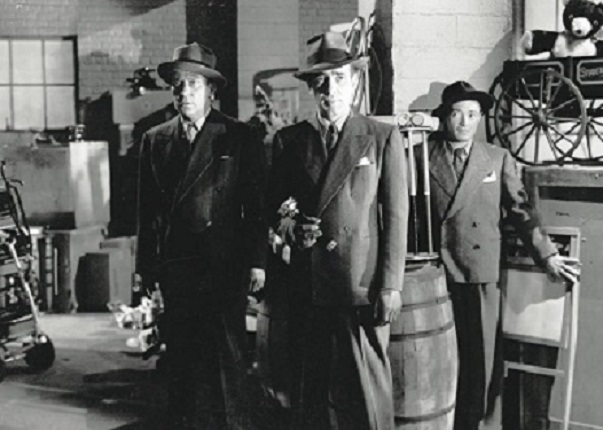 The stars of “All Through the Night” are, from left, William Demarest, Humphrey Bogart and Peter Lorre. Warner Bros. photo.
All Through the Night (1942, Warner Archive Collection, Blu-ray, NR, 107 min.). After starring in “High Sierra” and “The Maltese Falcon,” Humphrey Bogart took on this change-of-pace role as “Gloves” Donahue, a gambler interested in the Saratoga races who has a penchant for cheesecake made by his favorite German immigrant baker. When his investigation into the baker’s murder leads to an underground German fifth column of spies and saboteurs, the war overseas suddenly has a lot more meaning to Gloves.
The film, directed by Vincent Sherman (“Underground,” “Affair in Trinidad”), has a good mix of comedic elements and action. Gloves starts out pooh-poohing the overseas war, being more interested in gambling odds. However, when the waiter (Phil Silvers of “A Funny Thing Happened on the Way to the Forum” and TV’s “The Phil Silvers Show” in an early role) brings the wrong type of cheesecake, Gloves storms off to find why the regular version, made by Mr. Miller (Ludwig Stössel of “The Pride of the Yankees,” “House of Dracula,” “From the Earth to the Moon”), has not arrived.
Gloves discovers Miller has been murdered and stashed in his basement. The audience knows the killer to be Pepi (Peter Lorre of “Casablanca,” The Maltese Falcon,” “Arsenic and Old Lace”). Gloves’ mother (Jane Darwell of “Gone with the Wind,” “The Grapes of Wrath,” “The Ox-Bow Incident”), who lives upstairs from the bakery, tells Gloves of a frequent lady visitor to the bakery. Hunting her down, Mrs. Donahue discovers she is nightclub singer Leda Hamilton (Karen Verne of “Underground,” “Sherlock Holmes and the Secret Weapon”), with Pepi her pianist.
When Gloves arrives to talk to Leda, the club’s Joe Denning (Edward Brophy of “The Tin Man”) is killed and Leda taken. The police charge Gloves with the murder, but he escapes. Gloves and his assistant Sunshine (William Demarest of “Mr. Smith Goes to Washington,” TV’s “My Three Sons”) track Leda down to a warehouse near New York City’s harbor. Unable to find her initially, they discover an auction, conducted by Hall Ebbing (Conrad Veidt of “Casablanca,” “The Cabinet of Dr. Caligari,” “The Thief of Bagdad”), in the adjacent building. It is no surprise when Ebbing turns out to be leading German spies who are planning an attack in the harbor.
Action highlights include Bogart having a fight in a moving freight elevator and chase action through Central Park.
Extras include audio commentary by director Sherman and Bogart biographer Eric Lax; the featurette “Call the Usual Suspects” on character actors (22:42); a 1942 newsreel (1:59); the Joe McDoakes comedy short “So You Want to Give Up Smoking” (10:51); and the Merrie Melodies cartoon “Light Fantastic” (6:20). Grade: film 4 stars; extras 3 stars
Rating guide: 5 stars = classic; 4 stars = excellent; 3 stars = good; 2 stars = fair; dog = skip it
Purchase link for some titles: https://moviezyng.com?bg_ref=ApLKdWV51k
The Human Comedy (1943, Warner Archive Collection, Blu-ray, NR, 117 min.). Mickey Rooney, then 23, received his second of four Academy Award nominations for playing high schooler Homer Macauley, who becomes a bicycling telegram messenger in the small town of Ithaca, California during the middle days of World War II. The heartwarming look at family and friendship is based on a story by Pulitzer Prize-winning playwright William Saroyan, who later adapted it into a best-selling novel. The film is produced and directed by Clarence Brown (“Anna Karenina,” “National Velvet”).
Homer’s father (Ray Collins of “Citizen Kane,” “Touch of Evil,” TV’s “Perry Mason”) narrates the film, despite having died two years previously. Homer’s family consists of his mother (Fay Bainter of “Jezebel,” “State Fair”), sister Bess (Donna Reed of “It’s a Wonderful Life,” “From Here to Eternity,” TV’s “The Donna Reed Show”) and older brother Marcus (Van Johnson of “The Caine Mutiny,” “Thirty Seconds Over Tokyo”). Marcus is in the army, where he has befriended fellow soldier/orphan Tobey George (John Craven of “The Purple Heart”).
At the telegram office, Homer works with wire chief/telegrapher Willie Grogan (Frank Morgan of “The Wizard of Oz,” “The Shop Around the Corner”) and Tom Spangler (James Craig of “The Devil and Daniel Webster”).
The film has lots of lessons in it, and one of Homer’s first telegram deliveries is notice of a soldier’s death to his wife, who cannot read English. One of Rooney’s highlights is delivering an extemporaneous speech on noses in his English class.
The film won Saroyan an Oscar for Best Original Story and also was nominated for Best Picture, Best Director and Best Cinematography (Harry Stradling Sr.).
Extras include the featurette “Don’t You Believe It,” which debunks historical falsehoods, including Lady Godiva’s naked ride (10:20); the MGM Tex Avery cartoon “Blitz Wolf” (10:02); and two radio broadcast versions of “The Human Comedy”: Screen Guild Theater with Rooney and Morgan of July 12, 1943 (29:50), and Screen Director’s Playhouse with Rooney and Clarence Brown (29:13). Grade: film 3.5 stars; extras 2.75 stars
Wag the Dog (1997, Warner Archive Collection, Blu-ray, R, 97 min.). In this wonderful work of political satire, a sitting president, two weeks before his potential reelection, is accused of accosting a Firefly girl scout during a visit to the Oval Office. The president’s advisors call in political spin-master Conrad “Connie” Brean (Robert De Niro of “Raging Bull,” “Taxi Driver,” “Cape Fear”), who specializes in image rescues.
Brean’s solution is to make up a war with Albania, saying they have positioned a suitcase nuclear bomb in Canada near the border with the United States. The idea is to pull most of the news attention away from the Firefly indiscretion and direct it on the fake war and its non-existent B-3 bombers. To do this, Brean hires Hollywood producer Stanley Motss (Dustin Hoffman of “The Graduate,” “Tootsie,” “Midnight Cowboy”). Later, they concoct the story of one soldier left behind in Albania who needs to be rescued. He is played by Woody Harrelson (“No Country for Old Men,” “Natural Born Killers,” TV’s “Cheers”).
Helping out as Motss’ writers are Fad King (Denis Leery of TV’s “Rescue Me,” “Going Dutch”) and Johnny Dean (Willie Nelson), who also has to write a couple of songs for the war, including a multi-artist anthem we see being recorded. (“We Are the World” anyone?)
It is fascinating to watch Motss turn a video of a girl running holding a bag in the studio into an Armenian girl running from bombing in a ruined city while crying and carrying a kitten.
The fact of the matter is the movie was very prescient. Only a few weeks after the film’s release, President Bill Clinton was accused of having an affair with a White House intern. And today, so many of the fake details match President Donald J. Trump’s current war with Iran, including Iran being close to having a nuclear weapon even though we supposedly destroyed their nuclear facilities three months before the war began. Many believe the Iran war was started to pull attention from Trump’s name being in the Epstein Files dozens of times.
Extras include audio commentary by producer/director Barry Levinson and actor Hoffman; a look at political films, including “The War Room” and “Network” in “From Washington to Hollywood” (24:43); and actor William H. Macy discussing David Mamet, who wrote “Wag the Dog” with Larry Beinhart and Hilary Henkin. Mamet and Henkin received an Oscar nomination for Best Screenplay, while Hoffman was nominated as Best Actor. Grade: film 3.75 stars; extras 3 stars
Torrid Zone (1940, Warner Archive Collection, Blu-ray, NR, 88 min.). Although headed for Chicago, Nick Butler (James Cagney of “White Heat,” “Angels with Dirty Faces”) is talked into staying two more weeks to help get a load of bananas shipped out of the Central America banana-republic plantation owned by Steve Case (Pat O’Brien of “Some Like It Hot,” “Angels with Dirty Faces”).
Meanwhile, revolutionary Rosario (George Tobias of “Sergeant York,” “Silk Stockings,” TV’s “Bewitched”) escapes from execution and, with his men, blows up the train track used to transport the bananas to port. Also, Lee Donley (Ann Sheridan of “Kings Row,” “I Was a Male War Bride”), instead of being booted back to the United States, has sneaked aboard the train that brought Butler back to the plantation, which was run by Bob Anderson (Jerome Cowan of “High Sierra,” “Miracle on34th Street”) in Butler’s absence. There is immediate tension between Donley and Mrs. Gloria Anderson (Helen Vinson of “Jewel Robbery,” I Am a Fugitive from a Chain Gang”), over Butler’s attention.
Andy Devine (“Stagecoach,” “Robin Hood,” “The Man Who Shot Liberty Valance”) plays Wally Davis, Butler’s friend.
Extras include “Pony Express Days” (19:36); Ozzie Nelson and His Orchestra (9:42); the Bugs Bunny cartoon “A Wild Hare” (8:18); and two radio broadcasts of the story: the 1940 Screen Guild with Cagney and Joan Bennett, and the 1942 Screen Guild with George Raft and Paulette Goddard. Grade: film 3 stars; extras 2.75 stars
Montana (1950, Warner Archive Collection, Blu-ray, NR, 76 min.). Errol Flynn, the star who brought justice to “Dodge City” (1939) and “San Antonio” (1945), heads for the 1879 wide-open spaces of Montana, a time when there is a range war going on between cattle ranchers and those raising sheep. Flynn plays Australian sheepman Morgan Lane, who believes cattle and sheep can successfully share the same land.
Lane is returning to Montana, from which his father had been driven years ago. Seeking to maintain a low profile while trying to buy grazing land, he joins peddler Papa Otto Schultz (S.Z. Sakall of “Casablanca,” “Ball of Fire,” “Christmas in Connecticut”). While in town, Lane draws the attention, partially romantic, of land and cattle owner Maria Singleton (Flynn’s “San Antonio” co-star Alexis Smith), until she finds out he is a sheepman. When Lane is threatened in town, oldster Tecumseh Burke (Paul E. Burns of “Son of Paleface,” “Smoky River Serenade”) helps out.
One of the better scenes has Lane leading his sheep through the town.
Extras include three short Westerns starring Robert Shayne: “Oklahoma Outlaws” (1943; 19:52), “Wagon Wheels West” (1943; 17:28) and “Gun to Gun” (1944; 17:37); Joe McDoakes’ “So You Want a Raise (10:50); and the Looney Tunes cartoon “It’s Hummer Time” (7:05). Grade: film 3 stars; extras 2.75 stars
Broadway Melody of 1938 (1937, Warner Archive Collection, Blu-ray, NR, 110 min.). This MGM musical has bright stars, bright songs and memorable numbers, including 15-year-old Judy Garland singing “You Made Me Love You,” re-arranged as “Dear Mr. Gable.” Other songs include “Yours and Mine” (sung by star Eleanor Powell), “Follow in My Footsteps” (sung by George Murphy and Buddy Ebsen as former vaudeville act Sonny Ledford and Peter Trot) and “Feeling Like a Million” (a song and dance by Murphy and Powell performed on a studio street and park). Another of the 14 musical numbers is “Everybody Sing,” sung by Garland in a talent scout’s outer office and which turns into a mass sing by a couple dozen of would-be performers and their supporters.
Powell (“Born to Dance,” “Broadway Melody of 1940”) plays Sally Lee, who dreams of making it big on Broadway. She once raised racehorse Star Gazer, who will run an important race in the film. In a boxcar on the train to New York, she at-first accidentally performs in front of Broadway producer-composer Steve Raleigh (Robert Taylor of “Quo Vadis,” “Camille,” “Johnny Eager”), along with Sonny and Peter in one of the film’s many highlight scenes. Convinced by her talent, Raleigh wants Sally to star in his next show, even though it costs him his financial backer, Herman Whipple (Raymond Walburn of “Mr. Deeds Goes to Town,” “The Count of Monte Cristo”). Whipple’s wife Caroline (Binnie Barnes of “The Time of Their Lives,” “The Private Life of Henry VIII”) has become an instant enemy of Sally and the Whipples now own Star Gazer.
Interesting bits in the film include a man who does 10 variations of sneezes and the fact that when Peter wants to lose 70 pounds so he can jockey for Star Gazer, he is told it will cost 50 cents for each pound lost.
Extras include the shorts “That Mothers Might Live,” about founding modern hospitals (10:16), and “Romance of Celluloid,” how it is made from cotton (10:35); the Fitzpatrick Traveltalks “Glimpses of Peru” (8:25); the “Pipe Dreams” cartoon (8:27); and four audio only extras, including “Good News of 1938” (55:14), “Leo Is on the Air” radio trailer (14:10), six musical outtakes, including five with Garland (19:20); and alternate audio cues, including five of “Everybody Sing” (13:12). Grade: film 3.5 stars; extras 3 stars
The Magnificent Cuckold, aka Il magnifico cornuto (Italy, 1964, Radiance Films, Blu-ray, NR, 124 min.). The comedy, directed by Antonio Pietrangeli (“I Knew Her Well,” “Ghosts of Rome”), paints a jaded picture of Italian marriage.
Ugo Tognazzi (“La Cage aux Folles,” “Tragedy of a Ridiculous Man,” “Barbarella”) plays Andrea Artusi, who runs a hat company and is having Villa Maria built as the new home for himself and his wife Maria Grazia (Claudia Cardinale of “8½,” “The Pink Panther,” “Once Upon a Time in the West”).
After an event, Cristina (Michèle Girardon of“Treasure of the Aztecs,” “Hatari!”), the wife of the host, comes on to Andrea, after showing him the sleeping naked body of a servant girl, and makes an assignation with him for sex the next day at an out-of-the-way hotel, which also holds the beauty parlor she uses. So, one assumes this is not her first rodeo, so to speak.
Having noted other married women flirting with men other than their husbands, Andrea becomes convinced that his wife must be having an affair. That doubt soon becomes an obsession, and his behavior becomes completely crazy as he stalks her relentlessly.
Pietrangeli’s adaptation of Fernand Crommelynick’s tale of obsession and delusion skewers the changing mores and tenacious prejudices of 1960s Italian society. Eventually, Andrea’s fantasies come to life in dream sequences, including one of Maria Grazia being in an elevator with a dozen ogling men (available as an alternate color extra) and a tour of their new home leading her to sex with a half-dozen men in their bedroom.
Other extras include a discussion of the film by Italian cinema expert Richard Dyer (42:37); and a visual essay by cinema professor Remi Fournier Lanzoni, entitled “Under His Gaze: Women, Jealousy and Power in 1960s Italy” (17:33). This Blu-ray debut is limited to 3,000 copies and comes with a 20-page, illustrated booklet with a new essay by film critic Phuong Le, titled “This House Is Not a Home: Love in the Time of the Economic Boom.” Grade: film 3.5 stars; extras 2.75 stars
Fatal Flying Guillotine aka Yin yang xue di zi (Taiwan-Hong Kong, 1977, Visual Vengeance, Blu-ray, NR, 80 min.). Co-written, with Hsu Sheng-Yu, and directed by Raymon Lui (“Hard as a Dragon,” “Shaolin Deadly Hands”), the film is about a reclusive master (Chan Sing of “The Black Panther,” “The Shanghai Thirteen”) who lives in the Valley of No Return and has perfected the "Lightning Strike," an evolution of the flying guillotine with twin whirling blades. He kills everyone who enters his living space.
A fighter (Carter Wong of “Big Trouble in Little China,” “Lady Kung Fu”) enters the valley, seeking revenge for his wife’s death, as the medicine book he earned from fighting a monk turned out to be a false copy. The guillotine master has the real book.
Use of the Lightning Strike is usually shown in extreme close-ups, making it almost look like a 3D film at times.
The film, which has near constant fighting, although often seeming for no discernable reason, was part of the flying guillotine craze that swept 1970s international martial arts cinema. The essay by C.J. Lines in the 12-page, illustrated booklet gives an overview of flying guillotine movies. In addition, the film can be viewed in either the original Chinese (with red subtitles that are often hard to read) or in dubbed English.
The nicely packaged release also includes audio commentary by Justin Decloux of the Important Cinema Club podcast, as well as his video essays on the history of flying guillotine movies (8:20) and the career of fight choreographer/character in the background Chan Siu-Pang (9:36). Chan Siu-Pang himself demonstrates 10 styles of Tamo fighting stances (5:52). Additionally, there is an archival interview with actor Wong (20:49), plus a folded mini-poster, “Stick Your Own” VHS stickers, a lobby card reproduction set, wonderful slipcase art by Uncle Frank, an image gallery (36 secs.) and a longer, old school “dirty VHS” version of the film (87 min.). Grade: film 2.75 stars; extras 3.5 stars
All Creatures Great & Small Season 1 and Season 2 (each Great Britain, 2020 or 2021, PBS, 2 Blu-rays, NR, 6 hours). The series, of which season seven will begin in January 2027, follows newly qualified veterinarian, James Herriot (Nicholas Ralph of “Prey for the Devil”), as he joins an eccentric practice in the Yorkshire Dales during the late 1930s, working alongside Siegfried Farnon (Samuel West of “Howards End,” “Van Helsing”), his brother Tristan (Callum Woodhouse of TV’s “The Durrells”) and warm-hearted housekeeper Mrs. Hall (Anna Madeley of “In Bruges, TV’s “Utopia”). The series blends gentle humor, heartfelt storytelling and stunning countryside visuals. It is adapted from James Herriot’s beloved books.
Herriot quickly learns that treating his animal patients is as much about treating their owners, with the farmers a tough crowd to please. During the first season, Herriot becomes attracted to Helen Alderson (Rachel Shenton of TV’s “Switched at Birth”), who eventually becomes his wife. In season two, a trip home to Glasgow presents Herriot with a dilemma that means choosing between the people he loves.
The show has a wholesome tone, strong performances and gorgeous cinematography, earning it critical acclaim, high audience ratings and multiple award nominations, including a 2022 BAFTA Award nomination for its titles and graphic identity. Grade: seasons 3.75 stars
Note that there also was an earlier series of the same name that ran from 1978 to 1990 and starred Christopher Timothy (TV’s “Doctors”) as James Herriot for all 90 episodes and Robert Hardy (four “Harry Potter” films) as Siegfried Farnon for the complete run.
The stars of “All Through the Night” are, from left, William Demarest, Humphrey Bogart and Peter Lorre. Warner Bros. photo.
About this blog:

My music review column, Playback, first ran in February 1972 in The Herald newspapers of Paddock Publications in Arlington Heights, IL. It moved to The Camden Herald in 1977 and to The Courier Gazette in 1978, where it was joined by my home video reviews in 1993. The columns ran on VillageSoup for awhile, but now have this new home. I worked at the Courier Gazette for 29 years, half that time as Sports Editor. Recently, I was a selectman in Owls Head for nine years.