Expanded live Robin Trower
 Robin Trower Live!
Robin Trower: Robin Trower Live! 50th Anniversary Edition (Chrysalis, 2 CDs). Originally released in 1976, the album captured the raw power and expressive playing of the former Procol Harum guitarist in his golden period as a solo artist. Now, for the first time, the complete Swedish concert, as it was performed, is available and newly mixed and restored from the original multi-track tapes. This release also includes the original 1975 mix of the live album. However, the new release includes five previously unreleased songs from the Stockholm show.
The recording contains the electrifying chemistry between guitarist Trower, vocalist/bassist James Dewar and drummer Bill Lordan. The trio was widely regarded as one of the finest live bands of the era. There are searing live versions of fan favorites “Too Rolling Stoned,” “Bridge of Sighs” and “Day of the Eagle,” the latter two released for the first time, and all tracks sounding better than ever.
Also note that for the original “Live!” album, Dewar re-recorded all his vocals before the album was released. For this new release, Dewar’s vocals from the concert have been restored to the power and soulfulness of the day.
The first-disc, complete concert was remixed by Richard Whittaker, fully approved by Trower. The set also features brand-new liner notes by David Sinclair, interviews with Trower and Lordan, and previously unseen photos.
Trower’s journey as one of rock’s most expressive and soulful guitarists began during his time with Procol Harum (1967-1971, the first 5 albums), but it was when he stepped out on his own that his distinctive sound truly took flight. Trower formed The Robin Trower Band, releasing “Twice Removed from Yesterday” in 1973. A year later, the band hit its full stride with “Bridge of Sighs,” an album that cemented Trower’s reputation as one of the greats and brought the trio international success.
The original album had only seven tracks due to the limitation of vinyl. It also lacks Trower and Dewar’s talking to the crowd. It is included on disc two in its original mix.
The expanded full concert opens with four of the five tracks previously unreleased. “Day of the Eagle” was the track that opened the “Bridge of Sighs” album and it became the show-opener of choice at the time. The sound is superb, as it is throughout the disc. Lordan’s drumming is powerful, Dewar is in top vocal form and Trower’s guitar electrifies. Then Trower tickles the strings on his fretboard as his solo begins “Bridge of Sighs” (7:02). Another nice solo, slow and soulful, helps close the song, as Trower’s playing is heartfelt.
Up next is “Gonna Be More Suspicious,” with Trower’s signature Hendrix/Stratocaster played more in the Hendrix style. That Hendrix influence surfaces again later on the chunky approach to the rollicking blues of “Too Rolling Stoned.” Hendrix, by the way, was an early supporter of Procol Harum in London. The fourth previously unreleased track is the bluesier “Fine Day,” where Dewar’s vocal shines.
From the “For Earth Below” album come the next two songs, the ballad “Lady Love” and the magnificent “Daydream” (9:07), which Trower introduces by saying, “We’re gonna slow it down a little here.” A softer guitar solo ends the track. After “Too Rolling Stoned” comes “I Can’t Wait Much Longer,” the second of three songs from their debut album, “Twice Removed from Yesterday.” “Can’t Wait” is a bluesy number with lots of steamy soloing by Trower.
Next is the then-new “Alethea,” which rightfully became a fan favorite. Succinct and melodic on the “For Earth Below” album,” it is expanded with a drum solo by Lordan. The main set closes with “Little Bit of Sympathy,” the closing track on “For Earth Below.”
Two encore songs complete the show, including the previously unreleased “Confessin’ Midnight,” with Lordan’s drumbeat setting the pace for the funky riff that drives the song. Finally, the concert ends with “Rock Me Baby,” with a melodic solo by Trower, using his wah-wah pedal.
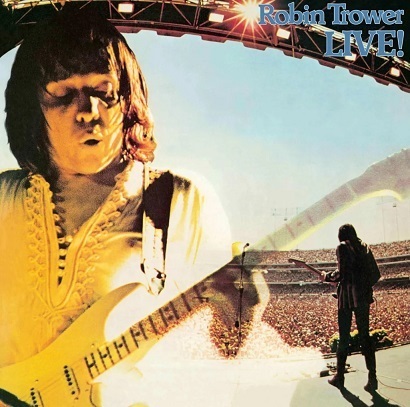
The Anniversary Edition is packaged as a hardcover book, with 24 pages and sleeves for the two CDs. It retains the original artwork on the front and back. The front cover photograph suggests the show took place in a huge outdoor stadium (Giants’ baseball stadium in San Francisco) rather than in the comparatively small confines of the Stockholm Concert Hall. Trower has assured fans that there was never any intention to mislead. Grade: album set A+
Cactus: Temple of Blues II (Cleopatra CD). By 2021, drummer Carmine Appice was the only original surviving member of Cactus. This album is the follow-up to Cactus’ 2024 release, “Temple of the Blues,” and features a score of guest musicians on the 11 tracks (one is a bonus CD track). Artists range from Eric Gales and Pat Travers to Dee Snider and Tracii Guns, with Appice leading the band.
The album opens with a heavy version of Willie Dixon’s “Back Door Man 1 & 2,” which was originally recorded by Howlin’ Wolf in 1960 and later recorded by The Doors in 1967. This updated version is influenced by the original Wolf recording. Gales opens with a heavy guitar riff, followed by his raspy, growling vocals. Gales plays some screaming guitar solos and Billy Sheehan plays bass.
The melodic “300 Pounds of Joy” is an autobiographical song by Wolf. The track opens with Appice’s explosive drumming driving the song forward until King’s X lead guitarist Ty Tabor jumps in with slide guitar licks. Ed Terry handles the vocals, while Artie Dillon is on bass.
“Moanin’ at Midnight” features blues rocker Travers on lead slide guitar and he shreds through the song. Terry’s soaring vocals also are featured. “Down to the Bottom” has King’s X bassist Dug Pinnick on vocals, with Phil Soussan on bass and Richard Fortus on guitar. Appice’s explosive drumming again drives another Wolf tune.
Ron Thal, known as Bumblefoot, plays fretless and lead guitar on “Token Chokin’,” a bouncy song from Cactus’ third album, “Restrictions” (1971), but here it rocks harder, with guitar peals replacing the harmonizing of the original. Terry again provides vocals, joined by heavy metal bassist Johnny Rod from W.A.S.P. and Artie Dillon on rhythm guitar.
“Bad Stuff” is a high-energy track that first appeared on Cactus’ fourth, and final, album from the 1970s. This explosive version features an ex-Deep Purple guitarist Steve Morse and vocalist Joe Lynn Turner, along with keyboardist Derek Sherinian and fretless bassist Tony Franklin.
“Tail Dragger” is another Dixon composition first recorded by Wolf. It has Testament guitarist Alex Skolnick, bassist Rudy Sarzo of Whitesnake and Ozzy Osbourne, vocalist Terry and Rocking Jake on harmonica. “The Little Red Rooster,” yet another Dixon song first recorded by Wolf, has Twisted Sister’s Snider on vocals and Guns on lead guitar, with jazz bassist Jimmy Haslip.
An unexpected number is Jimi Hendrix’s “Purple Haze” as a stripped-down power trio plus one, with the late Melanie’s vocals. It seems a strange choice to use Melanie. Yet, Hendrix, Melanie and Cactus all performed at the Isle of Wight Festival in August 1970. Artie Dillon plays guitar on the track.
“Spoonful” is still another Dixon song that Wolf recorded. Most notably, it was recorded by Cream. Here, Terry is on vocals and Ted Nugent provides lead guitar. Appice offers powerful drumming, coupled with Australian veteran bassist Bob Daisley.
The bonus track is “Feel So Good,” with Vixen guitarist Britt Lightning and former KISS guitarist Tommy Thayer, plus vocals by Rob Caudill. The song was co-written by Appice, Bogert, Day and McCarty and originally appeared on Cactus’ debut album, “Cactus” (1970). Grade: CD A-
Original Cast Recording: Soul to Soul (Liberation Hall CD). In February 1971, several dozen African American soul, jazz and gospel artists embarked on a journey from New York City to Ghana, West Africa to take part in a 13-hour concert entitled Soul to Soul. The concert was a celebration of 14 years of Ghana’s independence from British rule. For most of these artists, it was their first trip to Africa. For the African American musicians, it was a journey about personal roots, the ancestral homeland, history and discovery.
Directed by Academy Award winner Denis Sanders and produced by Tom Mosk and Richard Bock, the resulting concert film/documentary had a limited theatrical run in late 1971. In 2004, Reelin’ In The Years Productions President David Peck secured permission for a DVD release from the producer and copyright holder of Soul to Soul. With the help of a clearance specialist, he was able re-clear all the artists seen in the 1971 film.
That film will be re-released on Blu-ray and DVD on May 12, but the soundtrack album already has been released by Liberation Hall in March, on the 55th anniversary of the concert. The film’s soundtrack has been digitally remastered by Randy Perry.
Highlights include The Ike & Tina Turner Revue, with frontwoman Tina and the Ikettes, delivering fiery renditions of “River Deep-Mountain High,” the project’s first digital single; the title track “Soul to Soul,” specifically written for the concert; and the blues number, “I Smell Trouble.” Wilson Pickett, the most popular American artist known to West Africans at the time, delights with “In the Midnight Hour,” “Funky Broadway” and “Land of a 1000 Dances.”
Gospel, soul and R&B family group The Staple Singers perform “When Will Be We Paid,” “Are You Sure” and the upbeat “He’s Alright,” only five months before they recorded their legendary hits “I’ll Take You There” and “Respect Yourself.” Pianist Les McCann and tenor saxophonist Eddie Harris introduced many members of the audience to jazz via a spirited performance of “The Price You Gotta Pay to Be Free” (9:09). The Voices of East Harlem, an ensemble featuring young gospel singers, sing the funky “Run, Shaker Life” and the shouter, “Choose Your Seat and Set Down/ Walk All Over God’s Heaven.”
Santana, with guest percussionist Willie Bobo, excels on “Jungle Strut” and “Black Magic Woman/ Gypsy Queen.” Despite the San Francisco group only having one African American member, it played the most African-sounding music of any of the American guests. Santana relied on Afro-Cuban and other Latin American rhythms.
The sound is sometimes a bit muffled, while other acts sound clearer; but, as a whole, it is a worthwhile audio of the event. Grade: CD B+
Robin Trower Live!
About this blog:

My music review column, Playback, first ran in February 1972 in The Herald newspapers of Paddock Publications in Arlington Heights, IL. It moved to The Camden Herald in 1977 and to The Courier Gazette in 1978, where it was joined by my home video reviews in 1993. The columns ran on VillageSoup for awhile, but now have this new home. I worked at the Courier Gazette for 29 years, half that time as Sports Editor. Recently, I was a selectman in Owls Head for nine years.