
Rare comedies with Bogart, Davis
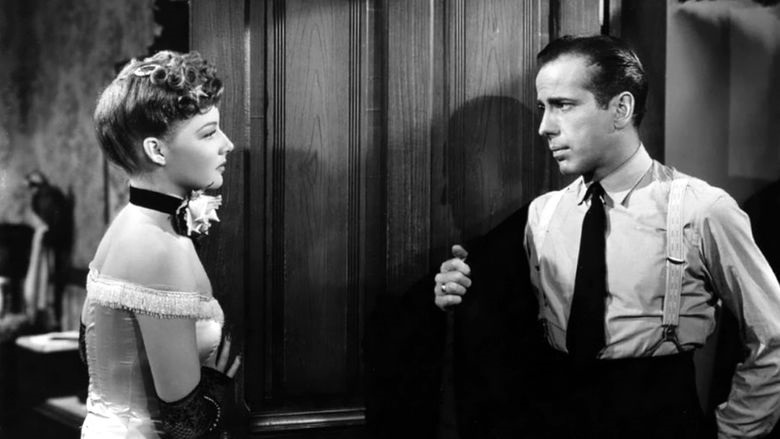 “It All Came True” stars Ann Sheridan and Humphrey Bogart. Warner Archive Collection photo.
It All Came True (1940, Warner Archive Collection, Blu-ray, NR, 97 min.). In this rare-for-him comedy, Humphrey Bogart (“Casablanca,” “To Have and Have Not”) plays crooked nightclub owner Chips Maguire. After his club is raided, Maguire murders a police informant, using a gun he registered under the club’s piano player’s name. Needing a place to hide out, Maguire uses that gun to blackmail the pianist (Jeffrey Lynn of “The Roaring Twenties” as Tommy Taylor) into allowing Maguire to stay at his eccentric mother's boarding house.
We already have been introduced to the owners – Mrs. Taylor (Jessie Busley of two “Brother Rat” films) and Maggie Ryan (Una O’Connor of “Bride of Frankenstein,” “The Invisible Man’) – and the zany boarders, who include aging magician The Great Boldini (Felix Bressart of “Ninotchka,” “The Shop Around the Corner”), Miss Flint (Zasu Pitts of “Greed,” “It’s a Mad Mad Mad Mad World”) and Mr. Van Diver (Brandon Tynan of “The Lady and the Mob”). Just prior to Tommy and Maguire’s arrival, Maggie’s daughter Sarah Jane (Ann Sheridan of “King’s Row”) has returned home after some time away.
Tommy and Sarah Jane, who sometimes is called Sally or Sal, were raised together, but more as friendly enemies. Now he is a pianist/composer and she is a wanna-be singer. Also, Sarah Jane once worked in Maguire’s club. Maguire is pretending to be Mr. Grasselli, but it only takes a half-hour for Sarah Jane to discover Grasselli, who has been staying in his room, is Maguire. That is helpful, because the two landladies will lose the house unless they can pay $1,189 in back taxes.
After the boarding house residents put on a vaudeville show for Grasselli – highlighted by Boldini’s hilarious magic act being disrupted by the dog Fanto and Sarah Jane and Tommy performing “The Gaucho Serenade” – Maguire comes up with the idea of turning the boarding house’s living room into an exclusive “Roaring ‘90s” nightclub with entertainment. Things are going fine until Miss Flint recognizes Maguire from a crime magazine.
Director Lewis Seiler (several Tom Mix Westerns, “Girls Gone Wild”) handles the comedy with a deft touch. Sheridan, who also sings “Angel in Disguise,” also acted with Bogart in “San Quentin” (1937), with Bogart and James Cagney in “Angels with Dirty Faces” (1938), and with Bogart and George Raft in “They Drive by Night” (1940). Sheridan also is in “The Man Who Came to Dinner” (see next) with Bette Davis.
Extras include the Merrie Melodies cartoon “Circus Today” (9:02) and the Porky Pig cartoon “The Sour Puss” (7:33). Grade: film 3.5 stars; extras 1.5 stars
Rating guide: 5 stars = classic; 4 stars = excellent; 3 stars = good; 2 stars = fair; dog = skip it
Purchase link for some titles: https://moviezyng.com?bg_ref=ApLKdWV51k
The Man Who Came to Dinner (1941, Warner Archive Collection, Blu-ray, NR, 113 min.). Monty Woolley reprises his Broadway triumph as acerbic critic Sheridan Whiteside, whose “tongue is dipped in venom” and who is super intelligent. In a rare comedy appearance, Bette Davis (“All About Eve,” “Dark Victory,” “What Ever Happened to Baby Jane?”) plays Whiteside’s unflappable secretary, Maggie Cutler. The play was written by George S. Kaufman and Moss Hart.
Whiteside is on a lecture tour and is to dine at the home of Ernest and Daisy Stanley (Grant Mitchell of “Arsenic and Old Lace,” “Mr. Smith Goes to Washington,” and Billie Burke of “The Wizard of Oz,” “Dinner at Eight”), but he slips on their icy front steps and ends up staying for weeks, mistakenly being informed by local Dr. Bradley (George Barbier of “The Merry Widow”) that he broke his hip.
Confined to the Stanley home, Whiteside plunges the household into chaos, while ruling as a dictator. He receives such gifts as an octopus and four penguins. He also invites four imprisoned murders to lunch at the Stanley’s home. Dr. Bradley tries to get Whiteside to edit his autobiography, while Whiteside tries to disrupt the growing attraction between Maggie and local newsman Bert Jefferson (Richard Travis of “Missile to the Moon,” “Backlash”), whose company he had come to enjoy. Bert also has written a play, which Whiteside tries to interest his actress friend Lorraine Sheldon (Ann Sheridan, see “It All Came True” above) in, figuring she would also be interested in Bert, thereby thwarting Maggie’s plan to quit and marry Bert.
Whiteside also meddles into the lives of the two Stanley children: would-be photographer Richard (Russell Arms of “By the Light of the Silvery Moon”) and June (Elisabeth Fraser of “A Patch of Blue”), who wants to marry Sandy (Charles Drake of TV’s “Wagon Train,” “Robert Montgomery Presents”), a union member in Stanley’s factory.
A lot of the comedy comes from Whiteside’s constant bullying of nurse Miss Preen (Mary Wickes of “White Christmas,” two “Sister Act” films). There also is an aggressively comic cameo by Jimmy Durante as Whiteside’s friend Banjo, who stops by to drop off a Christmas present.
The film has a lot of real people name-dropping and several of the actors play thinly-veiled real-life luminaries, including Sheldon being based on Gertrude Lawrence and Whiteside’s other friend, Beverly Carlton (Reginald Gardiner of “The Great Dictator”), being based on Noel Coward.
The film was directed by William Keighley (“The Adventures of Robin Hood”). Extras include the documentary “Inside a Classic Comedy” (11:47); a featurette on Glen Gray and Hiss Casa Loma Orchestra (8:53); the Bugs Bunny cartoon “The Wabbit Who Came to Supper” (8:09); and two radio broadcast versions, one the Hotspot Holiday Hour of Dec. 25, 1949 with Jack Benny, Rosalind Russell and Charles Boyer (59:40) and the other the Lux Radio Theater of March 27, 1950 with Clifton Webb and Lucille Ball (59:50). Grade: film 4 stars; extras 3.5 stars
This Is the Night (1932, Universal, Blu-ray, NR, 78 min.). The film features Cary Grant (“Arsenic and Old Lace,” “Charade.” “The Philadelphia Story”) in his screen debut. Directed by Frank Tuttle (“All the King’s Horses”), it is a comedy of sexual innuendo and amorous infidelity.
Claire Mathewson (Thelma Todd of “Horse Feathers,” “The Maltese Falcon”) plots to rendezvous with her lover Gerald Gray (Roland Young of “The Philadelphia Story,” “Topper”) in Venice for the weekend. When her husband Stephen Mathewson (Grant) returns home unexpectedly, when he was supposed to be throwing the javelin in the Summer Olympics, plans are hastily rearranged for a group outing, joined by Gerald's pal Bunny West (Charlie Ruggles of “The Parent Trap”) and Germaine (Lily Damita of “The Bridge of San Luis Rey”), a penniless woman hired to pose as Gerald's wife.
Stephen can easily see the attraction between his wife and Gerald, so he allows his attraction to Germaine to build. However, the younger Germaine soon finds herself ardently pursued by all three men, while Claire tries to hide her jealousy. Four times, Claire has the dress or nightgown she is wearing be accidentally pulled off.
While there are no extras, the Blu-ray also includes the version that has six night scenes tinted blue. Otherwise, the film is black-and-white. Grade: film 2.75 stars
Gambling Ship (1933, Universal, Blu-ray, NR, 71 min.). Cary Grant also stars here, one of six films he made that were released in 1933. Grant plays gambling boss/racketeer Ace Corbin, who has grown tired of the dangerous life in Chicago. After being acquitted by a jury, he retires and travels cross-country by train to begin a new life in California with a new name.
On the train, Corbin meets Eleanor La Velle (Benita Hume of “Tarzan Escapes,” “The Constant Nymph”) and they fall in love. He does not know she also has given a false name. It turns out Eleanor is the mistress of Joe Burke (Arthur Vinton of “The Viking,” “Gambling Lady”), who operates the Casino del Mar ship, which is floundering due to competition from a nearby ship casino run by Pete Manning (Jack La Rue of “Road to Utopia,” “Special Agent”).
Burke tells Eleanoe he needs $9,000 to save his casino and that they should break up. That is just what she wanted to do, but she refuses to abandon Burke when he is in trouble. Meanwhile, learning Corbin is in town, Burke approaches him and offers him a partnership in the casino, if he can pay off the debt. Corbin refuses until he learns – big coincidence – that his hated enemy Manning owns the other casino ship.
The film is rather average. Grade: film 2.5 stars
Honky Tonk (1941, Warner Archive Collection, Blu-ray, NR. 105 min.). In this Western, con artist “Candy” Johnson (Clark Gable of “Gone with the Wind,” “San Francisco”) has been run out of town after town. So, traveling with his poker-playing sidekick Sniper (Chill Wills of “Giant,” “The Alamo”) by train, he gets the idea to get a town of his own and decides on Yellow Creek, Nevada. He meets Elizabeth Cotton (Lana Turner of “Peyton Place,” “The Postman Always Rings Twice”) on the train, which helps on his decision.
Johnson meets widow Varner (Marjorie Main of “Meet Me in St. Louis,” several “Ma and Pa Kettle” films), who runs the boarding house Cotton and her father, Justice of the Peace Cotton (Frank Morgan of “The Wizard of Oz,” “The Shop Around the Corner”), are staying. To place roots that the town will enjoy, Johnson gives Mrs. Varner $1,500 to build a mission that would be the town’s first religious building. Soon after, he establishes the Square Deal Saloon, promising good liquor and honest gambling.
Dad Cotton actually knows Johnson from earlier scam days. In Yellow Creek, Cotton has been pocketing the fines, instead of turning them over to the town.
We first meet Johnson and Sniper when they are shirtless and about to be tarred and feathered in another town. However, Johnson actually swindles three of his imprisoners out of $10 each while supposedly showing them how to do the hidden card trick, and also stealing a gun to facilitate their escape.
In Yellow Creek, Johnson takes on crooked Sheriff Brazos Hearn (Albert Dekker of “The Wild Bunch,” “The Killers”) in a $5,000 game of Russian roulette. That is where the money for the mission and Square Deal Saloon came from. Claire Trevor (“Stagecoach,” “Key Largo”) plays “Gold Dust” Nelson, a dancehall girl Johnson knew in the past.
Johnson kisses Elizabeth four times the third time he meets her. They date, until she tricks him into marriage.
Eventually, the townspeople become tired of most of the town’s money going to Johnson and his “posse” of town officials, whose graft is even backed by the governor. This leads to a double-tragedy and an armed standoff.
Extras include the Our Gang comedy “Fightin’ Fools” (8:58); the Tom and Jerry cartoon “The Midnight Snack” (9:11); and the Lux Radio Theater audio version with Turner and John Hodiak (50:45). Grade: film 3 stars; extras 2.25 stars
Legend of the Fist: The Return of Chen Zhen (China, 2010, Well Go USA, Blu-ray, R, 106 min.). The film is a continuation of the 1995 television series “Fist of Fury,” with Donnie Yen reprising his role as Chen Zhen, a role made famous by Bruce Lee in “Fist of Fury” (1972) and continued by Jet Li in “Fist of Legend” (1994).
The film is set seven years after the apparent death of Chen Zhen, who was shot after discovering who was responsible for his teacher's death in Japanese-occupied Shanghai. A mysterious stranger arrives from overseas, having fought with the Allies in France against the Germans in World War I. An exciting wartime scene is the first of a few flashbacks to France.
The stranger is a disguised Chen Zhen (Yen of the “Ip Man” film series), who befriends local mafia boss Master Liu (Anthony Long of “Infernal Affairs,” “Hard Boiled”), who forms an alliance with the Japanese. Upset over the Japanese brutality, Chen becomes a caped fighter by night. Once the Japanese make up a kill list, Chen tries to either defend those on the list or talk them into leaving the city for safety. Still, many are killed.
While working at Liu’s Club Casablanca as its manager, Chen gets involved with singer/hostess Kiki (Shu Qi of “The Transporter”), not knowing she is a Japanese spy. The only one who knows he rally is Chen is Police Inspector Huang Hao Long (Huang Bo of “The Island,” “Across the Furious Sea”), who lives off bribes.
The best action scene, after the opening one in France, is the first time Chen dons his costume – looking like the Green Hornet, only in black – and fights several Japanese assassins during daytime. Later on, there are brief bursts of violence. The people of Shanghai, led by students, finally protest in the streets, leading to killings and explosions.
Overall, there is too much politics and not enough action in the film, although near the end, Chen takes on, and defeats, dozens of Japanese soldiers in a dojo.
Extras include two behind-the-scenes looks. The first is on filming the opening fight in France (7:57), while the second is mostly inside Club Casablanca (9:34). Grade: film 2.75 stars; extras 2 stars
Cruel Tale of Bushido (Japan, 1963, Eureka! The Masters of Cinema Series, Blu-ray, NR, 122 min.). Directed by Tadashi Imai (“Until We Meet Again,” “An Inlet of Muddy Water,” “Revenge”), the film has a salary-man's fiancée (Yoshiko Mita as Kyoko) attempt suicide. As he awaits to see if she will recover, the man remembers his gruesome family history, which sees his ancestors repeatedly sacrificing themselves for the sake of their cruel lords. He then realizes that he has been repeating their mistakes.
The basically dour film is made somewhat remarkable as the salary-man Susumu Iikura is played by Kinnosuke Nakamura, who also plays six of his ancestors – of various ages – as flashbacks go back to 1610 and follow seven generations until reaching the present. Information on the past had been found by teenaged Susumu in notebooks, after he returned from school for his mother’s funeral.
In 1637, ancestor Jirozaemon (Kinnosuke) helps repel the Shimabara Rebellion through the battle of Sekigahara. However, during the battle his lord failed to take action to prevent the ruler’s camp from catching fire. This leads to Jirozaemon taking his own life in atonement for his lord’s mistake.
Three years later, Jirozaemon’s son Sajiemon (also Kinnosuke) becomes a page, but loses the family’s stipend by offending the lord. Despite this, he takes his own life out of mistaken believe in loyalty, after the lord dies.
The next story is about student Kyutaro, Sajiemon’s grandson (Kinnosuke), who is forcibly taken as a concubine by Lord Munemasa (Masayuki Mori). Kyutaro is told that submitting to his superior’s sexual advances is a way to show his loyalty. For the time – 1963 – the open depiction of homosexuality in a Japanese film was groundbreaking.
Kyutaro, however, falls in love with Lady Hagi (Kyoko Kishida), another of Munemasa’s concubines, and is beaten for it. The pair eventually have sex, but are imprisoned afterwards, with Kyutaro castrated. Hagi had become pregnant, though, so the Iikura family lineage continued.
The next year is 1783, when the volcano Asama erupts. Shuzo Iikura (Kinnosuke) is a talented swordsman in the employ of a fief lord, who has five protesting farmers killed by sawing off their heads. The volcanic eruption had damaged crops and hunger was a big issue. The lord grabs both Shuzo’s wife Maki (Ineko Arima), who kills herself instead, and his daughter Sato (Kikko Matsuoka) for carnal purposes. After Shuzo is tricked into killing both his daughter and her would-be lover during his blindfolded cutting move, Shuzo kills himself as well.
In the 1890s, Shingo (Kinnosuke) is a student who takes care of an elderly former lord, putting him up in his own home. However, the old lord sexually attacks Fugi, Shingo’s female friend.
Finally, there is Osamu (Kinnosuke), in the briefest episode. Osamu is a kamikaze pilot, flying off to his death in World War II. Then the film details Susumu’s backstory of corporate espionage over a dam construction and his boss asking him to delay his marriage to Kyoko, after having her steal cost estimates from their competitor, for whom she worked as a secretary.
Extras include film critic Tony Rayns discussing the film, which won the Golden Bear Award at the 1963 Berlin Film Festival (21:32); the video essay “Seven Kinds of Samurai” by Jonathan Clements, author of “A Brief History of Japan”; and a 20-page booklet with an essay by Japanese cinema expert Hayley Scanlon. Grade: film 3.5 stars; extras 3 stars
Grizzly Night (Wee Go USA, Blu-ray, R, 87 min.). On Aug. 12, 1967 in Montana's Glacier National Park, nine miles apart were two fatal grizzly bear attacks. The film is based on these true events and follows a rookie park ranger who leads stranded survivors through chaos and fear in a fight that forever changed America's understanding of wildlife.
It is basically a story of humankind’s folly, but one that eventually inspired major changes in how to deal with bear-based encounters. The film, directed by Burke Deren, is not the thriller it could have been, as the large cast deal with the emergency situation. Grade: film 2 stars
Scooby’s All Stars Lafe-A-Lympics (1977-1978, 2012, Warner Archive Collection, 3 Blu-rays, NR, 550 min.). Sports, spoofs and shenanigans abound when three teams of favorite Hanna-Barbera characters, the Scooby Doobies, the Yogi Yahooeys and the Really Rottens, compete for glory in all 24 original episodes of the fan-favorite series. Hosted by yellow-jacketed commentators Snagglepuss and Mildew Wolf, the fractured face-offs feature other animated immortals joining Scooby Doo, including Huckleberry Hound, Yogi Bear, Wally Gator and Dynomutt.
The Scooby Doobies include Scooby-Doo, Shaggy, Scooby-Dum, The Blue Falcon and Dynomutt, Hong Kong Phooey, Captain Caveman and The Teen Angels, Speed Buggy and others. The Yogi Yahooeys are led by Yogi Bear, along with Boo-Boo, Cindy, Yakky, Huckleberry Hound, Pixie and Dixie, Quick Draw McGraw, Hokey Wolf, Mr. Jinks, Augie Doggy and his dad, Wally Gator, and the oversized Grape Ape.
The Really Rottens is a meddling group of villains, including Mumbly and The Dead Baron, Dinky and Dirty Dalton, Mr. and Mrs. Creepley, Orful Octopus, Magic Rabbit, Daisy Mayhem and others. Many of the Rottens were original characters created for this show and did not appear elsewhere. They do provide most of the series’ fun unpredictability, with every event involving some sort of underhanded trickery.
Events include skateboard polo, a three-legged kilt race, a fill up the oasis race and the Big Ben tower climb.
This collection also includes the 2012 special “Spooky Games” (23:18), which revisited the show’s format. Grade: series 3.75 stars; extra 2 stars
“It All Came True” stars Ann Sheridan and Humphrey Bogart. Warner Archive Collection photo.
About this blog:

My music review column, Playback, first ran in February 1972 in The Herald newspapers of Paddock Publications in Arlington Heights, IL. It moved to The Camden Herald in 1977 and to The Courier Gazette in 1978, where it was joined by my home video reviews in 1993. The columns ran on VillageSoup for awhile, but now have this new home. I worked at the Courier Gazette for 29 years, half that time as Sports Editor. Recently, I was a selectman in Owls Head for nine years.