
Eight years to the day since murder of 10-year-old Marissa Kennedy, Maine AG's office denies mother's petition to revisit case
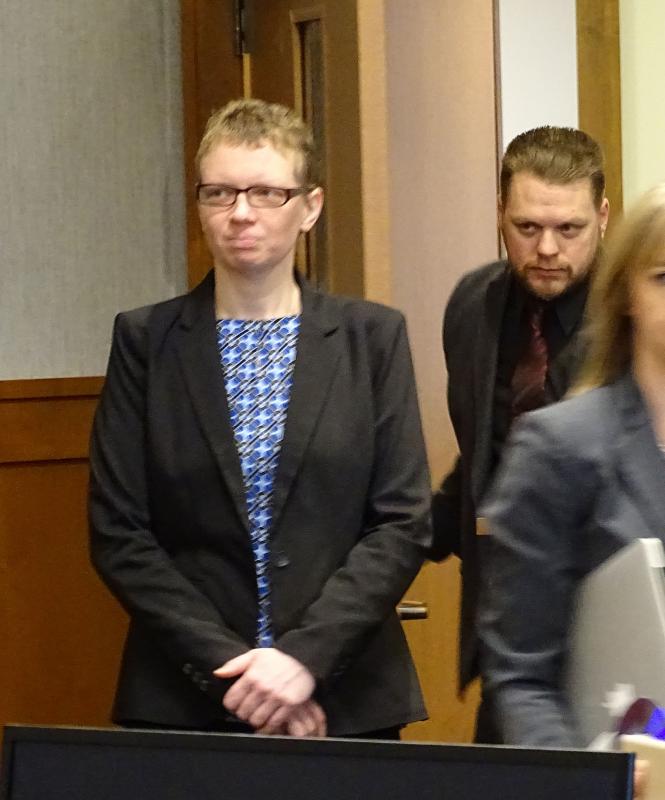 Sharon Carrillo enters the courtroom during her murder trial in 2019. (File photo by Erica Thoms)
Sharon Carrillo enters the courtroom during her murder trial in 2019. (File photo by Erica Thoms)
Sharon Carrillo enters the courtroom during her murder trial in 2019. (File photo by Erica Thoms)AUGUSTA — A petition from Sharon Kennedy (fka Sharon Carrillo, and hereby referred to as Sharon) for writ of habeas corpus, was dismissed by a Maine attorney general Feb. 25, exactly eight years since her daughter’s murder. In a March 6 letter to the court, she appealed again, "to really talk to someone and hopefully a court-appointed lawyer to help me with all of this."
Sharon, who was convicted of the Feb. 2018, murder of her daughter, 10 year-old Marissa Kennedy, was found guilty of prolonged, extreme abuse, ultimately leading to the death of her daughter. She was sentenced to 48 years in prison. Sharon’s then-husband, Julio Carrillo, pleaded guilty July 22, 2019, and was sentenced to 55 years in prison. A judge ultimately annulled their marriage after discovering Julio Carrillo was already married at the time he and Sharon got married.
Sharon had filed a writ of habeas corpus petition Jan. 9, which reportedly did not include the date on which she signed the petition. In that petition, Sharon made two allegations, including ineffective assistance of counsel, with two specific examples given:
-
Failing to utilize photographs taken shortly after her arrest depicting injuries to her allegedly caused by her husband, and
-
Failing to timely and adequately object to the State’s question on cross-examination about statements Sharon made to fellow inmate Shawna Gatto.
The same claims reportedly included the allegations in her amended petition for post-conviction review in the state Superior Court, the petition states.
Concerning the merits of the two alleged claims, Justice Robert Murray alluded to an 1984 law set forth by an unrelated 1984 criminal case, Strickland v. Washington, which resulted in “clearly established federal law.” State records attached to the filing “establish that the State Superior Court’s denial of the claims in Sharon’s state post-conviction review petition, and the Law Court’s affirmation of that denial, was not contrary to, nor an unreasonable application of, the United States Supreme Court decision in the Strickland case.”
With that in mind, the State Superior Court found as a presumptively correct fact that Sharon failed to establish either prong of the Strickland analysis.
“Regarding claim one, significant evidence was introduced by Sharon demonstrating she was a victim of domestic violence. Thus the photographs, which depicted only minor injuries to Sharon, were unnecessary for the jury to conclude that, at the time of the murder, Sharon was being abused by her husband. Moreover, Sharon’s minor injuries stand in stark contrast to the photographs depicting the extensive and extreme injuries inflicted on the child victim by Sharon and her husband. Accordingly, no probability exists that, even if trial counsel had introduced these photographs, the jury would have concluded that Sharon’s minor injuries excuse her infliction of severe, death producing injuries for her daughter,” the finding reads in part.
It was also found that as presumptively correct fact that the approximate 45 second delay between the first mention of Gatto’s name and trial counsel’s objection was not unreasonable under the circumstances. In addition, they said there is no probability that this brief delay undermines confidence in the outcome of the trial, given the extensive evidence upon which the jury could, and did, find that Sharon’s confessions to law enforcement were credible.
In a March 6 letter written after the court’s findings, Sharon stated that she was handling the filings on her own, as she reportedly does not have a court-appointed lawyer, despite allegedly requesting one. Carillo also took issue with reports that she had spoken to Shawna Gatto when placed in Two Bridges Regional Jail, where Gatto is also serving 50 years for the murder of a young girl in her care.
Sharon alleges she was placed in a “bubble” upon her arrival, and that the allegations made by Gatto were done while she was in the “bubble” making it impossible for her to have spoken to Gatto. Sharon states she believes Gatto “did what she did to get a lower sentence or something,” according to Sharon’s letter.
Of her injuries upon arrest, Sharon alleges that her husband: “always put bruises on me and all where no one cannot [sic] can see them when covered with clothes? I understand the condition that my daughter was in was way worse, but these pictures should have been included in my trial.”
She further alleged that photographs in question were taken a week after she was arrested.
Sharon also revisited her trial, which began Dec. 7, 2019.
She cited a cart of evidence was brought out for the jury to inspect, asserting that nothing in the cart pointed to her guilt.
She wrote that during her second interview with detectives: “I felt like they forced me to say things and I was scared of Julio Carrillo if I did not take responsibility. I was in a really bad abusive relationship, and I feel like the jurors, the judge and the AG did not care at all.”
The March 6, 2026 letter concluded by taking issue with the assertion she failed to take her daughter to the hospital, claiming she begged Julio Carrillo to call 911 numerous times before he did. Sharon claims she performed CPR on her daughter the day she died.
In addition to the petition for writ of habeas corpus, Sharon filed multiple petitions in an effort to alter her sentence, including an immediate appeal of her original sentence, filed March 12, 2020. The appeal was ultimately denied, with Sharon’s judgment and conviction affirmed.
Sharon signed a pro se state petition for post-conviction review on March 4, 2022, that was received by the court March 16; an evidentiary hearing was held March 24, presided over by Justice Robert Murray.
Murray issued an order denying Sharon’s petition May 6, 2024.
On May 8, 2024, a notice of discretionary appeal to the Maine Law Court was filed by Sharon, the appeal was from the denial of her state petition for post-conviction review. Sharon also filed a memorandum July 17, 2024, in support of her request for a certificate of probable cause to appeal the denial of her state petition.
The Maine Law Court issued an order denying a certificate of probable cause appeal Jan. 2.
Erica Thoms can be reached at news@penbaypilot.com