Tennessee Williams quartet, Bob Hope trio
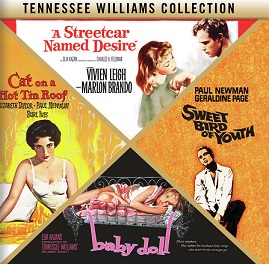 The cover of the Tennessee Williams collection from Warner Archive Collection.
Tennessee Williams 4-Film Collection (1951-1962, Warner Archive Collection, 4 Blu-rays, PG/R/NR, 467 min.). From the pen of one of the 20th century's greatest playwrights comes this collection of four stage adaptations. Marlon Brando and Vivien Leigh lead the cast in the unforgettable “A Streetcar Named Desire,” directed by Elia Kazan, while Paul Newman and Elizabeth Taylor create screen electricity in “Cat on a Hot Tin Roof” and Newman co-stars with Geraldine Page in the poignant “Sweet Bird of Youth.” Under Kazan, Karl Malden and Eli Wallach give superb performances, with Carroll Baker playing the titular role in “Baby Doll.” Combined, the films were nominated for 25 Academy Awards, winning five.
This is an update of the 2014 DVD set. The films are reviewed individually.
“A Streetcar Named Desire” (1951, PG, 125 min.) was the film that made Marlon Brando a star. Brando, who earned one of the film’s 12 Oscar nominations, had only appeared in one previous film (“The Men” in 1950) and on television in one episode of the “Actor’s Studio” series. Brando and co-stars Kim Hunter and Karl Malden, as well as director Kazan, all came from the successful Broadway production that lasted two years. The play also won Tennessee Williams a Pulitzer Prize.
The film is set against the sexy backdrop of New Orleans' gritty French Quarter. It tells the tale of former school teacher and socialite Blanche DuBois (Vivien Leigh of “Gone with the Wind,” “That Hamilton Woman”), as she is forced to move in with her sister Stella (Hunter of the “Planet of the Apes” film series) and Stella’s animalistic husband Stanley (Brando of “Julius Caesar,” “On the Waterfront,” “The Godfather”). They live in a squalid apartment that is arrived at on the iconic streetcar line named Desire.
The fragile Blanche quickly gets a gritty life lesson in the seamy, steamy underbelly of the city as the film shows what Blanche's arrival does to the fragile domestic environment of Stella and Stanley. The secrets in everyone's past are revealed as their interactions evolve. Malden (“On the Waterfront,” “Patton,” this set’s “Baby Doll”) plays Mitch, a gentleman caller who highlights Blanche's insecurities, especially with regard to her age, but also her duplicitousness and proclivity toward scheming.
Despite being the only one of the four leads not to win an Oscar, Brando gives an exceptional, physically intense performance, with his cries of “Stella” becoming iconic.
Winning Oscars were Leigh, Malden and Hunter for their acting. Oscar nominations were for Best Picture, Best Director (Kazan), Best Screenplay (Williams), Best Actor (Brando), Best Cinematography, Black and White (Harry Stradling Jr.), Best Art Direction-Set Direction (Richard Day and George James Hopkins), Best Costume Design (Lucinda Ballard), Best Sound Recording (Nathan Levinson) and Best Music Scoring (Alex North).
The film comes with the most extras of the four, dating from a 2006 release. There is audio commentary by actor Malden and film historians Randy Behlmer and Jeff Young; two excellent documentaries in “Elia Kazan: A Director’s Journey,” featuring Kazan interviews and a look at realism in his films (75 min.), and “A Streetcar on Broadway,” looking at the stage play with input from Malden, Kazan, Hunter and Behlmer (22 min.); a fine look at North’s career and score, including some unused music cues (9:41); “An Actor Named Brando,” with Kazan, Malden and Hunter (8:53); Brando’s screen test for “Rebel without a Cause” (5:06); outtakes of 10 scenes (15:38); and audio outtakes (17:01).
There also is “Censorship and Desire,” with Malden and Hunter (16:21), that looks at how the Catholic Legion of Decency affected Warner Bros. final editing of the film, which involved some cuts. Overall, the film rather alludes to pretty much everything Williams mentioned in the play, although usually in a more circumspect way. This Blu-ray presents the restored version of the film, with four minutes added. The extra shows what the cuts were.
On a personal note, I remember the effect of the Legion of Decency, as it had warned against “Peyton Place” and a neighbor criticized my mother as she was taking me to see the film in 1957. The film, which helped break barriers on what could be discussed in film, was filmed in and around Camden and Rockport, Maine. Twenty years later, I ended up moving to Camden – not influenced by the film – and stayed there 28 years. Grade: Streetcar film 5 stars; extras 4.5 stars
“Baby Doll” (1956, R, 114 min.). This film also was directed by Elia Kazan and starred Karl Malden. Despite being in many ways a very funny film, its subject of sensual teasing and provocation led to it being condemned by the Catholic Church’s Legion of Decency and eventually being pulled from theaters. One of the most controversial films of the 1950s, it was adapted by Tennessee Williams from his stage play “27 Wagons Full of Cotton.”
The film covers the exploits of "Baby Doll" Meighan (Carroll Baker of “Giant”), the 19-year-old bride of lecherous middle-aged Archie Lee Meighan (Karl Malden of “A Streetcar Named Desire”), whose cotton gin business is as run-down as his Mississippi Delta plantation. Archie Lee's in a foul mood because the marriage has not been consummated yet, something she has reluctantly promised to do on her 20th birthday.
Archie Lee’s failing business is his bigger problem, so he secretly destroys the gin of rival Silva Vacarro (Eli Wallach of “The Magnificent Seven,” “The Good, the Bad and the Ugly,” in his film debut), who brings truckloads of cotton to Archie Lee's door. Silva sees Baby Doll and the chasing begins.
Despite its censorship problems, the film earned Oscar nominations for actors Baker and Mildred Dunnock (she played Aunt Rose Comfort), Williams for adapted screenplay and Boris Kaufman for cinematography.
The sole extra is “See No Evil” (12:52), a look at the film’s raw sexuality, problems with the Legion of Decency and how the image of Baker sleeping in a baby crib became iconic. Grade: film 4 stars; extra 2.5 stars
“Cat on a Hot Tin Roof” (1958, NR, 108 min.). Directed and co-written (with James Poe) by Richard Brooks, the film was a hit for MGM. It was lavishly mounted, handsomely shot and features career-defining performances by Elizabeth Taylor, who was already a screen idol for “Giant” and “Father of the Bride,” and Paul Newman, who had mostly done television, before making this film as well as “The Long, Hot Summer,” “The Left Handed Gun” and “Rally ‘Round the Flag, Boys!” in 1958. Newman’s performance as Brick Pollitt cemented his movie star reputation as he gave a searing portrayal of an alcoholic ex-athlete disgusted with himself and the world.
Burl Ives's incarnation of plantation owner Big Daddy Pollitt, the role he originated on Broadway, is still widely regarded as the definitive interpretation against which all subsequent performances are measured. Ives was noted for “The Big Country” and TV’s “The Bold Ones: The Lawyers,” “Rudolf the Red-Nosed Reindeer.”
The strictures of the Hays Code governing studio productions required the elimination of crucial elements from Tennessee Williams' multi-layered portrait of a family in crisis. However, Brooks and co-screenwriter Poe (“They Shoot Horses, Don't They?”) also added a crowd-pleasing happy ending, the opposite of the beak one in Williams’ play.
The film starts on birthday 65 for birthday Mississippi cotton farmer Big Daddy Pollitt, a self-made man who has not yet been informed that he is dying of cancer. Instead, he has been told he is fine. So, Big Daddy is determined to reassert his control over his house, which is in conflict, much of it over the disposition of his sizeable estate between his two sons.
The elder son, Gooper (Jack Carson of “Mildred Pierce,” “Arsenic and Old Lace”), is an attorney with an ambitious wife, Mae (Madeleine Sherwood of this set’s “Sweet Bird of Youth,” TV’s “The Flying Nun”), five children and another on the way. Gooper is not the favored son, though. That distinction goes to Brick, a former football star who now drinks continuously and whose marriage to the beautiful Maggie (Taylor) is in shambles. Brick's refusal to sleep with Maggie has left her childless, thereby further endangering the inheritance that is already at risk from Brick's addiction to the bottle.
Between Brick's sexual rejection and her fear of being left penniless, Maggie is in a desperate state. She is the cat of the title, even referring to herself as "Maggie the Cat."
The marital conflict between Maggie and Brick is based on Brick's belief that Maggie slept with his best friend and football colleague, Skipper, who then killed himself out of guilt. Eventually Maggie reveals that nothing happened between her and Skipper, which allows a tentative reconciliation. Gone from the play is Brick's grief over the loss of his friend and sexual confusion that may or may not be due to repressed homosexuality.
The film earned six Oscar nominations including Best Picture, acting nods for Newman and Taylor, Best Director for Brooks, Best Screenplay from Another Medium for Brooks and Poe, and Best Cinematography for William H. Daniels.
The extras from 2006 include audio commentary by Williams’ biographer Donald Spoto and “Playing Cat and Mouse” (10:03), which tells how Taylor continued filming despite the death of her husband Michael Todd in an airplane crash. Grade: film 3.5 stars; extras 2.75 stars
“Sweet Bird of Youth” (1962, NR, 120 min.). Set on Florida’s Gulf coast, the film has Paul Newman (see “Cat on a Hot Tin Roof” above) as Chance Wayne, who, as a youth, left his budding romance with Heavenly Finley (Shirley Knight of “As Good As It Gets,” “Paul Blart: Mall Cop”), to make his mark in New York City in acting due to his good looks, but mostly ended up working in restaurants and as a gigolo. Subsequent trips home had connections with Heavenly, but her father, Boss Finley (Ed Begley of “12 Angry Men,” “Hang ‘Em High”) separated them.
As the film starts, Chance is driving back to Florida from Hollywood with aging actress Alexandra Del Lago (Geraldine Page of “Hondo,” “The Trip to Bountiful”), who is fleeing from the premiere of her latest film, because she did not like her closeup. Only her driver and temporary lover, Chance nonetheless has made her agree to sponsor him and get him a screen test. Both drink a lot and Alexandra even uses illegal Moroccan hashish.
Chance hopes to finally reconnect with Heavenly, but Boss Finley wants her to marry Dr. George Scudder (Philip Abbott of “The Invisible Boy,” TV’s “The F.B.I.”). Chance also has an enemy in Boss Finley’s son, Tom Jr. (Rip Torn of “Men in Black,” “The Man Who Fell to Earth”), who ultimately severely beats him. Tom Jr.’s castration of Chance in the play has been changed, as has Chance giving Heavenly a VD that leads to a hysterectomy. Instead, it was a pregnancy that Boss had aborted by Scudder.
Director Richard Brooks, who again made the changes, sometimes uses a split screen to show Chance’s flashbacks on one half. The film won one Oscar for actor Begley. The two other Oscar nominations were for actresses Page and Knight.
Extras include the 2006 documentary “Chasing Time” (11:44), discussing the film, its changes from the play, which Page also starred in, and how Torn and Page married afterwards. There also is a screen test of Page with Torn as Chance (2:56). Grade: film 3.5 stars; extras 2 stars
Rating guide: 5 stars = classic; 4 stars = excellent; 3 stars = good; 2 stars = fair; dog = skip it
Purchase link for some titles: https://moviezyng.com?bg_ref=ApLKdWV51k
Tea and Sympathy (1956, Warner Archive Collection, Blu-ray, NR, 122 min.). Robert Anderson adapted his own play as screenwriter for this sensitive take on prepschooler Tom Lee (John Kerr of “South Pacific,” “The Pit and the Pendulum”). Relatively new to the all-boys school, Tom finds himself harassed by the macho culture of his classmates and the unfeeling behavior of his father, only being treated with decency by his roommate Al (Darryl Hickman of “Network,” “Leave Her to Heaven”) and with affection by the coach/dormitory owner's wife, Laura Reynolds (Deborah Kerr of “From Here to Eternity,” “An Affair to Remember”). Both Kerrs (unrelated) and Leif Erickson, who plays Coach Bill Reynolds, also were in the original Broadway cast, for which John Kerr won a Tony Award.
Because it was the 1950s and homosexuality was a taboo subject in Hollywood, Anderson had to soften some of the plays directness and even has Tom married in the film’s present, which takes place 10 years after most of the film. Tom is a winning member of the tennis squad, but still is referred to as “sissy boy” by most of the other students. It does not help that, in order to join the drama club, he must play a female character in a school production of “The School for Scandal.” Tom’s aim is to become a folk singer.
Recognizing Tom’s sensitive nature and the fact that he likes to hang out with and help her, especially with gardening, Laura offers more than the usual “tea and sympathy” she has been advised to offer. Laura also has her own problems, having been married to Bill only for a year and now realizing he would rather hang out with the boys on his teams than with her.
An incident in which Tom is seen sewing while in the company of three faculty wives on the beach leads to increased pressure from the other athletes. A classic near-closing line in both the film and the play has Laura tell tom, “Years from now, when you talk about this – and you will – be kind.”
The film was directed by Vincente Minnelli (“An American in Paris,” “Gigi”). John Kerr did win a Golden Globe as Best Male Newcomer.
The sole extra is the Tom and Jerry cartoon, “Down Beat Bear,” about an escaped circus bear that likes to dance to music (6:30). Grade: film 3.75 stars; extra 2 stars
Variety Girl (1947, Universal, Blu-ray, NR, 92 min.). Directed by George Marshall “Pack Up Your Troubles,” “The Goldwyn Follies,” “The Railroad” segment of “How the West Was Won”), the film includes almost everyone under contract to Paramount Pictures at the time in cameos or performing songs, with Bob Hope getting the most time and Bing Crosby joining him for a golf skit and one of the closing half-hour’s performing numbers, playing Siamese twins during “Harmony.” Both Hope and Crosby play themselves.
In all, there are three dozen stars in the musical romance on how a movie star is born. Also appearing are Gary Cooper, Ray Milland, Alan Ladd, Barbara Stanwyck, Paulette Goddard, Dorothy Lamour, Burt Lancaster and many others. Starlet wannabe Amber LaVonne (Olga San Juan of “One Touch of Venus,” “The Countess of Monte Cristo”) is mistaken for her friend, the beautiful and talented, opera-trained Catherine Brown (Mary Hatcher of “The Big Wheel,” “Tales of Robin Hood”). While the zany Amber flubs her way from audition to screen test to stage debut, Catherine cannot seem to stop getting studio head R.J. O'Connell (Frank Ferguson of “Abbott and Costello Meet Frankenstein,” “Johnny Guitar”) wet.
Highlights include Amber pretending to receive a phone call at a restaurant to draw attention to herself, as a director and screenwriter are having lunch there; Catherine singing “Your Heart Calling Mine” with Spike Jones and His City Slickers, who go over-the-top comically at O’Connell’s pool party; and William Bendix, as himself, comically redoing the grapefruit twist in the face scene several times during a screen test. There is even a cameo by Cecil B. DeMille, directing a film scene with American Indians.
Catherine also sings to George Pal’s rare Puppetoon version of "Romeow and Juliacat." It is fun as, during the number, how the sound effects are created is shown.
The last half hour is devoted to the charity variety show and includes musical numbers by Pearl Bailey (“Tired,” as a maid) and The Mulcays (with Hope as a comedy harmonica trio). There are five musical number written by Frank Loesser. Grade: film 3.5 stars
Give Me a Sailor (1938, Universal, Blu-ray, NR, 87 min.). Ensign Jim Brewster (Bob Hope) and Lt. Walter Brewster (Jack Whiting of “Sailing Along”) are brothers and sailors in the U.S. Navy. Walter tells Jim that as soon as they get home, he is going to ask his beautiful girlfriend, Nancy Larkin (Betty Grable of “How to Marry a Millionaire”), to marry him. However, Jim also is in love with Nancy, so he begs Nancy's “ugly duckling” sister, Letty (Martha Raye of “Mountain Music”), to help break up Walter and Nancy. Letty agrees under the condition that Jim helps her win Walter’s heart.
Of course, plans go awry when Letty hides in the car, thinking Walter is driving to a fishing weekend with the admiral, when it actually is Jim driving, and Letty manages to blow up the car. Letty does get a late twist of fortune through a contest. One funny scene has Letty’s facial cream turn into a face straight jacket. Grade: film 3 stars
The Big Broadcast of 1938 (1938, Universal, Blu-ray, NR, 91 min.). The Bellows family causes comic confusion on an ocean liner, with time for radio-style musical acts that are being broadcast back to the United States. W.C. Fields (“The Bank Dick,” “Never Give a Sucker an Even Break”) plays both T. Frothingill Bellows, owner of the cruise steamship Gigantic, and his brother, S.B. Bellows, owner of the cruise steamship Colossal. The two ships are engaged in a transatlantic race. Serving as the radio show’s master of ceremonies is Bob Hope, in his feature film debut, as Buzz Fielding.
Buzz, just let out of “alimony jail,” has been chased onto the ship by his three ex-wives, Cleo (Shirley Ross of “Manhattan Melodrama,” “The Big Broadcast of 1937”), Grace (Grace Bradley of “Redhead,” “Wake Up and Live”) and Joan (Virginia Vale, as Dorothy Howe, of “Triple Justice”), who plan to prevent Buzz’s new, lukewarm girlfriend Dorothy Wyndham (Dorothy Lamour of “Road to Utopia,” “Donovan’s Reef”) from becoming former wife number four and thus lowering their alimony payments. However, once on board, Dorothy is romanced by First Officer Robert Hayes (Leif Erickson of “Tea and Sympathy” above), the inventor of the Gigantic's enormous power plant.
Due to a wild golf game, S.B. misses getting on the Colossal. T. Frothingill intended to send his nearly identical younger brother to sail aboard the Colossal, hoping he would cause trouble and sabotage the rival ship, enabling the Gigantic to win. When S.B.’s golf cart takes flight, he accidentally lands on the Gigantic instead, where mayhem ensues.
Much of Fields’ comedy is subpar here, certainly all of it on the ship. Most of his funny moments come on the golf course and when he accidentally causes a gas station to explode, after refilling his cigar lighter.
Also ending up on the Gigantic is Martha Raye as Martha Bellows, S.B.'s outrageously unlucky daughter who is brought on board after being rescued from the shipwreck of the yacht Hesperus V. She sings "That Moon Is Here Again" while getting tossed around by about eight sailors.
This film features the debut of Hope's signature song, "Thanks for the Memory" by Ralph Rainger, here sung by Buzz and Cleo. Grade: film 2.5 stars
Scott Pilgrim Takes Off: The Complete Limited Series (2023, Universal, Blu-ray, NR, 3 hours 26 min.). Scott is a 20-something Toronto indie rocker/slacker bassist, whom we see try to keep jobs to avoid being kicked out of his apartment. He has to survive encounters with the seven evil exes of Romona, the new girl in town on whom he has a crush and previously had been dreaming about. The eight-episode animated series has the same cast as the 2010 live-action film “Scott Pilgrim vs. the World,” including Michael Cera as Scott, Mary Elizabeth Winstead as Ramona, Kieran Culkin as Wallace Wells, Anna Kendrick as Stacey Pilgrim and Chris Evans as Lucas Lee. Scott is in the band Sex Bomb-omb with anxiety-ridden Stephen Stills (Mark Webber), his misanthrope high school ex-girlfriend Kim (Alison Pill) and Young Neil (Johnny Simmons), Stephen’s dimwitted roommate.
Ramona’s most recent ex, billionaire Gideon Graves (Jason Schwartzman), has established the League of Evil Exes, a group of physically powerful individuals Ramona dated in her past. They include musical theater wannabe Matthew Patel (Satya Bhabha), skater-boy/hot-shot actor Lucas Lee, disloyal vegan Todd (Brandon Routh), ninja Roxie (Mae Whitman) and the Katayanagi twins (Julian Cihi). As Sex Bomb-omb is about to perform one evening, Patel blasts into the venue and challenges Scott to battle.
The result is Scott actually vanishes for quite some time, although Ramona believes he is still alive, albeit missing. The following episodes point the show in a new direction. The series is fun and nicely illustrated in anime style. Extras include audio commentaries with creators and executive producers Bryan Lee O’Malley and BenDavid Grabinski. Grade: series 3.75 stars
Shakespeare & Hathaway: Private Investigators: Season Five (U.K., 2025, BBC, 2 DVDs, NR, 450 min.). After a split in season four, the unlikely crime-fighting duo of Luella Shakespeare (Jo Joyner of TV’s “Stay Close,” “Ackley Bridge”) and Frank Hathaway (Mark Benton of TV’s “Early Doors”) are back working the cobbled streets of Stratford-upon-Avon, Shakespeare's birthplace, to solve mysteries and murders most foul.
Grumpy ex-cop Frank and warm-hearted ex-hairdresser Lu had gone their separate ways, but both end up working the same case in the first of the season’s 10 episodes. Lu is hired by the wife, who believes her husband is sabotaging her half of the house they have been remodeling for their online video series. The husband has hired Frank, thinking his wife is having an affair, possibly with their assistant Nathaniel. Despite both detectives staking out the house, but distracted by a nosey neighbor, they miss the moment when Nathaniel is shot in the head by a nail gun.
As always, amusement is provided by their assistant Sebastian Brudenell (Patrick Walshe McBride), who has continued to work for both, but on different days, unbeknownst to the other. Now he has to work for both at the same time, donning a wig and a mustache in the process.
In other episodes, a horror movie director hires the trio when he finds himself terrorized by one of his own creations; a client is fatally electrocuted at a team-building retreat; and a killer is on the loose in an isolated mansion during a murder mystery school reunion. Meanwhile, a saboteur hides in the shadows, determined to destroy their agency. Tech whizz Spider (Darren Evans) tries to find the culprit. Grade: season 3.5 stars
The cover of the Tennessee Williams collection from Warner Archive Collection.
About this blog:

My music review column, Playback, first ran in February 1972 in The Herald newspapers of Paddock Publications in Arlington Heights, IL. It moved to The Camden Herald in 1977 and to The Courier Gazette in 1978, where it was joined by my home video reviews in 1993. The columns ran on VillageSoup for awhile, but now have this new home. I worked at the Courier Gazette for 29 years, half that time as Sports Editor. Recently, I was a selectman in Owls Head for nine years.