
Complete ‘Cobra Kai,’ ‘Resident Alien’ and a ‘Japanese Godfather’ trilogy
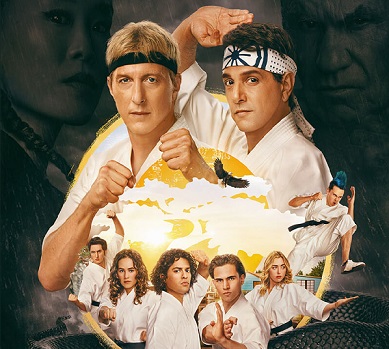 The cast of "Cobra Kai."
Cobra Kai: The Complete Series (2018-2025, Sony Pictures, 13 Blu-rays, TV-14, 2,193 min.). Set 33 years after the original “Karate Kid” film trilogy and the events of thee 1984 All Valley Karate Tournament, and continuing with the two main characters, played by the original actors, the “Cobra Kai” series continues the conflict between Daniel LaRusso (Ralph Macchio) and Johnny Lawrence (William Zabka).
In the first of the six seasons, a down-and-out Johnny, now in his 50s and drinking a bit too much, loses his handyman job after he mounts a TV screen on the wrong wall of a customer’s home – the client wanted it on the wall opposite the door, but of course there were two doors. Having seen Johnny fight, Johnny’s new teenage neighbor Miguel Diaz (Xolo Mariduena of “Blue Beetle,” TV’s “Sakamoto Days”) asks Johnny if he could teach him fighting, as he and his two friends are constantly harassed at school.
Johnny at first refuses, but after getting arrested for rescuing Miguel from a group of bullies, and then getting cut-loose and disowned by his stepfather (Edward Asner of TV’s “The Mary Tyler Moore Show” as Sid), Johnny agrees to teach Miguel karate and reopens the Cobra Kai dojo, attracting social outcasts from Johnny’s school who build their self-confidence under his unorthodox tutelage.
Meanwhile, Johnny’s opponent from the 1980s, Daniel LaRusso owns a successful chain of six car dealerships and is happily married to Amanda (Courtney Henggeler of “The Boys in the Boat”), but he struggles to keep a balanced life without the guidance of his now-deceased mentor, Mr. Miyagi (Noriyuki “Pat” Morita, shown in flashbacks from the films).
The entanglement of the two former combatants continues almost from the start of the series, as Daniel’s daughter Samantha (Mary Mouser of “Final Fantasy VII: Advent Children”), is a passenger in the car that smashes into Johnny’s and the car is then towed to Daniel’s main dealership for repairs. It also turns out, a bit later, that Samantha is the girl at school that Miguel wants to date.
Meanwhile, Johnny's estranged and troubled son, Robby Keene (Tanner Buchanan of TV’s “Designated Survivor”), hoping to get back at his father, comes under Daniel's wing when Daniel hires him to do grunt work, initially not knowing Robby's parentage. Daniel even teaches Robby Miyagi-Do karate. Daniel tries unsuccessfully to uphold a lifetime ban against Cobra Kai from the Under 18 All Valley Tournament, which is celebrating its 50th anniversary. It is no surprise that Miguel and Robby end up fighting each other in the tournament.
Miguel has interesting friends in Eli “Lip” Moskowitz (Jacob Bertand of “Rise of the Guardians”), who decides to toughen up by getting a Mohawk haircut and the nickname “Hawk” from Johnny, and Demetri (Gianni DeCenzo of TV’s “100 Things to Do Before High School”), who does not join Cobra Kai at first. A former friend of Samantha’s, who is extremely bullied at school, is Aisha Robinson (Nichole Brown), the second student to join Cobra Kai. On the side of the really bad guys is Danny’s cousin, Louis LaRusso Jr. (Bret Ernst), who, at one point, sets Johnny’s car on fire and is always pranking Robby at work.
In the last episode of season one, a sinister former character is re-introduced. He is John Kreese (Martin Kove, also of “Death Race 2000,” “Rambo: First Blood Part II”), Johnny’s former sensei, who broke his second-place trophy.
The interesting part of the series is the two main characters sort of reverse their roles. Johnny has more of a redemption story, questioning his role as a villain and a harsh karate teacher, while Daniel is the one initially more eager to fight. The series also introduces the struggles that both Daniel and Johnny faced with their respective father figures.
Season three, which was nominated for Outstanding Comedy Series at the 73rd Primetime Emmy Awards, picks up after the violent high school brawl between their dojos. Daniel seeks answers in the past and Johnny seeks redemption. Meanwhile, Kreese further manipulates his students with his vision of dominance.
The set’s bonus features include audio commentary on the pilot episode by show creators Josh Heald, Jon Hurwitz and Hayden Schlossberg; music featurettes (13:13; 1st season); chemistry reads with the cast (4:51); 32 deleted or extended scenes; four blooper reels; Easter eggs (5:50; 2nd season); looks at the fight choreography (6:41) and the characters (9:21); making faces (1:18) and goofing off (2:59); Macchio and Mauser discuss their father-daughter relationship (6:26); and audio commentary by same trio for the final episode.Grade: series 3.75 stars; extras 3.5 stars
Rating guide: 5 stars = classic; 4 stars = excellent; 3 stars = good; 2 stars = fair; dog = skip it
Purchase link for some titles: https://moviezyng.com?bg_ref=ApLKdWV51k
Resident Alien (2021-2025, Universal, 10 Blu-rays, NR, 1,950 min.). Based on the comic books by Peter Hogan and Steve Parkhouse, this hilarious series, created by Chris Sheridon, stars Alan Tudyk (“Firefly”) as an extraterrestrial who crash-lands on Earth with the intent to destroy the planet, but then learns to love some of the people of Earth, especially those in Patience, Colorado, where he takes over the body of local physician Harry Vanderspeigle. He is asked to do an autopsy on Vanderspeigle, the town's doctor and eventually takes over for the doctor at the town's clinic.
After he involuntarily forms human emotions, the alien wrestles with the moral dilemma of his secret mission, while also dealing with Max Hawthorne (Judeh Prehn), the mayor's young son, who can see his true alien appearance. He develops compassion for humanity and ends up defending them from other extraterrestrial threats.
For comedy bits there is the bit stuck-up and definitely easily-confused Mayor Ben Hawthorne (Levi Fiehler of TV’s “Mars”) and obtuse Sheriff Mike Thompson (Corey Reynolds of TV’s “The Closer”). Putting up with them are, respectively, wife Kate Hawthorne (Meredith Garretson of TV’s “The Offer”), who actually had a baby stolen by a different alien species, and Deputy Liv Baker (Elizabeth Bowen of TV’s “Fargo”), who believes she has hidden memories of aliens.
Harry’s new best friend becomes Asta Twelvetrees (Sara Tomko of TV’s “Once Upon a Time”), an assistant at the clinic whose father Dan (Gary Farmer) runs the restaurant where Harry loves the pies. During the show, Asta comes to know Harry’s secret and tries to get closer to the daughter she gave up for adoption. Asta’s best friend is D’Arcy Bloom (Alice Wetterlund of TV’s “People of Earth”), who runs the local bar, drinks to excess and is desperate for love.
Although alien Harry attempts to blend in with people, he constantly stands out because of his misunderstanding of social cues and awkward speech and behavior. As the series progresses, he learns more about human emotions and behavior. He possesses superhuman strength, durability and agility, as well as advanced intelligence, shapeshifting abilities and the power to alter or remove human memories. In the second-season finale, it is implied that alien Harry is millions of years old, as he recalls seeing live dinosaurs, and he has been to Earth before.
The only extras are deleted scenes from seasons two and three. Grade: series 3.75 stars; extras 1 star
Looney Tunes Collector’s Vault Vol. 2 (1930-1969, Warner Archive Collection, 2 Blu-rays, NR, 360 min.). This second helping of Looney Tunes vault rarities contains more than 50 classic cartoons, each making their first time on Blu-ray, with many not seen in decades.
They go from Bugs Bunny’s battle with a fussy genie to Tweety and Sylvester taking on Alfred Hitchcock. Side trips star Conrad Cat, Teenage Tom Thumb and Angelo, the Mighty Flea. The set covers the studio’s first four decades, with every Warner cartoon super-star s showcased. There are the musical 1930s, the wartime 1940s, the Chuck Jones, Friz Freleng and Robert McKimson classics from the 1950s and even a smattering of Road Runner gems from the early 1960s.
There is additional fun from directors Bob Clampett, Frank Tashlin, Art Davis and Norm McCabe, plus favorites featuring Foghorn Leghorn, Pepe LePew, Speedy Gonzalez, The Goofy Gophers and Charlie Dog.
Among the highlights is "A-Lad-in His Lamp," which marks Bugs Bunny's first trip to the Middle East (beware of what now would be considered offensive stereotypes). The fun adventure stars an uncredited Jim Backus (the future voice of Mr. Magoo) as a genie who whisks Bugs off to Baghdad. "I Taw a Putty Tat" is the first Tweety and Sylvester short during which the little yellow bird first utters his titular phrase. From 1949 comes "Wise Quackers," which has Daffy Duck serving as a slave on Elmer Fudd's farm.
The set comes with five legacy audio commentaries by animation experts. Grade: set 3.5 stars; extras 2 stars
The Japanese Godfather Trilogy (Japan, 1977-1978, Radiance, 3 Blu-rays, NR, 404 min.). The trilogy, released via high-definition digital transfers on Blu-ray for the first time, is based on the true story of Japan’s largest crime syndicate, which spread across the island nation in the post war years. The films, directed by Sadao Nakajima (“The Rapacious Jailbreaker”) and written by novelist Koichi Iiboshi (“Police Tactics”) and screenwriter Kôji Takada, feature a cast of genre legends, and obviously were influenced by director Francis Ford Coppola’s “The Godfather” films, the first two of which came out in 1972 and 1974.
“Japanese Godfather,” aka “Japan’s Don” or “Yakuza senso: Nihon no Don” (1977, 132 min.) starts the trilogy with an emphasis on the financial stuff, which frankly is boring to someone not attuned to the conditions in Japan of the time. It details efforts by the Nakajima Syndicate or Group to expand its control eastward from Osaka. Nakajima is led by Sakura Kazumasa (Shin Saburi of “The Fossil,” “Homecoming”), starting in 1967. Sakura’s right-hand man is Matsueda (Hiroki Matsukata of “13 Assassins,” “Yagyu Clan Conspiracy”).
Sakura has two adopted daughters. The obedient one is Toshiko (Ninomiya Sayoko), who marries Dr. Ichinomiya Yasuo (Etsushi Takahashi of “The Battle of Manchuria,” two “Men and War” films). The doctor plays a role throughout the trilogy, but especially in the third film. The rebellious one, willing to sleep with anyone, is Makiko (Orihara Maki of “Seishun sanka: Bouryoku gakuen dai kakumei”).
There is some violence in the film and in one scene, a man returns home to hug his women in bed only to find her head has been severed from her body. It immediately brings to mind the horse head on the bed in Coppola’s “The Godfather.” The film suffers from some scenes being too dark, including the fight inside a bar.
Back to the financial stuff, the police try to break up the Nakajima Group over tax evasion charges. The Kinjo Group is the big adversary.
The sole extra is the director talking about a rift with actor Koji Tsuruta (“Big Time Gambling Boss,” “Sympathy for the Underdog”) and how this film helped heal that (33:12). Tsuruta plays Shuhei Tatsumi. Grade: film 2.5 stars; extra 1.75 stars
“Japanese Godfather: Ambition” (1977, 140 min.). The second film picks up the story in 1971, with Sakura leaving the hospital after a health scare. The Nakajima Group now numbers 400 gangs and 12,000 men. On the family front, Makiko is about to return home from America with a surprise, a husband in Al Sanders (Joshua Rome), who soon is cheating on her with multiple women.
On the financial front, Sakura is trying to buy up shares of Japan Shipping through Goko Streamers to create a near monopoly. The competitor is the Kanto Alliance, headed by Oishi Kosuke (the great Toshiro Mifune of “Seven Samurai,” “Yojimbo,” “Throne of Blood”). The rival bosses are vying for national dominance while grappling with shifting alliances between tradition-bound yakuza codes, corporate interests and political influence. The latter comes through a new hostess club run by Takawa, a notable widow.
When the Japan Shipping efforts fail, attention is shifted to oil production. Shinsuke Tembo (Bunta Sugawara of “Battles Without Honour and Humanity”) is named number two man in the Kawamoto Group.
Sakura continues to have medical problems, this time falling into a coma. The film goes through 1973.
Violent scenes concern the killing of a man who has made off with a famous entertainer and two late street shootouts in Yokohama.
The extra is a new appreciation of the trilogy by Kazuyoshi Kamukiri (16:09). Grade: film 3 stars; extra 2 stars
“Japanese Godfather: Conclusion” (1978, 130 min.). A supposedly dying Oyama Kikuo (Kataoka Chiezô of “Zoku Shimizu minato”) urges Sakura and Oishi to work together to create the Japan Allies Association, even though the two are rivals who want to become Japan’s don. Oyama is saved from his cancer diagnosis by Dr. Ichinomiya’s operation, but later Sakura orders the doctor to kill Oyama, after he beats his son-in-law doctor up. Financial plans concern development of a gambling destination in Saipan.
The film is more focused in its events, which improves its watchability. There even is a car chase, after the theft of 400 million of a bribe to a U.S. senator, which ends with a spectacular crash of a helicopter. In fact, there is lots of killing in the film.
Extras are screenwriter Takada talking to his biographer Tache Kasuge (28:54; new) and a 40-page booklet with cast and crew notes; “The Toei Studio and the Yamaguchi-Gumi” by Akihiko Ito; “Familiar Faces” by Tom Mes; “Notes on Filming Japanese Godfather” by Toshio Masuda; and transfer notes and credits. Grade: film 3.5 stars; extras 3 stars
Relentless (2025, Well Go USA, Blu-ray, R, 93 min.). Teddy Brimsval (Jeffrey Decker of “Parasites”), who appears to be living in his car, forces his way into the home of Jun Kushida (Shuhei Kinoshita of “Crazy Rich Asians”) by shotgun and foot. Earlier we hear Teddy repeatedly listening to his woman breaking up with him via a cellphone message.
It appears Teddy is blaming Jun for his problems, but we do not learn why for 50 minutes. There is violence inside the house, with Teddy frankly getting the worse of it, but he does leave with Jun’s laptop computer. When Jun realizes that, he tracks the laptop by a phone app to a nearby gas station – Jun had been running away from the house and Teddy.
There is more violence between the two of them and Jun awakes, from being knocked out, tied up in a garage. Teddy tells him his sad story and why he blames Jun. When Jun eventually escapes, there is even more violence between the two of them.
The often-brutal film, written and directed by Tom Botchii (“Artik”), poses an intriguing mystery, but its logic falls apart in the second half. I do not buy how Teddy tracked down Jun – it makes no sense. The double images when Teddy thinks of his lost woman are unnecessary, and several of the late actions are frankly stupid. Semi-spoiler alert: Why would Jun chase Teddy down with a car instead of simply escaping? And the ending does not make sense either. Grade: film 2 stars
The cast of "Cobra Kai."
About this blog:

My music review column, Playback, first ran in February 1972 in The Herald newspapers of Paddock Publications in Arlington Heights, IL. It moved to The Camden Herald in 1977 and to The Courier Gazette in 1978, where it was joined by my home video reviews in 1993. The columns ran on VillageSoup for awhile, but now have this new home. I worked at the Courier Gazette for 29 years, half that time as Sports Editor. Recently, I was a selectman in Owls Head for nine years.