Pythons in Biblical times
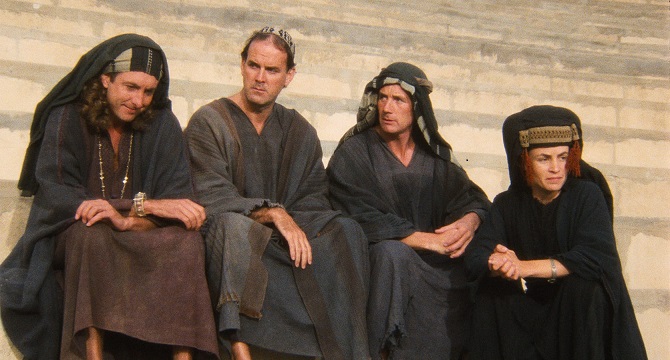 “Monty Python’s Life of Brian” includes, from left, Eric Idle, John Cleese, Michael Palin and Carol Cleveland in the new edition from the Criterion Collection.
Monty Python’s Life of Brian (1979, Criterion Collection, 2 Blu-rays, R, 94 min.). The main message of this Jesus Christ-adjacent film is “think for yourself.” Of course, as always with the six Pythons, there is lots of humor included, some of it wacky and some that may rub some viewers the wrong way. Having loved their 45-episode TV show, “Monty Python’s Flying Circus,” and their previous film, “Monty Python and the Holy Grail,” I am not among the offended.
The film tells the life story of poor Brian Cohen, born on the original Christmas day in the stable next door to Jesus Christ. Brian will end up his 33 years on Earth being mistaken for a messiah. That started when he was mistaken as God’s son as an infant, but the three Wise Men (Pythons John Cleese, Graham Chapman and Michael Palin) soon grabbed back their gifts of gold, frankincense and myrrh.
Here, it should be noted that the six Pythons play multiple roles each, including a total of 41 people, among them three women. A summary of some of what goes on shows how funny the film is.
The film jumps to 33 A.D., when Brian (Chapman), his mother the Virgin Mandy (Terry Jones, who also directed the film) and a friend start arguing with others in the hard-to-hear back of the crowd at Christ’s Sermon on the Mount. They then take off to attend a stoning, stopping to buy rocks and bags of gravel from a vendor. Despite being forbidden to attend, many women wear false beards so they too can throw stones. The accused is to be punished for just saying the word “Jehovah.” Cleese is hysterical as the official in charge of the stoning.
The film soon dives into the political climate of the time, especially the Peoples Front of Judea, led by Reg (Cleese) and including Stan (Eric Idle), who wants to be a woman known as Loretta. In order to join the group, Brian is assigned to write “Romans go home” on the temple walls. Caught by two Roman guards, they force Brian to correct the grammar in his graffiti and then write the slogan correctly 100 times.
The PFJ’s next plan is to enter Pontius Pilate’s (Palin) home through the sewer and kidnap the prefect’s wife. Once inside, though, they meet the splinter group, the Campaign for Free Galilee, and starting fighting. Brian, the only one left conscious, is arrested, but is rescued by a space ship piloted by two aliens, which then crashes, forcing him to escape through a window and pretend to be one of the street preachers.
Suddenly, Brian has dozens of unwanted followers who believe him to be a messiah, with one follower declaring everyone should take off a sandal, as Brian lost one while running from them. They follow him into the desert and then to his home, massing in the street below his windows.
Some of the absurdity occurs because Pilate always substitutes “w” for “r” when speaking and his pal is Biggus Dickus (Chapman).
The bits that some have felt are sacrilegious are mainly two. The first is Palin as an ex-leper, who is complaining because Jesus healed him, thus hurting his begging business. The second is the final crucifixion scene, with those on the crosses breaking into song, singing “Always Look at the Bright Side of Life.”
The film itself comes with a 1997 audio commentary by the five surviving members of Monty Python. Chapman died of cancer in 1989.
The second disc contains two fine documentaries. “The Story of Brian” (2007, 59:51), aka “The Secret Life of Brian,” discusses the making of the film in Tunesia, with ex-Beatle George Harrison the main financial backer after EMI dropped out of its agreement. The five remaining Pythons are interviewed, as is Harrison. It also discusses the protests when the film was released in the United States and efforts by Britain’s Festival of Light to ban the film.
The second documentary is “The Pythons” (1979, 49:54), filmed in Tunesia during the making of the film. It also looks at the TV show and other subsequent individual projects, including “The Rutles,” “Ripping Tales,” “Fawlty Towers” and “Jabberwocky.” It ends with each Python talking about the other members.
Additional disc two extras include a short Super 8 film by Palin made when they were in Barbados working on the script (1:08); a reading of the draft screenplay on July 15, 1977 in London, prior to final changes, but accompanied by Jones’ storyboards (110 min.); five deleted scenes (with optional commentary by Jones, Terry Gilliam and Idle), including a discussion of sheep by three herders (4:28), Pilate’s wife (1:51), an earlier scene of Nazi-like Otto (Idle) and his suicide squad, including a song (4:21), the sign that is the sign (1:10) and a souvenir salesman (32 secs.); four radio ads, involving three mothers and a dentist (3 min.); and a stills gallery, set to the wonderful title song (1:50). That amazing title song tells Brian’s life story in brief detail, but with a vocal and music as if it were a James Bond film theme. There also is a 10-page booklet with an essay by Bilge Ebiri, a writer for New York magazine. Grade: film 5 stars; extras 4 stars
Rating guide: 5 stars = classic; 4 stars = excellent; 3 stars = good; 2 stars = fair; dog = skip it
Purchase link for some titles: https://moviezyng.com?bg_ref=ApLKdWV51k
The Gay Divorcee (1934, Warner Archive Collection, Blu-ray, NR, 105 min.). After supporting roles in “Flying Down to Rio” set their movie careers soaring, Fred Astaire and Ginger Rogers starred for the first time in this comedy about marriage, divorce and mistaken identities. The film set the style and tone for the eight Astaire and Rogers pairings that followed. The film received five Academy Award nominations, including Best Picture, Art Direction (Van Nest Polglase, Carroll Clark), Sound Recording (Carl Dreher) and Music Score (Max Steiner), while winning the first Oscar for Best Original Song (“The Continental” by Con Conrad and Herb Magidson).
The film features 11 songs, with the highlights being Cole Porter’s “Night and Day,” sung by Astaire and elegantly danced by he and Rogers; and “The Continental,” made up of six parts and taking 17 minutes of screen time as it goes from a crowded dance floor, to just Astaire and Rogers, then back to a crowded production number with more than 16 dancers in pairs and even using revolving doors to finally Astaire and Rogers dancing on steps as they rejoin the other dancers. The 1932 Broadway play by Dwight Taylor actually used more Porter songs, but the film only has the one.
Astaire plays American performer Guy Holden, who has to dance for his supper in a Parisian restaurant, as neither he nor his English lawyer pal Egbert “Pinky” Fitzgerald (Edward Everett Horton of “Arsenic and Old Lace,” “Top Hat”) have their wallets with them. They then take a boat to England and after disembarking, Holden meets the lovely Mimi Glossop (Rogers), who is stuck in two unfortunate situations: Holden sees part of her dress is caught in a suitcase; we later learn she is unhappily married to an estranged geologist (William Austin as Cyril Glossop) who prefers the company of rocks to her.
Holden accidentally rips her dress fabric while trying to free her and offers his coat to cover up. She promises to return it, but never gives her name. Holden has become completely infatuated with her, so he attempts to track her down for two weeks, finally reconnecting when he accidentally bumps into her car. She takes off, but he follows for several miles, and even sets up a fake roadblock.
Coincidentally – and there always are such in a comedy like this – Mimi asks Fitzgerald to be her solicitor in her divorce suit. He says the easiest way would be to hire a man to be her co-respondent and they agree to do so, with the overnight meeting to take place at a seaside hotel.
Naturally, Holden is with Fitzgerald at the hotel and soon recognizes Mimi, whom he tries to woo with “Night and Day.” Due to a mix-up, Mimi comes to believe Holden is supposed to be the co-respondent, instead of Rodolfo Tonetti (Erik Rhodes of “Top Hat”), who is married himself but has served as a co-respondent in dozens of divorce cases.
Meanwhile, Mimi’s Aunt Hortense (Alice Brady of “My Man Godfrey”), who has had a brief romantic past with Fitzgerald, sets her sights on him again.
The music and dance numbers are generally terrific – even classic – but one is slightly odd. It is “Let’s K-nock K-nees,” during which the dancers do just that. Astaire and Rogers do a closing dance in a hotel room, including on furniture.
Extras include the shorts “Art Trouble,” a comedy with Harry Gribbon (1934, 20:50), and “Masks and Memories,” with Lilliam Roth and songs, set in New Orleans (32:14); the Merrie Melodies cartoons “I Like Mountain Music” (7:01) and “Shake Your Powder Puff” (6:20); a radio promotional trailer (13:45); the Screen Guild Players’ abridged radio version of March 6, 1944 with Frank Sinatra, Horton and Gloria DeHaven (27:58); and the ability to go directly to any of the musical numbers. Note that Jimmy Stewart makes his first-ever onscreen appearance in an uncredited supporting role in “Art Trouble.” Grade: film 4.5 stars; extras 3 stars
Birth of the Blues (1941, Universal, Blu-ray, NR, 85 min.). This is another delightful music-based film, this time starring Bing Crosby and Mary Martin.
As a 12-year-old in the 1890s, Jeff Lambert (Ronnie Crosby as the boy, Bing Crosby as the adult; unrelated) hangs out in New Orleans' Basin Street, playing hot swing on his clarinet instead of the classics his father prefers. Dad is opposed to “darkie music.” Young Jeff is inspired by an African-American group there and, some years later, sets out to form an all-white jazz band of his own.
That band includes cornetist Memphis (Brian Donlevy of “Beau Geste,” “Two Years Before the Mast”), after he is bailed from jail, as well as singer Betty Lou Cobb (Martin of “Peter Pan”) and trombonist Jack Teagarden (of the Original Dixieland Jazz Band). The film’s plot loosely follows the origins and breakthrough success of the New Orleans-based Original Dixieland Jazz Band.
The film was Academy Award-nominated for Best Music Score, even though many of the 11 songs, including “St. Louis Blues” by W.C. Handy and “Tiger Rage” by the Original Dixieland Jazz Band, were not new.
Elsewhere in the plot, Jeff has taken pity on Betty Lou, after seeing her about to be overcharged by a horse-cab driver, and ends up allowing her and her Aunt Phoebe (7-year-old Carolyn Lee) to live in his same building. Naturally, Betty Lou falls for the seemingly-oblivious Jeff, with the complication that Memphis falls for her.
Jeff has a good friend in Louey (Eddie "Rochester" Anderson of “Cabin in the Sky,” “Gone with the Wind,” TV’s “The Jack Benny Program”), who originally was his father’s servant.
Highlights include Crosby singing “By the Light of the Silvery Moon” and Crosby and Martin dueting on “Wait Till the Sun Shines, Nellie.” The film’s ending highlights through photographs some of the early pioneers of Dixieland big band music. Grade: film 3.5 stars
The Great Smokey Roadblock, aka “The Last of the Cowboys” (1977, MGM, Blu-ray, PG, 104 min.). The film’s original title, “The Last of the Cowboys,” is still on the title page, and while it may seem to indicate the film is a Western, which it is not, it at least does not give away a major plot point as does the newer title.
Written and directed by John Leone (writer of “Tough Enough”), the film is the tale of an aging 18-wheel trucker who, after his truck is repossessed because he missed a couple of payments while hospitalized with terminal cancer, decides he and his truck have one more good run in them and he escapes the hospital and steals the truck, intent of picking up a load to deliver across country. Along the way, he and his passengers become celebrities on TV and radio.
The trucker, who is only 60 by the way, is Elegant John Howard, played by Henry Fonda (“On Golden Pond,” “12 Angry Men,” “The Grapes of Wrath”). His first passenger is hitchhiker Beebo Crozier (Robert Englund of the “Nightmare on Elm Street” films), who wants a ride to Florida, but John is more interested in using the few dollars Beebo has for truck fuel.
They get a shipment of refrigerators momentarily, but the shipper changes his mind after hearing on the radio that the truck has been stolen. The truck by the way, is named Eleanor, after Eleanor Roosevelt, whom John met one time.
His next passengers, who are headed for South Carolina, are Penelope Pearson (Eileen Brennan of “Private Benjamin,” “Clue,” “Jeepers Creepers”) and the six ladies of her Wyoming whorehouse, whom the police have just arrested and ordered to cease business. Among the ladies are Ginny (Susan Sarandon of “Thelma & Louise,” “The Client”), Lulu (Melanie Mayron of TV’s “Jane the Virgin”) and Glinda (Leigh French of “The Usual Suspects,” “Halloween II”).
John has a longtime enemy in trucker Charlie La Pere (Gary Sandy of TV’s “WKRP in Cincinnati”), who eventually tells the police where they might stop John’s ride.
The film gets very boisterous towards the end, including a try-too-hard comedy segment with Austin Pendleton (“My Cousin Vinny,” “What’s Up, Doc?”) as loud Guido, who believes in aliens, and John Byner (TV’s “Soap,” “The Pink Panther”) as fired DJ Bobby Apples. The film’s blockade-involved ending seems a bit nonsensical too.
The sole extra is a behind-the-scenes gallery (1:40). Grade: film 2.5 stars; extra 0.25 stars
“Monty Python’s Life of Brian” includes, from left, Eric Idle, John Cleese, Michael Palin and Carol Cleveland in the new edition from the Criterion Collection.
About this blog:

My music review column, Playback, first ran in February 1972 in The Herald newspapers of Paddock Publications in Arlington Heights, IL. It moved to The Camden Herald in 1977 and to The Courier Gazette in 1978, where it was joined by my home video reviews in 1993. The columns ran on VillageSoup for awhile, but now have this new home. I worked at the Courier Gazette for 29 years, half that time as Sports Editor. Recently, I was a selectman in Owls Head for nine years.