
Inside the 17-hour final day of Maine’s ranked-choice voting count
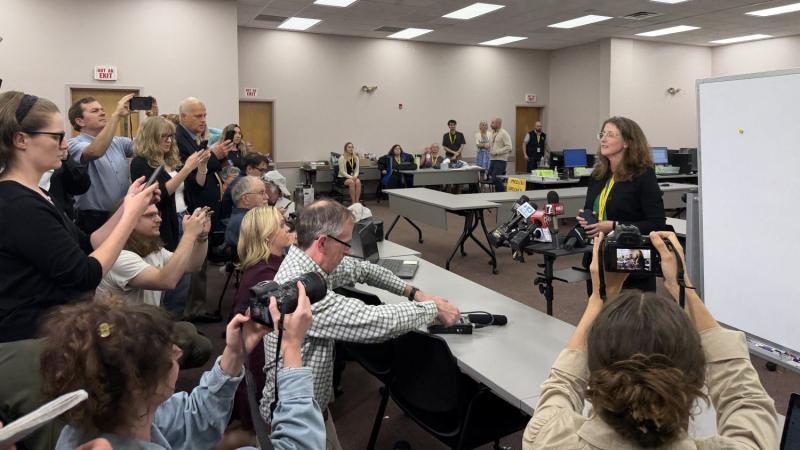 A small army of campaign staff, political party operatives, journalists and other members of the public descended on the Augusta conference room to observe the ranked-choice tabulation process. Photo by Matt Junker.
A small army of campaign staff, political party operatives, journalists and other members of the public descended on the Augusta conference room to observe the ranked-choice tabulation process. Photo by Matt Junker.
A small army of campaign staff, political party operatives, journalists and other members of the public descended on the Augusta conference room to observe the ranked-choice tabulation process. Photo by Matt Junker.
A printer jam. Spreadsheet issues. Mixed-up memory sticks. A two-hour warning that turned into a four-and-a-half hour wait. A livestream broadcast that stopped working just as it appeared election results were about to be announced.
Depending on who you ask, these were either minor hiccups that come with administering a complex and public ranked-choice voting tabulation and proof of the transparency of the process, or they were signs that the ranked-choice approach Maine has been using in some elections for nearly a decade is inescapably cumbersome and unworkable.
That process was on display last week as officials from the Maine secretary of state’s office sorted through primary election results from each of the state’s 487 municipalities and verified them in order to run a ranked-choice tabulation in races where no candidate immediately received more than 50 percent of the vote.
It’s a slow and methodical slog that starts with law enforcement going around the state to collect voting materials, then transporting them securely to the state capital for tabulation. Cities and towns that use digital ballot scanners send encrypted memory sticks with their results, and towns that still hand count their paper ballots send those to be scanned in Augusta.
The process that follows is deliberative by design, with secretary of state staff amassing the results from each municipality and then undergoing a series of checks to make sure what they have in their centralized system matches the numbers from the cities and towns. The staff conducts this work in a conference room that is open to the public and broadcast live on YouTube.
A small army of campaign staff, political party operatives, journalists and other members of the public descended on the Augusta conference room to observe the ranked-choice tabulation. That part of the process began with secretary of state staff opening and inputting results on Friday, June 12, three days after the June 9 primary election, and stretched until the early hours of Friday, June 19.
That timeline, finishing 10 days after Election Day, was similar to that of previous statewide counts in Maine since the onset of ranked-choice voting in 2018. But this particular tabulation was like none Maine had seen before.
One difference was the number of major primary races that needed a ranked-choice runoff this year. For the first time, Maine saw three different statewide or congressional races go to ranked-choice tabulation. The previous record was two races in 2018.
In ranked-choice races, Maine voters are able to rank each candidate by order of preference rather than selecting just one candidate on their ballot. If a candidate gets more than 50 percent of the vote in the first round, then a ranked-choice tabulation isn’t needed.
But if no one immediately eclipses that 50 percent threshold — as with this year’s packed Republican and Democrat primaries for governor, and the Democratic race for Maine’s 2nd Congressional District — ranked-choice rounds kick into gear. In the second round, the candidate with the fewest votes is eliminated and their votes are reallocated to those voters’ second choice. That process continues until someone passes the 50 percent mark.
With three major races needing the additional tabulation in this primary along with two smaller races for seats in the Maine Legislature, representing more than 15 campaigns, the conference room in Augusta became a home away from home for a diverse group of operatives and observers. And while the first few days of the count were mostly uneventful, if not mundane, the process took on a more unpredictable tenor later in the week.
Just as secretary of state officials seemed confident that the end was near, a host of unexpected delays kept pushing back a conclusion that had previously seemed imminent. At one point, officials thought they might be wrapping up at some point on Wednesday, June 17. But they discovered issues with several of the municipal memory sticks, from places such as Bath, Biddeford and Bowdoinham.
In some cases the issue was that local officials had sent the wrong drive or none at all; in others it was that the data wasn’t uploading properly. Officials also identified and had to resolve a paperwork discrepancy in South Berwick’s results. This meant law enforcement had to return to several cities and towns, some a couple of hours away from Augusta, to retrieve other materials.
That combination of issues pushed the tabulation to Thursday, with the secretary of state staff seemingly nearing the finish line. But what looked like it might be a short day of wrapping up instead dragged into a roughly 17-hour marathon, with the winners not announced until after 1:30 a.m. on Friday morning.
During the wait, an interesting dynamic took hold among the observers in the room: frustration mixed with bemusement as campaign staff and journalists embraced the shifting and unclear timelines with a combination of laughter, shrugs and the occasional curse word.
Republican campaign and party staff broke out a deck of cards and started playing Go Fish, later sharing cards with a group of Democratic staff. A few other Democrats started assembling a Lego set. Several reporters, including from The Maine Monitor, huddled around a computer to watch the World Cup. There was even a nonpartisan pizza party, and an impromptu happy birthday sung for a TV reporter during a live shot.
It wasn’t all fun and games. Shortly after midnight, as officials appeared to be setting the stage to announce results, campaign staff in the room reported that people watching remotely couldn’t hear the livestream. Then the broadcast ceased entirely.
That was part of a hectic back-and-forth as secretary of state staff fielded reports of the livestream working, then not working, and then finally working again.
“We need every win we can get at this point,” said Kate McBrien, the chief deputy and chief of staff for the secretary of state’s office, when the livestream came back online.
The surprises didn’t stop there. At around 1:30 a.m., with anticipation high and late-night delirium rampant among the onlookers, election officials started to print the first results of the tabulation in the Republican primary for governor. But then the printer jammed, which was met with a chorus of incredulous laughter and mumbled expletives in the crowd.
Workers scrambled to set up a second printer, and fairly quickly got back on track after yet another unexpected delay.
Just after 1:40 a.m., they began announcing the results.
‘You just hit one snag’
McBrien, who was overseeing the tabulation process in place of Secretary of State Shenna Bellows because Bellows was among the Democratic candidates for governor, explained some of the delays in an interview this week with The Maine Monitor.
She said one of the issues they encountered last Thursday was that results from several towns initially showed up improperly in the tabulation spreadsheet and had to be re-uploaded from the memory sticks.
Another issue involved a punctuation discrepancy. One of the candidates in the Democratic primary for Maine’s 2nd Congressional District had a period after their middle initial in most, but not all, columns of the spreadsheet, and that caused the system to read each variant as a separate candidate. Staff had to correct the discrepancy in order to run the tabulation.
“That’s always the challenge with this process, is that you know parts of it will be going really well and really smoothly and everything’s lining up. And then you just hit one snag, one little piece where we have to stop and pause everything and investigate to really figure out why numbers may not be matching up, or do we have exactly the right information in front of us,” McBrien said. “And that’s really what slows it down. And the unfortunate part is you just don’t know when that will come up. It’s completely random based on whatever happened in that town, whatever happened with getting the information to us.”
McBrien said the interruption with the livestream was likely a result of staff rearranging equipment so that viewers could better see the unveiling of results, and acknowledged the inopportune timing of the paper jam.
“It was a bit crushing, and we were all exhausted at that point too,” she said about the printer issue, “but we fixed it as quickly as we could.”
McBrien originally said she was aiming to have the tabulation wrapped up before the Juneteenth holiday on June 19. And though she and her team only missed that initial target by a couple of hours, McBrien had provided several more hopeful predictions throughout the process that ended up not coming true.
“The other thing I did learn, and I think we all learned, is that I’m not the best one at estimating how long any process will take us,” she said.
‘Maine voters deserve better than this’
As the tabulation was still unfolding last Thursday, one of the frontrunners arrived onsite to share his thoughts on the process. Bobby Charles, who went on to win the Republican primary for governor, criticized the delay.
“No voter should have to wait nine days to find out who won the primary election,” Charles said around 4:30 p.m. as reporters crowded around him in the hallway outside of the conference room. “This is not a close presidential race. This is a state primary. It should take a few hours, not two weeks.”
In the decade since Maine voters approved the use of ranked-choice voting via a statewide referendum, the debate surrounding the new system has largely split along party lines, with Democrats generally supporting and trying to expand the approach while Republicans have advocated for its repeal.
Though those party perspectives don’t seem to have changed much over the past decade, this primary election did see a new level of ranked-choice voting strategy from campaigns — and not just from Democrats.
A few of the Republican candidates forged ranked-choice alliances or expressly recommended that supporters not rank one of the other candidates, while still making clear that they weren’t fans of the ranked-choice process itself.
Charles, however, eschewed that approach. He asked his supporters to rank him in all rounds across their ballot, and made clear on Thursday that he would try to repeal ranked-choice voting as governor.
“The system just does not work. It has been delayed, unwieldy. It is impractical,” Charles said. “It is unconstitutional, and I say that as a former law clerk on the U.S. Court of Appeals, especially by reference to our country’s and our state’s founding. It just needs to end.”
The question of constitutionality is a complicated one. The Maine Supreme Judicial Court has repeatedly advised that the use of ranked-choice voting in general elections for governor and the Maine Legislature would conflict with Maine’s Constitution. That’s why ranked-choice is only used in primaries for these state offices, but in both the primary and general elections for federal offices that are not subject to the same state constitutional provisions.
It’s a different story with the U.S. Constitution. A U.S. District Court judge in Maine ruled in 2018 that Maine’s use of ranked-choice voting does not violate the U.S. Constitution.
After years of court rulings and back-and-forth in the state Legislature, it is clear that Maine Republicans remain opposed to the process.
“We’ve seen it time and time again, ranked-choice voting delays results, and Maine voters deserve better than this,” Maine GOP Executive Director Jason Savage said.
Watershed moment
Maine and Alaska are the only two states that use ranked-choice voting in statewide elections, and the District of Columbia just completed its first ranked-choice election.
Until this primary, Maine had only ever seen two statewide or congressional races go to ranked-choice voting at the same time. Those were the 2018 Democratic primaries for governor and the 2nd Congressional District. The three major ranked-choice races in this primary set a new record, and followed a surge in ranked-choice strategy among campaigns.
While a couple of Republican campaigns waded into the world of ranked-choice endorsements, it was a trio of Democrats running for governor that provided the most prominent example of this approach. Bellows, the current secretary of state, eventual primary winner Hannah Pingree, and former Maine Senate President Troy Jackson announced a cross-endorsement during the race and encouraged supporters to rank the other two candidates and their second and third choices.
“This was a watershed moment for ranked-choice in Maine,” said Deb Otis, the director of policy and research at FairVote, a nonpartisan election reform organization that supports ranked-choice voting. “We saw record turnout in this election, and campaigns were embracing ranked-choice voting like never before.”
This primary election also made ranked-choice voting history for the state during the tabulation, where for the first time, two different candidates who weren’t leading after the first round came back to win. While Charles was ahead throughout the Republican gubernatorial tabulation, Pingree overtook Democratic frontrunner Dr. Nirav Shah in later rounds and State Auditor Matt Dunlap came back to beat state Sen. Joe Baldacci in the 2nd Congressional District.
In eight years, Maine had only ever had one come-from-behind ranked-choice winner: Jared Golden, when he leapfrogged then-Rep. Bruce Poliquin in the 2018 general election for the 2nd Congressional District. And then in the course of one night, that number swelled to three.
“Maine is seeing more of the come-from-behind winners than the national average,” Otis said. “I think that’s a function of competitive elections with candidates running who under the previous system might have been pushed out of the race, might have not been given a fair shot to compete.”
Otis said that the larger fields of candidates with five or more people running can increase the chances of a come-from-behind victory.
And McBrien said that the volume of prominent ranked-choice races, along with the high number of candidates in those races, created more work during the tabulation process.
“It just meant that there’s a lot more data to pull in, a lot more data to proof and make sure everything’s there, and hasn’t gotten confused at any point in the process,” McBrien said. “It does just take more time to ensure that all of that is accurate.”
After the 10-day wait for the tabulation results, even some ranked-choice voting supporters agreed that the process should move faster.
Otis credited Maine for the transparency that comes with broadcasting the tabulation process live, but said she sees potential avenues to make it more efficient. She highlighted the number of towns that still hand count their ballots as a primary factor in the delay.
McBrien commended the work done by election staff during the tabulation, and said that her office would be reviewing how the process went and would continue looking for ways to make it more efficient without sacrificing security.
Asked about whether the delays and issues encountered during the recent tabulation could erode public trust in the system, McBrien said she hoped that wouldn’t be the case.
“I’m hoping that people are really understanding that with any project, anything that you’re doing in front of a crowd and everyone’s watching you, little things are gonna come up,” McBrien said. “And those delays or little interferences always seem bigger when there’s an audience, because everyone notices them. But this is part of our ongoing project refinement and project review — is that we’ll look at any of those things and make sure we can improve them for the future.”
This story was originally published by The Maine Monitor, a nonprofit civic news organization. To get regular coverage from The Monitor, sign up for a free Monitor newsletter here.