Prediction market users wager millions on Maine elections
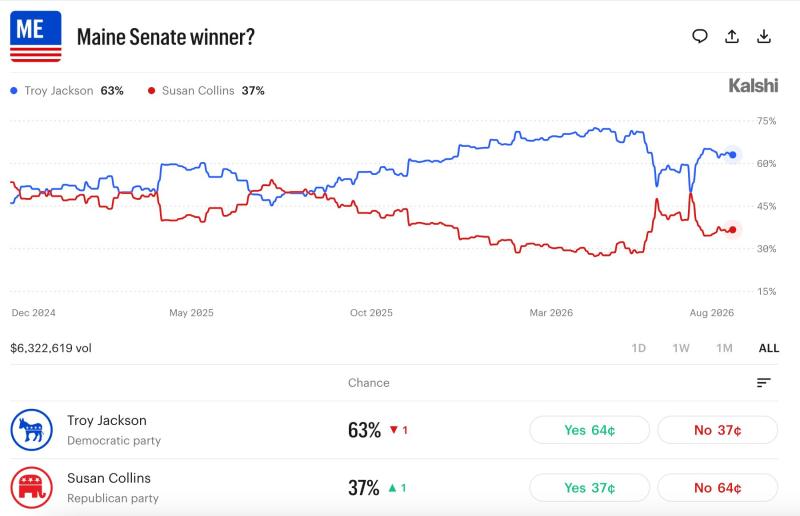 A screenshot of a Kalshi wager on which party will win the U.S. Senate race in Maine.
A screenshot of a Kalshi wager on which party will win the U.S. Senate race in Maine.
A screenshot of a Kalshi wager on which party will win the U.S. Senate race in Maine.On June 10, Tom Hill was at his office in Sydney, Australia, when his phone pinged with a notification: the U.S. Senate Democratic primary race in Maine had been called. Before trading closed, Hill quickly bought stakes on the financial trading platform Polymarket, wagering that Gov. Janet Mills would lose.
Hill, who has never been to Maine and “didn’t even know that there were Maine elections going on that day,” made $17 in just a few minutes based on the outcome of an election on the other side of the world.
He isn’t the only one making money on Maine’s elections this year. More than $42 million has been wagered on markets affiliated with Maine’s elections on Polymarket and Kalshi, another financial trading platform. There is more money at stake in Maine’s Senate contest on Kalshi than in that of any other state besides Texas. And it isn’t just race outcomes that are the subject of political trades — so are questions about endorsements, debates, voter turnout, margin of victory and more.
The popularity of prediction markets, where users make trades on yes or no questions about real-world events, has skyrocketed in the past few months, with Polymarket and Kalshi breaking $50 billion in combined trading volume in July, the highest monthly volume recorded for the platforms.
As prediction markets grow in popularity, they are facing scrutiny across the country. More than half of U.S. states ban or restrict betting on elections, according to a recent analysis by the Pew Research Center, and some have taken legal action against the platforms for violating these laws or are looking to pass new legislation that regulates them specifically.
In Maine, the agency that regulates gambling told The Maine Monitor it was aware of these regulatory discussions and would monitor them to see if there is an impact on the state’s laws. Federal regulators, for their part, have largely upheld the platforms’ argument that prediction markets are different from gambling because users are trading financial products called “event contracts,” not betting against odds set by the platform, and thus should not be subject to state gambling rules.
As these debates play out, people are turning to the platforms as a way of understanding public sentiment. When it comes to Maine’s politics, much of the spending has focused on whether Graham Platner would drop out of the Senate race — an amount that totaled nearly $13 million on the day he announced he was suspending his campaign. The question of who would replace him was also popular even before he withdrew from the race, garnering more than $6 million. Academics who study the platforms say these forecasts can sometimes be useful — so long as they are understood in the right context.
A legal gray area
The United States has a long history of wagering on elections. Political betting markets were a multi-million-dollar industry in the late nineteenth and early twentieth century, according to Koleman Strumpf, an economics professor at Wake Forest University. The daily odds for presidential elections were published regularly by major newspapers, and, until the widespread adoption of scientifically designed polls, were widely considered to be predictive of election outcomes. While the bets were technically illegal, they were popular enough to be stationed in the lobby of the New York Stock Exchange. The practice waned over the course of the twentieth century, but picked up again with the invention of the internet.
Event contracts of the kind traded on Kalshi and Polymarket are regulated by the Commodity Futures Trading Commission, an independent federal agency created in 1974. While election betting has long operated in a legal gray area, with no explicit federal regulation and a patchwork of laws across states, the CFTC has historically banned event contracts concerning election outcomes. This precedent was overturned, however, when Kalshi successfully sued the agency ahead of the 2024 presidential elections.
Under the Trump administration, the CFTC has become more friendly to event contracts, dropping its appeal of Kalshi’s lawsuit as well as an investigation into Polymarket. The changes cleared the way for Polymarket to operate a separate app for U.S. traders. Users in the U.S. currently have fewer options on what they can bet on, but Polymarket intends to roll out more markets in the coming months. And U.S. users appear to already be accessing those restricted markets anyway: a recent Rutgers University study found that as much as 30 percent of the international platform’s trading volume comes from U.S. users who are logging on via virtual private networks, which Polymarket says it bans.
Federal regulators at the CFTC have argued in court that platforms such as Kalshi and Polymarket should be exempt from state gambling bans, suing six states for challenging its “exclusive jurisdiction” over prediction markets. The states have pushed back. Last week, 44 states, including Maine, signed a letter stating that the CFTC is overreaching its authority by seeking to exclusively regulate sports trading on prediction markets.
A recent Politico poll found that although Americans show widespread interest in betting on sports and pop culture, a large group said they drew the line at betting on politics. While many voters The Monitor spoke to during the primary elections were not aware of prediction markets, those who were voiced concern over how such markets might change the incentives around voting and elections.
“It adds something that shouldn’t be there,” said Dan Kinley, a Standish voter and member of the Green Party. “You’re not voting for the politics, you’re voting to make money.”
Democrat Ali Waks Adams of Brunswick articulated a similar critique: “I think monetizing our election system is very un-American.”
More accurate than polls?
Prediction markets have been touted as a way to forecast election outcomes, and are sometimes pitched as a replacement for polls, especially following several years of high-stakes misfires from survey centers. A Washington Post analysis in June found that election markets were accurate about as often as the percentage odds in the days and weeks leading up to the elections would indicate.
Alex Tabarrok, an economics professor at George Mason University, said the platforms can beat out polls for accuracy because “when you are making a bet — you’re putting your money where your mouth is — you are much more likely to be careful.”
But willingness to spend doesn’t always equate to political knowledge. Strumpf, of Wake Forest University, attributed prediction markets’ accuracy in part to “rational, deep-pocketed people” who see an opportunity to profit off the money flowing in from casual users who are on the sites for entertainment. These traders sometimes go to extensive lengths to research the markets on which they are betting, using tactics similar to pollsters — building complex models, conducting private surveys and getting tips from experts.
Benjamin Freeman, a former trader who was hired earlier this year by Kalshi, traveled to cities ahead of local elections, speaking to voters at polling sites, gas stations, and even a hardware store, to inform the wagers he placed. One trader from France made more than $80 million on the 2024 U.S. presidential election by conducting a neighborhood poll in key battleground states. It’s these carefully researched traders who often end up affecting the odds the most — and walking away with the most money.
Prediction markets differ from polls in fundamental ways. Traders are not a representative sample of Maine voters; most of those trading on Maine’s elections are probably not from the state at all. The likelihoods produced by polls come from the spread of candidate support professed by participants, whereas the odds produced by prediction markets are an aggregate of traders’ predictions for what will happen.
Prediction markets quantify changing sentiment in real time, said Strumpf, where polls can offer only occasional updates. Observing the markets, he said, is a free way to “find out what a bunch of smart people think about what’s going on in the world.”
Others, however, point to this live nature as a reason to doubt the accuracy of the markets in predicting election outcomes. Traders can change their wagers as the outcome becomes apparent, creating the illusion that the markets were right all along.
This seemed to be the case in the Democratic primary for Maine governor in June. Traders who checked Kalshi between election day and the time the results of the ranked-choice runoff were calculated ten days later would have found Hannah Pingree — who ended up winning the nomination — sitting comfortably with over 50 percent odds. But she only took the lead as the polls closed on June 9 and the initial results were reported. Until that point, candidates Nirav Shah and Troy Jackson had held the highest odds of winning.
When prediction markets do end up accurately predicting an outcome, researchers point to the participation of strategic traders like Freeman who have conducted in-depth research before placing wagers. Some also point to insider trading, which is formally prohibited on these sites but difficult to enforce. Instances of the practice, such as campaign staffers trading based on unreleased polling data, along with manipulations of real-life events to fulfill certain markets, have been regularly documented in the past two years.
Gaeten Dugas, a Kalshi trader who lives in Minnesota and has wagered on Maine’s Senate race, said he has made more from prediction markets than from his day job as a business analyst for the past two years.
“As a trader, I’m not necessarily buying who I think will win right now,” he said. “What I’m trying to do is identify opportunities.”
Dugas called the current moment — with a lack of regulation, minimal competition with other sites and unprecedented popularity — a “golden age” for prediction markets. But as casual traders catch on to their disadvantage against deep-pocketed researchers and users with insider information, he wondered if the sites’ popularity would falter. He said he was supportive of Kalshi increasing their internal regulation, particularly through sharper punishments for insider trading.
In May, Kalshi announced a monitoring program that would cross check users’ names with the names of campaign staffers in Federal Election Commission data and prevent them from trading on related markets. Kalshi spokesperson Jacki McGavick told National Public Radio that the company blocked more than 100 insider trading moves in the first quarter of 2026. Still, FEC data does not fully capture campaign volunteers, subcontractors, staffers for state and city elections, or friends and family members who may also be privy to insider information.
As questions about their reliability play out, prediction market odds are increasingly publicized by news outlets and candidates as a part of election coverage. In an article about Platner’s postponement of campaign events before the news about the sexual assault allegation was published, the Bangor Daily News noted that the odds on Kalshi of Platner dropping out had risen to nine percent from two percent the morning prior. Maine’s Republican nominee for governor, Bobby Charles, regularly references prediction markets and celebrated his 90 percent odds on Kalshi in a social media post just days before the primary.
Still, his campaign acknowledged the market’s limitations.
“Prediction markets are one data point among many,” Vincent Harris, senior strategist for Charles’ campaign, wrote to The Monitor. “The people of Maine will decide this election, not a market.”
This story was originally published by The Maine Monitor, a nonprofit civic news organization. To get regular coverage from The Monitor, sign up for a free Monitor newsletter here.