
Hospital spending on contract staff almost back to a pre-pandemic normal
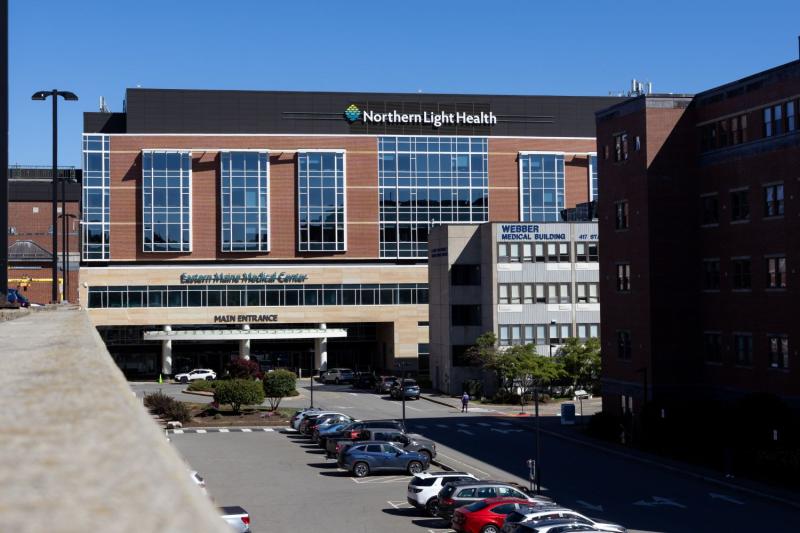 Northern Light Health employed more than 400 traveling staff — mostly registered nurses — across its system at the height of the pandemic. Four years later, the system has reduced that number to about 100 contract staff. Photo by John Forbes.
Northern Light Health employed more than 400 traveling staff — mostly registered nurses — across its system at the height of the pandemic. Four years later, the system has reduced that number to about 100 contract staff. Photo by John Forbes.
Northern Light Health employed more than 400 traveling staff — mostly registered nurses — across its system at the height of the pandemic. Four years later, the system has reduced that number to about 100 contract staff. Photo by John Forbes.
Maine hospitals have worked for years to reduce the number of costly, temporary staff — particularly travel nurses — they have hired since the pandemic. Now hospital spending on contract staff is almost back to normal.
The Maine Hospital Association, which represents 32 of the state’s 34 hospitals, said that spending from its member hospitals has dropped each year since peaking in 2022. The yearly reductions became so consistent that the spending became less of a worry, said Jeffrey Austin, president of the hospital association.
“I really stopped asking [about contract staff] just because the answers were getting pretty uniform,” Austin said. “Things are going down; we’re getting back to normal.”
In 2019, Maine hospitals belonging to the association spent nearly $99 million, which was typical at the time, to hire 535 contract staff, according to the association. Three years later, when COVID-19 cases were at their highest levels, that number quadrupled to $560 million for nearly 2,200 temporary staff.
This year, the hospitals are projected to spend around $214 million on contract staffing, still above an inflation-adjusted “normal” of around $145 million, Austin said.
Hospitals hire contract staff through third-party agencies, and, before the pandemic, would use them as short-term substitutes for full-time employees who take extended leave or as an emergency to fill labor shortages in response to increased demand.
But pandemic-driven demand for labor amid a worsening nursing shortage caused pay rates for contract staff, especially travel nurses, to explode to three or four times the typical pay rate for a full-time nurse.
The difference in pay even prompted some Maine nurses to quit their full-time jobs to become contract staff.
Maine hospitals have continued to use some contract staff post-pandemic, while simultaneously working to hire full-time staff to replace them. To do so, the state’s largest hospital systems have set their sights on new graduates, especially those from nursing schools in the state.
The yearly reductions in spending on contract staff show hospital efforts are working. The hospital association reported in March that the number of contract staff employed by its member hospitals continued to fall last year — from 1,905 contract staff in 2025 to 991 this year.
Nurse union groups contested the reasons behind the shortage of nurses. They said that open roles are staying vacant because nurses are reluctant to work in Maine hospitals that are short-staffed and have poor working conditions.
‘The system broke during COVID’
As Maine hospitals saw more patients infected with COVID amid the public health emergency, temporary nursing agencies exploited the high demand for registered nurses and other staff. They advertised to Maine nurses that they could become a travel nurse without the need to move by simply working in a nearby city, Austin said. Hospitals, with no other choices, hired them.
“The system kind of broke during COVID,” Austin said. “What was meant to be a surge protector or a temporary sub became normal staffing.”
MaineGeneral Health, based in Augusta, paid contract registered nurses about $65 per hour before the pandemic. Later, at the pandemic’s worst, the hospital saw those rates shoot up to $250 per hour, MaineGeneral Chief Nursing Officer Jennifer Riggs said.
The high pay rates convinced regular employees at MaineGeneral to sign on as contract staff, increasing the hospital’s need for contract labor, Riggs said.
“It was supply and demand,” she said in an email. “We did our best to retain staff, but it was understandable that a number of staff did not want to miss out on the earnings opportunity.”
Hospitals responded by investing heavily in their staff such as by increasing raises, incentives and overtime pay. The Maine Hospital Association estimated hospital labor expenses encompassed more than 70 percent of total operating costs in 2022, up from 62 percent three years earlier, before the pandemic.
Hospitals could not have afforded the contract staff without hundreds of millions of dollars in financial assistance from state and federal governments for their COVID response, Austin said.
Working tactics
Hospitals have focused on recruiting new graduates and retaining current employees to restore their ranks of full-time staff, hospital administrators said.
MaineGeneral’s programs with schools have helped the system hire graduating nurses directly, Riggs said. Last year it spent only $600,000 on temporary labor, far less than the nearly $28 million it spent on contract staff at the height of the pandemic and even less than it spent before COVID. But the bottleneck has been the capacity of nursing schools.
“We did better than most,” Riggs said. “[I]ncreasing the pipeline requires increasing capacity at nursing schools to meet the need, which takes time.”
MaineHealth, the state’s largest hospital system, has also focused on recruiting new graduates. It is expected to spend about $117 million on contract staff this year, which is still nearly double its pre-pandemic budget for temporary labor but far less than the height of its spending on contract labor — which topped $283 million — in 2022, according to spokesperson John Porter.
Jackie Morgan, vice president of talent acquisition and workforce development for MaineHealth, credited a residency program and recruitment efforts in helping reduce spending. The system’s nurse residency program reported an 85 percent retention rate in April over two years, slightly higher than the 82 percent Northeast average.
“Even though you’re new in the system, you feel like you have a family that you can talk to and get more information,” Morgan said.
Northern Light Health, the state’s second-largest hospital system, has focused on retention over recruitment, said Paul Bolin, executive vice president at Northern Light Health.
“It’s better to retain the staff that you have than recruit new people,” he said.
Northern Light Health employed more than 400 traveling staff — mostly registered nurses — across its system at the height of the pandemic, Bolin said. In 2023, Associate Vice President of Northern Light Eastern Medical Center Mikele Neal told the Maine Legislature’s labor and housing Committee that Northern Light Health’s $130 million deficit in 2022 was driven “in large part” by travel nurses.
Four years later, the system has reduced that number to about 100 contract staff.
The system’s nurse retention rate is currently over 80 percent, compared with about 75 percent in 2021, said Catharine MacLaren, Northern Light vice president of talent and workforce development.
National Nurses United, a national nursing union partnered with the Maine State Nursing Association, maintains that there is no shortage of nurses in the United States. Instead, the union said there is a shortage of hospitals willing to provide adequate working environments to properly retain nursing staff.
The union said that 1.15 million registered nurses in the U.S. are actively licensed but not working as nurses, according to May 2025 Bureau of Labor statistics and National Council of State Boards of Nursing data.
The organization cited a study of nurses in 10 states who recently left their jobs in health care. The study found that adequate staffing would most increase their likelihood of returning to the nursing field — more so than increased pay and additional career advancement opportunities.
In Maine, there are also significantly more registered nurses with active licenses than those who are working. State and federal data show that only 16,540 registered nurses out of more than 29,000 registered nurses with active licenses were working in Maine last fiscal year.
“The so-called ‘nursing shortage’ is frequently brought up by hospital management as a reason to hire more contract staff or as a reason for not staffing hospitals appropriately,” said Michelle Morris, National Nurses United spokesperson.
Maine Sen. Stacy Brenner, D-Cumberland, introduced “the Maine Quality Care Act” in 2023 to address hospital staffing issues that would have set mandatory nurse-to-patient ratios. The bill sparked heated debate and highlighted tensions between hospitals and nurses, who faced understaffing in hospitals that led to patient harm.
The Maine Hospital Association alongside MaineHealth, Northern Light Health and a variety of state medical associations opposed the bill, claiming it would worsen patient care and put hospitals under strenuous financial conditions to find staff or face steep fines.
The bill, L.D. 1639, passed the Maine Senate with a wide margin but effectively died when the House did not pick up the bill before the end of the session.
Still, open positions at hospitals are staying open.
Northern Light Health last year cut more than 300 roles, about 3 percent, of its workforce due to higher supplies and labor costs alongside a lack of reimbursement, spokeswoman Karen Sanborn told the Portland Press Herald.
About two-thirds of the cut positions were open roles that had not been filled.
And although hospitals have made significant progress reducing spending on contract staff, a financial analysis last year said Maine hospitals are still reeling from the pandemic — operating in old facilities while struggling to turn a profit and address debt.
At the same time, more work is needed to address short-staffing, said Erin Oberson, co-president of the Maine State Nurses Association, which is currently in contract negotiations with hospitals in the state.
“[Hospitals need to] give nurses a seat at the table,” she said.
This story was originally published by The Maine Monitor, a nonprofit civic news organization. To get regular coverage from The Monitor, sign up for a free Monitor newsletter here.