A Hawk on a Mailbox?
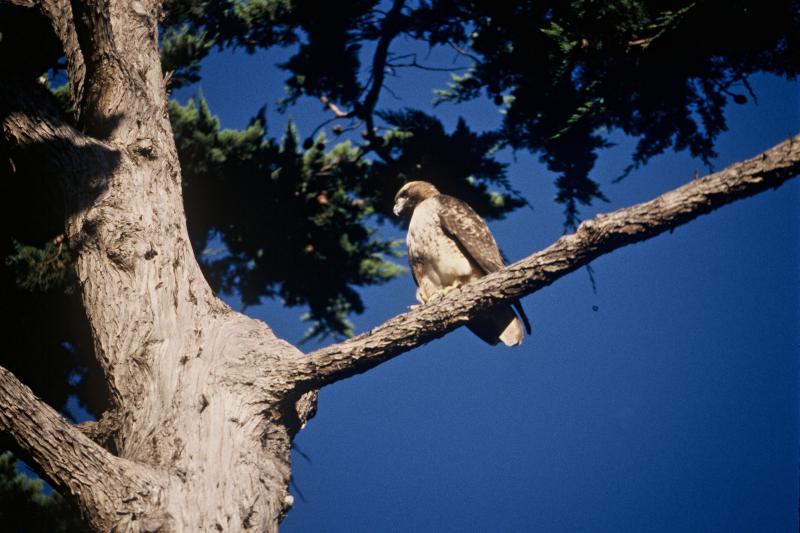 Hawks perch where they can best see the prey they are hunting. The authors recently saw a young red-tailed hawk, like the one here, perched on a mailbox at a farmhouse, perhaps hunting nearby house sparrows. Photo by Department of the Interior. U.S. Fish and Wildlife Service, courtesy of Wikicommons.
Hawks perch where they can best see the prey they are hunting. The authors recently saw a young red-tailed hawk, like the one here, perched on a mailbox at a farmhouse, perhaps hunting nearby house sparrows. Photo by Department of the Interior. U.S. Fish and Wildlife Service, courtesy of Wikicommons.
Hawks perch where they can best see the prey they are hunting. The authors recently saw a young red-tailed hawk, like the one here, perched on a mailbox at a farmhouse, perhaps hunting nearby house sparrows. Photo by Department of the Interior. U.S. Fish and Wildlife Service, courtesy of Wikicommons.
Countless times, we’ve driven past the big, white farmhouse next to the long, red milking barn in the center of our favorite local grassland. But a few days ago, we saw a peculiar sight: a red-tailed hawk perched on the mailbox on the roadside at the end of the driveway to the farmhouse.
A large hawk sitting on top of a four-foot high mailbox beside the road is kind of startling. Many hawks hunt by sitting in places that afford them a great, wide view of the place where their potential prey resides. When they spot the prey, they can drop quickly down to try to plunge their sharp talons in and catch it.
Red-tailed hawks are often seen perching in or near the tops of trees, sometimes 50 or 100 feet high. But in locations lacking high trees, they may use utility poles, sturdy bushes, or even fence posts just three or four feet high.
But a red-tailed hawk perched on a mailbox was something we hadn’t seen.
The image brought to mind a young red-tailed hawk that we remember years ago spending the better part of a week sitting on top of the poles holding up some bird feeders at the Cornell Lab of Ornithology when we were there. The bird was clearly still learning how to be an effective hunter, and the gray squirrels scampering around under the bird feeders must have been making him hungrier and hungrier. A bird of that size was just too slow to get down to the squirrels five feet below him before they scampered off. That was a situation in which the predator was too close to its prey, which enabled the squirrels to track his every move and avoid become dinner.
The red-tailed hawk on the mailbox near the grassland was also an immature bird. We wondered what it might have thought it could capture from that perch. Was it hoping for one of the house sparrows and starlings that from the flocks that were always in and around the yard of the farmhouse? Did it think that one of the barn cats we occasionally see skulking out into the field would make a nice meal? Neither scenario seems like a recipe for success, so we are guessing that the bird is still learning.
Until they left for South America, we were regularly seeing broad-winged hawks perched on the lower, thicker telecommunications cables strung between poles along roadsides. We don’t see red-tailed hawks using those for perches as often. Perhaps that’s because red-tailed hawks are about two-and-a-half times heavier than broad-winged hawks. Is the heavier weight why you also don’t see bald eagles and ospreys regularly sitting on such wires (at least in our experience)? Lending credence to that argument is that American kestrels—small falcons about the size of blue jays—are frequently seen using roadside telecommunications wires as a perch from which to hunt.
Some hawks, eagles, and falcons seem to develop favorite perches where they can see and be every day. There’s a tall spruce up behind Walgreen’s in Gardiner where we see bald eagles perched nearly every morning and evening from about December through February.
Birders, too, have perches from which we “hunt,” though we use binoculars and telescopes and only hope to see them, not capture them! One of our favorite perches from which to watch birds are the comfortable chairs on our front porch. What’s yours?
Jeffrey V. Wells, Ph.D., is a Fellow of the Cornell Lab of Ornithology and Vice President of Boreal Conservation for National Audubon. Dr. Wells is one of the nation's leading bird experts and conservation biologists. He is a coauthor of the seminal “Birds of Maine” book and author of the “Birder’s Conservation Handbook.” His grandfather, the late John Chase, was a columnist for the Boothbay Register for many years. Allison Childs Wells, formerly of the Cornell Lab of Ornithology, is a senior director at the Natural Resources Council of Maine, a nonprofit membership organization working statewide to protect the nature of Maine. Both are widely published natural history writers and are the authors of the popular books, “Maine’s Favorite Birds” (Down East Books) and “Birds of Aruba, Bonaire, and Curaçao: A Site and Field Guide,” (Cornell University Press).