UMaine’s Local Catch Network: Bolstering seafood businesses and coastal communities nationwide
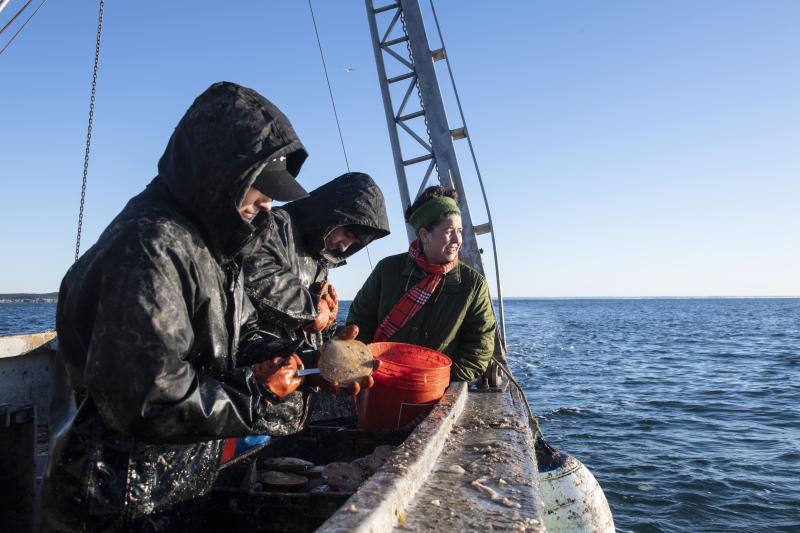 Peter Robinson (left), Willie Ramsdell (center) and Touge Brawn, owner of Downeast Dayboat, sail aboard a boat to collect scallops. (Photo courtesy Togue Brawn)
Peter Robinson (left), Willie Ramsdell (center) and Touge Brawn, owner of Downeast Dayboat, sail aboard a boat to collect scallops. (Photo courtesy Togue Brawn)
Peter Robinson (left), Willie Ramsdell (center) and Touge Brawn, owner of Downeast Dayboat, sail aboard a boat to collect scallops. (Photo courtesy Togue Brawn)ORONO, Maine — Dayboat scallops from inshore waters — known for their succulent texture and optimal balance of buttery and briny flavors — are unlike any other, according to Downeast Dayboat founder Togue Brawn.
Most scallops can take many days — if not weeks — to reach shore after they are harvested, but dayboat scallops are brought back within 24 hours to be sold, packaged, shipped or frozen.
Brawn launched Downeast Dayboat in 2011 to share the product she loves with customers nationwide. While the business showed promise, Brawn said her technical savvy didn’t match her passion. She searched for business consultants who could help her plan for long-term stability and growth but worried they would be too expensive or prioritize profit over her commitment to supporting Maine seafood.
Then she applied to join the Local Catch Network, an organization anchored at the University of Maine that offers free business and technical assistance, scientific research and networking opportunities for seafood businesses nationwide. The goal is to grow community-based seafood systems by supporting businesses committed to the well-being of their coastal communities and marine ecosystems.
“As someone who wants to promote local seafood, I can’t just hire a consultant that’s going to focus on profit,” Brawn said. “The original impetus for this business was to get fishermen more money, not to make money for myself. While I realize I can only advance my mission if I stay in business, which requires turning a profit, I don't ever want to lose sight of why I started this all.”
Since the Local Catch Network was co-founded in 2011 by Joshua Stoll, UMaine associate professor of marine policy, it has helped more than 70 community-based seafood businesses like Downeast Dayboat across New England, Florida, Alaska, California and Puerto Rico.
The U.S. Department of Agriculture announced that it has allocated funding to the Local Catch Network through a new grant from the Agricultural Marketing Services. This funding allows the organization to continue its services and support more seafood businesses. The network’s growth and capacity have also been fueled by $2 million in Congressionally Directed Spending secured in 2022 by U.S. Sen. Susan Collins, now chair of the Senate Appropriations Committee.
“These federal funding sources provide the foundational support for our organization to foster a vital and growing network of community-based seafood businesses,” Stoll said. “Together we are cultivating a shared vision of thriving food systems that contribute to the health, prosperity and sovereignty of the communities and ecosystems that make them possible, as well as connect consumers to the fishing communities that feed them.”
Brawn enrolled in the Local Catch Network’s Seafood Accelerator & Innovation Lab (SAIL) in 2025, specifically its one-year mentorship program. The mentorship pairs entrepreneurs with fishing business professionals who provide one-on-one guidance and long-term financial planning through biweekly, quarterly and annual reviews.
The SAIL program connected Brawn with Chris Kantowicz of Skipper Otto, a community supported fishery in British Columbia and strategic partner of the Local Catch Network. Kantowicz dedicated time to get to know Brawn’s operations and keeping her focused on financial planning.
By the end of the mentorship, Brawn decided the best way to advance her mission was to downsize her business to focus on what she does best: direct to consumer sales. She also decided to attend more events to promote her products, rather than focusing on wholesale growth.
“The SAIL mentor program allowed Chris to spend the time digging into my business, my company and me in order to ask the right questions and make the right recommendations,” Brawn said. "I would not have had the confidence to make this counterintuitive choice to downsize without Chris's candid, well-informed feedback."
Now in its third year, the SAIL mentorship program has helped 12 businesses build long-term resilience and explore opportunities for growth.
The Local Catch Network also offers SAIL Catalyst, a three-month group program that provides participants skills and knowledge to strengthen their businesses and expand their networks. Twice-a-week sessions in the program offer instruction on a broad range of business assets, such as capital access, contracts, partnerships, insurance, employment, taxation and marketing. Now in its fourth year, SAIL Catalyst has benefited 54 businesses and nearly 150 individuals, including owners and staff.
“Both of our SAIL programs help small-scale seafood companies boost their business acumen, not only to sustain or grow their operations in a highly competitive market but also to set themselves apart as stewards of sustainable and local food systems that support other small businesses,” said Jessica Gribbon Joyce, program manager of the Local Catch Network.
Linda Smith, owner of Wasco Fisheries LLC in Oregon, enrolled in SAIL Catalyst to improve her ability to scale, market and distribute seafood within her Native- and woman-owned salmon business while staying true to values rooted in the fishing traditions of the Columbia River. Fishing is an intrinsic part of Smith’s identity, family and culture, and Wasco Fisheries allows her to honor her traditions while supporting herself and her family.
SAIL Catalyst taught Smith how to strengthen marketing, streamline distribution and build wholesale relationships. The program also connected her with other seafood entrepreneurs whose shared experiences and challenges helped her think more broadly about growing her own business.
Using what she learned from the program, Smith hopes to expand the company’s smoked, canned and fresh salmon offerings; enhance her branding; create stronger customer relationships; and establish more consistent sales channels.
“This work is deeply personal to me. Fishing connects me to my ancestors, the river and my community. Programs like SAIL help small fishing businesses like mine stay strong, adapt to change and keep these traditions alive while creating real economic opportunities,” Smith said.
As Maine’s only public research university and a Carnegie R1 top-tier research institution, the University of Maine advances learning and discovery through excellence and innovation. Founded in 1865 in Orono, UMaine is the state’s land, sea and space grant university with a regional campus at the University of Maine at Machias. Our students come from all over the world and work with faculty conducting fieldwork around the globe — from the North Atlantic to the Antarctic. Located on Marsh Island in the homeland of the Penobscot Nation with UMaine Machias located in the homeland of the Passamaquoddy Nation, UMaine’s statewide mission is to foster an environment that creates tomorrow’s leaders. As the state’s flagship institution, UMaine offers nearly 200 degree programs through which students can earn bachelor’s, master’s, professional master’s and doctoral degrees as well as graduate certificates. For more information about UMaine and UMaine Machias, visit umaine.edu/about/quick-facts/ and machias.edu/about-umm/umm-facts/.