
Live Bob Marley & the Wailers, Herbie Mann
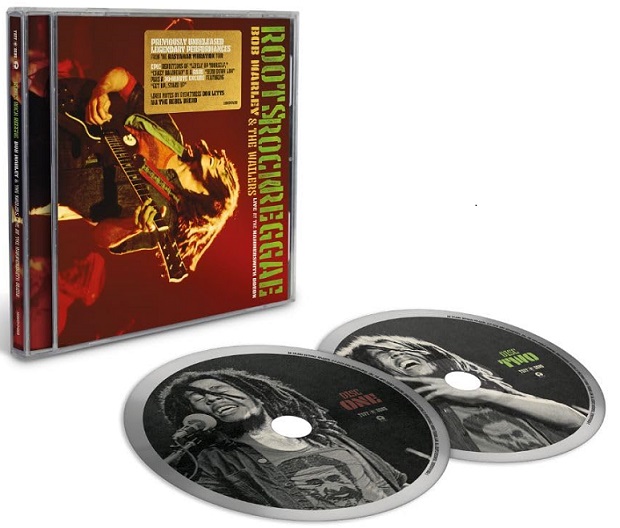 The new live Bob Marley release from Tuff Gong/Island/UMe.
Bob Marley & the Wailers: Roots Rock Reggae: Live at the Hammersmith Odeon (Tuff Gong/Island/UMe, 2 CDs, 1:27:21). This excellent, engaging previously unreleased live album from Bob Marley was recorded during the Wailers' four-night residency at London's prestigious Hammersmith Odeon in June 1976, during their Rastaman Vibration tour. Some might have thought that booking the venue was an audacious move, as there were five times the usual number of tickets for a Wailers show, but Marley had newfound stardom from the U.K. chart success of "No Woman, No Cry," one of 18 numbers here, and the shows sold out.
The residency proved to be a watershed moment for the group. Two years earlier, within months of Eric Clapton taking “I Shot the Sheriff” to No. 1 in the U.S., Marley had answered with “Natty Dread” (1974), his first major statement for a widening international audience. “Live!,” recorded at London’s Lyceum Theatre, delivered the breakthrough in late 1975, aided by the concert version of “No Woman, No Cry,” which reached the U.K. Top 20 in early 1976. This growing momentum carried Marley into his celebrated June run at London’s Hammersmith Odeon. In the weeks that followed, “Rastaman Vibration” became his first U.S. Top 10 album.
Except for an incomplete bootleg, recordings of the moment remained elusive, especially since “Live!” had been issued just six months earlier. Remote tapes from the Island archives, separated into different facilities over the years, were only recently connected into the full experience. The resulting live album curates the best performance of each song across four shows recorded June 16-18, 1976.
The album starts with the familiar “Trenchtown Rock,” which announces: “When you hear music, you feel no pain.” “Burnin’ and Lootin’” features a fine guitar solo. More familiar songs follow, including “Them Belly Full (But We Hungry),” “Rebel Music,” “I Shot the Sheriff,” “No Woman, No Cry” and the title track.
Of note are the rarity “Bend Down Low,” which was performed only on the final night of the Hammersmith run; an extended, new-to-the-set “Crazy Baldhead”; and an improvisatory, deep bass rendition of “Lively Up Yourself.”
The second disc contains the nearly 30-minute encore, punctuated by the chilling “War” and an intense, 12+-minute "Get Up, Stand Up,” in which Marley weaves a call to dance into a plea for unity.
New liner notes by Marley confidant and associate Don Letts bring an eyewitness account to the experience. The album has been packaged with six photographs from the shows, including a unique cover design that appears sideways, but folds out to full-body photo of Marley in his performance trance. Grade: A
The All-American Rejects: Move Along (Interscope/UMe, CD, 54:05). Originally released in 2005, “Move Along” was the sophomore studio album from The All-American Rejects. This reissue adds three rare tracks: “Kiss Yourself Goodbye,” “Bite Back” and “Eyelash Wishes,” the latter in a non-album version.
The album proper has the hits “Move Along,” standout “Dirty Little Secret” and “It Ends Tonight.” The album propelled the band to household-name status, achieving RIAA-certified 3X Platinum and filling arenas at the height of a three-year tour cycle that rarely took a break.
It was the first album to feature rhythm guitarist and backing vocalist Mike Kennerty and drummer Chris Gaylor, making it their first to be recorded as a full band. The two founding members were lead vocalist and bassist Tyson Ritter and lead guitarist and backing vocalist Nick Wheeler. Wheeler and Ritter serve as the band's songwriters, with Wheeler the primary composer and Ritter the primary lyricist.
The song "Dance Inside" was first written and performed during their then-current tour. After the end of their tour, Ritter and Wheeler spent the majority of 2004 writing more new material in their Destin, Florida homes. Album production took place in Burbank, California the following December, taking a majority of seven weeks to record.
“Dirty Little Secret” is bright and energetic, qualities that fit most of the album. In fact, there is a sameness to the overly punchy production, such as on “Change Your Mind.” Other highlights are the title track (especially its second half), “Stab My Back,” and the car songs, the drum-happy “Night Drive” and “11:11 p.m.,” with its nice guitar.
The band and producer Howard Benson (Kelly Clarkson, My Chemical Romance) expanded the sound on “Top of the World,” the softer “Straitjacket Feeling” and the original album closer “Can’t Take It,” which is opened by strings.
"Move Along" was released as the second single on Feb. 27, 2006, but did not chart until the following summer. In July, "Top of the World" was released as a promotional single in the United States, with a music video made up of videos and photographs taken by the band while on tour released to help promote it. A music video was released for “It Ends Tonight,” the album’s final single, in August. In September, the band went on a tour of the U.K.
In May 2026, the band released “Sandbox,” its first full-length record in 14 years. Grade: B+
Kent Blazy: The Tulsa Sessions (kentblazy.com, CD, 38:09). The new album by Nashville Songwriters Hall of Fame member Kent Blazy, the songwriter behind seven No. 1 hits, including Garth Brooks’ “If Tomorrow Never Comes” and “Ain’t Goin’ Down (’Til the Sun Comes Up),” is the result of unexpectedly happy feelings. Blazy originally entered The Church Studio to record demos. By the end of the day, 11 songs had turned into “The Tulsa Sessions,” a new album captured in the same room once used by Leon Russell, Bob Dylan, Eric Clapton and J.J. Cale.
The album features 10 newly-written Blazy songs, alongside a reworked “Once Upon a Rhyme,” written by Blazy and Cory Batten. Blazy recorded the project in a single session with engineer Gary Laney, allowing the room, the musicians and the songs to guide the finished record. The performances are exactly as they happened.
Highlights include “Any Given Day,” which reflects on the passage of time and aging; being friends before lovers in “Nobody Loves Me Like You Do”; “Everything you are,” which mentions Louis Armstrong; Johnny Cash and others mentioned in “Once Upon a Rhyme”; and “Footsteps of Dylan,” which starts with Woody Guthrie’s influence. There is humor in “Perfect for Me,” a description of a perfect woman except for her being upset over the toilet seat being left up. The closing “Life Is” is a celebration.
Among the other No. 1 songs in his catalogue is Chris Young’s “Gettin’ You Home (The Black Dress Song).” Grade: B+
James Taylor: Gorilla (1975, Warner Records/Rhino, Quadio Blu-ray, 39:40). This was Taylor’s sixth studio album, released in April 1975. It proved more successful than “Walking Man,” his previous release, and got this additional quadrophonic release. Both “Mexico” and “How Sweet it Is (To Be Loved by You)” were released as singles that rose to the top five on the Billboard charts. It was Taylor's second-to-last album of new material for Warner Bros. Records.
“Mexico” is a nice change of pace for Taylor, as he sings of a yearning to visit the neighboring country. It is highlighted by the vocal harmonies of Graham Nash and David Crosby, who also sing on “Lighthouse,” which adds Randy Newman on Hornorgan. His cover of Motown’s “How Sweet it Is (To Be Loved by You)” has his then-wife Carly Simon on vocal harmonies. Marvin Gaye sang the original version.
The title track shows off Taylor’s fun side, opening with a description of the beast and adding some late gorilla grunts and vocal scatting. There is a love song in “You Make It Easy” and "Sarah Maria" is about his daughter Sally (born Sarah Maria Taylor on Jan. 7, 1974). The traditional “Wandering,” arranged by Taylor, is the description of a lonely life. “Angry Blues” features harmony vocals by Lowell George (Little Feat) and Valerie Carter.
Taylor wrote eight of the 10 tracks. The Blu-ray also includes a DTS stereo version of the album. Grade: B
Herbie Mann: Hold On, I’m Comin’ (1973, Atlantic/Rhino, Quadio Blu-ray, 38:13). Mann was a jazz flute player and an early practitioner of world music. This live album, now re-released in quadrophonic and DTS stereo, is considered one of his best albums, with high quality solos and spirited ensembles. In addition to Mann, the players of his The Family of Mann include David Newman on tenor sax and flute, Sonny Sharrock on guitar, Pat Rebillot on piano, Andy Muson on bass and Reggie Ferguson on drums.
The first two tracks, Mann’s “(Gimme Some of That Good Old) Soul Beat Momma” and a terrific cover of “Never Can Say Goodbye,” were recorded July 8, 1972 at Yankee Stadium in New York. The other three, a solid “Respect Yourself,” Mann’s “Memphis Underground” and a cover of “Hold On, I’m Comin’,” were recorded June 25, 1972 at the Montreux Jazz Festival.
All of the Montreux playing is excellent, with “Memphis Underground” extending to 12:58, including twisty sections. It has the crowd clapping along by the ending. Grade: A
David Gates: First (1973, 37:31) and Never Let Her Go (1975, 27:09) (Elecktra/Rhino, Quadio Blu-ray). These are the first two solo albums by the frontman and co-lead singer of Bread (13 Billboard Hot 100 charted songs between 1970 and 1977, including “Make It with You,” “If,” “Baby I’m-a Want You”). Lyrics for both albums are included, as are the quadrophonic and DTS stereo versions of the music.
Highlights of “First” include the string-filled “Sail Around the World,” the upbeat rocker “Sunday Rider,” “Suite: Clouds, Rain” with its wind and rain sounds, piano and strings, and the louder guitar on the end times speculating “Do You Believe He’s Comin’.” A softer vocal and prominent guitar are found on “Sight and Sound” and there is a long instrumental introduction to the closing “Lorilee.”
Highlights of the better “Never Let Her Go” album include the title track, the rocker “Angel,” the softer tracks “Playin’ on My Guitar” with its nice vocal harmonies, and “Part Time Lover” with its strings, plus the ballad “Someday” and the nice strings on the closing “Strangers.”
Overall, Gates’ first two solo efforts are melodic, but lyrically not very memorable. Grades: First B-; Never Let Her Go B
James Gang: Miami (1974, Atco/Rhino, Quadio Blu-ray, 32:52). This was the seventh studio album for the band and the last with lead guitarist/songwriter Tommy Bolin, who then left to join Deep Purple. Bolin wrote all 10 tracks, with five being collaborations. Bolin’s guitar playing makes this album worth owning. The Blu-ray also includes a DTS stereo version of the album.
Bolin joined the band in 1973, replacing Domenic Troiano, who had replaced Joe Walsh. Bolin also recorded 1973’s “Bang” with the James Gang, again writing all the songs, all but one a collaboration.
The two standout tracks are “Cruisin’ Down the Highway” and “Sleepwalker,” which has lovely soaring guitar and a soft vocal. All but one lead vocal is by Roy Kenner. There is a fine instrumental section on the bluesy “Wildfire,” while “Miami Two-Step” is a non-rock instrumental. Also good is the combo of the soft “Praylude” with “Red Skies.” “Spanish Love” is folkish and the one song with Bolin on lead vocals. Grade: B+
The new live Bob Marley release from Tuff Gong/Island/UMe.
About this blog:

My music review column, Playback, first ran in February 1972 in The Herald newspapers of Paddock Publications in Arlington Heights, IL. It moved to The Camden Herald in 1977 and to The Courier Gazette in 1978, where it was joined by my home video reviews in 1993. The columns ran on VillageSoup for awhile, but now have this new home. I worked at the Courier Gazette for 29 years, half that time as Sports Editor. Recently, I was a selectman in Owls Head for nine years.