
MaineHealth sued over potential closure of labor and delivery unit
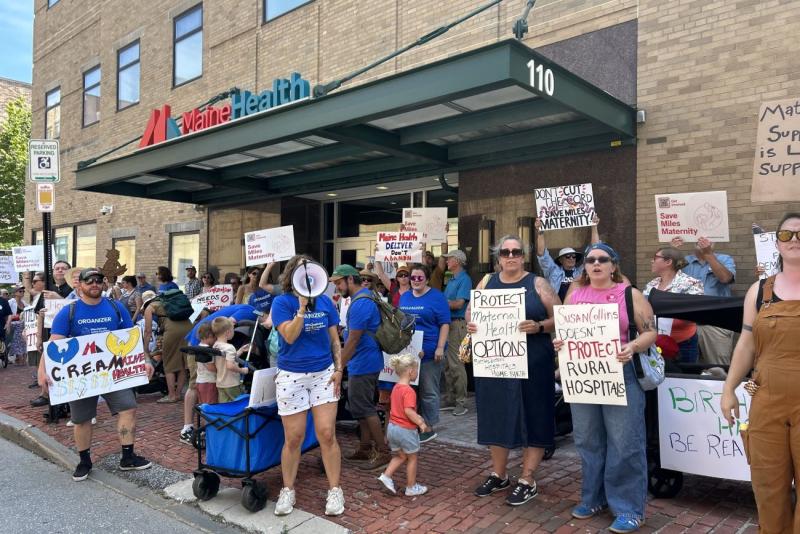 Members of Miles Delivers Action Coalition marched to MaineHealth in Portland to protest the potential closure on Saturday, August 1. Photo by Megan Blonigen.
Members of Miles Delivers Action Coalition marched to MaineHealth in Portland to protest the potential closure on Saturday, August 1. Photo by Megan Blonigen.
Members of Miles Delivers Action Coalition marched to MaineHealth in Portland to protest the potential closure on Saturday, August 1. Photo by Megan Blonigen.
A pregnant resident of Lincoln County, with the backing of a grassroots organizing group, filed a lawsuit against MaineHealth on Wednesday to prevent the closure of a labor and delivery unit at MaineHealth Lincoln Hospital in Damariscotta. MaineHealth’s board of trustees is expected to vote on the closure Thursday morning.
The lawsuit, which seeks an emergency injunction to prohibit the board from taking a final vote pending judicial review, follows months of community opposition and organizing by Miles Delivers Action Coalition, a group that formed as the hospital, also known as the Miles campus, began discussing the potential closure of the maternity unit earlier this year.
If the hospital were to close its birthing center, it would be the 12th in Maine to do so since 2015, and would leave Lincoln County, as well as neighboring Waldo and Sagadahoc counties, without any operating birthing units. The hospital has said it is considering the closure because of declining birth volumes and difficulty recruiting obstetrics staff.
The lawsuit is the first legal action taken against the closures. It follows a request from Gov. Janet Mills to delay the decision by two years, which she sent to the MaineHealth board of trustees on July 31. U.S. Rep. Chellie Pingree, whose district includes Lincoln County, also pushed for a delay, urging the hospital system to “explore every possible avenue to preserve access to labor and delivery services in Damariscotta.” All three gubernatorial candidates have also said they believe the hospital should keep the maternity unit open.
The lawsuit was filed on Wednesday morning by Corrinna Stum, who is scheduled to give birth at Lincoln Hospital in January 2027.
Separately, members of Miles Delivers Action Coalition met with MaineHealth chief executive officer Dr. Andrew Mueller and two members of the board of trustees on Wednesday morning, according to one of the coalition’s organizers, Margaret Reynolds. Reynolds told The Maine Monitor she felt the board was not considering alternative options and was planning to vote to close the maternity unit.
“We were hoping that we could, in the first couple meetings with them, maybe come to a solution, but we’re afraid in large part that they’re not listening,” Reynolds said.
Reynolds said the group is also planning to file a rulemaking petition in Augusta that would require hospitals to document how they notified affected patients, nearby hospitals and government agencies of any planned unit closures and report how they provided emergency plans for alternate health care options.
A new law that went into effect earlier this year requires hospitals to give 120 days notice before closing or changing maternity or newborn services, and Reynolds said this would aim to strengthen that process.
The lawsuit follows months of discussion and tension between Lincoln Hospital leadership and community members.
Miles Delivers Action Coalition has challenged MaineHealth’s official line of reasoning for the closure, arguing that publicly available data shows birth rates at the 25-bed critical access hospital are rising and maternity care services there are sought after.
The coalition also analyzed MaineHealth’s public tax returns, which it said shows the Miles campus is financially strong and “contradicts the case for closure.”
MaineHealth did not immediately respond to a request for comment on Wednesday, but representatives for the health system have said previously that they are taking community feedback into consideration.
“MaineHealth understands the deep concern about access to maternity care in rural communities expressed by members of the Lincoln County community,” a spokesperson for the system said in a statement earlier this week. “These challenges are real and extend well beyond Lincoln County. We value their perspective, as well as the broader public discussion about how Maine can strengthen maternal healthcare, address workforce shortages and support sustainable access across the state.”
The hospital has had trouble recruiting permanent staff since the departure of its only full-time obstetrics and gynecology provider in 2020, according to an assessment MaineHealth released last month.
The lack of available maternal care providers, the assessment said, has resulted in a “high call burden and an ongoing inability to recruit into these roles for more than five years” at the Miles campus.
The assessment also said that despite an uptick in births at Lincoln Hospital last year –– 131 in 2025, 20 more than in 2021 –– the hospital expects birth rates to decline due to the county’s aging population. Unlike other low-volume delivery hospitals within the MaineHealth system, the lack of a full-time OB-GYN at Lincoln Hospital “has proven to be a critical factor in our ability to recruit.”
The Damariscotta hospital would join a growing list of hospitals in rural areas across the country that are closing their labor and delivery units. More than 140 rural hospitals nationwide have stopped offering maternity services since 2020 and less than half of all rural hospitals in the country have maternity units, according to The Center for Healthcare Quality and Payment Reform. Maine has seen the second-highest rate of maternity unit closures since 2020 in the country.
Cuts to Medicaid further threaten access to maternity services in rural areas. President Donald Trump’s sweeping budget bill is expected to slash funding to Medicaid and the Children’s Health Insurance Program by $1 trillion over the next decade. While the legislation did not make specific changes to Medicaid’s coverage of pregnancy services, the cuts are expected to accelerate rural labor and delivery unit closures across the country.
Lincoln Hospital’s leadership has maintained ending maternity services is not a financial decision, but one tied to staffing shortages, difficulty recruiting doctors and nurses, and low birth rates. MaineHealth has said on its website that it is looking at ways to “redesign labor and delivery services” to meet the needs of local communities, “within the realities of our recruitment challenges and low birth rates at the hospital.”
Miles Delivers Action Coalition hosted a rally and march in Portland on Saturday to protest the potential closure, drawing political candidates, state legislators and dozens of people concerned about what the closure of yet another maternity unit could mean for rural families.
During the rally, Democratic gubernatorial candidate Hannah Pingree called for a one-year moratorium on labor and delivery unit closures and said one of her first actions as governor would be to convene a statewide maternity care summit.
Troy Jackson, the Democratic nominee for Senate, said Saturday that MaineHealth should listen to families, health professionals and local leaders.
“In rural Maine, we are struggling and we have to have places like Miles stay open so we can have people continue to live and grow up there,” he said.
If the hospital were to close its birthing center, the closest maternity units would be in Rockport and Brunswick, each at least a 40-minute drive from Damariscotta.
“That distance is not just an inconvenience, it really is a danger,” Jackson said.
Approximately 100 attendees traveled from across Maine to show their support at the protest, citing concerns around lack of access to maternal care and increased birthing complications in rural areas if the unit closes. Protestors marched from Portland City Hall to MaineHealth’s headquarters on Free Street while chanting “MaineHealth deliver, don’t abandon.”
Doula Rachel Katyl of Portland said closing Lincoln Hospital’s birthing unit would force expectant parents in the area to make a difficult decision: to travel a long distance to the nearest hospital or to give birth at home. Without a hospital nearby in case of complications, both options could turn dangerous.
Kali Bird Isis, a doula and therapist from Portland, knows that tragedy first hand.
“I’m here because 35 years ago I had a baby who died because I didn’t get to the hospital in time. I myself almost died because I hemorrhaged so badly,” she said.
The closure would also have broader, long-term consequences, according to Stacey Rees, a midwife at the Damariscotta hospital.
“In a moment when Maine needs more young families, closing labor and delivery sends the message that they are not welcome,” Rees said. “And I don’t think that’s the message we want to send.”
Former U.S. House candidate Jordan Wood, one of Saturday’s speakers, told The Monitor that MaineHealth needs to be more aggressive about pursuing solutions to its staffing problems, including offering housing options or increasing pay for nurses and OB-GYNs.
Maternity deserts are expanding in Maine as more rural hospitals close their birthing units, MaineHealth’s chief health improvement officer, Dr. Dora Anne Mills, wrote in a 2025 analysis for Maine Policy Review, a peer-reviewed journal out of the University of Maine.
“Studies show that maternal and infant health significantly worsen after a rural hospital maternity unit closes,” Mills wrote. Mainers living in rural areas are hit particularly hard by maternity unit closures.
Caryn Howell, an organizer with the Miles Delivers Action Coalition who had her first child at Lincoln Hospital, said Saturday she hoped the rally would convince MaineHealth’s board to reconsider.
“We hope some of those voices convince the MaineHealth Board to pause, to look at the data more completely, to listen to some of the doctors who have really good ideas, to listen to our coalition and really consider what it would mean for rural Maine.”
This story was originally published by The Maine Monitor, a nonprofit civic news organization. To get regular coverage from The Monitor, sign up for a free Monitor newsletter here.