They wanted to restore wild oyster reefs to the Maine coast. Could it be done?
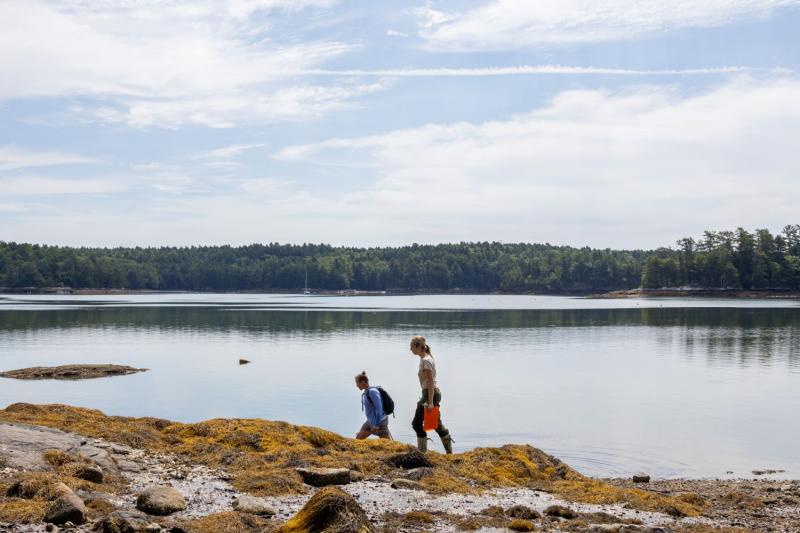 Cait Cleaver, an assistant professor at Colby College, and Olivia Winn, a student of Cleaver's interning with The Basin Oyster Project, walk along the coastline during low tide, surveying the ground for oysters. Photo by John Forbes.
Cait Cleaver, an assistant professor at Colby College, and Olivia Winn, a student of Cleaver's interning with The Basin Oyster Project, walk along the coastline during low tide, surveying the ground for oysters. Photo by John Forbes.
Cait Cleaver, an assistant professor at Colby College, and Olivia Winn, a student of Cleaver's interning with The Basin Oyster Project, walk along the coastline during low tide, surveying the ground for oysters. Photo by John Forbes.On a sticky August morning in Phippsburg, Cait Cleaver, an assistant professor of environmental studies at Colby College, crouched along a section of rocky shoreline that framed a circular expanse of deep green seawater. She gently brushed aside strands of thick seaweed to reveal a large oyster nestled between two boulders.
“We’ve got 50 percent algae cover, acorn barnacles, and 100 percent rock,” Cleaver reported to her summer intern. “And we’ve got one live 55-millimeter American oyster!”
Less than three inches long, the oyster didn’t look like much. But it was evidence of something Cleaver and her team had been looking for for years: a wild oyster that had successfully grown from free-floating larva and survived the winter.
For the past seven years, Cleaver has helped run The Basin Oyster Project, a collaboration initially started by The Nature Conservancy. The project’s long-term goal is to restore wild oysters up and down the Maine coast. More immediately, that means getting oysters to survive and spawn on their own in the Basin, a deep, protected saltwater inlet on the New Meadows River, creating a self-sustaining reef.
Wild oysters were once prevalent along the coast of Maine, but had largely disappeared by the early 1900s, victims of overharvesting by European settlers, pollution and rising sea levels, which brought in cold water and predators. The state has been trying to re-establish oyster populations in Maine since the late 1940s, but they have struggled to take hold at scale.
While oyster farming — where oysters are carefully bred in hatcheries and grown in regulated nursery tanks or ponds — has become popular in Maine, the wild oyster population remains small and fragile. Wild oysters often don’t survive Maine’s harsh winters, succumbing to storms or ice. If they do survive, they still have to battle a growing number of invasive species, algae blooms and pollutants. Today, wild oysters are limited to small populations in warm, shallow estuaries, such as the Piscataqua, Damariscotta and Sheepscot rivers. There are no known self-sustaining wild oyster reefs in Maine.
Restoring them to the wild at scale, said Jeremy Bell, a program director with TNC who helped with the initial planning stages of the project in 2017, is an uphill battle.
“We were not even sure that it could be done in Maine,” he said.
Testing the waters
The Basin, with its decreased tidal flow and historic wild oyster presence, seemed a natural fit for a potential oyster restoration project when TNC began looking in 2017. The group had already successfully collaborated with the town of Phippsburg on nearby land preservation efforts, and the town was open to the idea of a reef restoration project in the Basin.
With the location decided, a team of ten researchers, including staff from TNC, the Maine Department of Environmental Protection, the Casco Bay Estuary Partnership and the Town of Phippsburg Shellfish Committee, set about testing different methods for restoring reefs in Maine waters. The project’s initial budget was $7,000, money from a broader TNC grant gifted by an anonymous donor.
While oyster restoration has become popular along the Eastern and Gulf Coast, it had not been attempted north of the Piscataqua River, said Helena Tatgenhorst, TNC’s coastal program manager for Maine.
As the Gulf of Maine has warmed, it has become more viable for wild oysters to survive. The growing number of aquaculture operations in Maine has also fostered limited wild oyster growth, as farmed oysters spawn and their larvae attach themselves to rocks along the tide line nearby.
But these are scattered, small populations, not the kind of self-sustaining reefs that were once common along Maine’s shoreline — communities of thousands of bivalves formed when living oysters grow on top of older shells, fusing together into a dense stack. This was what the Basin project aimed to create.
A flourishing oyster reef offers numerous environmental benefits. Oysters improve water quality by filtering excess nitrogen and sediment, while the reef provides habitat for numerous other species, increasing biodiversity. Reefs also serve as natural coastal protection against storm surges, helping prevent erosion.
But wild oysters are sensitive: cold can kill them, as can too much sediment. They are also threatened by predators, including the invasive green crab, which eats young oysters in large quantities. Creating an oyster reef — one that is self-sustaining and regenerative — requires thousands of oysters to spawn, attach and survive harsh winters and predators.
Wild oysters spawn in late summer, when adult eggs release eggs and sperm into the ocean. Their larvae drift through the water, attempting to attach to a rock or pre-existing shell. In 2017, the Basin project team began colonizing oyster larvae in a University of New England laboratory, allowing them to grow until they were visible to the naked eye. They then placed the oyster spat in shell bags and put them on settlement tiles — textured tiles made of biodegradable material that are designed to provide a surface for oyster spat to attach and grow — in the intertidal zone.
This method had been successful at other shellfish restoration sites along the East Coast. But it did not adapt as easily to the Basin: in the first year, the ocean bottom was too muddy and soft to support the weight of the tiles and the bags. The following year, the team moved the shell bags and tiles to a different section, with a rockier bottom to support the weight.
For the next three years the team monitored the site, measuring water quality, oyster growth and survival, and habitat usage. They saw an increase in biodiversity, as lobsters, blue mussels, slipper snails and kelp began to colonize the area. While some of the lab-grown oysters survived, no wild spat or oysters bred on the tiles.
By the end of 2019, TNC was ready to hand the project off. The group asked Dorothy ‘Dot’ Kelly, a member of the Phippsburg Shellfish Committee who had been involved in the effort, if she would continue the work. Kelly approached her fellow committee members about taking it on.
“My other six commissioners were like: ‘Dot, if you want to get trained and have the license in your name, we’re behind you, but don’t cost us any money,” she recounted.’
TNC handed over their aquaculture license, along with $1,000, to the new team, which also included representatives from the Massachusetts-based Manomet Conservation Sciences, Colby College and the Maine Oyster Company.
‘Still hard to survive’
Over the next several years, the group experimented with different methods. One year, they tried putting oyster spat in floating oyster bags, mesh enclosures traditionally used for off-bottom aquaculture. Cleaver remembered that process being particularly grueling.
In 2023, with $20,00 in grant money from the Davis Conservation Foundation, the researchers began buying thousands of “uglies,” visually unappealing adult oysters supplied by local oyster farmers, to dump along the bottom of the Basin.
The team theorized that buying uglies would give wild oyster larvae a place to settle. It would also provide a source of revenue for local oyster farmers, who at times have been worried about shellfish restoration, said Cleaver. Fishermen worry about competition for water space, landowners are hesitant about aesthetic changes to their waterfront properties and oyster farmers are concerned about wild oysters becoming disease hosts. To be feasible in the long term, an oyster restoration project must address these concerns, she said.
Max Burtis, an oyster farmer who sells and donates oysters to the project, said there could be a partnership model in which oyster farmers maintain both aquaculture and restoration leases side by side, which he said has been done in other states.
“A model like that could work really well,” Burtis said. “And there’s no one that’s going to grow better oysters than the farmers themselves.”
Joe Jerome, a registered Maine guide and the primary captain for the project, has started giving free community tours to residents interested in learning more about the restoration in their waters.
“If they come out with me they can learn about the benefits to aquaculture and the working waterfront from a scientific point of view,” he said.
One barrier for this type of restoration is that Maine still does not have shellfish restoration leases. Tatgenhorst, with TNC, has been working with the National Sea Grant Law Center and the Maine Department of Marine Resources to begin the process of developing a lease for scalable shellfish restoration sites, but the process will take a while.
Jeff Nichols, a spokesperson for the department, said it “is generally supportive of restoration efforts and recognizes that many of these projects do not fit neatly within existing permitting frameworks.” The department “is not currently engaged in any legislation or rulemaking efforts to create such a pathway,” said Nichols, “but we continue to be engaged in discussions about these efforts.”
“Everything is set up for oyster consumption,” said Burtis. “But it’s a different ball game doing it for restoration.”
For the past three years, with funding from TNC as well as a $190,000 grant from the Maine Community Foundation, the Basin team has continued to buy and dump around 30,000 uglies at their two sites.
The project still grows oyster larvae outside of the water until they’re large enough to be released into the Basin to settle on the uglies. The hope is that the adult oysters will not only provide adequate habitat for the larvae, but that they will also reproduce and generate new oyster larvae in the Basin. The next phase, Jerome said, focuses on long-term surveying.
Initial surveys have shown that while the adult oysters are growing and reproducing, their larvae are struggling to attach, often getting sucked out of the Basin before they get a chance to settle, said Jessie Batchelder, a project researcher. Those that are able to attach often do not survive Maine’s cold, icy winters, said Cleaver.
The team is beginning to look elsewhere for potential restoration sites, focusing on places such as the Damariscotta River, where some wild oysters have begun to reappear, likely the result of the larvae of nearby farmed oysters settling in the river.
Nearly a decade after the project began, said Cleaver, it has yielded valuable insights into how to engage communities in restoration efforts. The collaboration with farmers, said Cleaver, can also be used as a strategy for future oyster restoration efforts. But getting oysters to spawn on their own and survive at scale remains elusive.
“The reality is that, at least in the inner tidal [zone], it’s still hard to survive as an oyster in Maine,” she said.
This story was originally published by The Maine Monitor, a nonprofit civic news organization. To get regular coverage from The Monitor, sign up for a free Monitor newsletter here.