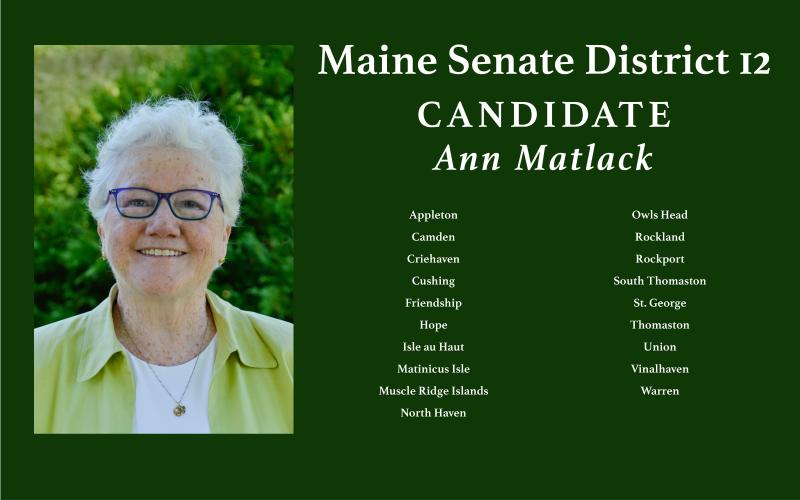
Maine Senate District 12 Candidate Ann Matlack
PenBayPilot.com has circulated questions to Midcoast Senate and House of Representative candidates seeking election to serve in the Maine Legislature. As candidates return their responses, we are posting them on the Pilot's front page, and then they will reside on the Elections 2026 Voter Resource Page, which also includes letters, opinions, information about local referendum questions, and more, so that voters can be prepared for the November 3 polls.
Ann Matlack, D-Tenants Harbor, is seeking to represent Maine Senate District 12. The district comprises Knox County, except Isle au Haut and Washington. She is running against Nicole Lynn Kalloch, R-Rockland.
1) Please provide a short biography of yourself and explain why you are running for office.
I have many years of experience representing my communities at the municipal, county and state levels. I served as a member of the MSAD 50 School Board, on the St. George Budget Committee and the Knox County Budget Committee, and eight years in the Maine State House. I have a master’s degree in public policy and management from the Muskie School and my experience on the Taxation and Appropriations and Financial Affairs committees has given me insights into the broad aspects of state budgets and taxation issues.
I’m running for the State Senate because I participated in the state Legislature when there was optimism around what we could achieve for the people of the State of Maine. Now that actions on the federal and international levels have replaced optimism with apprehension, I would like to continue the work of enhancing the lives of the people of Maine.
2) What issues are emerging from your conversations with the public as you go about your campaign, and what actions and/or solutions do you envision?
Rural healthcare is being starved of funding at the federal level and insurance companies and prescription benefits managers are siphoning billions of dollars out of our healthcare system with no increase in benefits to patients. Washington, D.C., is creating barriers and complicating the ability of individuals and families to receive the treatments they need at prices they can afford, and denigrating and obscuring the science of medicine so people no longer know whom to trust.
We need to support the nurses, doctors and local hospitals who provide the care we need and push back on private equity firms that only invest in medicine for the profits to be had.
I agree with Hannah Pingree and support working toward a Maine healthcare plan that provides, “coverage we can afford, care where and when we need it, and communities that keep us healthy.” We need to create a public option for healthcare.
3) Are there any specific issues affecting your particular district that you want to address in the Legislature?
The effects of climate change. Climate change is not just a local issue and should be dealt with on a broader geographic area. There are currently funds to assist municipalities with planning grants to assess issues facing individual communities and funds to address those issues. More communities should avail themselves of these funds and work not just within their towns but also with neighboring communities to address issues that affect them regionally. The huge storms two years ago devastated Maine, especially along the coast. Preparing for more storms like these in the future must be a priority for our towns, counties and state.
4) A recent AARP poll indicates affordability is the top issue for older voters, with concerns about Social Security, healthcare and rising utility costs shaping their decisions. What will you do to address their concerns?
As far as Social Security is concerned, this is an issue at the federal level. Social Security can be a more viable program if the income cap is removed and all earners pay into the system, as recommended by both Senator Collins and former Maine Senate President Jackson.
As mentioned above, we need a public option for healthcare. We need, “coverage we can afford, care where and when we need it, and communities that keep us healthy.”
Rising utility costs are being driven by the high cost of natural gas. We need to push back on federal curtailment of renewable energy production to offset the cost of natural gas.
5) Property owners throughout most of Maine are watching their property tax bills increase on an annual basis. What would you do, as a legislator, to help relieve the financial load on property-owning taxpayers?
For the past year, I have served as the House Chair of the Legislature’s Real Estate Property Tax Relief Task Force, which has been doing an in-depth review of how property taxes can be mitigated for Maine property owners and renters.
We have reviewed how property taxes are developed, the programs in place to assist homeowners and renters, how successful these programs are and how they can be improved, and whether there are other ways to look at property taxes that would ease the burden on seniors and those with modest incomes. The report will be completed in December and released to the Legislature in January. We will be introducing legislation in January to address property tax issues raised in the report.
6) How will you maintain our strong economic and cultural ties with Canada?
The state Legislature has had a Maine-Canadian Legislative Advisory Commission for many years and participates in the New England and Eastern Canada Legislative Commission. These commissions encourage increased cooperation between Maine and Canada, especially between the Legislature of Maine and the legislative bodies of Canada, “… to encourage economic, cultural and educational exchanges between Maine and the Canadian Provinces.”
Additionally, the Governor has traditionally maintained cordial and close contact with the Canadian Provincial Premiers. I will be supporting the Governor and the Commissions in their efforts maintain ties with Canada.
7) Do you think the state should prohibit state and local law enforcement from entering into formal contracts with federal immigration authorities? (For example: An Act to Enhance Public Safety in Maine by Defining the Relationship Between Local and Federal Law Enforcement. That bill did not make it out of committee last year, but the issue remains.)
Yes. Municipal, county and state employees, including members of law enforcement, should not use local resources to assist federal law enforcement. Local taxes should be used for local priorities and to build trust within the community. Unless a judicial warrant has been received, or employees are legally required to assist federal agencies, no state, county or local employees should be put in the position of having to participate in federal abuses of power against members of their own community.
8) What legislative committees would you like to serve on and why?
I have served on the Taxation Committee for the eight years I have been in the Maine State House. I have also been a member of the Appropriations and Financial Affairs Committee for three years. I would like to return to both committees because I have a thorough grounding in the work of both committees and can make informed recommendations and decisions as a member of both.
9) Maine’s environment is fundamental for its outdoor economy. Does the state do enough to protect its natural resources?
I believe Maine does a great deal to protect our natural resources and myriad natural resources nonprofits do excellent work in monitoring and alleviating problem issues. I do think we have one resource we should monitor more closely: our water.
Maine has always had an abundance of water. The State Geologist regularly reminded the Taxation Committee, when testifying about an effort to tax water extraction, that every spring, our aquifers would recharge with the spring melt of ice and snow. We can no longer afford to be lackadaisal about one of our greatest resources. We are currently in a severe drought and in a snow drought, meaning our aquifers are not replenishing from spring runoff as they historically have. We need to ensure Maine continues to have clean, potable water from now into the future.
10) What is your position on the siting and construction of data centers?
While Maine wants to encourage projects that make deep capital investments in our communities and generate long-term quality employment, I am skeptical that data centers will achieve either goal. Data centers can place extraordinary demands on electric infrastructure, the environment and on the communities where the centers are sited. Many states around the country are rethinking the benefits and costs of data centers and the impact on their communities.
In April, the Governor established the Maine Data Center Advisory Council, “with the goals of protecting ratepayers, maintaining electric grid reliability, minimizing environmental impacts, and enabling responsible and appropriately sited economic development.” The Commission will release its final report in January. We should wait on the Commission’s final report before encouraging data centers to be built in our communities.
11) How would you define "good state government?”
I have never really thought about what makes “good state government”. But I found a definition for good government that can be applied to state government.
“Key principles of good government include accountability, transparency, the rule of law, public ethics and democratic participation. These principles ensure that government actions are fair, responsible, and responsive to the needs of the people.
And to ensure good government, additional principles should include efficient administration, responsiveness, sound financial management, long-term orientation and openness to change and innovation.”
12) What are the qualities and attributes of Maine that you want to enhance and cultivate?
Maine is an amazing place to live.
We have natural resources: the ocean, the lakes, the mountains, the forests. We have been utilizing these resources for generations. Now, we are using them to create new products: plastic from trees, moisturizer from lobster shells, salad from the ocean, 3D printed houses.
We are known for craft beers, award-winning restaurants, amazing cheeses, organic grains, hometown diners, sustainable agriculture, homemade ice cream, bakeries, local pubs, fresh oysters, locally roasted coffee, wine bars, corn mazes.
We have fishermen, farmers, loggers and an astronaut; historic downtowns, rolling farmlands, working waterfronts, stunning mountains; novelists, poets, historians, painters, sculptors, singers, songwriters and musicians.
We have cities, moderately sized towns, small towns, islands, unincorporated territories and indigenous communities that continue the traditions of their ancestors and work toward tribal sovereignty.
We have amazing sunrises and beautiful sunsets, lovely summer days, glorious fall foliage, wonderful winters, when it snows, mud season and springs that just sorta arrive.
We have universities, colleges, community colleges and a maritime academy with a 96% placement rate after graduation.
Mainers build ships, boats, houses, libraries, monuments, trails through the woods, a bridge with an observation tower and communities.
These are the pieces of Maine that I celebrate and support. Mainers are rightly proud of what we have already accomplished and what we will accomplish in the future.
(Apologies if I left anyone out.)
13) Is there any other topic or issue you'd like to talk about here? Have at it!
Every municipality in our state is facing housing shortages, with young people just starting out being the most affected by the lack of affordable community housing, along with seniors who are looking to downsize but cannot find appropriate housing within their budgets.
The Legislature and the Governor have appropriated millions of dollars in an effort to reduce the shortages. But local municipalities and their residents must be open to changes in our zoning codes and to rethinking how and where we build these much needed homes. “Not in my backyard” and “no one helped me when I started out” are terrible reasons to reject innovative projects that will bring much needed houses and apartments to those who currently are priced out of the housing market.
We need to do more to help those looking to find good housing in our local communities.