Alliances and feuds shape final stretch of crowded primary races for Maine governor
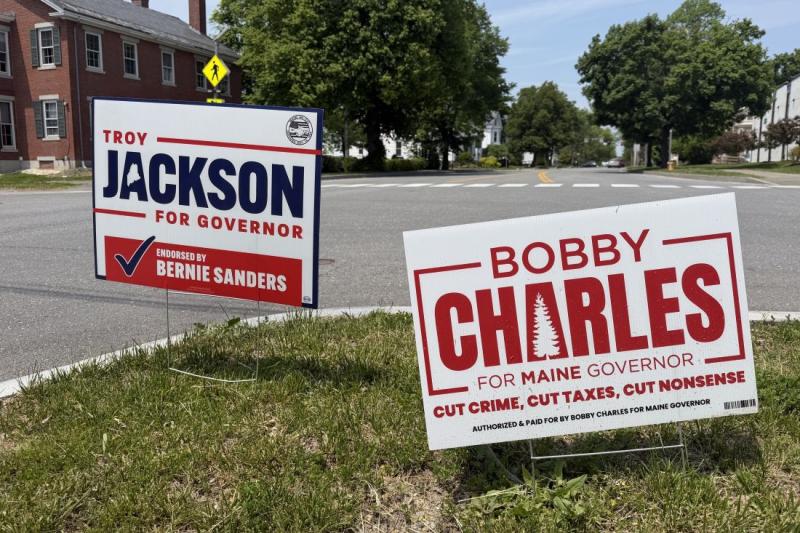 A complicated web of alliances and warnings among the crowded Republican and Democratic fields for governor could ultimately decide who gets each party’s nomination. Photo by Matt Junker.
A complicated web of alliances and warnings among the crowded Republican and Democratic fields for governor could ultimately decide who gets each party’s nomination. Photo by Matt Junker.
A complicated web of alliances and warnings among the crowded Republican and Democratic fields for governor could ultimately decide who gets each party’s nomination. Photo by Matt Junker.At the Maine State House last week, Republican candidate for governor David Jones showed voters how he would rank himself and other GOP contenders in a crowded primary election. But there was a notable absence from his ballot choices.
Using Maine’s ranked-choice voting system, Jones selected himself first — followed by five of the six other active candidates in the race to represent Republicans in the general election for Maine governor. Absent from that descending list of Jones’ preferred candidates was Bobby Charles, who has consistently led the GOP field in recent polling and repeatedly drawn criticism from Jones.
“Trust matters, and at this point, Robert Charles has not earned mine,” said Jones, a real estate businessman who has knocked former U.S. State Department official and lobbyist Charles for not attending all of the debates during the Republican primary.
Jones’ public unveiling of his ballot is just one example of how feuds and alliances have come to define the packed fields in both the Republican and Democratic primaries to help choose Maine’s next governor.
And with Maine’s use of ranked-choice voting, at least in these June 9 primaries, those fault lines could very well decide the final results as candidates from both parties look to cobble together enough support to reach more than 50 percent of the votes at some point in the ranked-choice tabulation.
Unlike the more typical “first past the post” voting system, in which voters select one candidate and whoever gets the most votes wins whether or not they get a majority, ranked-choice voting allows voters to rank all candidates by preference and can involve multiple rounds of tabulation until one candidate gets more than 50 percent of the votes.
The GOP primary has included some level of acrimony for several months, largely between frontrunner Charles and other candidates. For much of the campaign, discord hasn’t been as visible among the five Democratic candidates for governor, with many often highlighting their policy similarities, but as the June 9 primary approaches they too have seen prominent disagreements and partnerships take form.
Those alliances and feuds haven’t just factored into what candidates are saying about each other on the campaign trail. Candidates are also making direct appeals to voters based on those relationships, not only telling people to vote for them, but also giving them suggestions on how to rank the other candidates as well. If followed, those instructions could determine how both primary elections shake out.
The nominees from each party will face state Sen. Rick Bennett, who is running as an independent and recently qualified for the November ballot.
Republican rancor
Charles has not only routinely found his way to the forefront in GOP primary field polling, he has also frequently been at the center of intra-party squabbles. When Jones criticized him during a March debate in Bangor hosted by the conservative outlet The Maine Wire, Charles framed it as a reflection of his positioning in the race.
“So this is what it looks like to be the frontrunner,” Charles responded at the time.
It can be lonely at the top, and while Charles’ popularity with potential primary voters has looked solid, he hasn’t exactly been winning any popularity contests among his fellow candidates.
While some of the other GOP candidates have formed alliances and offered suggestions to supporters on which of their opponents to make their second choice in ranked-choice voting, Charles has implored supporters to rank only him “straight across” their ballot in every spot. Charles’ campaign and others have also traded barbs and accusations about a group of shadowy websites created during the primary to criticize GOP candidates Garrett Mason, Ben Midgley and Charles.
Amid the discord, Jones and fitness industry executive Midgley have formed an alliance and encouraged supporters to rank the other as their second choice. Businessman Robert Wessels, whose campaign hasn’t gained significant traction in the polls, has announced fellow Republican candidate and former health care technology entrepreneur Jonathan Bush as his second choice and became a grassroots regional chair for Bush in May while continuing his own campaign.
Bush, whose campaign sent out a press release on Thursday knocking Charles’ time spent as a lobbyist in Washington, D.C., has also picked up the endorsement of state Sen. James Libby, another candidate listed on the Republican primary ballot. Though voters will still see Libby’s name on that ballot, he ended his gubernatorial campaign earlier this spring after failing to qualify for public financing.
Libby’s exit left seven candidates still actively campaigning for the Republican nomination, and, combined with the use of ranked-choice voting, the complicated web of alliances, endorsements and warnings among this large field could ultimately decide the race.
Not all of the candidates have gotten tangled up in that web. Engineer and entrepreneur Owen McCarthy cited his pledge to run a positive campaign in a video posted Tuesday on Facebook.
“I just had a supporter say, ‘Owen, I decided today that I’m going to vote for you.’ And I asked them why,” McCarthy said. “And they said, ‘While all your competitors are burning each other’s houses down, you’re running on ideas for a better future.’”
Democrats turn up the heat
For much of the primary, the five Democratic candidates for governor were, at least publicly, projecting a uniformly friendly rapport across the board. The general sentiment among the candidates seemed to be: any of them would make a good governor.
But as former Maine Center for Disease Control and Prevention director Dr. Nirav Shah has led the polls, outside groups and money have increasingly entered the fray, and candidate alliances have formed, that veneer of collegiality has worn thin.
Not unlike with Charles in the Republican primary, Shah’s status as the apparent frontrunner has been met with opponents coming together around a concerted ranked-choice voting strategy. Secretary of State Shenna Bellows, former Speaker of the Maine House Hannah Pingree and former Maine Senate President Troy Jackson have formed an alliance and encouraged their supporters to rank the other two candidates as their second and third choices.
“I’m asking Mainers to rank me first, but also to support these two colleagues with their second and third place votes,” Bellows said in a press release announcing the cross-endorsement. “I helped pass ranked choice voting so you’d have this power. Use it.”
And as alliances have deepened, so too have disagreements.
Shah has seen an influx of support from out-of-state group 314 Action, which works to elect Democrats with science backgrounds. The at least $650,000 that group is spending independently from any of the campaigns in Maine hasn’t just been to support Shah — it has also included swipes at his opponents, including an ad from the outside group that portrayed Jackson as opposing abortion based on past positions and statements, despite his more recent evolution on the issue.
“They’re flooding the airways and putting hundreds of thousands of dollars lying to people about my record on abortion, when I spent the past decade fighting to protect abortion rights,” Jackson said at a Thursday press conference. “And unlike Dr. Shah, I have the votes to back it up.”
A different out-of-state group that supports progressive candidates around the country, the Working Families Party, has committed a nearly $200,000 independent expenditure to support Bellows, Jackson and Pingree over Shah and renewable energy entrepreneur Angus King III.
The group released an ad that criticized Shah on several fronts, including for his time leading the Illinois Department of Public Health and his handling of a deadly Legionnaire’s Disease outbreak before coming to Maine.
Shah authored an op-ed in the Portland Press Herald on Thursday pushing back against the ad and its claims, and saying that he “will not let dark money attack ads define this race.” He similarly accused the dark money ads of injecting lies into the primary race.
King released a statement Friday about the late flurry of attack ads, saying that Maine voters deserve better.
“Some folks have decided their best argument is against someone else rather than for something better,” King said. “I’m not going to join them.”
Shah has also taken the notable step of actively courting second-choice voters in an ad, a nod to the likelihood that this race won’t be settled in just one round. And those subsequent rankings could ultimately decide who represents the Democratic Party in November’s general election for governor.
Ranked-choice voting at the forefront
Maine’s unique deployment of ranked-choice voting looks guaranteed to play an important role in both of these primaries — perhaps in a more substantial way than ever before.
In the eight years that Maine has used ranked-choice voting in statewide and federal elections, almost every candidate who led after the first round went on to win the election.
According to FairVote, a nonpartisan elections reform organization that supports ranked-choice voting, there has only been one instance in Maine’s ranked-choice voting history where the candidate leading after the first round went on to lose in subsequent rounds. That’s out of 24 total races that have featured three or more candidates since 2018.
That lone come-from-behind win was in the 2018 general election for Maine’s 2nd Congressional District, when Democrat Jared Golden leapfrogged past then Republican Rep. Bruce Poliquin to win the seat.
Not only could that rare scenario happen again in this year, it appears possible in both party primaries for governor given the crowded fields and complicated slate of feuds and alliances.
FairVote and SurveyUSA released a ranked-choice poll late last week in partnership with the Bangor Daily News that had Shah leading after the first round in the Democratic primary but saw Pingree catapult to the front of the pack in later rounds. The same poll showed Bobby Charles maintaining his lead throughout the GOP primary rounds.
FairVote Director of Policy and Research Deb Otis said she has seen candidates and organizations engaging with the ranked-choice process more than ever.
“It’s been really interesting to see all of the different campaigns and all of the different organizations that have embraced this to some degree,” Otis said.
Otis pointed to the level of ranked-choice voting strategizing from Maine Republicans, which is particularly notable given Republican opposition to the state’s adoption of the approach.
But even as Republican candidates such as Jones have embraced the ranking process in this election, they haven’t exactly started to heap praise on the method itself.
“The Maine Democrats gave us ranked-choice voting,” said Jones, who was part of a lawsuit several years ago that unsuccessfully challenged Maine’s use of ranked-choice voting. “Today, we are going to beat them at their own game, right here, in front of all of you.”
Many Republicans haven’t jettisoned their philosophical opposition to ranked-choice voting, but this crowded GOP primary for governor shows how some conservative candidates are at least embracing its reality as part of some Maine elections.
And while Democratic candidates have already been on board, their alliance-building and appeals for second- and third-place votes demonstrate a deeper engagement with the ranked-choice process than in previous elections.
Any candidates who share more insight into their later-round choices provide important information for voters, Otis said
“This level of engagement, I think, gives voters so much more information about where these candidates stand about who might be a good leader, who can work well with others and build coalitions,” Otis said.
When ranked-choice voting was pitched to Maine voters as part of a 2016 referendum, part of the argument from supporters was that it could promote civility and reduce negativity in politics. As the current primary demonstrates, negative campaigning is alive and well. But Otis doesn’t see that as a failure of ranked-choice voting.
“In political campaigns, we’re always going to see candidates needing to draw distinctions with one another,” Otis said, “Even within these party primaries, these candidates have different visions for how they would like to lead. And so some of that is absolutely going to show up on the campaign trail.”
This story was originally published by The Maine Monitor, a nonprofit civic news organization. To get regular coverage from The Monitor, sign up for a free Monitor newsletter here.