The Warblers Who Stayed All Winter
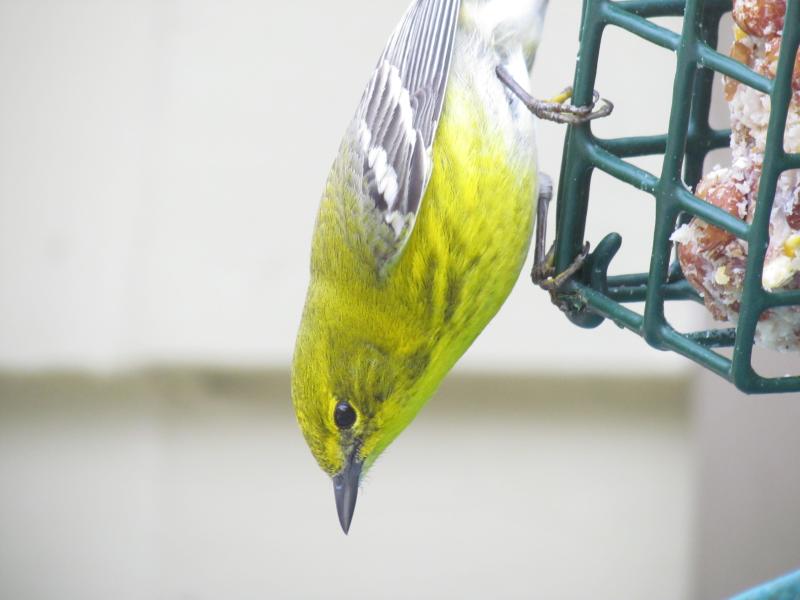 Pine warblers are one of two regular warblers who winter in small numbers in Maine. They are most often spotted feeding on suet at backyard bird feeders like this one was, at a feeder in Boothbay several years ago. Courtesy of Jeff Wells
  The yellow-rumped warbler is the most expected wintering warbler species in Maine. The species can subsist on natural fruits and berries during Maine's winters. Courtesy of Jeff Wells.
Pine warblers are one of two regular warblers who winter in small numbers in Maine. They are most often spotted feeding on suet at backyard bird feeders like this one was, at a feeder in Boothbay several years ago. Courtesy of Jeff Wells
The yellow-rumped warbler is the most expected wintering warbler species in Maine. The species can subsist on natural fruits and berries during Maine's winters. Courtesy of Jeff Wells.
The yellow-rumped warbler is the most expected wintering warbler species in Maine. The species can subsist on natural fruits and berries during Maine's winters. Courtesy of Jeff Wells.
Pine warblers are one of two regular warblers who winter in small numbers in Maine. They are most often spotted feeding on suet at backyard bird feeders like this one was, at a feeder in Boothbay several years ago. Courtesy of Jeff Wells
The yellow-rumped warbler is the most expected wintering warbler species in Maine. The species can subsist on natural fruits and berries during Maine's winters. Courtesy of Jeff Wells.
Warblers, those brightly colored sprites of the bird world, are abundant here in Maine in summer. On a June day in Midcoast Maine during a morning of birding, it’s not too hard to find blackburnian warblers with their flaming orange throats singing their high-pitched songs from the tops of tall green spruces. Nearby, may be the buzzy “zee-zee-zee-zoo-zee” of a black-throated green warbler, its bright yellow cheeks gleaming in the sun. Yellow warblers, chestnut-sided warblers, American redstarts, northern parulas, black-and-white warblers—they are all relative easy to find.
But come winter, those avian gems, all of whom primarily make most of their living catching and insects, fly south to more tropical climes. Some can go as far as South America.
So when a warbler is here in winter, it always seems amazing.
Two warbler species, though, are regulars here in Maine in winter, but only in small numbers and generally in southern Maine and/or near the coast.
The yellow-rumped warbler is the most expected wintering warbler species in Maine. Butter butts, as birder’s affectionately call them because of the bright yellow patch on the rump, are an abundant warbler that breeds across a vast area of the boreal forest from Alaska to Newfoundland and Labrador and south into the northeastern U.S. They winter in large numbers across the southeastern U.S, and south into Mexico and the Greater Antilles, occasionally farther south.
A few tough, resilient individuals figure out how to survive a Maine winter, feeding off bayberries and other berries and sometimes by eating suet at bird feeders. This year (2026), eBird shows reports of yellow-rumped warblers from about 20 Maine locations in January. A similar number are being reported to eBird from the Canadian Maritimes, There’s even one wintering on the Gaspe Peninsula of Quebec.
The other regular wintering warbler in Maine is the pine warbler. In summer, the liquid trill of a pine warbler can be heard drifting out from just about every grove of white pines, at least in the southern two-thirds of the state. What is particularly surprising is that Maine is near the northern limit of the pine warbler breeding range. You might expect that a warbler would be most likely to occasionally winter somewhere nearer the southern edge of the breeding range.
Not this bird!
Pine warblers, like yellow-rumped warblers, are also known to be able to eat seeds and berries in winter. They winter in greatest numbers in the pine forests of the southeastern U.S. Here in Maine, there are a few each winter that spend a lot of their time feeding on suet at backyard feeders. This year (2026), eBird shows nine locations where pine warblers have been reported, mostly in southern Maine, and one in Boothbay. With climate change, the number of pine warblers spending the winters here is likely increasing. A project to understand more about pine warblers wintering in Maine is underway in connection with the Mid-Coast Audubon chapter of Maine Audubon. If you have a pine warbler at your feeder, please send an email to mainepinewarblers@gmail.com and consider also reporting it to eBird.
Jeffrey V. Wells, Ph.D., is a Fellow of the Cornell Lab of Ornithology and Vice President of Boreal Conservation for National Audubon. Dr. Wells is one of the nation's leading bird experts and conservation biologists. He is a coauthor of the seminal “Birds of Maine” book and author of the “Birder’s Conservation Handbook.” His grandfather, the late John Chase, was a columnist for the Boothbay Register for many years. Allison Childs Wells, formerly of the Cornell Lab of Ornithology, is a senior director at the Natural Resources Council of Maine, a nonprofit membership organization working statewide to protect the nature of Maine. Both are widely published natural history writers and are the authors of the popular books, “Maine’s Favorite Birds” (Down East Books) and “Birds of Aruba, Bonaire, and Curaçao: A Site and Field Guide,” (Cornell University Press).