The Vulture Who Came to Dinner
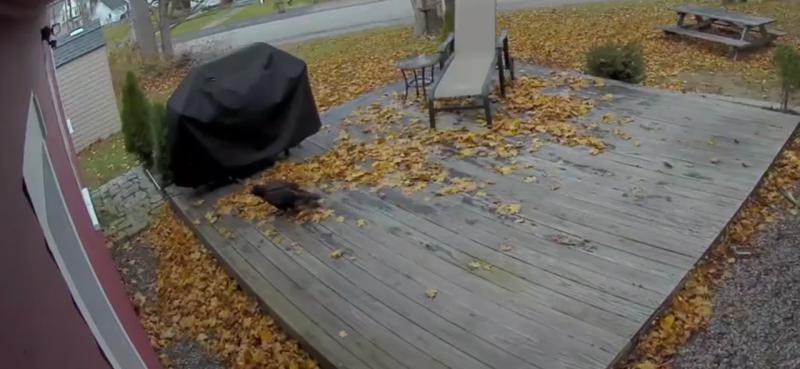 This turkey vulture was caught on the security cam at a friend's home in the authors' neighborhood. Courtesy of Jason Hudson
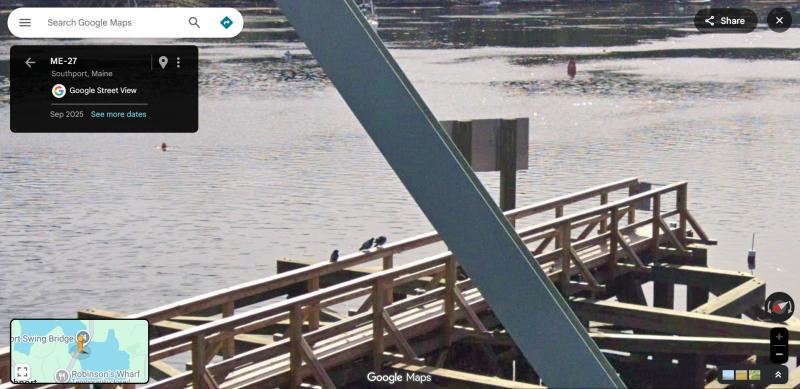 These pigeons were minding their own business on the Southport Bridge when the Google Street View camera snapped their portrait.
 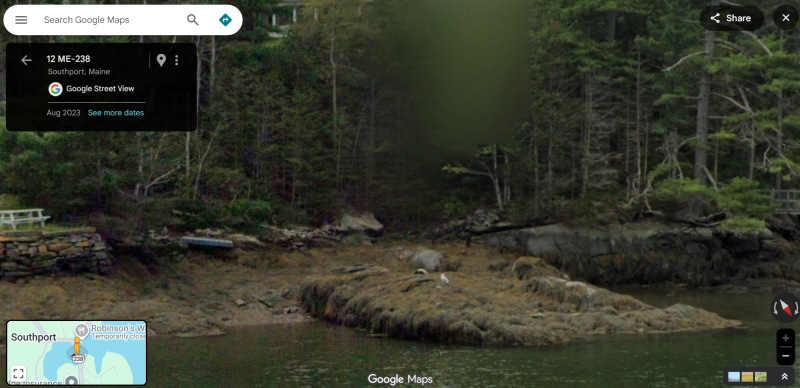 This herring gull was captured by the Google Street View camera while seemingly contemplating its next meal on the seaweed-covered shore of Southport.
This turkey vulture was caught on the security cam at a friend's home in the authors' neighborhood. Courtesy of Jason Hudson
These pigeons were minding their own business on the Southport Bridge when the Google Street View camera snapped their portrait.
This herring gull was captured by the Google Street View camera while seemingly contemplating its next meal on the seaweed-covered shore of Southport.
This herring gull was captured by the Google Street View camera while seemingly contemplating its next meal on the seaweed-covered shore of Southport.
This turkey vulture was caught on the security cam at a friend's home in the authors' neighborhood. Courtesy of Jason Hudson
These pigeons were minding their own business on the Southport Bridge when the Google Street View camera snapped their portrait.
This herring gull was captured by the Google Street View camera while seemingly contemplating its next meal on the seaweed-covered shore of Southport.
“Is this a turkey vulture?”
That was the question a friend from Gardiner posed to us over Facebook with a link to a video. The clip was captured mid-morning in November by an automated security camera pointed at his back deck.
The bird was indeed a turkey vulture.
What was a turkey vulture doing poking around on his deck? Maybe it had learned to check around the entrances of houses for outdoor dog food bowls. Or maybe the grill had been used recently and still held some delectable barbequed meat smells?
Hard to know what it was doing that drew it there and inspired it to explore, but fascinating to know that turkey vultures at least occasionally engaged in such behavior. We can’t remember seeing one snooping around a house like that here in Maine (maybe down in the southern U.S. where they are more abundant).
We expect more and more people are finding interesting birds and other creatures on the various automated cameras attached to people’s homes nowadays.
Cameras of another kind have led to an interesting game (?) or pastime for some bird enthusiasts. Through Google Maps you can get a 360-degree street view photo for many, perhaps most, addresses in the U.S. and many other parts of the world. These photos are captured by a person driving around with a special camera mounted on the vehicle that snaps a photo at precise intervals. It’s now possible (for better or worse) to open up Google Maps and zoom in to a particular location to see the scene as if you were standing on the road at that place.
The photos are taken without consideration of the presence or absence of birds (or other creatures, including humans). So occasionally a bird can appear in one of these images. Maine Audubon’s Nick Lund discovered this fact a few years ago and began looking around to see what birds he could identify from these images. Eventually, he shared news of this obsession with others and started a Facebook group that now has thousands of participants who have reported finding and identifying as many as a thousand species!
Of course, this prompted us to check Google Street View images for some familiar spots in the Boothbay region. In one image, we spotted a laughing gull flying over near Lobsterman’s Wharf, near the bridge in East Boothbay. The bird is a bit blurry and far off, but you can see its distinctive black hood and black wingtips. That’s often how the birds appear—blurry and cryptic—as the primary targets are the homes and businesses, not birds and wildlife.
We checked the Google Street View images for the Southport Bridge, and the image taken from the middle of the bridge shows some of the pigeons that regularly hang out there. Nearby, another view shows the familiar figure of a herring gull, with light gray back and white head, as it searches for food in the brown-and-orange rockweed.
All of this technological snooping on the natural world seems a wee bit weird and voyeuristic, and yet we keep thinking of new places to check. What will be next?
Jeffrey V. Wells, Ph.D., is a Fellow of the Cornell Lab of Ornithology and Vice President of Boreal Conservation for National Audubon. Dr. Wells is one of the nation's leading bird experts and conservation biologists. He is a coauthor of the seminal “Birds of Maine” book and author of the “Birder’s Conservation Handbook.” His grandfather, the late John Chase, was a columnist for the Boothbay Register for many years. Allison Childs Wells, formerly of the Cornell Lab of Ornithology, is a senior director at the Natural Resources Council of Maine, a nonprofit membership organization working statewide to protect the nature of Maine. Both are widely published natural history writers and are the authors of the popular books, “Maine’s Favorite Birds” (Down East Books) and “Birds of Aruba, Bonaire, and Curaçao: A Site and Field Guide,” (Cornell University Press).