Student research team helping coastal businesses adopt reusable takeout containers
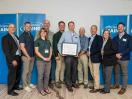
 Cindy Isenhour (second from left) and her students, pictured outside of South Portland City Hall, are helping businesses in Bar Harbor, Bath and South Portland incorporate reusable food containers into their dining experiences to reduce waste. (Photo courtesy Cindy Isenhour)
 Cindy Isenhour (second from left) and her students, pictured outside of South Portland City Hall, are helping businesses in Bar Harbor, Bath and South Portland incorporate reusable food containers into their dining experiences to reduce waste. (Photo courtesy Cindy Isenhour)
University of Maine student researchers are helping businesses in Bar Harbor, Bath and South Portland incorporate reusable food containers into their dining experiences to reduce waste.
The cohort is implementing Reuse Maine, a pilot program in partnership with the coastal towns of Bar Harbor, Bath and South Portland. Participating eateries include Cafe This Way and Coffee Matter/Mother’s Kitchen in Bar Harbor, Solo Pane in Bath, and Second Rodeo Coffee and Verbena in South Portland.
By testing the viability of reusable takeout packaging in participating restaurants, students are at the forefront of developing a model that reduces waste, prevents plastic pollution and saves local businesses and municipalities money on the purchase and disposal of single-use food and beverage packaging.
Throughout this project, UMaine student researchers are working directly with these businesses to track results and analyze usage patterns to refine the returnable model.
“The driver for this project has been a focus on wanting to maintain and protect Maine’s coastal environment because it’s a very important part of the state’s culture,” said Ryan Kennedy, a University of Maine senior in the Department of Anthropology.
Kennedy, an undergraduate research assistant on the project, has been involved since the initial baseline surveys last June. They noted that the team met with restaurant owners to discuss their establishments’ capabilities and customer habits.
“I want to help bring cost savings to the frontline because that drives most business decisions,” Kennedy said. “On the commercial side, choosing between the wallet and the planet can be difficult. With the cost of everything going up, people want to know if a change will save them money. By providing hard data to businesses and a simple message to its customers, we can show that sustainable swaps don’t have to be a complicated transition.”
These five local eateries now offer diners the option of having their food and/or beverage packaged in returnable stainless steel containers. Customers can check out these containers by signing up for a free account in the Recirclable app. After enjoying their takeout meals, customers can return the containers to any of the participating establishments.
“I think we’re starting to see people realize how easy it is to make more sustainable swaps,” Kennedy said.
In just a little over a month since the Reuse Maine pilot project launched, more than 100 customers across the state have borrowed nearly 500 reusable containers.
Other student researchers involved in the project include Chyanne Yoder, Catherine Segada, Gianna DeJoy, William Brenneman and Alejandro Snell. They are joined by project advisor Cindy Isenhour, a professor in the Department of Anthropology and the Climate Change Institute.
As part of an extensive, interdisciplinary effort to mitigate marine pollution, the project is funded by the National Oceanic and Atmospheric Administration (NOAA), Maine Sea Grant and the Maine Department of Environmental Protection. The support allows the team to tackle environmental challenges while providing student researchers with the resources needed to develop scalable, real-world solutions.
“I think the hard data and transparency between the businesses, their customers and our team is what’s really driving the success and the happiness with this project,” Kennedy said. “It helps people feel like they’re making a difference without having to go out of their way. It’s just a part of their routine when they pick up a coffee or grab lunch.”
As Maine’s only public research university and a Carnegie R1 top-tier research institution, the University of Maine advances learning and discovery through excellence and innovation. Founded in 1865 in Orono, UMaine is the state’s land, sea and space grant university with a regional campus at the University of Maine at Machias. Our students come from all over the world and work with faculty conducting fieldwork around the globe — from the North Atlantic to the Antarctic. Located on Marsh Island in the homeland of the Penobscot Nation with UMaine Machias located in the homeland of the Passamaquoddy Nation, UMaine’s statewide mission is to foster an environment that creates tomorrow’s leaders. As the state’s flagship institution, UMaine offers nearly 200 degree programs through which students can earn bachelor’s, master’s, professional master’s and doctoral degrees as well as graduate certificates. For more information about UMaine and UMaine Machias, visit umaine.edu/about/quick-facts/ and machias.edu/about-umm/umm-facts/.