
Camden police and paid parking petitions back for discussion; nonbinding PD warrant article proposed
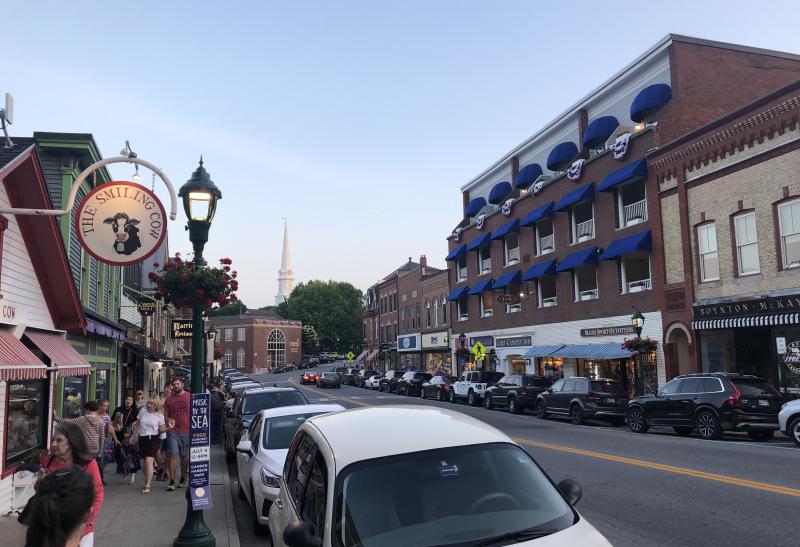 Downtown Camden, July 4, 2019 (File photo Lynda Clancy)
Downtown Camden, July 4, 2019 (File photo Lynda Clancy)
Downtown Camden, July 4, 2019 (File photo Lynda Clancy)CAMDEN — When it convenes Tuesday, April 21, for a regularly scheduled meeting, the Camden Select Board will pick up the conversation concerning two citizen petitions that had asked for town meeting warrant inclusion; one directing the town to continue its town-operated and police chief-led law enforcement department, and not contract with the Knox County Sheriff's Office for management services, the other to eliminate the paid parking program.
As Town Manager Audra Caler noted in her premeeting newsletter to the Select Board, Town Attorney William Kelley advised not placing the police department article on the June 9 2026 warrant per an March 28 memo he wrote.
In that, said Caler: "He concludes that the proposed Warrant Article conflicts with provisions of the Camden Town Charter and the statutory Town Manager Plan, both of which vest exclusive authority over police department management, including appointment and removal of the Police Chief, in the Select Board and Town Manager."
She continued: "He further advises that if placed on the ballot and approved, the Article would likely be unenforceable as an unlawful attempt to amend the Charter through an improper process. The Town Attorney concludes theSelect Board has sufficient basis to reasonably deny placement on the Warrant, and suggests the Board might alternatively consider placing a non-binding advisory referendum on the subject."
Kelley wrote in his March 28 memo: "It sometimes surprises people that in the role of gatekeepers of the Annual Town Meeting Warrant, it is incumbent on the Select Board to consider the actual wording and legal effect of a Voters' Petition."
Citing prior court cases in Bangor and Pittston, Kelley said if a binding warrant article were placed on the ballot and if approved, he would advise the Board and Town Manager that they would be legally obligated to follow the town's charter and the town manager plan, thus the article would not be legally enforceable. Instead, he suggested a nonbinding article.
The nonbinding warrant article language is included the April 21 Select Board meeting packet. It comprises three questions: Should Camden maintain a full-service PD, as it has done for decades; should the town consider financial costs and benefits of using an outside law enforcement agency, such as the Knox County Sheriff's Office to provide all or a portion of law enforcement services specifically designated for patrol" in Camden; and should the town maintain its own independent Police Chief full-time or part-time as an employee of the town.
Concerning the petition that asks for warrant article posing the elimination of the paid parking program, Kelley likewise advised against its placement on the warrant. In his April 3 memo to the Board, he pointed out that state statute directs municipal officers to enact all traffic and parking ordinance, "not the voters at town meeting," wrote Caler.
Kelley said the parking petition represented a political effort, and, "not one seeking a true legislative enactment."
"Because this authority cannot be directed or overridden by the voters, the Parking Article would be unlawful and unenforceable," wrote Caler, in her premeeting memo. "Unlike the police petition, the Town Attorney does not suggest a non-binding advisory alternative is appropriate here, given the exclusively legislative nature of the Select Board’s authority over parking regulation."
Kelley wrote in his memo: "In my view, the politics of persuading municipal officers in their capacity as legislators of traffic, parking and public safety on the roads is best done in real time within Select Board meetings in the normal course."
Since the parking petition was submitted to the town office with 577 signatures, and since the last Select Board meeting April 7, there have been more changes to the proposed May 22 roll-out of the downtown parking plan.
As town office liaison to the Parking Working Group, consisting of citizens and municipal staff, Holly Anderson wrote in an April 17 memo to the Select Board: "To eliminate the 'need' for Resident Permit holders to interact with enforcement when parking in paid/green spaces, the 2026 Resident Permit offers free parking all day for Camden-registered vehicles. To wit, paid/gree spaces become 2-hour/blue spaces for residents, and a Resident Permit would be a sticker displayed on a window."
With that move, the town anticipates a revenue loss from the projected earnings of the overall program, which had been estimated in 2024 to run annually at $638,000 ($531,238 from metered parking, $5,875 from permit fees, and $101,699 from parking citations).
"While there will be revenue loss, it is likely minimal and will be outweighed by the volume of appreciation and support from residents for this plan," wrote Anderson.
In other town business
2026 Annual Town Meeting Warrant
The Select Board will set the June 9 town meeting warrant, which includes 22 articles, and the possible inclusion of more, depending on what the Board concludes about the petitions.
The 2026 Annual Town Meeting Warrant proposes six zoning code amendments, a moratorium on building seawalls and bulkheads while Camden works on ordinance language governing waterfront stabilization rules.
Amendments, if approved by voters, would:
Article 3, Remove minimum off-street parking space requirements for residential dwellings, consistent with LD 427 (signed June 2025), which limits towns to no more than one parking space per dwelling unit in growth areas.
Article 4, Update the definition of “Coastal Wetland” to comply with state Shoreland Zoning Act adjustments to highest annual tide regulations.
Article 5, Add the term, “Adaptive Reuse,” to the Zoning Code’s Definitions section.
Article 6, Amend the Downtown Business District (B-1) regulations to allow limited street-level residential adaptive reuse of certain historic structures under defined conditions.
Article 7, Amend Shoreland Overlay Zone administration to require applicants for certain projects to submit plans stamped by a licensed design professional.
Article 8, Amend Certificate of Occupancy requirements to require professionally stamped as-built site plans and a certificate of compliance for certain projects prior to issuance of a CO.
Article 9, Allow the Planning Board to require third-party technical review during the site plan review process at the applicant’s expense.
Article 11 on the warrant asks voters to consider accepting a deed from Alkco Acceptance Corporation, and other owners for a portion of the “Greenfield Subdivision” on Linden Lane described as “Reserved for Open Area,” which includes a “Detention Pond,” on the subdivision plan for Greenfield Subdivision, "for the purpose of establishing Town ownership, access, control, maintenance rights, and development of a multi-use pathway; and, assume maintenance and repair responsibility for the existing storm water drainage Detention Pond that receives drainage from multiple municipally owned roads?" the article reads.
The article wraps up unfinished business dating back to the June 2003 Annual Town Meeting, at which voters unanimously authorized the Select Board to accept a deed to the Greenfield Subdivision common lot for the purpose of establishing a multi-use pedestrian and bicycle pathway, the warrant notes said.
"Although conveyance documents, including a certified quitclaim deed and a survey showing a 25-foot-wide corridor along the top of the earthen berm, were prepared at that time, the deed was never executed and recorded, leaving the Town without legal title. Approving this article would formally vest ownership of the common lot in the Town, allowing municipal staff to inspect, maintain, and improve the stormwater detention pond and drainage features that serve multiple Town-owned roads, clarify and secure public access rights along the pathway corridor, and resolve longstanding ambiguity in the Town's land records for the benefit of residents, abutters, and the Town's insurers," the warrant notes said.
Voters are also being asked to approve deed acceptance of 3.16 acres of open space in the Lupine Terrace subdivision. The Lupine Terrace Homeowners Association asked the town to take acquire it, given erosion problems into the Rawson Brook and eventually the Megunticook River.
"Municipal ownership would allow Camden to pursue state and federal stormwater and watershed restoration grants that are unavailable to private associations," wrote Caler, in the article's explanation.
And, voters will be asked to consider a $13.37 million 2026-2027 budget.