
Rockport begins responding to FOAA requests, attaches processing fees to two
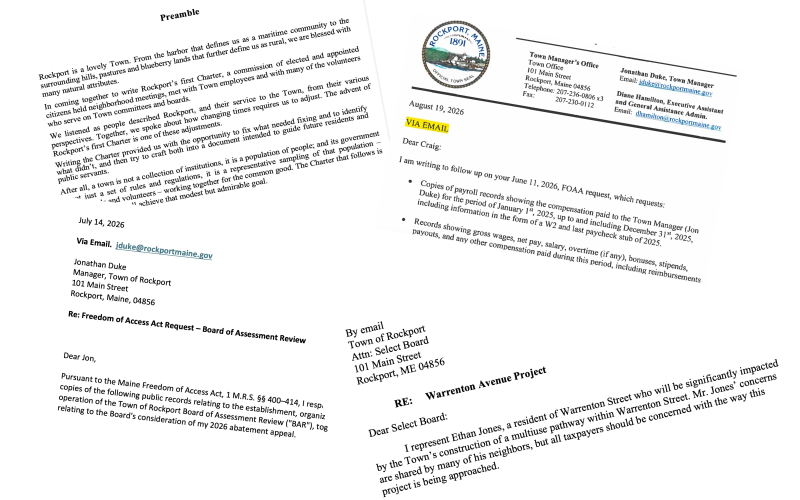
ROCKPORT — In late July, Rockport Town Manager Jon Duke told the Select Board that his office was processing eight Freedom of Access Act requests for information, and suggested the fulfillment of the FOAAs would not only require substantial municipal resources, but also affect the delivery of other town services, "not to mention delay the response time of any individual FOAA request."
Since then, the town has been served with two Knox County Superior Court actions: One property owner filed an appeal of his property valuation and abatement denial while another filed a Freedom of Access appeal, saying his requests for public documents were ignore.
But Duke said September 1 that municipal responses to the FOAAs are underway, and recounted their progress.
Ethan Jones and Kristin Collins FOAA requests
Ethan Jones and his attorney Kristin Collins submitted questions and then a FOAA concerning a planned Warrenton Street culvert and pathway project.
According to Collins, Jones had submitted a FOAA on April 1, before he retained her counsel. Collins then submitted her own FOAA request.
In a May 7 letter to the Rockport Select Board, she wrote: "I represent Ethan Jones, a resident of Warrenton Street who will be significantly impacted by the Town’s construction of a multiuse pathway within Warrenton Street. Mr. Jones’ concerns are shared by many of his neighbors, but all taxpayers should be concerned with the way this project is being approached."
On July 10, she wrote another letter, requesting information about a Nov. 5, 2024 town meeting warrant article associated with a bond to fund, she wrote, "'the 'design, planning, preparation, permitting, construction, equipping, purchase and/or acquisition' of 'roadway water crossing rehab, repair, replacement, and/or improvements to the following water crossing areas,' including on Warrenton Street and other roads. "Should excess funding be available,” the article authorized the Select Board 'to allocate funding to other necessary infrastructure projects.' The article further authorized a bond to pay for the work."
In Collins' July 10 letter, she wrote: "As to whether the bond funds can be used for this [pathway] project, I have seen no evidence that the Warrenton Street project is being paid for with funds that are in excess to those funds necessary to complete all the other projects named in Article 9. Simply put, the voters did not authorize the use of the bond funds for this superfluous project unless and until those other projects have been fully funded."
She asked for: "all requests for proposal, contracts and invoices for the other projects listed in Article 9. Apart from the above, this project involves significant work in the shoreland zone. I have seen no evidence that shoreland zoning and NRPA permitting have been received or in process. Please provide the status of all required permits, and copies of any applications that have been filed before the Town or State for permitting."
On Sept. 1, Town Manager Duke said he was working on responses to Collins and Jones but could not talk about them because of the Freedom of Access Act appeal legal action filed Aug. 11, and which claims the town failed to reply to multiple requests for public documents about a proposed expansion project and creation of a pathway on Warrenton Street.
According to state statute, the public has the right to inspect any public record during reasonable office hours. An agency or official may not charge a fee for inspection unless the public record cannot be inspected without being converted or compiled, in which case the agency or official may charge a fee.
The official holding the records are to provide an estimate of the time frame to comply with the FOAA request and of the total cost.
The first two hours of fulfilling a request are free. After that, the agency or official may charge a fee of not more than $25 per hour. If the estimate of the total cost is greater than $50, the agency or official is to inform the requester before proceeding. If the estimate of the total cost is greater than $100, the agency or official holding the public record may require a requester to pay all or a portion of the estimated costs to complete the request prior to the search, retrieval, compiling, conversion and copying of the public record.
Duke said Sept. 1 that fulfilling the Collins FOAA request is estimated to cost $372.50.
Collins said Sept. 2 that: "Mr. Duke responded after the appeal was filed to finally provide a cost estimate to fulfill the request. No time estimate was given. The Town is seeking to dismiss the appeal and refuses to pay Mr. Jones’ legal fees even though the suit seems to be the only thing that prompted a response from Mr. Duke."
Scott Gazelle FOAA
Rockport homeowners G. Scott Gazelle and Judith Bonzi elevated their property valuation dispute to Knox County Superior Court with an Aug. 6 filing that appeals a July 7 decision by the Rockport Board of Assessment Review (BAR) to uphold denial of their property tax abatement request made to the Rockport assessor's office.
Bonzi and Gazelle maintain the town's 2025 property tax assessment of $3,971,400, which had increased from the 2023 valuation of $3,512,800, was made in error.
On July 14, Gazelle submitted a FOAA request to Town Manager Duke, requesting information about the Rockport BAR, such as its bylaws and procedures, drafts, minutes of Select Board or any other meetings concerning the creation of the current BAR, the appointment of BAR members, and their training.
He also requested copies of communication between BAR members from January 1 to July 14 concerning procedures, findings of fact, deliberations and BAR business concerning hearings. And, he requested draft documents specific to his July 7 abatement hearing, communications between the BAR and the Rockport Assessor, internal memoranda concerning his appeal, and town staff notes.
Duke said the cost estimate of responding to the Gazelle FOAA would be $575. Gazelle confirmed that cost on Sept. 2.
Gazelle said he had yet to receive the substantive records responsive to the request.
Stephen Bowen FOAA
"That one is out the door," said Duke. "I think he has got everything he needs."
Bowen, who is a member of the Rockport Budget Committee, confirmed Sept. 2 that he received answers to the FOAA request that he made December 8, 2025.
In a March 10, 2026 email exchange with Duke, Bowen said that he wanted the information in his pursuit of, "Just looking for more background on the 2023 charter changes generally and the origin of and goals for the changes to the Budget Committee language specifically."
Bowen had asked for minutes and/or notes made from a July 10, 2023 Select Board workshop concerning Town Charter amendments, and a specific document cited during a July 31, 2023 Select Board meeting.
In his December 8 email exchange with Duke, Bowen wrote: "During the discussion of the charter amendments at the subsequent July 31 Select Board meeting, you made a reference (at the 1:53:00 mark of the recording) to 'the document that I got back from Denise,' telling the Board that this document 'was not sharable'. I hereby request a copy of the document you referenced, which you evidently received from Denise in some manner (I assume by email, in which case I hereby request that email). Importantly I am requesting the exact document you received from Denise, not a later copy that was subject to additional editing.
"You also make reference to a 'file' which contained other suggested changes to the charter, including some from Kerry and Megan. I hereby request the contents of the file you mentioned, as well as access to the shared folder or file to which you announced you would give the Select Board access."
On Sept. 2, Bowen said he received the email he had sought, and it proved that there was an effort in 2023 to eliminate the Rockport Budget Committee through amendments to the Rockport Town Charter.
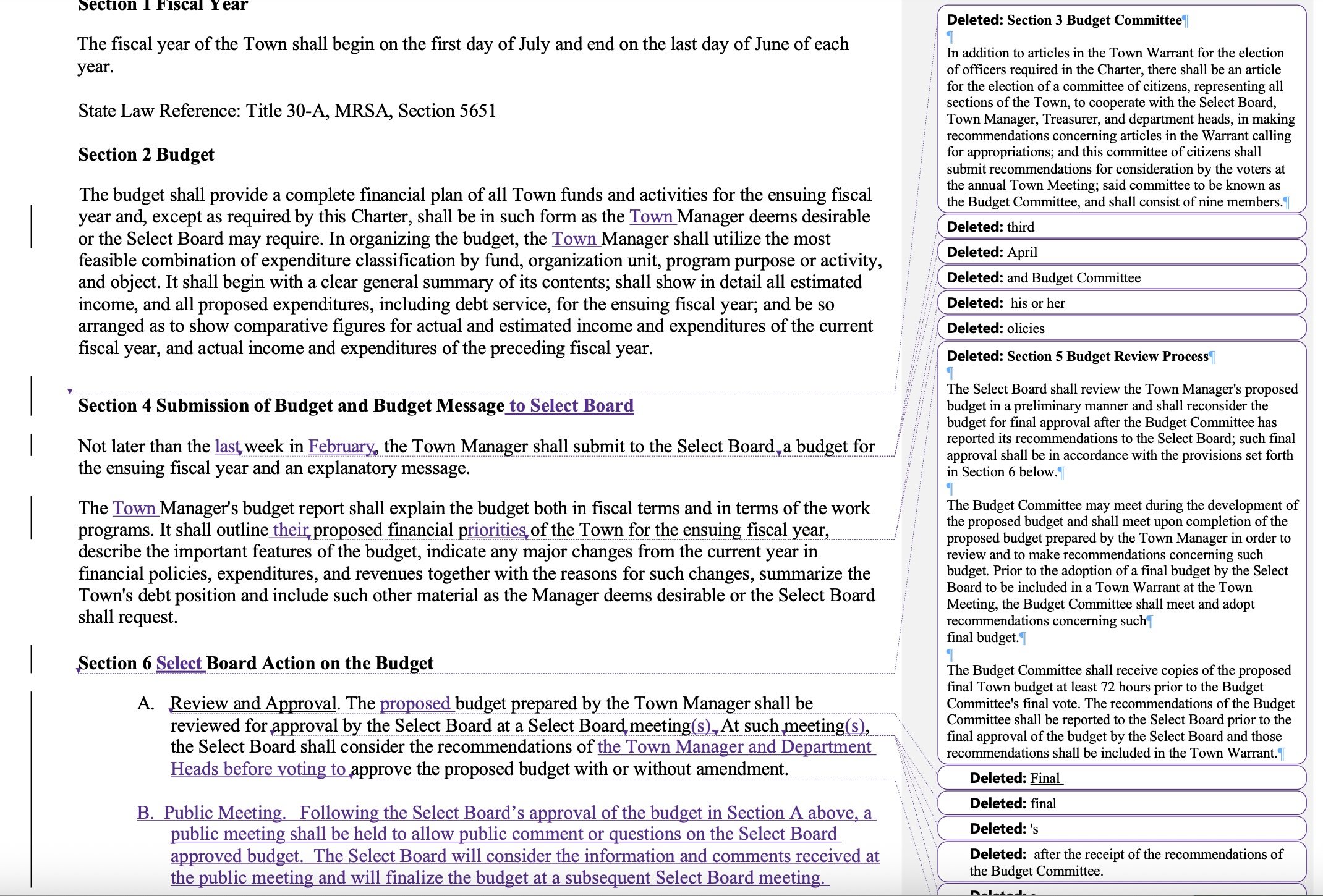
In 2023, there were suggested changes to the Rockport Town Charter under discussion via a shared file on the town's website. The above excerpts from a then ongoing internal edit to the Rockport Charter via a shared internet file. Its edits represent suggested changes that various town officials — elected and staff—were making.
In a July 26, 2023 email to then Select Board member Eric Boucher, Select Board member Denise Munger had written: "Here is the current charter with my suggested tracked changes. I think that reflects a lot of what we discussed as well as some suggested changes from Megan and Kerry. At the end of the day after discussing with Megan and Jon, I thought we should consider removing the budget committee rather than creating an appointed board — and allowing for a public meeting for all citizens to weigh in on the proposed budget before final SB approval. We can discuss that more."
Bowen said in a Sept. 2 email, "At some point, which I have yet to discover, they decided not to move that forward, but they made the changes they did make to put the committee under firmer control by the Select Board."
Craig Mitchell FOAA
Craig Mitchell, also a member of the Rockport Budget Committee, submitted a FOAA June 11, asking the Town Office to produce copies of payroll records showing compensation paid to Duke for Year 2025. He asked for the information to be in the form of a W2, and include the last paycheck stub of 2025.
Mitchell asked for records, "showing gross wages, net pay, salary, overtime (if any), bonuses, stipends, payouts, and any other compensation paid during this period, including reimbursements for a car, cell phone, technology, health or life insurance, etc."
He also asked for, "all sources of income and reimbursements."
And, he asked for: "a copy of ALL payroll contracts with our town managers with all select board signatures as required by our town charter. This includes past and present contracts since we hired our town manager Jon Duke."
On August 18, Mitchell received a document that summed up Duke's 2025 compensation, but did not include his W2, given that the latter is not considered a public record because it contains a person's Social Security number, and other private information.
"Steve Bowen’s FOAA request got me thinking about my own FOAA findings and whether our town charter is being followed," said Mitchell, Sept. 10. "While reviewing the Town Manager’s gross pay, I found an April 10, 2024, employment contract listing a $137,000 salary. It was signed by the Town Manager, the Select Board Chair, and the Town Manager’s administrative assistant. The contract does not include stipends or bonuses, yet my FOAA revealed 13 additional stipends."
He said the Town Charter, Article III, Section 1, states the Select Board, "shall, by contract, fix the Town Manager’s compensation, benefits, and other terms of employment. It does not state that the Select Board Chair alone signs these contracts," said Mitchell. "Our property taxes have nearly doubled over the past five years and so has the town payroll. That should raise questions about how taxpayer dollars are being spent and whether our elected officials are providing adequate oversight. What is the point of having a town charter if we don’t follow it? And what is the point of having a Select Board if it does not actively oversee the Town Manager and his contract?"
Those are the heavy ones [FOAAs]," said Duke, before outlining two more FOAA information requests, one relevant to a court case and Rockport "police matter", which is currently under investigation.
He said the case was still going through the court system.
The last FOAA request comes from a commercial entity, Starbridge Open Records, which collects and collates public data and then sells to companies that market their products to public entities.
"We get these periodically," said Duke. "They want all our purchase orders, payment records for vendor entities, such as companies, organizations, contractors," since January 1, 2025 until the current date.
Rockport receives 10 to 12 of those commercial FOAAs per year, said Duke.
At the State House there have been discussions about separating commercial FOAA requests from the citizen and media FOAA requests, as well as FOAA requests originating from legal disputes, and charging those commercial interests at a higher rate.
A bill, LD 1788, An Act to Strengthen the Freedom of Access Act by Categorizing Commercial Requesters, was introduced in 2025, but did not proceed out of legislative committee last February.
LD 1788 was designed, in part, to mirror the federal Freedom of Information Act by requiring entities who seek access to public records for commercial purposes to pay more than members of the public who seek public records for noncommercial purposes, according to the Twentieth Annual Report of the Right to Know Advisory Committee, issued in January 2026. Its substance is up for continued discussion by the state's Right to Know Advisory Committee.
In the case of Rockport, Duke said the commercial requesters often withdraw their requests when the town indicates that the process of retrieving the town's purchase and sales data will require more payment for going beyond the two-hour free response window.
Rockport gets more commercial FOAA requests than Duke remembers when working in smaller towns.
"But here," he said, "we are definitely on the radar."
Reach Editorial Director Lynda Clancy at lyndaclancy@penbaypilot.com; 207-706-6657