Pennsylvania was comfortable
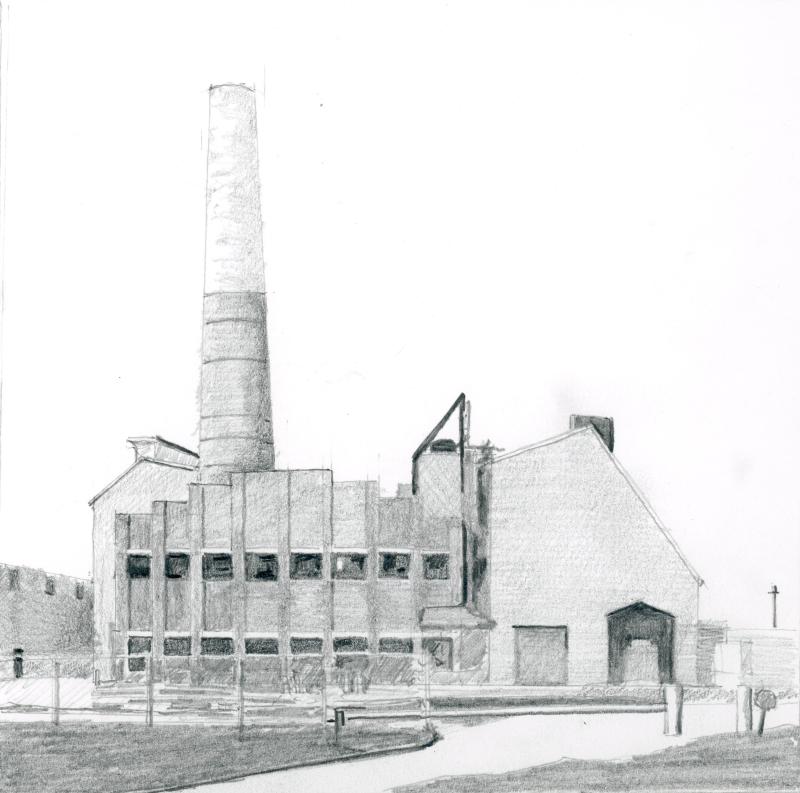 Erie Forge and Steel (Drawing by Rick Cronin)
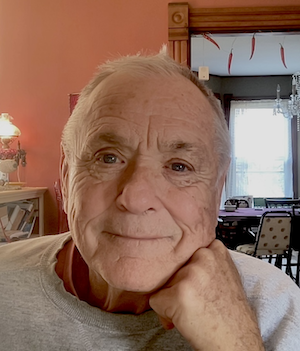 Rick Cronin, a Belfast artist, began exploring Waldo County with his sketchpad in 2024, finding the mystery and peace of the landscape, and drawing it. Then last summer, he thought: Why not broaden his horizons, explore the U.S. and sketch what captured his attention on the road? So, he bought a 1997 Dodge Roadtrek camper, and he and his wife, Susan, agreed that their shaggy dog, Dolly, would be up for the adventure. Right now, Rick and Dolly are traveling the highways of America and sending back their observations and sketches for us all to read. Those interested in receiving the full set of drawings of each state, email croninme47@gmail.com.
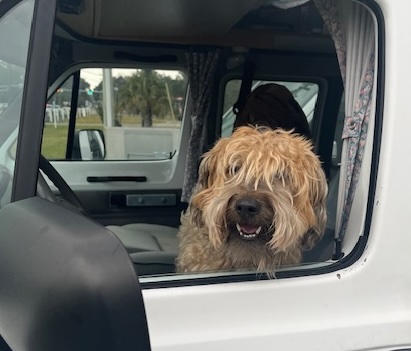 Dolly (Photo courtesy Rick Cronin)
Erie Forge and Steel (Drawing by Rick Cronin)
Rick Cronin, a Belfast artist, began exploring Waldo County with his sketchpad in 2024, finding the mystery and peace of the landscape, and drawing it. Then last summer, he thought: Why not broaden his horizons, explore the U.S. and sketch what captured his attention on the road? So, he bought a 1997 Dodge Roadtrek camper, and he and his wife, Susan, agreed that their shaggy dog, Dolly, would be up for the adventure. Right now, Rick and Dolly are traveling the highways of America and sending back their observations and sketches for us all to read. Those interested in receiving the full set of drawings of each state, email croninme47@gmail.com.
Dolly (Photo courtesy Rick Cronin)
Dolly (Photo courtesy Rick Cronin)
Erie Forge and Steel (Drawing by Rick Cronin)
Rick Cronin, a Belfast artist, began exploring Waldo County with his sketchpad in 2024, finding the mystery and peace of the landscape, and drawing it. Then last summer, he thought: Why not broaden his horizons, explore the U.S. and sketch what captured his attention on the road? So, he bought a 1997 Dodge Roadtrek camper, and he and his wife, Susan, agreed that their shaggy dog, Dolly, would be up for the adventure. Right now, Rick and Dolly are traveling the highways of America and sending back their observations and sketches for us all to read. Those interested in receiving the full set of drawings of each state, email croninme47@gmail.com.
Dolly (Photo courtesy Rick Cronin)I took my pencils to Pennsylvania and began drawing where I was born, in Erie, on the Lake. I wasn’t born on the lake, but almost in a snow drift in my father’s hurry to get my mother to the hospital.
I was only six months old when we left Erie, but I returned often to visit grandparents and cousins. My grandmother, Mildred, taught me to play cards and she could draw. The drawing above is of Erie Forge and Steel where my father’s father, John Jerome Cronin, worked from the time he was 16 until a few months before he died at 71. He was a self taught metallurgist and drank Iron City Beer.
My mother’s side of the family was from the Pennsylvania Dutch farmland around Bloomsburg and her mother’s maiden name was Zula Zoe Zeisloft — a spectacular scrabble bonanza of a name. Her husband, my grandfather, was Warren Hendershott. He caught trout on Little Fishing Creek in Eyers Grove.
While in high school, Miss Weaver, my German and Modern European history teacher, would take us on an annual field trip to spend a day in an Amish school in Lancaster County. Eight grades were taught in a one-room school and we played baseball at recess. Most of what Amish kids learned was from home on the farm. Important stuff like working hard. In school they learned German and to sing their times tables.
While driving around I’ve tried to stay away from traffic and cities. Out in the country I’ve passed through Amish communities in many states. I’ve also listened to a lot of talk radio.Much of the air time is given over to issues that the Amish have been dealing with for a century or more. Where do we put the brakes on technology for the good of society? How do we support each other when we need mutual help? How do we end wars? How much money do we need to be rich? They’ve done a pretty credible job of making those decisions for themselves.
But, a lot of important things would be missing if the Amish model had been followed by the rest of us. All those medical cures of diseases like malaria, smallpox, measles, etc. — probably gone. No jets to fly around in. No laptops. No energy crises. No plastic pickleballs. No ATMs. No global warming. No electric guitars. No moon landings. No Spotify. No Disney World. No ’55 Chevys. No wars. No MRIs. No Facebook.
Of course there are so many moving parts to history that it makes it impossible to predict outcomes. I think Miss Weaver taught me that. But certainly the Amish model would have led us to a different world. Elon Musk might be the planet’s richest buggy maker. In the middle of the night Donald Trump might post messages on Truth Social like, “Blessed are the merciful, for they shall receive mercy.”
It was an interesting trip going down that Amish rabbit hole and I now know more about the Reformation, the Beatitudes, the Anabaptists, and what life was like on an Amish farm in Bird-In-Hand, Pennsylvania. That’s one of the pleasures of traveling — I’m constantly confronted with things I realize I know nothing about, even here in the state where I was born.
But, like I said, Pennsylvania was comfortable. I spent a day in Eyers Grove trying to find a treasure chest my cousins and I were sure was there in a creek bottom. I went to the Little League Field in Williamsport. My grandmother took me and my cousin as nine- and 10-year-olds there by bus to see the Little League World Series almost 70 years ago. I visited Hershey where they make chocolate and where I made my first stock investment — one share of Hershey Chocolate, which I still own.
Was it the familiarity or is it something else that makes the seven drawings I made in Pennsylvania among my favorites?
And by the way, in 1900, there were about 5,000 Old Church Amish in the U.S. and Canada, Now there are over 40,0000. In Europe they’ve been persecuted, assimilated, and emigrated to extinction. Amish Replacement Theory.