Smart grid, deadly device: Camden's ospreys are a warning for Maine
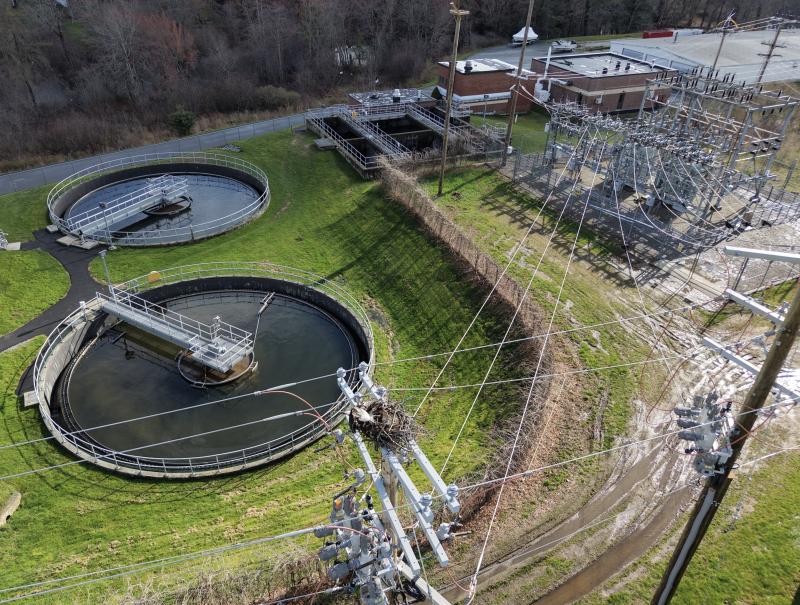 The newly installed pole and smart device where the returning ospreys built their nest and were ultimately electrocuted. Note the substation in the background as well as the pole and platform installed by CMP as an alternative nesting site. The platform is now being used by another pair of ospreys who began building shortly after the death of the orginal pair. (Photo courtesy Alison McKellar)
The newly installed pole and smart device where the returning ospreys built their nest and were ultimately electrocuted. Note the substation in the background as well as the pole and platform installed by CMP as an alternative nesting site. The platform is now being used by another pair of ospreys who began building shortly after the death of the orginal pair. (Photo courtesy Alison McKellar)
The newly installed pole and smart device where the returning ospreys built their nest and were ultimately electrocuted. Note the substation in the background as well as the pole and platform installed by CMP as an alternative nesting site. The platform is now being used by another pair of ospreys who began building shortly after the death of the orginal pair. (Photo courtesy Alison McKellar)In case you missed it, two ospreys were found electrocuted last week in a nest near the Camden-Rockport Middle School. The pictures you may have seen on the evening news are mine, but the official reports you’ve read are missing a lot.
In case you don’t have the energy to read all of this, here’s the quick takeaway. Power lines kill millions of birds a year and the bigger they are the more likely they are to be electrocuted. It may be about to get a lot worse in Maine because we have no laws requiring modern design standards for avian protection.
As the Maine Public Utilities Commission reviews the $189 million request from Central Maine Power (revised from the $1.4 billion that was rejected late last year), Mainers have an opportunity to decide whether the protection of migratory birds and endangered species should rely on voluntary measures by the power company or if these new installations, like the “smart device” that killed Camden’s ospreys, should be designed to be less deadly.
The funds are primarily for what CMP refers to as a “grid hardening” plan, which includes aggressive tree trimming, the installation of hundreds of miles of insulated wire, and a multi-year rollout of thousands of automated smart devices—the same technology that proved fatal to the Camden ospreys.
Osprey issues may be the most noticeable, in part because of the large nests they build in prominent places, but the problem of power lines killing birds is well known and what happened in Camden is a warning of potential unintended consequences of the smart devices being installed throughout the state.
The most frequent victims are not ospreys but perch hunting raptors with large wingspans. For every osprey pair found by a citizen, there are likely dozens of other hawks, owls, and eagles that have died silently across tens of thousands of miles of line, only to be eaten by scavengers, hidden in grass, or swept away by water before a human ever sees them.
When a concerned citizen told me about a lifeless body sticking out of the nest, he said he knew exactly what had happened. But I wasn't so sure. They must sometimes die of natural causes in the nest, right? Why now? How had they managed all these years? I knew the nest, as most people do. It’s next to the middle school ball fields and many of us have sometimes preferred watching the ospreys over the athletes we were there to support.
It's the same nest of ospreys that once caused me to google "do ospreys attack humans." All I wanted to do was walk under the pole where the nest was mounted on my way to the river, but these ospreys were territorial, and they had my full respect.
Roughly 20 years ago, Central Maine Power constructed a platform on top of a pole there to keep the ospreys from building directly on the cross-arms. It's a solution that worked well for the osprey pair. Maybe multiple generations of them? Or maybe even the same pair as some have been known to live up to 30 years.
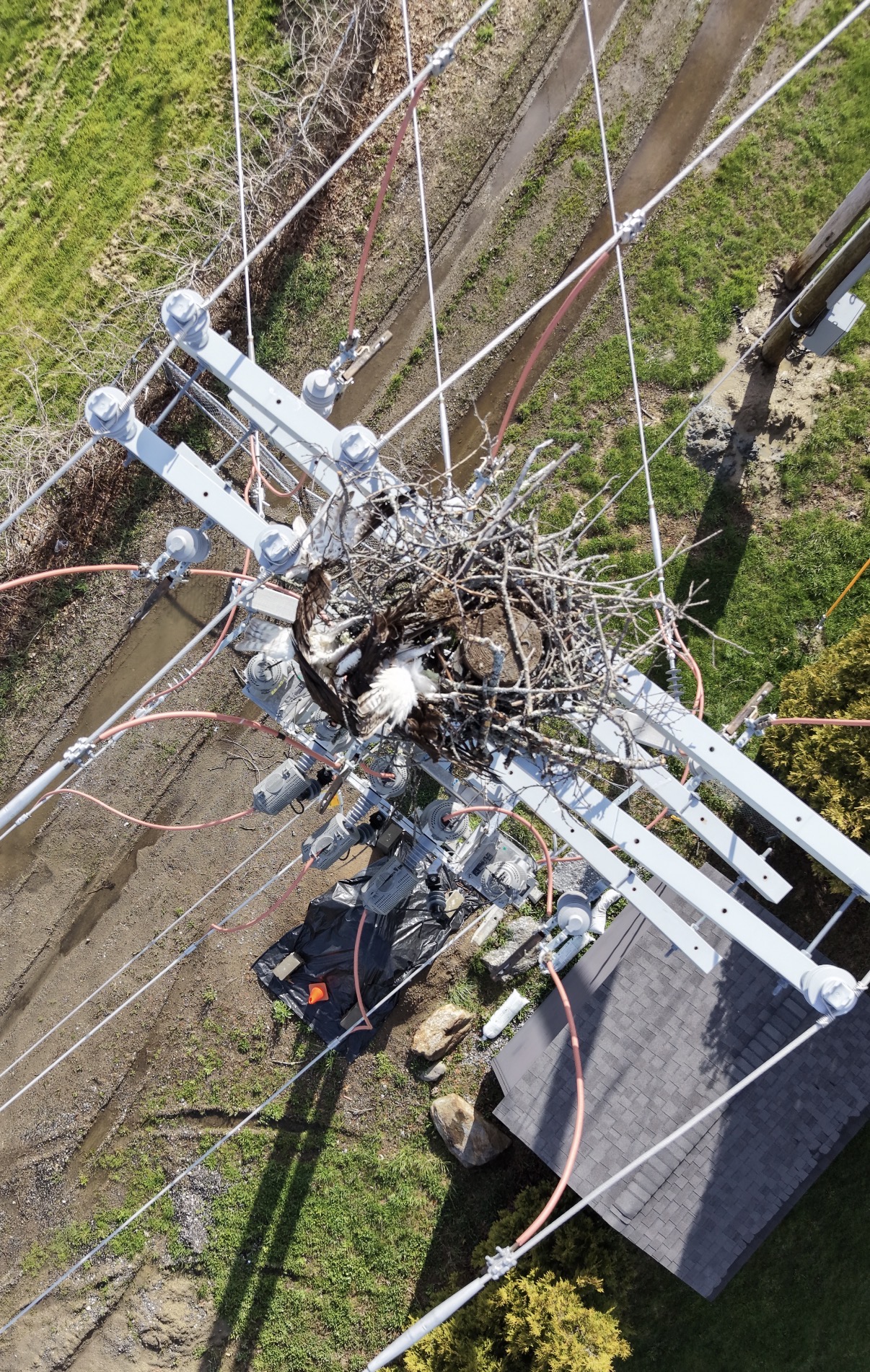
Drone photo taken on May 3rd showing two dead osprey in a nest at the Camden Rockport Middle School
But last Sunday the sky was quiet and not one but two ospreys lay lifeless in the same position amidst their partially constructed nest. They had been there for at least four days based on the report I received. The area around the nest was quiet, allowing me to launch my drone for a closer look and when I compared the photos with those I had taken over the last decade, the picture came into focus. I posted the photos on social media and reported the incident to Central Maine Power, the Maine Department of Inland Fisheries and Wildlife, and the U.S. Fish and Wildlife Service. The post went viral in a Maine sort of way and there has been an outpouring of concern for the ospreys and an overwhelming amount of interest in holding someone accountable.
2018 photo showing the osprey pair in the former nest near the CMP substation and the Camden-Rockport Middle School
As an elected official, I deal with a lot of things where people don’t agree, but for once, everyone in Camden seemed to be on the same page an the news quickly spread around the state with a similar reaction.
The morning after the report, CMP contacted me while en route to remove the nest and the birds. At that point, they were uncertain if it was an electrocution at all since the incident had not resulted in a power outage or even a detectable fault in the system. I was told it was very abnormal to hear about an osprey death through a citizen report rather than to discover it after the power was knocked out. The electrocution was later confirmed by both CMP and USFWS.
I learned that the nest was removed last fall as part of infrastructure upgrades that included pole replacement and the installation of new smart devices (also known as reclosers). In accordance with the law, the nest was removed after the birds migrated for the winter and the company did take the totally voluntary action of providing another platform about 120 feet away.
However, the poles at the former nesting site were left without any kind of deterrent to prevent the pair from rebuilding their nest on hardware that was now more dangerous than ever. The more complex the setup and the closer the electrified elements are to one another, the greater the chance of a bird touching two of them at the same time and completing a circuit. This is what kills birds. Touching two electrified components or one electrified and one grounded component.
There are also known engineering solutions to many of these issues. Wider distances between conductors and wildlife rated guards where that is not possible, as well as nesting deterrents. According to the Avian Power Line Interaction Committee (APLIC), best practices dictate that when removing a nest from powerlines, you must create a functionally superior alternative well also making the former nesting site "unnestable." But there are no laws in Maine requiring any best practice be followed when it comes to birds and power infrastructure.
Ospreys have high nest fidelity. They choose a spot, usually the highest place with a good vantage point close to the water, and they return year after year. If you remove a nest, they will rebuild. We have seen it happen over and over at the smoke stack at the Knox Mill. The difference is that this time, they had no way of knowing that they were returning to a historic nesting spot that had become exponentially more dangerous.
Both CMP and USFWS were very responsive to my inquiries.The official statement from CMP spokesperson Dustin Wlodkowski explained:
"After ospreys left the site last fall, CMP relocated the platform in this area about 40 yards away because nest materials were falling onto a smart device serving more than 3,000 local customers, including downtown Camden. Ospreys are now nesting on that relocated platform… we are fully cooperating with Maine IFW as they investigate the circumstances of what occurred."
CMP went on to say that they frequently review their policies related to osprey nests and they will again following the completion of the investigation. I have been told by at least one representative that they are working on joining APLIC as a result. So far, I feel fairly satisfied with the response from CMP and I believe they are following the law.
Maine IFW on the other hand did not respond to my inquiry nor ask any questions. The only official response I've heard from the agency was a media statement. Maine Inland Fisheries & Wildlife spokesperson Mark Latti dismissed the deaths as an inevitable byproduct of modernization, stating: "Maine has an abundance of wildlife, and in areas where wildlife and human development intersect, situations occur that don't end well for wildlife, including turtles on roads being crushed by cars, deer and moose being struck by vehicles, and osprey being killed atop powerlines.… CMP attempted to minimize the impacts by voluntarily installing two nesting platforms in the area."
I couldn’t believe it. The IF&W spokesperson was making claims that not even CMP was making. And I don't know about you, but I brake for turtles, deer, and moose.
This directly contradicts both CMP’s own statement and the observable reality at the site, where only one relocated platform exists about 40 yards away. This wasn’t just a relocated nest platform. It was an installation of a device that violates virtually every APLIC standard for raptor safe design. I know there are biologists at IF&W who understand this but whoever calls the shots at IF&W is content with a canned response that completely missed the point.
According to IF&W, the investigation is complete and found no violations of the law. I'm not surprised, because it turns out that Maine doesn't have any laws that protect migratory birds from power infrastructure and IF&W doesn't conduct investigations. Those are done by USFWS in their role as the enforcement agency for the Migratory Bird Treaty Act.
Unfortunately, there’s very little federal law can do since the Trump Administration reinterpreted the “incidental take” rules. If the birds weren’t killed on purpose, no crime occurred. But the State can and should fill the gap here.
Talking to the media and CMP without talking to the person reporting the issue is not an investigation, it is a public relations exercise. IF&W's official statement went so far as to say that this electrocuted pair was not the original pair, claiming the original pair had chosen the new platform and then some other osprey couple came wandering in after and squeezed into the dangerous spot.
This was an odd point to make but I see why they did it. New nest platforms are supposed to be functionally superior to the old one. If the old ospreys chose the new platform, then that's another gold star for CMP.
But it’s not at all true and if anyone had bothered to contact me, I could have shown them photos proving that the deadly nest was far more developed than the platform nest, even after the pair had been dead for several days. The first returning osprey pair clearly chose the lethal site as the preferential one, and it's no surprise given the history.
And then there’s the behavior of the new couple. One of the news stations put their drone up to photograph them and I gasped when I saw the footage. A drone near the nest would not have been tolerated by the old guard. Remember how I said I once googled whether and osprey would attack a human? I have video footage from that same day.
And to top it all off, IF&W's statement asserted, falsely, that the osprey deaths had resulted in a power outage. Again, totally contradicting what CMP had said. And this gets to the heart of it. Deaths that don't result in a power outage are almost never discovered. So the new smart device that killed the birds is smart enough to turn the power back on after it's hit with a stick but not smart enough to know when it electrocutes to full sized raptors. Something doesn't add up.
But aside from all that, the statements from IF&W and CMP missed the most critical issues. This wasn’t an isolated incident but the direct result of grid improvements that are only just beginning. Here are a few noteworthy points and unanswered questions.
CMP’s official statement suggests the ospreys were some kind of primary cause of outages and that removing the nest was a critical protection for downtown Camden.
So are we to believe that a few stray sticks were knocking out power to thousands of customers, yet this entire new nest was woven into the lines attached to the smart device and two birds were electrocuted without it creating any kind of detectable issue for CMP?Not only did it not result in a power outage, but it went completely undetected by the smart system.
Is killing birds without shutting off the lights a new feature of this technology or has it been happening all along? Can we change some settings?
CMP’s spokesperson made it sound like the smart device was being threatened by the ospreys, but the nest was removed as part of the installation of the device, so the threat was only an anticipated one. The smart devices weren’t even there until after the nest was removed. How many power outages in Camden have been blamed on ospreys over the last decade in Camden? I was able to find one.
On July 27, 2023, a nest on Tannery Lane was "thought to be the cause" of an outage that affected 966 customers. In that instance, CMP was quick to publicize the event and even quicker to point out that "no birds were involved" or harmed. They successfully disentangled the sticks, restored power in 90 minutes, and treated it as a routine success story.
So why, in 2025, did they treat the middle school site like a high-stakes emergency that required the total removal of a decades long safety solution? They didn’t. Again, the media people for CMP and IFW have their talking points but they don't really know the details. While IFW was the most egregious in their factually incorrect account of this incident, CMP takes the prize most of the time when it comes to failure to explain what is really causing outages and what funding is needed to fix it.
This incident wasn't the result of an isolated hazard nest but rather part of a planned upgrade that is being repeated at hundreds of poles around the state, though not all with nests. Just like towns try to fix things under the road all at once rather than digging things up multiple times, CMP planned the new platform, the pole replacement, the nest removal, and the smart device.
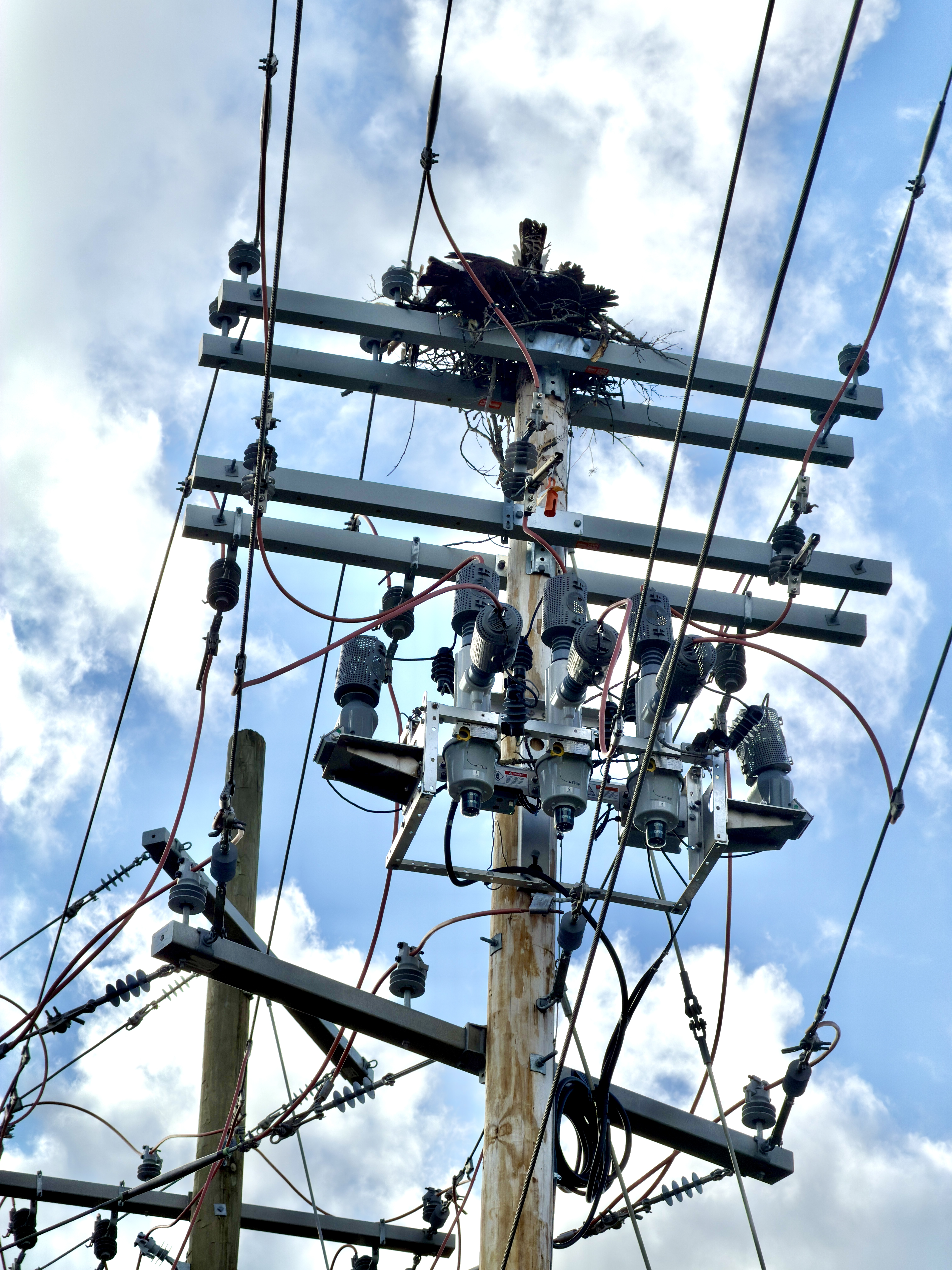
A view of the newly installed smart recloser—an automated high-voltage switch designed to improve grid reliability by detecting and "clearing" temporary faults like falling branches. While effective for traditional debris, this device and its crossarms created a lethal, unmonitored bridge for the returning ospreys, which was never detected by the system's "smart" sensors.
At an outreach event for municipalities and public officials a couple years ago they shared with me that all of the recent outages in Camden had been caused by squirrels at the substation. They showed me photos of the electrocuted squirrels when I expressed skepticism. That was at a private event and you won’t find it in the official press releases, probably because it makes the whole thing seem a lot less sophisticated than we might imagine.
The real culprit and thorn in the side of CMP are the trees. They rarely miss an opportunity to remind Mainers how much trouble the trees are causing them. Since Mainers have resisted cutting them all down, CMP says they are investing in heavier wire and heavier poles. They are currently asking for a $189 million rate hike largely to fund aggressive tree trimming and “grid hardening.”
So what’s causing the outages? Ospreys, squirrels, trees? I understand it’s complicated but considering that CMP shareholders are entitled to a 10% return on their investment for necessary capital expenditures, I think it’s fair to understand what the research shows.
And shouldn’t IF&W be concerned about these impacts? Remember, unless Maine is some great anomaly, raptors are dying silently by the millions every year.
The most disturbing part of this incident isn't just that it happened, but that the only reason we know about it is because a neighbor happened to notice a lifeless body and spoke up.
If that citizen hadn't reported it, these birds wouldn't have just disappeared; they would have become a lethal lure. When a raptor dies and remains in the nest, it attracts scavengers—crows, hawks, or eagles. In a configuration as crowded as this new "smart" pole, the next bird to land for an easy meal is just as likely to complete the same mortal bridge, leading to a stack of casualties that CMP’s system is apparently designed to ignore.
We live in a world of strict codes for a reason. If I want to wire a shed in my backyard, I have to follow the National Electrical Code to ensure it doesn't kill me or burn down my neighbor's house. Our Legislature recently recognized this same logic for wildlife, passing a law (LD 670) that requires bird-safe glass in new state buildings to prevent collisions. We have codes for human safety and now codes for window safety—yet when it comes to the multi-billion dollar infrastructure crisscrossing our entire state, there is not a single law requiring known, industry-standard engineering solutions to prevent the electrocution of our iconic ospreys and eagles.
And then there are bird collisions with power lines which is a separate but related issue.
This regulatory vacuum is a choice. While federal protections under the Migratory Bird Treaty Act have been weakened under the Trump administration to exclude "incidental" deaths, Maine has the power to close the gap.
As the Maine PUC reviews CMP’s $189 million request for "modernization," we must ask why that money isn't tied to the same level of code enforcement we expect from every other builder in the state. We are paying for "smart" technology that is smart enough to keep the power on, but too dumb to know when large raptors are electrocuted. Ospreys, eagles, and falcons have been coming back from extinction in a success story that we are all proud of, so shouldn't we commit to at least attempting to avoid killing them? Yes, some are going to be killed, but if we are making massive grid investments, shouldn't we also check to make sure we are not about to significantly add to the number killed?
Many utilities, some of them publicly owned, have implemented design standards, standards that have existed for years. It is time for CMP, IF&W and the PUC to stop treating these deaths as inevitable byproducts of modernization and start treating them as a problem that deserves the same kind of research and solutions that have been implemented elsewhere. Some deaths are going to happen. Nature is cruel. So are humans. But give us the science and be transparent about the real costs and benefits.
In this moment, we are focused on the nests we can see, but the real tragedy is the mortality we don't. Science tells us that 90% of bird electrocutions never cause an outage and there is evidence to suggest this advanced technology will cause more silent kills with no one around to notice. While CMP asks for $189 million to install more 'smart' reclosers, they are actually installing the most lethal hardware in their inventory without the 3D molded covers required to make them safe.
But it's not the power company's job to be experts on protecting birds. It's not their job to define the public priorities. It's their job to follow the law and the advice of state resource agencies. It's our job to set the priorities for our service level and our shared natural resources, and if we don't make it a priority, CMP isn't about to spend extra time and money on the issue. I can't say I blame them.
Maine IFW has made it very clear they are not making this a priority. Now it's our job to tell them that raptors like ospreys, hawks, and eagles matter to Mainers and we aren't ok with lagging behind the rest of the country in implementing protections for them. Here is a short video about raptors on power lines and what can be done through better design to prevent their deaths. It's a good primer on the causes and solutions.https://youtu.be/oStjxi7WS0k?si=vYhE2yruugXmo69x
Links to resources mentioned:
- CMP crew determines osprey nest cause of Camden power outage (Tannery Lane, July 27, 2023): Read Articles
-
Maine LD 670 (Public Law 2023, c. 221): An Act to Protect Birds and Wildlife in the Construction and Maintenance of Public Buildings: View Official Guidelines (PDF)
-
BirdSafe Maine - Maine Audubon Advocacy: Maine Audubon Resource
-
Avian Power Line Interaction Committee (APLIC): APLIC Official Site
-
USFWS: Migratory Bird Treaty Act Summary: USFWS Resource
-
Dead osprey discovered in nest atop Camden CMP power pole, sparks community outrage (PenBay Pilot, May 4, 2026): Read Article
-
https://www.cmpco.com/w/cmp-installs-250-smart-devices-on-maine-s-energy-grid-in-2025
-
Camden residents voice concerns after ospreys found dead (Video, May 8, 2026): Watch Video
Alison McKellar lives in Camden and is currently the vice-chair of the Camden Select Board. Her opinions and commentary are her own and are not intended to represent the views of the Select Board nor the town of Camden. she can be reached at alisonmckellar@gmail.com