National Audubon Society’s first fully electric passenger boat launches at Hog Island
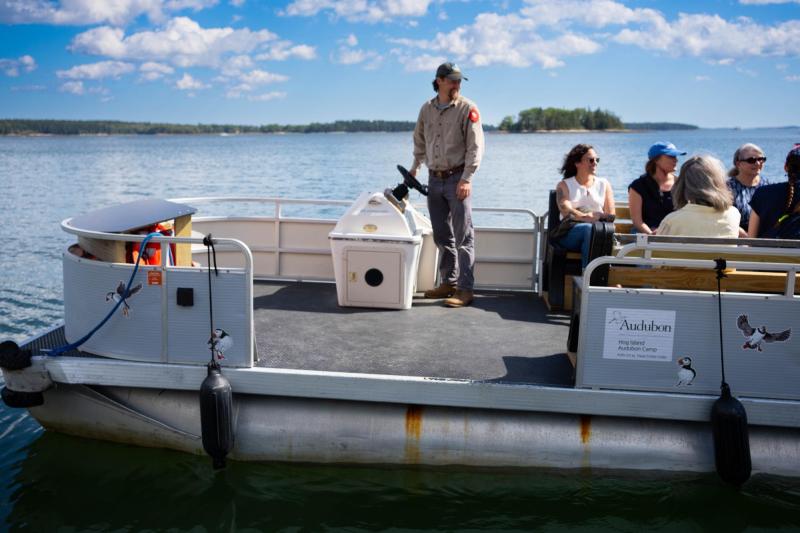 Eric Snyder, facilities and operations manager at National Audubon Society’s Seabird Institute, captains an electric-powered passenger boat at Hog Island Audubon Camp. (Photo courtesy Island Institute)
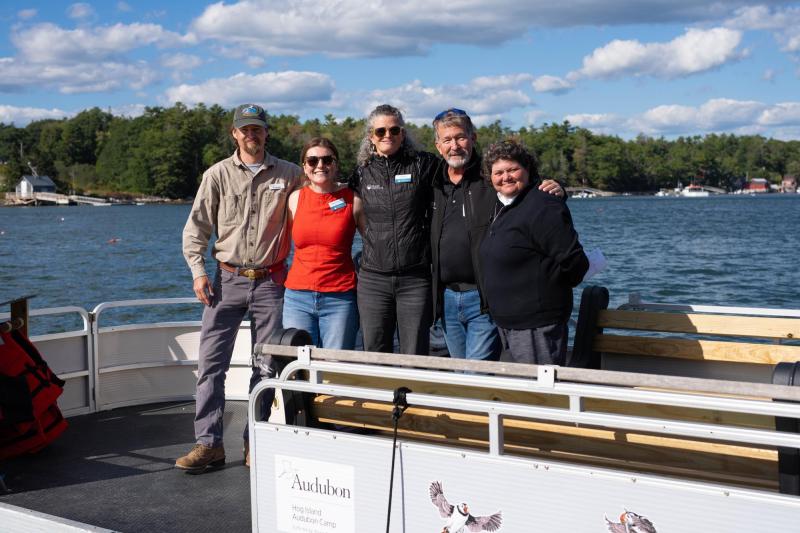 Project partners, from left: Eric Snyder, National Audubon Society’s Seabird Institute; Phoebe Walsh, Island Institute; Lia Morris, Island Institute; Tom Watson, ePropulsion; and Laurie Bragg, National Audubon Society’s Seabird Institute. (Photo courtesy Island Institute)
Eric Snyder, facilities and operations manager at National Audubon Society’s Seabird Institute, captains an electric-powered passenger boat at Hog Island Audubon Camp. (Photo courtesy Island Institute)
Project partners, from left: Eric Snyder, National Audubon Society’s Seabird Institute; Phoebe Walsh, Island Institute; Lia Morris, Island Institute; Tom Watson, ePropulsion; and Laurie Bragg, National Audubon Society’s Seabird Institute. (Photo courtesy Island Institute)
Project partners, from left: Eric Snyder, National Audubon Society’s Seabird Institute; Phoebe Walsh, Island Institute; Lia Morris, Island Institute; Tom Watson, ePropulsion; and Laurie Bragg, National Audubon Society’s Seabird Institute. (Photo courtesy Island Institute)
Eric Snyder, facilities and operations manager at National Audubon Society’s Seabird Institute, captains an electric-powered passenger boat at Hog Island Audubon Camp. (Photo courtesy Island Institute)
Project partners, from left: Eric Snyder, National Audubon Society’s Seabird Institute; Phoebe Walsh, Island Institute; Lia Morris, Island Institute; Tom Watson, ePropulsion; and Laurie Bragg, National Audubon Society’s Seabird Institute. (Photo courtesy Island Institute)
A new electric-powered boat at Hog Island Audubon Camp is putting coastal resilience into practice, demonstrating how clean energy can support the people, organizations, and ecosystems that make Maine’s coast thrive, according to a news release. This vessel is the first fully electric passenger boat in National Audubon Society’s fleet.
The National Audubon Society’s Seabird Institute, Island Institute, and ePropulsion, through its North American distributor Mack Boring & Parts, Co., have launched a refurbished pontoon boat powered by a 20-kilowatt ePropulsion X20 electric outboard motor at Hog Island Audubon Camp in Bremen.
On Sept. 18, Island Institute and its partners brought together funders, state and local leaders, energy utilities, nonprofit organizations, and other stakeholders at Hog Island to see the boat in action, build awareness, and grow support for electric marine propulsion.
The vessel transports people and supplies between the mainland, Hog Island and other coastal research operations from April through October. On busy operational days, the boat could make more than 25 round trips between Hog Island and the mainland.
“Hog Island is becoming Audubon's model for understanding environmental change and developing adaptation and resilience solutions,” said Laurie Bragg, Center Director for Audubon’s Seabird Institute. “It takes partnerships, expertise, creativity, and a willingness to invest in climate-friendly solutions to achieve a more resilient future. This investment from Island Institute and ePropulsion not only allows us to reduce our footprint, but it provides an opportunity to educate campers from across the country about coastal resilience.”
For 90 years, Hog Island has been a place where people come to experience and learn about the Gulf of Maine. As the National Audubon Society’s only residential camp facility, it brings together hundreds of campers, volunteers, researchers and other visitors each year to learn about conservation, ornithology, ecology and the natural world.
Now visitors have the opportunity to experience the benefits of electric outboards firsthand. Electric propulsion is significantly quieter than a conventional gasoline-powered outboard, reducing engine noise in an area used for wildlife observation and research. For Hog Island, the transition is also expected to save thousands of dollars in gasoline and future maintenance costs, while also reducing carbon emissions.
“For more than five years, we’ve worked alongside Maine’s commercial boat operators to prove that electric propulsion can hold up on a working waterfront,” said Lia Morris, Senior Community Development Officer at Island Institute. “Hog Island gives us a chance to bring that same work into a new setting and show just how many ways this technology can support coastal operations. The case for clean, quiet boats keeps getting stronger.”
As Maine’s working waterfronts face rising costs, climate impacts and aging infrastructure, electric propulsion offers an opportunity to make coastal operations more resilient, according to the news release. Since 2020, Island Institute has helped lead Maine’s transition to marine electrification, working with commercial operators, technology companies and other partners to test and put electric propulsion to work on the water. Island Institute has supported the transition of 23 vessels to electric power across aquaculture, fishing and other coastal operations, using demonstration projects and real-world data to build confidence in the technology and identify opportunities for broader adoption. The Hog Island project expands that work into a new coastal application and demonstrates what cleaner, quieter marine operations can look like in Maine.
“It has been a pleasure working with Island Institute to help bring awareness of the capabilities of electric propulsion to the State of Maine, both in recreational and commercial applications,” said Tom Watson, President of ePropulsion Americas. “Our cutting-edge technology provides quiet, sustainable and effective propulsion that allows visitors of Hog Island to enjoy the peaceful beauty of the region, without disturbing the natural habitat. We are grateful for this continued partnership with Island Institute and the trust of the National Audubon Society in allowing us to safeguard their guests and this fragile ecosystem.”
Island Institute’s electric boat initiative is made possible with funding support from Builders Vision, Maine Technology Institute, the State of Maine, and corporate sponsors.
About Island Institute:
Founded in 1983 and based in Rockland, Island Institute is a community development nonprofit that boldly navigates climate and economic change with island and coastal communities to expand opportunities and deliver solutions. For more information, visitwww.islandinstitute.org.
About the National Audubon Society:
The National Audubon Society is a leading nonprofit conservation organization with 120 years of science-based, community-driven impact, dedicated to protecting birds and the places they need, today and tomorrow. Birds are powerful indicators of our planet’s health, acting as sentinels that warn us of environmental change and inspire action. Audubon works across the Western Hemisphere, driven by the understanding that what is good for birds is good for the planet. Through a collaborative, nonpartisan approach across habitats, borders, and the political spectrum, Audubon drives meaningful and lasting conservation outcomes. With over 1,000 staff and more than 2.6 million supporters, Audubon is a dynamic and ever-growing force committed to ensuring a better planet for both birds and people for generations to come. Learn more at audubon.org and on Facebook and Instagram @audubonsociety.
The National Audubon Society’s Seabird Institute conducts research and conservation work focused on seabirds and the marine ecosystems they depend on. Hog Island Audubon Camp, located in Bremen, Maine, provides residential educational programs that connect people with the natural world and the Gulf of Maine. For more information, visit www.audobon.org/seabird-institute.
About ePropulsion:
ePropulsion was set up in 2012 and is led by a team of technology entrepreneurs that are focused on developing uncompromising superior products. Since the company launched its first electric outboard it has fast become a force to be reckoned with in the electric propulsion market with a presence across Europe, the US and Asia. ePropulsion set out with a clear mission to become the global leader in marine electric propulsion systems and services. This pioneering, market challenger brand is at the very forefront of the industry and is recognized across the world for its exceptional product quality, performance, and technological innovations.
ePropulsion was the first company to launch a brushless, direct-drive electric outboard motor in the market and offers a portfolio of 1 – 6kW outboard engines across its Spirit and Navy ranges. These are renowned for being high quality, quiet, eco-friendly and low maintenance. In 2022, ePropulsion expanded its OEM capabilities with the global debut of the H-Series, an innovative 60-250kW electric inboard motor for vessels between 60 to 100’ (18-30m) with full displacement up to 200 tons. Subsequently, the I-Series was introduced, an environmentally friendly electric inboard motor series with advanced technology, smart features, and human-centric design. Supported by the ePropulsion Smart System Architecture (eSSA) and IoT connectivity service, it offers users an unmatched, easy-to-use, intelligent, safe, and reliable experience. The latest additions to the lineup include the X Series and the eLite Motor. Unveiled at Fort Lauderdale International Boat Show and METSTRADE 2023, the X Series features three innovative electric outboard motors—X12, X20, and X40—delivering remarkable propulsion systems with ingenious features. The all-new eLite is the smallest electric outboard in ePropulsion’s extensive portfolio. Benefiting from new technology and meticulous design, the eLite is set to transform the tender and small boat market.
ePropulsion remains focused on providing customized and pioneering services for OEMs across the world, offering fully flexible solutions for a wide range of commercial and leisure marine applications. www.ePropulsion.com