Maine Dept. of Labor November report: Unemployment rate unchanged; number of jobs slightly increases from October

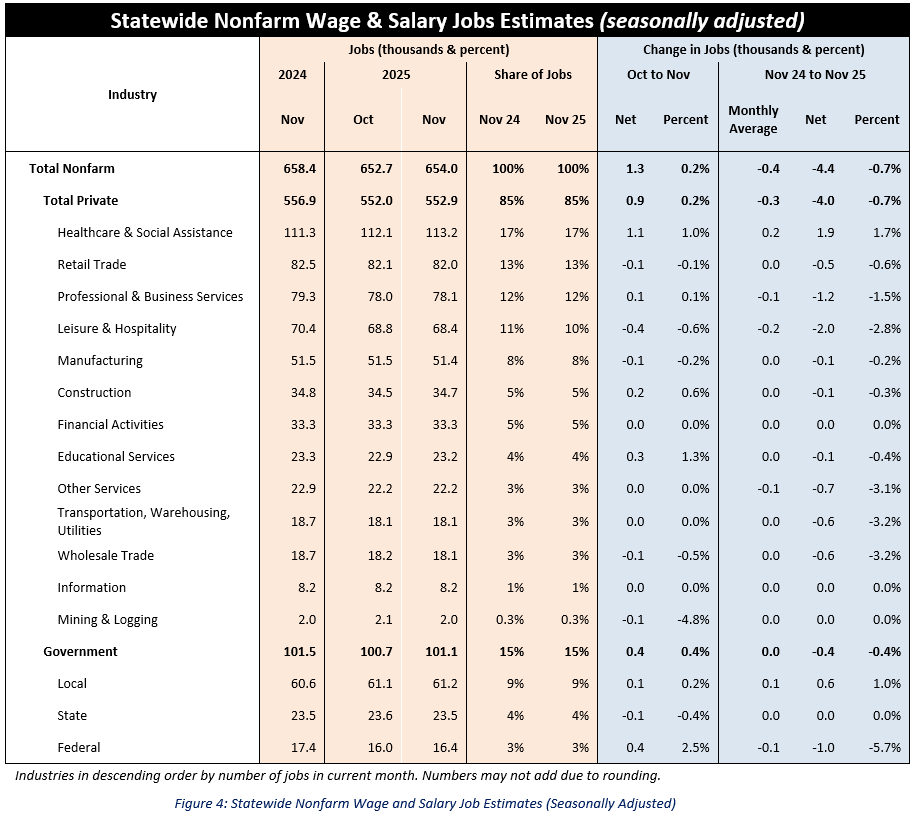
The Maine Dept. of Labor reported Jan. 7 that the unemployment rate in the state remain unchanged in November at 3.2 percent and the number of nonfarm wage and salary jobs increased by 1,300 in from a 30-month low in October.
The number of jobs decreased by 4,400 from January 2025 and almost 6,000 from the peak in Fall 2024, the report said.
The Dept. of Labor issues a monthly report and the Jan. 7 release covers the month of November 2025. The report acknowledged that the one federal survey that is used regularly in the analysis was not available due to the federal shutdown.
The leisure and hospitality and the professional and business services sectors, combined with federal government, accounted for most of the job decrease, though most sectors were down. Job gains in healthcare and social assistance partially offset the broader trend.
The estimates are derived from two monthly surveys, the report said.
The Current Population Survey collects information from households on labor force status, including labor force participation, employment, and unemployment.
The Current Employment Statistics survey collects information from nonfarm employers by industry on the number of wage and salary jobs, hours worked, and wages paid to individuals on their payrolls. Both surveys are administered by the U.S. Bureau of Labor Statistics.
"Preliminary estimates from the two surveys sometimes diverge in direction or magnitude of change," the report said. "Over extended periods they tend to be more aligned."
Seasonally Adjusted Statewide Labor Force Estimates
The 3.2 percent unemployment rate was unchanged from September. (The Current Population Survey of households was not conducted during the federal government shutdown that began in October. Unemployment and labor force estimates for the month are not currently available.)
Year to date, unemployment rates have dipped somewhat even as employment rates also dipped. A factor in this pattern may be more people reaching retirement than young people aging into the labor force, though these indications could change when more complete data are incorporated with annual estimate revisions.
Unemployment has been below four percent for 47 months, approaching the previous long of 49 months that ended in the spring of 2020.
Maine’s unemployment rate has been below the U.S. average for all but three months for more than 17 years, and below the long-term average of 5.4 percent for the state since 1976.
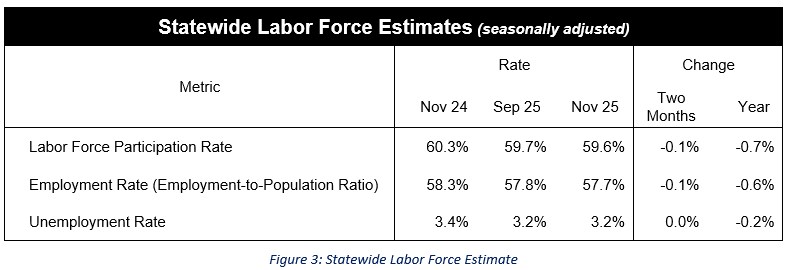
Unemployment averaged 4.2 percent for New England and 4.6 percent for the U.S. in the month.
Note on Preliminary Unemployment Estimates: They should be considered in the context of whether they are below, near, or above historical or U.S. averages, rather than if they are up or down a few tenths of a point from some other month. The household survey sample they are derived from is large enough for direct estimates for the nation.
For states it is much smaller and statistical modeling is used to prevent large single-month changes that may overstate the magnitude or the direction of changes in labor market conditions.
One result of this is that preliminary unemployment rates for Maine tend to follow an undulating pattern, moving in one direction for several months and then the other through the course of a year. Revisions, published annually in March, have consistently smoothed these patterns.
Upward or downward changes in preliminary unemployment or labor force participation rates often are not as indicative of improvement or deterioration in conditions as may appear. Though rates for many months will change when revised, unemployment rates for 2024 and to date in 2025 certainly will remain well below the long-term and national averages.
Seasonally Adjusted Statewide Nonfarm Jobs Estimates
Preliminary seasonally adjusted estimates indicate nonfarm wage and salary jobs increased by 1,300 in November from a 30-month low in October. (Data for the Current Employment Statistics survey of employers was collected for October.) The number of jobs decreased by 4,400 from one year ago and nearly 6,000 from the peak in the fall of 2024. The leisure and hospitality and the professional and business services sectors, combined with federal government, accounted for most of the decrease, though most sectors were down.
Job gains in healthcare and social assistance partially offset the broader trend.
Note on Preliminary Nonfarm Jobs Estimates
Preliminary estimates of nonfarm jobs from the payroll survey of employers tend to provide a better indication of the magnitude and direction of change than labor force and unemployment estimates from the household survey. The payroll survey is much larger and revisions to jobs estimates tend to be smaller.
Not Seasonally Adjusted County and Metro Area Labor Force Estimates
On a not seasonally adjusted basis, the statewide unemployment rate was 3.4 percent. Rates were at least 0.3 percentage points higher than that in six counties, at least 0.3 points lower than that in two, and close to the average in eight. Rates were lowest in outhern and Midcoast counties and highest along the northern rim of the state.
Among the three metro areas, unemployment was below the statewide average in Portland-S. Portland, and close to the average in Lewiston-Auburn and Bangor.
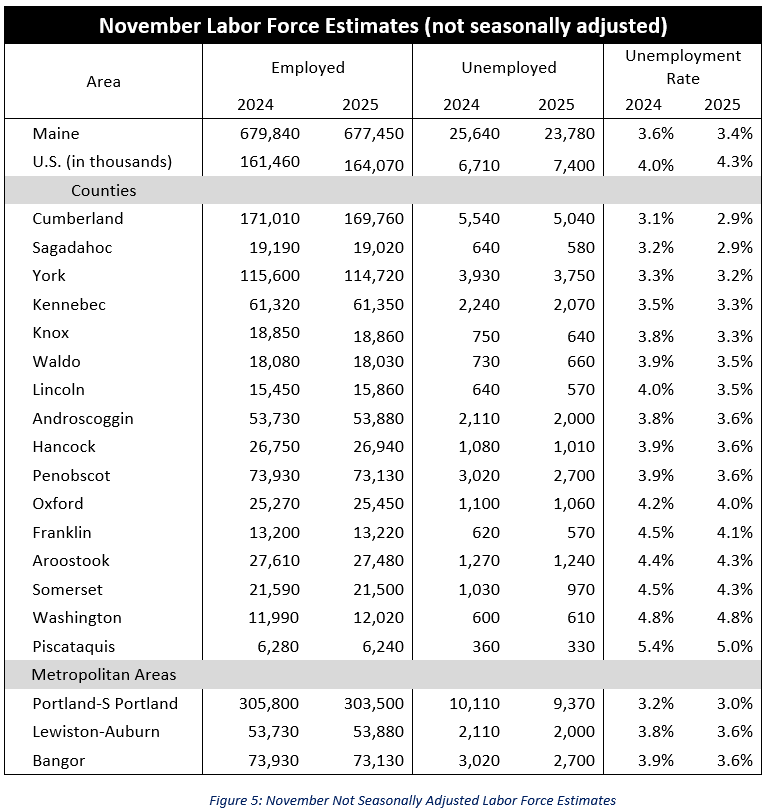
(Labor force estimates for substate areas, including unemployment rates, are not seasonally adjusted. Because of this, estimates for a certain month should be compared to the same month in other years and should not be compared to other months in the same or other years.)
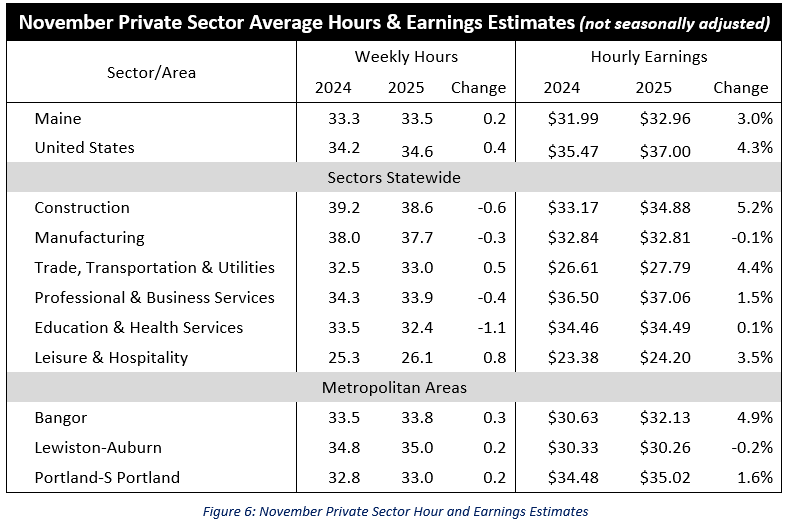
Not Seasonally Adjusted Statewide and Metro Area Hours and Earnings Estimates
The private sector work-week averaged 33.5 hours and earnings averaged $32.96 per hour in November.
Average hours increased slightly, and hourly earnings increased 3.0 percent from a year ago.
The workweek was longest in construction and shortest in leisure and hospitality.
Earnings were highest in professional and business services and lowest in leisure and hospitality.
Hourly earnings were above the statewide average in Portland-S. Portland and below it in the Bangor and Lewiston-Auburn metros.
December workforce estimates will be published Tuesday, January 27 at 10 a.m.
The data release schedule is here.
Nonfarm jobs data is available here
Unemployment and labor force data is available here
NOTES: Preliminary seasonally adjusted labor force estimates, including rates (labor force participation, employment, and unemployment rates), and levels (labor force, employed, and unemployed), as well as nonfarm wage and salary job estimates are inexact.
Annual revisions (published in March each year) add accuracy. A comparison of 2023 and 2024 previously published to revised estimates is available in this blog.
The 90 percent confidence interval for the statewide seasonally adjusted unemployment rate for November was between 2.5 and 4.0 percent.
Nonfarm wage and salary jobs from the payroll survey provide a better indication of changes in employment than resident employment from the household survey.
The payroll survey is larger and has smaller margins of error.
Nonfarm payroll jobs estimates tend to be variable from month to month because the representativeness of reporting employers can differ.
Seasonal adjustment is imperfect because weather, the beginning and ending of school semesters, and other events do not always occur with the same timing relative to the pay period that includes the 12th day of the month, which is the survey reference period. This sometimes exacerbates monthly changes in jobs estimates.
Users should look to trends over multiple months rather than change from one specific month to another. Jobs estimates for the period from April 2024 to September 2025 will be replaced with payroll data in March 2026. Those benchmark revisions usually show less monthly variability than previously published estimates.Maine CareerCenters and Maine Department of Labor are equal opportunity providers.
Auxiliary aids and services are available to individuals with disabilities upon request.