
The cost of treating addiction in Maine’s jails
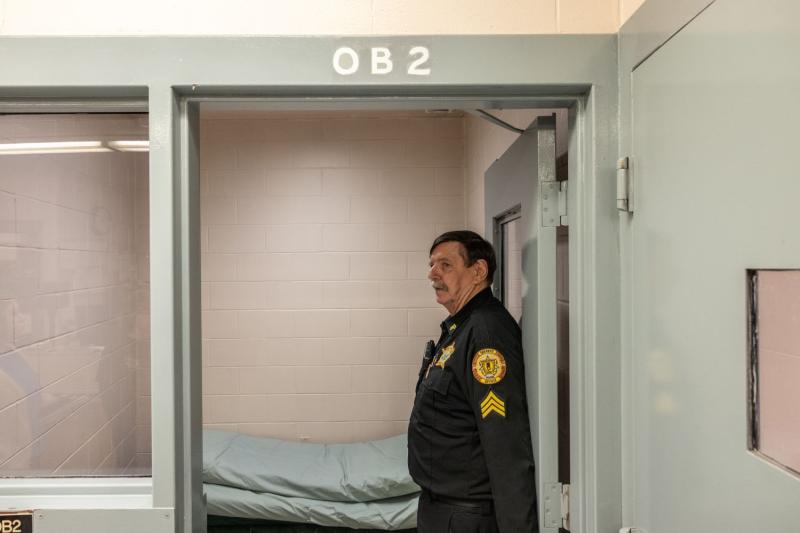 Sgt. Alan Wintle, a corrections officer at the Piscataquis County Jail in Dover-Foxcroft, stands in the doorway of an observation cell where people withdrawing off drugs and alcohol are temporarily held. Photo by Greta Rybus for The Maine Monitor.
Sgt. Alan Wintle, a corrections officer at the Piscataquis County Jail in Dover-Foxcroft, stands in the doorway of an observation cell where people withdrawing off drugs and alcohol are temporarily held. Photo by Greta Rybus for The Maine Monitor.
Sgt. Alan Wintle, a corrections officer at the Piscataquis County Jail in Dover-Foxcroft, stands in the doorway of an observation cell where people withdrawing off drugs and alcohol are temporarily held. Photo by Greta Rybus for The Maine Monitor.At the Piscataquis County Jail in Dover-Foxcroft, the smallest in the state, corrections officers sometimes spend hours a day administering medications to people in their custody.
One by one, prisoners are taken to a windowless booking area and seated across a counter from an officer. Those who are receiving treatment for an addiction to opioids, such as heroin or fentanyl, go last.
After checking the prisoner’s medical record, a corrections officer hands them a dose of a combination medication of buprenorphine and naloxone, commonly known by its brand name Suboxone, which tamps down withdrawal symptoms and cravings. Though not as strong as an opioid painkiller like oxycodone, it is still a partial opioid that can be misused. To prevent smuggling, officers watch and wait while the crushed pills dissolve under prisoners’ tongues, then have them drink a cup of water and eat a cracker before sending them back to their pods. The process can take up to 15 minutes per person. On one day in early April, 7 of the 19 people in custody received a dose.
Maine’s county jails have been required to provide medications for opioid use disorder for the past seven years, the result of a landmark court ruling in 2019. Jail officials have come to see the value of such treatment, in part for the potential it holds to help reduce recidivism, but finding the money to pay for the medication remains an ongoing challenge amid a broader debate about how jails are funded.
Medical costs at the state’s 15 jails have been rising in recent years, growing nearly 40 percent between 2023 and 2025, according to a January report from the Maine County Corrections Professional Standards Council. That report also estimated, for the first time, how much jails are spending on addiction and mental health treatment, a total that came to over $12.6 million last year.
As these costs, and the costs to staff the jails, have risen, the amount the state contributes to Maine’s county-run jails has largely stayed the same, leaving counties –– and their taxpayers –– responsible for a growing share of the expenses.
Some counties have turned to other, temporary sources of funding, such as opioid settlement dollars and pandemic relief money, to pay for addiction treatment and medical expenses in their jails — but they argue this is unsustainable, especially as increasing health needs come up against space constraints in their aging facilities.
“The individuals coming in today, unfortunately, are checking every box,” Penobscot County Sheriff Troy Morton told lawmakers in March. “There’s violence, there’s mental health, there’s substance use … We’re dealing with people [who are] incredibly expensive to manage.”
‘Unfunded mandate’
In February 2019, shortly after taking office, Gov. Janet Mills signed an executive order that directed the Maine Department of Corrections to pilot a medication-assisted treatment program in prisons and encouraged county jails to do the same. In Maine, prisons are state-run while jails are run by counties, leaving the governor with limited power to direct jails to do anything without legislative changes.
A couple of months later, a slate of federal judges upheld a ruling by a lower court that found that the Aroostook County Jail in Houlton would be in violation of the Americans with Disabilities Act if it refused to allow a prisoner to continue medication-assisted treatment. It was a landmark ruling that meant all jails and prisons in the First Circuit –– Maine, Massachusetts, New Hampshire, Rhode Island and Puerto Rico –– would have to provide addiction treatment to any person with a substance use disorder in their custody.
In May 2022, Mills signed a bill codifying this requirement in Maine law and establishing the County Jail Operations Fund, which appropriated an annual sum of $20.3 million across the 15 jails, plus anything additional appropriated by the Legislature. At least a quarter of this money must be used for county corrections programs, such as work release and community service. The law also capped how much counties could raise taxes to pay for jail costs.
In the years since, state spending has largely remained the same while the total cost to run jails has risen by more than a third, according to the January report from the Maine County Corrections Professional Standards Council. When the 2022 bill was crafted, the annual cost to run all 15 jails was about $100 million, putting state support at about 20 percent of total expenses, said Tim Curtis, the Somerset County administrator and a member of the corrections council. The report estimated jails’ expenditures to top $141 million this year, meaning the state’s $20.3 million contribution would account for less than 15 percent of total costs.
Meanwhile, several counties have incurred large deficits in their jail budgets over the past few years. Officials say the rising costs are outpacing available funding and the limit on tax increases is hampering their ability to keep up.
The Legislature acknowledged the need for more funding this year and appropriated a one-time addition of $4 million — watered down from a proposed extra $10 million annually. To Curtis, this was a “band-aid.”
The Mills administration told The Maine Monitor it has heard county officials’ concerns about funding and has worked with the Legislature to make additional appropriations. But the state has limited authority over county-run jails, a spokesperson for the governor, Anna Parker, said in a statement.
“The Governor would encourage the incoming Administration to continue working with the Legislature to support this important initiative, while also continuing to work with county leaders on strategies to effectively manage finances related to county jail operations,” Parker said.
County officials have called the requirement to provide addiction treatment an “unfunded mandate,” referring to a section in the Maine Constitution that says that the state cannot require local governments to make cost-incurring changes to their operations unless the state provides 90 percent of the funding. The nonpartisan Office of Fiscal and Program Review generally flags any potential state mandates in fiscal notes attached to proposed legislation for the legislative committee to consider. The only way to exempt legislation identified as a state mandate from the 90 percent state support requirement is by a two-thirds majority vote in both chambers.
Gordon Smith, Mills’ director of opioid response, said he has long “bristled” at the idea that county officials see providing addiction treatment as an unfunded mandate. For one, the Office of Fiscal and Program Review did not flag the bill as a state mandate in its fiscal note. Regardless, Smith said, the 2019 court order established that jails must provide addiction treatment to prisoners.
“They are your residents and it’s your constitutional responsibility and certainly a responsibility under the Americans [with] Disabilities Act to treat them for illnesses,” Smith said. “You can’t discriminate because the illness happens to be mental illness or substance [use].”
Previously, most jails in Maine only provided medication-assisted treatment to pregnant women, if at all. Opioid-related overdose is the leading cause of death nationwide among people recently released from a jail or prison.
After Rhode Island became the first state to implement a comprehensive medication-assisted treatment program in its jails and prisons in 2016, fatal overdoses among those recently released from incarceration declined by 12 percent.
Funding sources
As this debate over jail funding has played out, the County Corrections Professional Standards Council, a committee of seven local and state officials, tried to measure how much jails were spending on various expenses and published their findings in their January report.
The council report came to the conclusion that personnel and medical costs are driving jails’ budget crises. Personnel costs, which accounted for about 63 percent of all jail expenses last year, increased by about a quarter from 2023 to 2025, far exceeding the rate of inflation. Prisoners’ medical costs –– 16 percent of jails’ total costs –– increased by more than a third during the same period.
Jail officials have pointed to medication-assisted treatment as a particular burden. But the council found that getting a clear picture of this spending is challenging, said Curtis, the Somerset County administrator.
The monthly reports jails are required to submit to the Department of Corrections do not include any spending that comes from grants or opioid settlement funds, nor do they break down medical spending into subcategories. The result is an incomplete snapshot of spending on medical services that does not fully capture the effect that addiction and mental health services have on jails’ budgets.
The only way to estimate how much each county spent on medication-assisted treatment and mental health care last year, Curtis said, was to work individually with each jail to review expenses.
Grant and opioid settlement money that Franklin and Somerset counties each used to pay for their extended-release, injectable buprenorphine programs last fiscal year, for example, was not included in the total medical spending reported in the DOC’s system.
In the council report’s estimates, some counties included indirect spending on medication-assisted treatment, Curtis said. York and Cumberland counties included American Rescue Plan Act funds that are being put toward new facilities that will be used to provide treatment services.
In total, the council found that counties spent about $9.1 million on medication-assisted treatment and more than $3.5 million on mental health care last fiscal year, according to the report. This ranged from just over $180,000 at the Washington County Jail to nearly $1.8 million at the Somerset County Jail.
The Maine Monitor also tried to measure this spending, and sent records requests for data on finances to the 15 agencies that run the jails, asking for the total spent on medical services and addiction treatment last fiscal year. All but two agencies –– the sheriffs’ offices in Oxford and York counties –– responded.
The numbers some jails provided to The Monitor differed from the numbers in the council report: For example, Androscoggin County told The Monitor it spent about $180,000 on medication-assisted treatment last year but according to the council report, it spent over half a million dollars.
Curtis said this could be because of the same issue the council ran into: the jails’ financial reporting systems are not yet set up to track these costs in a standardized way. It could also be because the council’s estimates included some one-time expenditures, such as the construction of new medical wings.
Responses to The Monitor’s requests showed a hodgepodge approach to data collection, from the level of detail in counties’ expense reports to the specific spending categories they track. Still, the records made clear how jails have tried to keep up with the growing costs by turning to state and federal grants, pandemic relief funds and opioid settlement money.
Contracts from the Maine Department of Administrative and Financial Services showed that since 2022, 10 of the agencies that run jails have received nearly $5.2 million from the Department of Health and Human Services for medication-assisted treatment.
Over the past seven years, DHHS and the Department of Public Safety have awarded six counties just under $1.9 million in direct or federal pass-through grants for addiction treatment. Separately, Cumberland and Franklin counties each received $1 million grants from the U.S. Department of Justice’s Comprehensive Opioid, Stimulant, and Substance Use Program.
Counties have also used $2.25 million in opioid settlement funds — money local and state governments have received from pharmaceutical companies accused of fueling the opioid epidemic — to pay for addiction and mental health treatment in jails. This has drawn the criticism of people who say the money should instead be spent on community-based programs.
Pinpointing exactly how many people are receiving addiction treatment also proved difficult. In response to a records request for jails’ quarterly reports on medication-assisted treatment submitted to the DOC, the department told The Monitor that data for last year is incomplete and may be inaccurate due to changes in its data collection procedures. Only nine jails were able to provide these numbers to The Monitor; those show at least 3,446 prisoners received medication-assisted treatment last year.
Growing need
County officials have said rising costs are linked to prisoners’ growing medical and mental health needs. Approximately 75 percent of people in county jails have a substance use disorder, and approximately 60 percent have a mental health disorder, according to testimony from the Maine County Commissioners Association.
Individuals being booked into jails have a long list of chronic conditions that often require immediate care, from severe withdrawal from opioids and septic skin wounds from injecting drugs mixed with an animal tranquilizer, to diabetes and heart disease, jail officials said. In many cases these issues have gone untreated for years. The officials said they have seen prisoners’ medical needs grow as increasingly lethal drugs, such as fentanyl and xylazine, have spread in Maine.
Kyle Manahan, the Cumberland County Jail’s former health services administrator, estimated that for every 10 prisoners there’s at least one person detoxing off opioids, alcohol, benzodiazepines or methamphetamine on any given day. The daily average population at the jail last year was nearly 400 prisoners.
“We’re probably the largest detox center in the state,” Manahan said.
Cumberland County Sheriff Kevin Joyce agreed, saying the jail is likely also Maine’s largest mental health institution. A lack of available mental health beds means that some people remain in custody despite court orders transferring them to state psychiatric facilities.
In some cases, prisoners are in such bad shape when they enter custody that jails have to transport them to local hospitals for treatment. Although services are billed to MaineCare as soon as a prisoner is admitted to a hospital, counties usually foot the bill for transportation. Plus, at least one corrections officer or sheriff’s deputy must accompany a prisoner at all times while in the hospital, at a significant cost to a county. (Maine’s application for an 1115 waiver –– which would allow correctional facilities to bill Medicaid for some medical and behavioral health services provided to prisoners up to 90 days before their release –– is still under review by the federal government.)
Even five years ago, hospital admissions were infrequent, said Joyce. Admissions lately have been “unprecedented.” During the fiscal year that ended last summer, 24 prisoners from the Portland jail were admitted to a hospital and were there for an average of six days, according to records requested by The Monitor. It cost the county nearly $61,000.
In an appeal to build a new jail, Penobscot County’s commission chair Andre Cushing earlier this year pointed to an instance in which a prisoner hospitalized for just over a day cost the county $27,000 in officer overtime.
The proposed jail in neighboring Hampden, which could cost as much as $84.5 million to build, would hold more people and have updated medical facilities that the aging Bangor jail currently lacks. This effort has been met with pushback, with a group called No Penobscot Jail Expansion saying the money should instead be spent on programs that prevent people from going to jail in the first place.
Adding medical services has been a challenge with limited space, jail administrators said. Some have taken steps to address that by turning closets and offices into medical exam rooms or, as is the case for Franklin County and Cumberland County, using American Rescue Plan Act funds to build new medical wings.
Major renovations are still years away for others, as is the case for the Aroostook County Jail. The Houlton jail was built in 1886, making it the oldest in the state. The last major renovation was 50 years ago and nearly every space in the jail has been repurposed at some point or another as needs changed, jail administrator Craig Clossey said. Plans have been underway to build a new jail for a year and a half, but Clossey said that project is still years away from completion.
Some jails have considered consolidating resources. The sheriffs from Androscoggin, Franklin and Oxford counties last fall proposed exploring a regional jail similar to Two Bridges Regional Jail in Wiscasset, which is funded by Lincoln and Sagadahoc counties, as a way to ease overcrowding and save on staffing. The corrections council encouraged solutions like this but the proposal died earlier this year.
The concerns about space constraints come as a shortage of defense attorneys and pandemic-related delays have left people sitting in jails longer, leaving counties on the hook for medical expenses for extended periods of time. According to a U.S. Department of Justice census, 66 percent of people incarcerated in a Maine jail in 2019 were pre-conviction. Last year, close to 80 percent of prisoners on average were awaiting trial, 10 agencies said in response to The Monitor’s records requests.
Maine’s treatment and recovery courts are one way prosecutors have tried to divert people away from jails. Through these courts, individuals who meet certain criteria can avoid jail time if they complete specialized programs aimed at addressing the underlying substance use or mental health factors that may have led to criminal conduct. There are 15 of these courts across the state; the latest opened in Caribou in June.
But their reach, at least so far, is limited. Nearly 500 people participated in one of the state’s treatment courts last year. More than 25,000 people, meanwhile, were booked in county jails.
The average daily population across all jails was nearly a quarter greater last year than it was in 2021, marking a return to pre-pandemic population levels, according to the corrections council report. The number of people booked into jails increased by nearly half during the same time period.
“The jail is like the emergency room of a hospital,” said Joyce, the Cumberland County sheriff. “We don’t know who’s coming, we don’t know when they’re coming, and we don’t know what condition they’re in.”
This story was originally published by The Maine Monitor, a nonprofit civic news organization. To get regular coverage from The Monitor, sign up for a free Monitor newsletter here.