Camden Police Chief issues statement following a dog welfare complaint
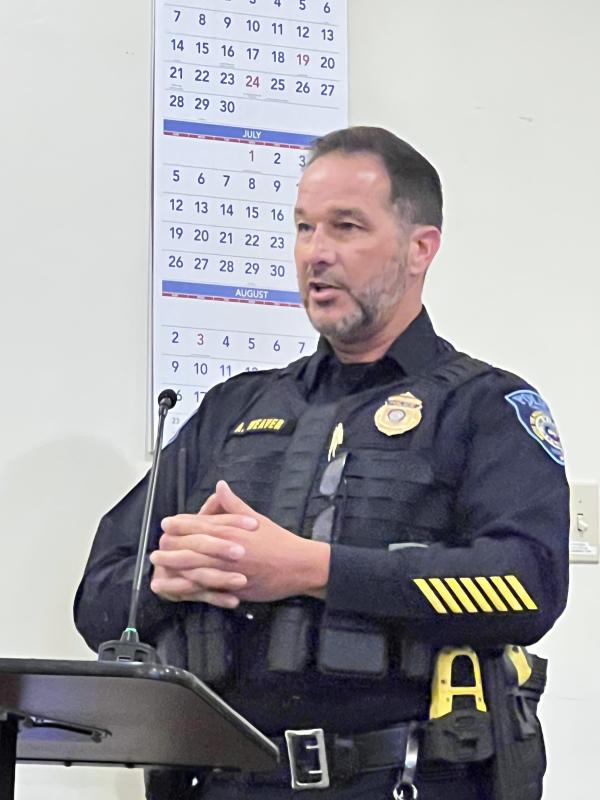 llen Weaver, Jr., Camden Police Chief (Photo courtesy Holly Anderson)
llen Weaver, Jr., Camden Police Chief (Photo courtesy Holly Anderson)
llen Weaver, Jr., Camden Police Chief (Photo courtesy Holly Anderson)Camden Police Chief Allen Weaver, Jr., issued the following statement concerning an Aug. 21 incident in downtown Camden. It follows:
As police chief for the Town of Camden, I am responsible for the good, the bad, and everything in between when it comes to law enforcement. The Camden Police Department is not a perfect organization, and when there is an incident that I believe could have been handled differently, it is important that we acknowledge and learn from it and use it as an opportunity to improve.
I believe it is important to provide some additional context and clarify the sequence of events surrounding an Aug. 21 incident involving a dog in a vehicle on upper Washington Street near Long Grain restaurant.
At 12:08 p.m., Camden Police received a complaint about the dog. Animal Control Officer Spencer Tooley responded and arrived at 12:10 p.m. Officer Tooley assessed the dog and conditions and found the truck was parked in the shade, the outside temperature was approximately 73 F degrees, and the vehicle's window was open. He reached his hand through the open window and found the interior of the vehicle to be cool, remaining at the scene until 12:18 p.m.
During that time, no one, including the complainant, made contact with Officer Tooley concerning about the dog. Based on his observations, Officer Tooley did not believe the dog was in distress or in immediate danger under the circumstances, as outlined in Maine law, and left the area.
On his way back at 12:28 p.m. to check on the dog, Officer Tooley was called back to the Police Station to meet with an individual regarding a dog and a vehicle. He was unaware that the two incidents were the same until he met with the individual, later identified as Molly Harish, who said she had removed the dog from the Washington Street vehicle and brought it to the station. Because she entered another person's motor vehicle without permission, Mrs. Harish was issued a summons for burglary of a motor vehicle.
After issuing the summons, Officer Tooley made contact with the owner of the vehicle when he came out of the Opera House at approximately 1 p.m. to check on his dog.
The owner explained that he was working on a project at the adjacent Opera House and had been coming outside approximately every hour to check on his dog and give it water. It was determined that the owner did not violate the law, his vehicle was not damaged, and the dog was subsequently returned to him.
I was made aware of the incident and after reviewing the circumstances with Officer Tooley we consulted with the District Attorney's Office and it was determined that the criminal charge against Mrs. Harish was not warranted and the charge was dropped. I have spoken with Mrs. Harish' attorney about the incident and police response, including the legal limitations officers face when responding to complaints involving animals in vehicles. I offered through her attorney and invitation to meet with me personally.
In responding to the numerous annual complaints we receive involving pets in vehicles, officers are required to assess the condition of the animal and the circumstances upon arrival. If an animal does not appear to be in distress or immediate danger, officers can continue to monitor and check on the animal, if necessary. Maine law establishes specific circumstances under which an animal may be removed from a vehicle, and those provisions apply differently to law enforcement than private citizens.
Title 7: AGRICULTURE AND ANIMALS
Part 9: ANIMAL WELFARE
Chapter 739: CRUELTY TO ANIMALS
§4019. Removal from unattended motor vehicle
1. Removal authorized. A law enforcement officer, humane agent, animal control officer, firefighter as defined in Title 26, section 2101 or security guard licensed under Title 32, chapter 93, referred to in this section as "authorized persons," may take all steps that are reasonably necessary to remove an animal from a motor vehicle if the animal's safety, health or well-being appears to be in immediate danger from heat, cold or lack of adequate ventilation and the conditions could reasonably be expected to cause extreme suffering or death.
After reviewing the incident, I determined there had been a communication issue as the complainant did not speak directly with Officer Tooley when he arrived. Consequently, they may have believed that police simply checked the dog and left without taking further action when in fact, as noted above, that was not the case.
In addition to dropping the charge against Mrs. Harish, Officer Tooley was issued a digital laser thermometer to provide an additional objective measurement when responding to future complaints of this nature. While a thermometer will not replace an officer's assessment of an animal's condition, it provides another useful piece of information when evaluating these situations.
In the end, people were concerned about the welfare of the dog and Officer Tooley acted on the information and conditions he observed when he arrived. Our responsibility is to protect people and animals while operating within the law. We will not always get everything right, but we can always take the opportunity to learn, improve our communication, and do better. That is the standard I expect from myself and from my officers.
My office is always open to those with concerns and questions. Those conversations are welcome and important and give us an opportunity to explain what occurred, talk through issues, and make sure that information is not lost through misunderstanding or miscommunication. An open line of conversation between our department and the community is an important part of effective policing.
Allen A Weaver Jr
Chief of Police
Camden Police Department