
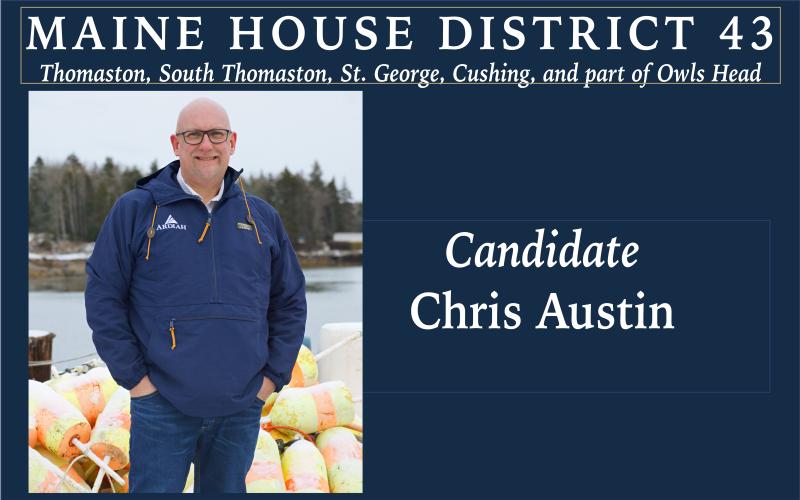
Maine House District 43 Candidate Chris Austin

PenBayPilot.com has circulated questions to Midcoast Senate and House of Representative candidates seeking election to serve in the Maine Legislature. As candidates return their responses, we are posting them on the Pilot's front page, and then they will reside on the Elections 2026 Voter Resource Page, which also includes letters, opinions, information about local referendum questions, and more, so that voters can be prepared for the November 3 polls.
Chris Austin, R-St. George, is seeking the House District 43 seat. The district comprises Cushing, Owls Head (part), South Thomaston, St. George, Thomaston. He is running against Rhiannon Hampson, D-Thomaston.
1) Please provide a short biography of yourself, and explain why you are running for office.
My name is Chris Austin, and I’m running to represent Maine House District 43, which includes Thomaston, South Thomaston, Cushing, St. George and part of Owls Head.
I was born in Brunswick and spent my early childhood in Maine before my family moved to Florida. I began my banking career right out of high school as a teller and worked my way into leadership and management. I was eventually recruited back to Maine, where I spent 14 years with MBNA/Bank of America and continued my career in banking and financial services.
In 2018, I became a small-business owner. Today, I provide payroll and merchant services to businesses throughout our area. That experience has given me a first-hand view of the challenges Maine's small businesses face every day. I’m also a husband and father of four in our blended family, with our fifth child arriving in December.
Throughout my career, I’ve advocated for employees, customers, small-business owners and our community. I’m running because Maine has become increasingly unaffordable for families and increasingly difficult for small businesses to operate and grow.
I want to bring my business and leadership experience, fiscal responsibility and common-sense approach to Augusta. We need to control spending, lower the cost of living and doing business, reduce unnecessary government barriers, and make Maine a place where our children can afford to stay, work and raise their own families.
2) What issues are emerging from your conversations with the public as you go about your campaign, and what actions and/or solutions do you envision?
The overwhelming issue I hear about is affordability. People feel they are working harder and paying more but getting less in return. They talk about rising state and local taxes, property taxes, energy costs, housing, and the limited affordable choices for health insurance.
Education is another major concern. We have many dedicated teachers, but parents and taxpayers are frustrated that spending continues to increase while student outcomes have declined. We need to get back to the fundamentals of reading, writing and math, support our teachers, expand opportunities in the trades, and demand accountability for both spending and results.
I also hear significant concern about Maine’s drug crisis and public safety, along with frustration over fraud, waste and abuse within government programs and a feeling that Augusta isn't listening.
My approach starts with accountability. We need to control state spending, scrutinize programs for results, eliminate waste and fraud, lower energy costs, increase competition and choices in healthcare, support law enforcement and recovery efforts, and stop passing costs from Augusta down to municipalities and taxpayers.
For the past eight years, one party has controlled much of state government. Voters I speak with are telling me they want greater balance, accountability and a government that listens to them. I’m running to bring their voice and a common-sense, fiscally responsible approach to Augusta.
3) Are there any specific issues affecting your particular district that you want to address in the Legislature?
One of the strongest messages I hear throughout District 43 is that people want to be heard. Whether I’m talking with residents, small-business owners, law enforcement or community leaders, they want a representative who is accessible, listens and then takes their concerns to Augusta. Many small-business owners have told me they have had very little interaction with their current representation. I intend to be present and accessible throughout the district.
Public safety is also a significant concern. People are frustrated when they see repeat offenders arrested multiple times, charges dismissed or individuals repeatedly released on bail only to return to the criminal justice system. We have outstanding local police officers and sheriff’s deputies doing difficult work. We need a criminal justice system that supports their work, protects the public, provides appropriate opportunities for treatment and recovery, and holds dangerous and repeat offenders accountable.
Affordability and the small-business environment are equally important. Business owners tell me they are tired of additional mandates, red tape and costs being imposed from Augusta. Paid Family and Medical Leave is one example I hear about frequently.
As their representative, I will scrutinize legislation based on a simple question: What will this cost the people and businesses of District 43? I will oppose additional tax increases and policies that unnecessarily increase energy costs or make it more expensive to operate a business or raise a family here.
Most importantly, representation starts with listening. I won't know every answer, but my constituents will always know where to find me, and they will know their concerns are being heard in Augusta.
4) A recent AARP poll indicates affordability is the top issue for older voters, with concerns about Social Security, health care and rising utility costs shaping their decisions. What will you do to address their concerns?
Affordability is one of the biggest concerns I hear from older Mainers, particularly those living on fixed incomes. Social Security is a federal program, so as a state legislator I would not have authority over how it is funded or administered. I believe it is important to be honest with voters about what Augusta can and cannot control.
What we can address is the growing cost of living in Maine. I support increasing property-tax relief for longtime homeowners, including strengthening the Homestead Exemption in a fiscally responsible way. I will oppose state policies that increase taxes or shift additional costs onto municipalities and ultimately local property taxpayers.
Healthcare is another major concern. Maine needs more affordable choices and competition in the health insurance marketplace, greater access to telehealth, and policies that help preserve rural healthcare providers.
Energy costs also demand action. I will oppose policies that unnecessarily increase utility costs or shift costs from favored energy programs onto other ratepayers. We need an energy strategy focused on reliability and affordability.
No senior who has worked their entire life and paid for their home should find themselves priced out of it because taxes, healthcare and utility costs have become unaffordable.
5) Property owners throughout most of Maine are watching their property tax bills increase on an annual basis. What would you do, as a legislator, to help relieve the financial load on property-owning taxpayers?
Property taxes are determined locally, so I won't promise voters that a state legislator can simply lower their local mil rate. However, decisions made in Augusta absolutely can increase or reduce the financial pressure placed on municipalities and ultimately property taxpayers.
I will oppose unfunded mandates and state policies that push additional costs onto our towns. I also support strengthening property-tax relief, including increasing the Homestead Exemption in a fiscally responsible way, with particular concern for seniors and longtime homeowners who are being priced out of homes they may have owned for decades.
We also need to address the spending side. State government must scrutinize programs, eliminate waste, fraud and unnecessary spending, and ensure taxpayer dollars are producing measurable results before asking Mainers for more.
Education represents a significant portion of local spending, and while we must properly fund our schools and support our teachers, taxpayers also deserve accountability for rising costs and educational outcomes.
My goal is not to simply shift the tax burden from one group of Mainers to another. We need to reduce the underlying cost of government and stop Augusta from adding expenses that eventually find their way onto the local property-tax bill.
6) How will you maintain our strong economic and cultural ties with Canada?
This issue is personal to me because much of my family heritage comes from and through Canada. Maine and Canada share generations of cultural, family and economic ties that are particularly important to our state.
Trade and tariff policy is primarily a federal responsibility, but no one wins when escalating tariffs from either side make it harder and more expensive for Maine businesses to compete. I oppose tariffs that are harming Maine businesses and believe we should be working toward fair, stable trade with our Canadian neighbors.
One of the four pillars of my campaign is protecting Maine’s working waterfront and fishing communities. Our fishermen, lobstermen, processors and other small businesses depend heavily on trade and relationships with Canada, and many are being squeezed by the current situation.
As a state legislator, I would advocate for those industries, listen directly to the businesses being affected, and work with our federal delegation where federal action is required. Maine should continue treating Canada as the important neighbor, trading partner and friend that it has been for generations.
7) Do you think the state should prohibit state and local law enforcement from entering into formal contracts with federal immigration authorities? (For example: An Act to Enhance Public Safety in Maine by Defining the Relationship Between Local and Federal Law Enforcement. That bill did not make it out of committee last year, but the issue remains.)
No. One of my priorities is supporting law enforcement and first responders and keeping our communities safe. I do not support a blanket state prohibition preventing Maine's state and local law enforcement agencies from appropriately cooperating with federal law enforcement, including ICE, consistent with the law.
Immigration has become highly politicized, but our country has immigration laws that have been created and enforced under both Republican and Democratic administrations. Those laws should be enforced. At the same time, law enforcement agencies and individual officers must be accountable for their conduct. If misconduct occurs, it should be investigated and addressed, but concerns about individual cases should not become a reason to prevent legitimate cooperation between law enforcement agencies.
Legal immigration is also extremely important to Maine. My own family came to this country legally because they wanted to build a life here and loved America. As a small-business owner, I also see how desperately Maine employers need workers. I strongly support workable legal guest-worker visa programs that allow people to come here legally and help meet the workforce needs of our tourism, hospitality, fishing, agriculture and other seasonal industries.
We can enforce our immigration laws, support law enforcement, welcome legal immigration and treat people with dignity. Those principles are not mutually exclusive.
8) What legislative committees would you like to serve on and why?
My committee interests would closely reflect the four pillars of my campaign: Maine families, small businesses, our fishing communities and working waterfronts, and law enforcement and first responders.
I would be particularly interested in committees dealing with small business and economic development, where I can bring my experience as a small-business owner and longtime financial-services leader. Maine needs to become more affordable and competitive, reduce unnecessary red tape, control costs and create an environment where businesses can grow and our children can afford to stay here.
Marine Resources would be especially important to me because District 43 is home to fishing families and working waterfronts that are not only an important part of our economy, but part of who we are as coastal Maine communities. Their voices need strong representation in Augusta.
Criminal Justice and Public Safety would align directly with my commitment to supporting law enforcement, firefighters, EMS and other first responders while addressing public safety, repeat offenders and Maine's drug crisis.
Finally, I want my work in Augusta to improve life for Maine families — particularly affordability, education, healthcare and energy costs.
Committee assignments are ultimately determined by legislative leadership, but wherever I am asked to serve, my focus will remain the same: listen to the people I represent, protect their interests and bring common sense and accountability to Augusta.
9) Maine’s environment is fundamental for its outdoor economy. Does the state do enough to protect its natural resources?
As a hunter, fisherman and someone who loves Maine’s outdoors, protecting our natural resources is personal to me. Our woods, waters, wildlife and working lands are part of Maine’s identity and a major part of our economy. We have a responsibility to protect them for future generations.
At the same time, environmental policy needs balance. Maine must be able to grow, create jobs, produce affordable energy and remain economically competitive without unnecessarily sacrificing the natural resources that make our state special.
One area where I believe we need greater balance is large-scale solar development. I support solar on homes and businesses and creative solutions such as rooftops, parking areas, brownfields and already-developed land. I have much greater concern when productive farmland or large areas of forest are converted to industrial-scale solar development, particularly where wildlife habitat, watersheds or the character of rural communities may be affected.
Good environmental policy shouldn't simply trade one environmental concern for another. We should protect Maine's forests, farms, fisheries and wildlife while pursuing responsible energy solutions and economic growth.
As a legislator, I would approach these decisions by asking about the long-term environmental impact, the cost to ratepayers and whether there is a better alternative that protects both Maine's environment and the people who live here.
10) What is your position on the siting and construction of data centers?
I believe data centers represent a significant economic opportunity for Maine. Technology and artificial intelligence are part of our future, and with the right policies, Maine can attract investment, create good-paying jobs, expand our tax base and encourage improvements to our energy and technology infrastructure.
However, we need to get the policy right. I would support responsible siting that considers impacts on surrounding communities, our natural resources, water use and existing infrastructure. Most importantly, Maine families and small businesses should not be asked to subsidize these developments through higher electricity rates or additional tax burdens.
If companies want to invest significant private capital in Maine, create jobs and contribute to our communities, we should welcome that investment rather than bury it in unnecessary bureaucracy. At the same time, they should pay their fair share of the infrastructure and energy costs their operations require.
Maine has an opportunity to participate in the economy of the future while protecting the affordability and quality of life that matter to the people already living here. Those goals can and should work together.
11) How would you define "good state government?”
Good state government puts people before party and common sense before ideology. It listens to the people it serves, spends taxpayer dollars responsibly, provides essential services effectively, and is accountable when it gets something wrong.
I also believe good government requires people with different political views to work together. We need less rhetoric and division and more willingness to sit at the same table, find common ground and solve problems. Maine families, businesses and communities should come before political parties.
Ultimately, good government should work for the people — not expect the people to work for government.
12) What are the qualities and attributes of Maine that you want to enhance and cultivate?
I want Maine to remain a place where people can afford to live, work, raise a family and build a future. We should protect the qualities that make Maine special — our small towns, working waterfronts, outdoor heritage, strong communities and independent spirit — while also embracing the opportunities of the future.
That requires balance. We need a strong free-market economy that encourages entrepreneurship, investment and good-paying jobs, while making Maine more affordable by addressing taxes, energy, housing and the cost of doing business. Growth and protecting what makes Maine special do not have to be competing goals.
My measure of success is simple: I want our children and grandchildren to look at Maine and say, “I can build my life here.” We should be creating the opportunities that allow the next generation of Mainers to stay, succeed and raise the generation after them right here at home.
13) Is there any other topic or issue you'd like to talk about here? Have at it!
Throughout this questionnaire I’ve discussed a lot of individual issues, but ultimately my campaign comes back to four priorities: Maine families, small businesses, our fishing communities and working waterfronts, and law enforcement and first responders.
I’m a small-business owner, husband and father. I understand what it means to make payroll, manage a budget and make difficult decisions when the numbers don't work. I also believe elected officials need to remember that every dollar government spends first came from someone who earned it.
I want Maine to be affordable again. I want our small businesses to have the opportunity to grow instead of constantly facing another mandate or expense. I want our fishing families and working waterfronts protected as an essential part of our economy and heritage. And I want our law enforcement officers and first responders to know that the people making policy in Augusta have their backs.
Most importantly, I want to be accessible to the people I represent. I won't always have every answer, and I won't agree with everyone on every issue, but I will listen, show up and explain my decisions.
I’m running because I want our children and grandchildren to have the opportunity to stay in Maine, build careers, start businesses, buy homes and raise the next generation here. That's the Maine I want us working toward.