
Maine has never seen a ranked-choice primary like this one
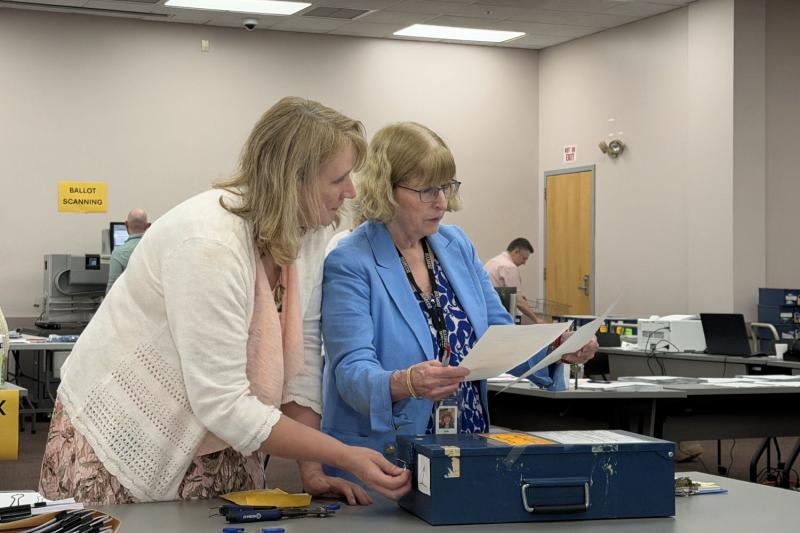 Maine Secretary of State officials review voting materials during the ranked-choice voting tabulation process on Friday, June 12, in Augusta. Photo by Matt Junker.
Maine Secretary of State officials review voting materials during the ranked-choice voting tabulation process on Friday, June 12, in Augusta. Photo by Matt Junker.
Maine Secretary of State officials review voting materials during the ranked-choice voting tabulation process on Friday, June 12, in Augusta. Photo by Matt Junker.
Maine voters have become more familiar with ranked-choice voting since they adopted it statewide a decade ago. But Maine has never seen a ranked-choice primary quite like this year’s set of races — and neither has any other state across the country.
Maine is one of two states, alongside Alaska, that deploys ranked-choice voting in statewide and federal elections, allowing voters to rank candidates in order of preference rather than picking only one top choice. But Alaska only uses ranked-choice in its general elections, not its primaries. That means Maine stands alone with its use of this voting method during primary season.
Ranked-choice voting has played a significant role in this year’s primary. Candidates and campaigns made it an overt part of their electoral strategy by forming ranked-choice alliances and telling supporters who to rank second or not at all.
And for the first time ever, Maine has seen three statewide or congressional primary races move on to ranked-choice voting tabulation. The previous record was two in 2018.
The close contests this year to determine the Republican nominee for governor, Democratic nominee for governor and Democratic nominee for Maine’s 2nd Congressional District all advanced to ranked-choice tabulation because no candidate garnered more than 50 percent of voters’ first-choice picks.
While primary voting ended on Tuesday, June 9, the ranked-choice process for these three races has stretched into this week. In an Augusta conference room, staff from the Maine secretary of state’s office have worked to compile election results from around the state and run the ranked-choice tabulation.
This methodical process is open to the media, campaign staff and lawyers, as well as any member of the public who wants to attend and observe. It is broadcast live in slow-moving detail on the secretary of state’s YouTube page.
“It might be mundane, but it’s also incredibly important for the future of the state,” said Joel Stetkis, the campaign chairman for Republican gubernatorial frontrunner Bobby Charles, as the ranked-choice tabulation process got underway on Friday.
How the process works
Staff from the secretary of state’s office start by processing and verifying the results from each of Maine’s 487 municipalities. Once they have uploaded all data from towns that use electronic ballot scanners and scanned the paper ballots from towns that still count them by hand, they use a software program to conduct additional rounds of ranked-choice voting tabulation. For each of the ranked-choice races, the candidate with the fewest first-round votes is eliminated and those voters are shifted to their second choice. That process continues until a candidate reaches more than 50 percent of the total.
Julie Flynn, the longtime deputy secretary of state in charge of elections, explained Friday that the ranked-choice tabulation process takes two different tracks depending on the election technology used in each municipality.
For larger cities and towns that use high speed-ballot scanners, the election results are saved on encrypted memory sticks and uploaded by secretary of state staff after they’ve arrived at the central location in Augusta. For the small municipalities that still hand count their paper ballots, those ballots are sent to Augusta and run through one of the ballot scanners there. In both cases, law enforcement are the ones transporting the memory sticks and paper ballots to Augusta for the ranked-choice tabulation. For security reasons, ballot scanners are not connected to the internet.
Flynn said sometimes people misunderstand how the ranked-choice process works.
“They don’t understand why every town can’t run their own ranked choice and come up with a result and you just add it all together. That’s not how it works,” Flynn said. “You have to have all the ballot results in one place in order to run software that applies the rules to determine which candidate is eliminated, and their second choice is rolled up and added to the total.”
Flynn also said Maine’s rural nature factors heavily into this process.
“That’s the biggest challenge, is getting the material here, doing the steps to get it into the database, making sure we have everything,” Flynn said Friday. “And it really does give us an excellent check and balance in the process, because we’re proving that the results recorded on election night are the correct results.”
Secretary of state staff have been plodding through the results city by city and town by town since Friday, and expect to be ready for the final tabulation for each of the three prominent races on Wednesday.
“It’s going to be a lot of fun when we do the reveal,” Flynn said last week. “It won’t be like a gender reveal, but we’ve got a few things planned for how we might spice it up a little bit this year.”
A notable absence
In years past, Maine’s secretary of state has presided over ranked-choice tabulations. But Secretary of State Shenna Bellows is a candidate in the Democratic race for governor, so she has stepped back from the process and let her deputies Kate McBrien, the chief deputy and chief of staff in the Maine secretary of state’s office, and Flynn take center stage.
There is no legal requirement to do so, but Bellows wanted to remove the possibility that someone could interpret her presence as a conflict of interest, McBrien said. Bellows has ceded any decisions related to the June elections to McBrien, Flynn and legal counsel from the Maine attorney general’s office.
“From the beginning of the election, Secretary Bellows said that she didn’t want to be involved,” McBrien said. “She didn’t want to have any perception of a conflict of interest, so she just stepped back.”
In Maine and elsewhere, secretaries of state from both parties have in previous election cycles continued to serve in that role while simultaneously running for higher office. But the practice has frequently drawn criticism, both from political opponents and election reform advocates, as a potential conflict of interest.
In Michigan, Secretary of State Jocelyn Benson is running as a Democrat for governor. She released a detailed written policy outlining how she will and won’t be involved in the 2026 election administration.
Bellows has not released such a document.
“We haven’t done anything in writing,” McBrien said. “She knows that if there was something that was not election-related, I would bring it to her attention. But otherwise, she doesn’t want to be copied on emails. She doesn’t want the questions to come to her, because she doesn’t want that perception of the conflict.”
Still, Bellows’ concurrent role as both secretary of state and candidate for governor has drawn some Republican ire. Charles, for example, has repeatedly made vague allegations of a “Shenna Steal” online.
In Augusta on Friday, however, his campaign chairman struck a less accusatory tone. Stetkis said he would “of course” have concerns if Bellows was overseeing the tabulation, but expressed confidence in Flynn and credited her and her team for transparency in the process, at least at the outset.
“Julie Flynn is the professional of professionals,” Stetkis said.
Republicans embrace RCV strategy, not process
One of the biggest changes this primary election was the way Maine Republican candidates increasingly adopted ranked-choice voting strategies in their campaign despite years of GOP hostility toward the voting method. The state Republican Party event went to court a few years ago to try to keep ranked-choice out of their primary, but that effort was unsuccessful.
And though Republican candidates and their supporters have started to embrace some of the ranked-choice strategies, they still aren’t showing much enthusiasm for the process itself. Of the roughly 10 self-identified Republican voters that The Maine Monitor spoke with while leaving the polls last Tuesday, none of them said they supported the ranked-choice voting process.
“I think people have come to terms with the fact that if it is going to be the law for the time being, then they have to work with it in some way,” said Maine GOP executive director Jason Savage. “But I think that, across the party, they’d still love to repeal it.”
Stetkis said he believes the process violates the principle of “one person, one vote” and pointed to the ongoing wait in the three prominent primary races.
“I think I join every Mainer with the frustration that it does take so long,” Stetkis said.
Chance for more Maine history
Maine voters have never had to wait for the ranked-choice results of three different statewide and congressional races at the same time. The 2020 primary featured six total races that went to a ranked-choice tabulation, but five of those were in races for the state legislature that only covered a small portion of the Maine electorate.
When it comes to major statewide and congressional races, the 2018 primary previously held the record for races that needed ranked-choice tabulation when both the Democratic primaries for governor and the second congressional district went past the initial round. The first-round leaders of those races, Janet Mills and Jared Golden, both went on to win their primary.
Later that year, Golden became the first, and so far only, Maine candidate to trail during the first round of ranked-choice voting but go on to win in a subsequent round. Golden’s come-from-behind victory in 2018 over then-Rep. Bruce Poliquin is the lone example in 24 total ranked-choice races that have featured three or more candidates here in Maine, according to FairVote, an election reform organization that supports ranked-choice voting.
But with three packed races still to be decided as of Tuesday, it’s looking like at least one if not multiple candidates could join Golden on that list — especially on the Democratic side.
Republican gubernatorial candidate Charles came out of the first round with an unofficial lead of around 17 percent over Ben Midgley, followed closely by Jonathan Bush. On the Democratic side, frontrunner Dr. Nirav Shah had a roughly four percent edge over Hannah Pingree. Troy Jackson and Bellows were also trailing close behind, meaning it is still very much a four-way race.
And state Sen. Joe Baldacci took a razor-thin lead into the ranked-choice tabulation for the Democratic primary in the 2nd Congressional District, hovering around 30 percent alongside Matt Dunlap and Jordan Wood.
“Probably at least one of their front runners is going to be uprooted and lose,” said Savage, the Maine GOP executive director. “And they have to start reckoning with this stuff in the context of maybe the person who is most liked by the voters on election day is going to be told they’re not the nominee.”
At least one Democratic primary voter, Kalyn Black in Brewer, wasn’t worried about that possibility as she was leaving the polls. She said she trusted the eventual Democratic nominee for governor to do a good job even if it didn’t end up being her preferred candidate.
“I trust the process,” Black said.
This story was originally published by The Maine Monitor, a nonprofit civic news organization. To get regular coverage from The Monitor, sign up for a free Monitor newsletter here.