
Maine has engaged in 48 lawsuits against the federal government in President Trump’s second term. Here’s how the state is handling them.
 Graphic by Stephanie McFeeters.
Graphic by Stephanie McFeeters.
Graphic by Stephanie McFeeters.At a dinner at the White House in February 2025, President Donald Trump turned to Gov. Janet Mills and threatened to withhold federal funding from Maine for refusing to comply with an executive order banning transgender athletes from competing on women’s sports teams.
“We’ll see you in court,” Mills responded.
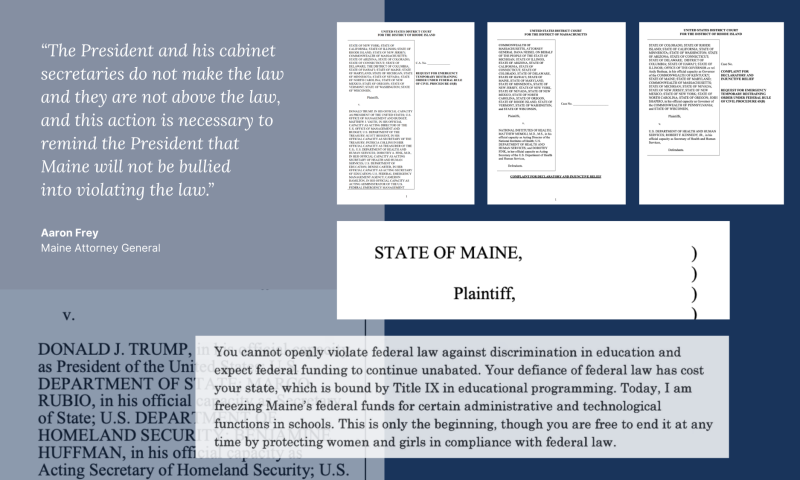
Since Jan. 2025, the state has been involved in 48 lawsuits against the Trump administration, challenging the administration’s policies on issues including birthright citizenship, education, access to state data and voting regulations, alongside a coalition of other states led by Democrats. In that same period Maine has been sued by the administration three times.
The Maine attorney general’s office said it does not track how many of its cases involve the federal government, so The Maine Monitor has compiled this data from news reports, press releases and court databases. According to The Monitor’s data, the state has filed or joined eight times more lawsuits against the federal government in the past 18 months than under the entirety of the Biden administration, when the state was involved in suing the federal government six times.
“I can say it is clear we are handling more cases than we were previously under other administrations, including the first Trump administration,” spokesperson Danna Hayes wrote in an email.
The litigation spans a wide range of issues. Many of the cases filed by the states attempt to prevent the Trump administration from pulling federal funding, often in response to their refusal to comply with sweeping executive orders.
The increase in federal litigation has been dramatic compared to previous administrations, both in Maine and around the country. Under both Obama administrations combined, Maine sued the federal government only once. During President Trump’s first term, that number skyrocketed to 55 lawsuits.
Maine is not the only state that has seen an uptick in litigation against the federal government since President Trump took office for his second term in Jan. 2025. Eighteen months into Trump’s second term, states’ attorneys general have filed more than 100 lawsuits against the administration, nearly as many as the entirety of the Biden administration, when 133 multistate lawsuits were filed in total.
Other New England states have also been heavily involved in litigation against the Trump administration. Massachusetts, Rhode Island, Connecticut and Vermont are all involved in dozens of suits. The sole exception is New Hampshire, which has joined only three.
Maine has directly sued the second Trump administration on its own twice. Maine sued the U.S. Department of Agriculture in April 2025 after the federal government abruptly froze funding used to feed schoolchildren and disabled adults over alleged violations of Title IX. Maine agreed to dismiss the case in May 2025 after the Trump administration stated it would refrain from additional funding cuts regarding Title IX. Maine also sued the National Oceanic and Atmospheric Administration and the Commerce Department in June 2025 after the cancellation of a $9 million grant to the Maine Department of Marine Resources. The case is still pending.
The other 46 cases have been multistate efforts that Maine has signed on to as a plaintiff.
“While greater resources might allow us to take more of a lead on some of these cases, we benefit from our close relationship with larger offices across the country with whom we collaborate regularly,” Hayes wrote.
The state hired one additional assistant attorney general last fall to “oversee the body of work required for these cases and coordinate with the attorneys in office and across the country,” wrote Hayes. The position is a limited two-year contract with a $112,382 annual salary.
The position, created in the litigation division, represents the state in high-impact civil litigation in federal district and appellate courts. The Maine attorney general’s office has 135 full-time attorneys who provide regular counsel to state agencies and are responsible for representing the state on behalf of the attorney general in civil and criminal proceedings.
While “there may be more overlap between the work of the litigation division and other divisions than usual,” the state has not reassigned attorneys to other divisions to help with the caseload or hired any outside counsel, wrote Hayes.
The AG’s office regularly hires limited-time positions for temporary increased needs or when it is waiting on a legislative budget request, wrote Hayes.
“Our office is a public office and expanding broadly is not something we can or want to do without time and careful consideration,” Hayes wrote.
The office saw a 16 percent increase in its budget for fiscal year 2026, from more than $56 million to more than $65 million, the largest budget increase in a decade. The office also saw another increase of more than $3.5 million for fiscal year 2027, jumping up to more than $68 million.
The increase in the budget was not related to the federal litigation, wrote Hayes.
“Our budget reflects the general pace of inflation, increased assessments from other government agencies, and changes in pay ranges, largely,” Hayes wrote. “It does not have any relationship to the litigation with the federal government.”
Of the nearly 50 lawsuits Maine has joined against the Trump administration, courts have ruled in favor of the states in 31 of them, 10 of which are now being appealed by the federal government. Courts have halted Trump administration policies in six additional lawsuits while those cases are ongoing.
“It bears noting that the office, through this litigation, has saved the state millions of dollars that would have fallen to state and local governments to cover,” Hayes wrote.
Maine has also been sued by the administration three times. The Justice Department filed a lawsuit against Maine’s Department of Education in April 2025, alleging that the state violated Title IX by allowing transgender girls to participate in girls’ school sports. The DOJ sued Maine again this May after the state refused to issue undercover license plates to federal immigration enforcement officials. Both cases are still pending. Another case, filed in Sept. 2025 by the Justice Department over the state’s refusal to provide confidential voter records, was dismissed by a U.S. district judge in late May.
The Maine Monitor is tracking each of the lawsuits Maine has joined against the Trump administration here.
This story was originally published by The Maine Monitor, a nonprofit civic news organization. To get regular coverage from The Monitor, sign up for a free Monitor newsletter here.