
How two rural Maine jails are rethinking addiction treatment
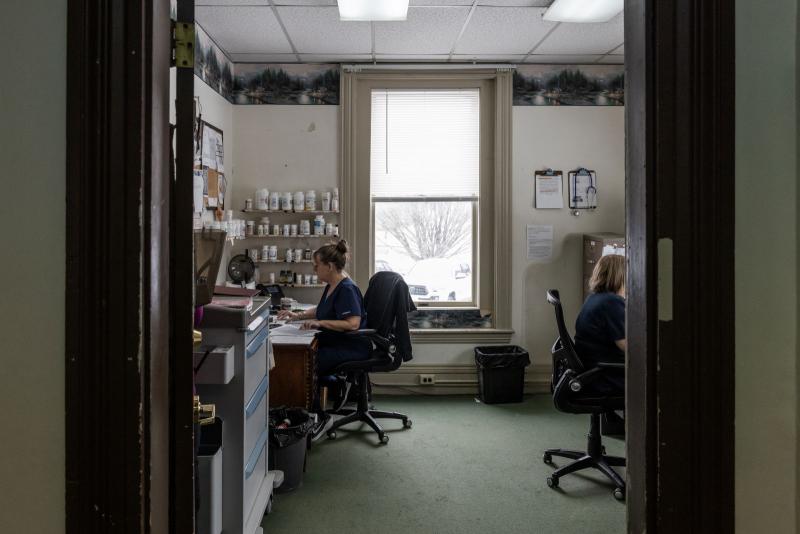 Nurses Lea Riley, left, and Ruthie McEwen, review paperwork at the Aroostook County Jail in Houlton in April. Photo by Greta Rybus for The Maine Monitor.
Nurses Lea Riley, left, and Ruthie McEwen, review paperwork at the Aroostook County Jail in Houlton in April. Photo by Greta Rybus for The Maine Monitor.
Nurses Lea Riley, left, and Ruthie McEwen, review paperwork at the Aroostook County Jail in Houlton in April. Photo by Greta Rybus for The Maine Monitor.One day this spring, Sgt. Ryan Close went into the secure evidence room at the Franklin County Sheriff’s Office and retrieved a heavy-duty lockbox containing doses of Brixadi, an extended-release, injectable form of buprenorphine that is used to treat opioid use disorder.
Close took one of the doses out of the lockbox, recorded the time and date and walked across the parking lot and into the jail, through a dark hallway and into the cramped medical office where he handed it to the jail’s nurse. A corrections officer then brought in 44-year-old Tom, who had been incarcerated at the jail for just over two months and was set to receive his second monthly shot that day.
Tom’s girlfriend had been getting the injections outside of the jail and was five months sober, so Tom had been eager to try it himself, said Greg Ellis, the physician assistant who administers the shots.
The Franklin County jail began offering this treatment a year ago, and has seen promising results: Morale among both jail staff and prisoners has improved, Close said. Use-of-force incidents have decreased by half, and physical altercations between prisoners have gone down by more than 90 percent, according to the jail’s data.
In neighboring Somerset County, the jail has provided the injections since 2022. A study examining the first year of its program showed that individuals released from the jail were about three times as likely to continue their treatment after release than those in another Maine jail that provided the more commonly available daily pill.
The two rural jails are the only ones in Maine providing the extended-release injection, which is considered the gold standard for addiction treatment for high-risk individuals, such as people who are incarcerated, because of its long-acting effects and built-in protections against misuse and diversion.
“People ask me how I managed to convince the two most conservative sheriffs in the state to implement comprehensive substance use disorder treatment in their jails,” Dr. Alane O’Connor, the medical director for the Franklin and Somerset jails’ treatment programs, said in a March speech.
But she said the sheriffs needed no convincing: “They said things to me like, ‘The people in this jail are my neighbors and I have an ethical responsibility to make them better off when they re-enter the community than they were when they came in.’”
The results from the two jails show how effective the long-acting injections can be. But they are also significantly more expensive than the alternative –– one monthly shot costs more than twice as much as a month’s supply of the daily oral medications. Other counties are interested in providing the shots in their jails but officials have struggled to find adequate funding to get such a program off the ground.
“It has never been about a lack of commitment,” O’Connor said. “It has been about finding the financial resources needed.”
‘No one did this’
Nationwide, about a third of jails and prisons offer medication-assisted treatment for opioid use disorder. In Maine, it has been required since 2019, when a federal judge sided with a Madawaska woman in a landmark ruling in a lawsuit against the Aroostook County Jail.
In August 2018, attorneys for Brenda Smith reached out to Aroostook County Jail officials to request that the jail allow Smith to continue taking her daily dose of buprenorphine during her upcoming 40-day sentence.
Her attorneys were told that the Maine Department of Corrections — which sets policies for county jails — prohibited medications for opioid use disorder except to treat pregnant women.
The following month, attorneys with Portland-based Andrew Schmidt Law filed a lawsuit against Aroostook County and then-Sheriff Shawn Gillen for violating Smith’s rights under the Americans with Disabilities Act and the Eighth Amendment. The American Civil Liberties Union of Maine joined as co-counsel soon after.
The jail provided necessary medical care to people in its custody except when it came to treatment for opioid use disorder, the complaint said.
Opioid drugs, such as morphine, fentanyl and heroin, relieve pain by mimicking endorphins, the body’s natural painkillers. They do this by attaching to nerve cells, blocking their opioid receptors from sending pain signals to the brain and releasing dopamine, the body’s “feel-good” hormone, which can create a sense of euphoria, or a high.
The longer someone takes opioids, the less the body naturally produces endorphins and the more it becomes physically dependent on opioids to maintain a baseline “normal.” Over time, people tend to build a tolerance and need to use more opioids in order to reach that baseline. Opioid use crosses over into a disorder, or addiction, when someone feels a compulsive need to use opioids despite the potential for harm.
Withdrawal, sometimes called “dopesickness,” happens when the body is suddenly deprived of opioids in the system. Withdrawal, with its flu-like symptoms, such as body aches and spasms, stomach cramps and intense chills, can be so unpleasant that the looming fear of going through it contributes to drug-seeking behavior.
Medications for opioid use disorder, including buprenorphine and methadone, keep withdrawal at bay and help manage the cravings that make opioids so addictive. Many people safely take these medications for years, or even the rest of their lives, as a form of chronic disease management.
Smith, the Madawaska woman, was in this camp. She had been in recovery for nearly 10 years, her attorneys said, in large part because of the medications.
The county fought the suit. While it made its way through the courts, the newly inaugurated Gov. Janet Mills signed an executive order in February 2019 directing state officials to figure out how to make medication-assisted treatment accessible to incarcerated people.
At the time, “no one did this” except Rhode Island, said Gordon Smith, Mills’ director of opioid response.
Craig Clossey, the Aroostook County Jail administrator, told The Maine Monitor bringing addiction treatment into the jail was no easy task. At the time of the Smith case, Clossey said, it was difficult to find local providers willing to prescribe medications for opioid use disorder for people in custody. In a 2018 affidavit for the Smith case, Clossey also said Suboxone and its generic versions were banned in the jail because of long-standing issues around smuggling.
Federal regulations were different then: Providers who wanted to prescribe certain controlled substances had to obtain a special waiver from the Drug Enforcement Administration first and had to see patients in-person, not via telehealth. These restrictions weren’t loosened until the pandemic.
“We called all the county doctors, nobody would come into the jail. We reached out downstate, nobody would come to the jail,” Clossey said in April. “Our medical provider wasn’t federally licensed to prescribe Suboxone. It was a series of these missteps. We looked for other medical providers, but nobody wanted to touch it.”
In April 2019, the First District Court of Appeals in Boston upheld a lower court’s decision that, by refusing to allow Smith to continue her treatment, Aroostook County was violating her rights under the Americans with Disabilities Act. This was a landmark ruling for both Maine and the Northeast: The order extended to all corrections facilities in Massachusetts, New Hampshire, Rhode Island and Puerto Rico.
Zachary Heiden, chief counsel at the ACLU of Maine and an attorney on the Smith case, called getting treatment in jail “a devil’s bargain.” While incarceration can have a devastating impact on someone’s life, he said, officials have a responsibility to care for the health and well-being of the people in their custody –– which includes providing access to addiction treatment.
Types of treatment
Jails are a logical venue to help people get off drugs and give them a chance to get sober, said O’Connor. She said that while jails are not the preferred way to reach people, they can serve as a critical point of public health.
There is a growing body of evidence that suggests extended-release injections of buprenorphine, such as those provided at the Franklin County jail, lessen the burden on jail staff, improve prisoner morale and lead to better results once prisoners are released. But these shots are more costly than the alternative — a daily pill — and so far are available at just two of the state’s 15 jails.
A single dose of the long-acting injectable costs between $1,500 and $1,900, according to jail officials. A month’s worth of pills or strips for one person, meanwhile, costs between $250-$750.
The daily pills are designed to provide 24-hour protection against cravings. But cravings and withdrawal symptoms can start setting in before that 24-hour mark is up, which can be anxiety-inducing for a lot of people, said Ellis, the physician assistant who works at the Franklin and Somerset county jails.
With severe addiction, using drugs is no longer about getting high — it’s about staving off dopesickness, Ellis said.
This becomes a particular challenge once prisoners are released. Even though jails try to provide what they call a bridge prescription — a few days to a week’s worth of medication to hold someone over until they can see a provider — that anxiety leads some to seek out drugs immediately when they are at high risk of fatal overdose.
The daily medications provide “no post-release protection,” said Somerset County Sheriff Dale Lancaster. Plus, administering daily doses of buprenorphine is labor and time intensive, and it’s possible for prisoners to pocket the medications to hoard or sell to others in custody.
With about three-quarters of prisoners at the Somerset County Jail on medication-assisted treatment at any given time, administering it could take most of the day, Lancaster said. The jail and prisoners, he said, were “set up for failure.”
In 2022, the jail switched to Sublocade, a brand of extended-release, injectable buprenorphine that only needs to be administered once a month.
People who received the long-acting injectable at the Somerset County Jail were more likely to continue their treatment post-release compared with those who received the daily form of buprenorphine at an unnamed comparison jail in Maine, according to a study co-authored by O’Connor.
The study also found that at least three people from the comparison jail died from overdoses after they were released, while none of the former Somerset County prisoners died from drug-related causes.
“The program itself is extremely successful,” Lancaster said. “The continuing challenge is funding.”
Somerset County has received nearly $2.7 million in state contracts or grants since 2022, including $1.85 million from the Maine Department of Health and Human Services to support its injectables program and $805,000 in federal pass-through money and state grants awarded through the Maine Department of Corrections. The county has also turned to money the state has received through national settlements with pharmaceutical companies accused of supercharging the opioid epidemic. Between 2023 and 2025, the county used $208,000 of its opioid settlement money, plus $175,000 from the statewide Maine Recovery Council, to pay for the medication.
“If you’re really serious about helping people with addiction, [long-acting injectables are] something that’s been proven, and it’s something that should be aggressively pursued,” Lancaster said.
Other jails have tried to get these programs going, but haven’t been able to sustain it.
Penobscot County Sheriff Troy Morton helped spearhead a pilot program to start the state’s first medication-assisted treatment program in a jail 10 years ago, providing Vivitrol, an extended-release, injectable form of naltrexone, to its female prisoners. But state funding for that program only lasted a couple of years, and the jail couldn’t afford the medication anymore and had to switch back to the daily version.
Extended-release injectables are more effective than the pills, Morton said, but out of reach financially for most jails.
Beyond medication
The newest jail to offer extended-release, injectable medication is the one in Franklin County, which started offering Sublocade shots last July. The jail switched over to Brixadi, another brand of injectable buprenorphine, in the fall.
The process began several years earlier, as the sheriff’s office, jail officials and community partners tried to figure out how to lessen the opioid epidemic’s impact on the jail, Sheriff Scott Nichols said. The jail’s board of visitors had recommended the county look into the injectables as a way to reduce staff workload, decrease diversion and improve treatment outcomes.
Franklin County got a 3-year, $1 million federal grant from the Department of Justice’s Comprehensive Opioid, Stimulant, and other Substances Use Program to launch its new addiction treatment and re-entry program. The grant prohibits using the money to buy the medications itself, so the county has supplemented the program with a $50,000 Maine Department of Public Safety grant and $125,000 in opioid settlement money from the Maine Recovery Council.
About half of the federal grant pays the salaries for three years of a re-entry coordinator and two corrections officers who work exclusively with her. About $170,000 of the grant was used to renovate a couple of closet spaces in the jail to make offices for the re-entry team. The remainder is budgeted to pay for supplies and furniture, including security cameras; contract stipends for O’Connor, the medical director, and LeeAnna Lavoie, the program director; training, education and overtime for corrections officers; and a small amount for conference travel.
The success of the program hinges on more than the medication itself, said Lavoie, who as the former executive director of MaineHealth’s healthy community coalition in Farmington was instrumental in designing the program and now helps oversee the federal grant.
The jail needed to shift away from a punitive culture to a restorative one, Lavoie said, which it has worked to do by educating staff about the science of addiction and emotional intelligence. The jail increased its in-house programming for prisoners, expanding access to peer recovery coaching and support groups and offering classes, such as financial literacy and parenting, largely in connection with community partners, including the Franklin County Recovery Center.
The jail hired Alison Prior, a former community health worker, to serve as the facility’s re-entry coordinator. She meets with prisoners soon after they’re booked into the jail, assesses their needs and works with them throughout their time there to connect them to services and resources once they’re released.
The jail also implemented a new screening process for all prisoners and a way to track how the treatment program is working. The jail recently sent the first year of data to the University of Southern Maine’s Catherine Cutler Institute for analysis.
In the year since the Franklin County jail began offering the long-acting form of buprenorphine, morale among prisoners and staff has gone up, said Close, the sergeant who helps oversee the federal grant.
The injectables eliminated the daily pills as a “valuable currency,” he said. Use-of-force and physical altercations decreased significantly. Fewer violent incidents means fewer ambulance rides to hospitals and fewer workers’ compensation claims, which cost money and take corrections officers out of work.
Close said he also heard from prisoners that they got the best night of sleep in a while after receiving their first injection, as the long-acting drug “removed that roller coaster” of cravings and withdrawal symptoms.
Nichols, the sheriff, said the injections have even changed prisoners’ perspectives on life after jail.
“This actually gives people hope, and, you know, that’s what we want,” Nichols said. “If they can get in here and get clean, then we’re not worried about them coming back.”
This story was originally published by The Maine Monitor, a nonprofit civic news organization. To get regular coverage from The Monitor, sign up for a free Monitor newsletter here.