
Here’s how ranked-choice voting will work in Maine’s 2026 election
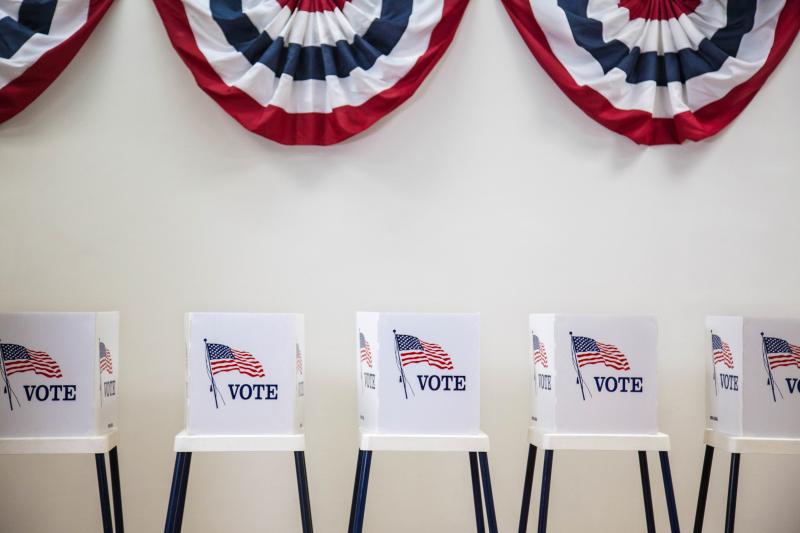
Mainers started early voting on Oct. 5 ahead of Election Day on Nov. 3. And the state’s unique use of ranked-choice voting will once again factor into some — but not all — of the races on the ballot.
Maine is one of only two states in the country, along with Alaska, that conducts some statewide elections using ranked-choice voting. This process allows voters to rank candidates by preference rather than selecting just one candidate, and can involve multiple rounds of tabulation if a candidate doesn’t initially get more than 50 percent of the vote. It is sometimes called instant runoff voting because the process avoids the need for a separate runoff election if a candidate does not immediately win a majority.
When Mainers first adopted ranked-choice voting via referendum in 2016, it was supposed to apply in both state and federal elections. But Maine’s Supreme Court has repeatedly advised that the ranked-choice process is incompatible with parts of the state Constitution that guide how general elections for state offices should work.
State primaries and federal races, meanwhile, are governed by state statute. That has resulted in a hybrid system where the ranked-choice approach is used in Maine’s primary elections for governor, the state Legislature and federal offices, and in federal races during the general election. But it is not used in state races during the general election.
As a result, Maine voters will be using ranked-choice voting in the 2026 general election only in a couple of races for federal office that have at least three candidates, including declared write-in candidates. Ranked-choice voting will be used in the high-profile contest for U.S. Senate and in the 2nd Congressional District matchup, but it will not be used in the governor’s race or State House races.
What is ranked-choice voting?
In ranked-choice voting, which is used only when there are three or more contenders, voters can rank their candidates by preference rather than choose a single candidate.
If a candidate wins a majority of voters’ first-choice votes, they are declared the winner. But if no one gets more than 50 percent, that can trigger additional rounds of tabulation. The last-place candidate is eliminated, and voters who had picked the eliminated candidate as their first choice then have their vote redistributed to their second choice. That process repeats until one candidate secures more than 50 percent and wins the election.
Which elections will it be used in this November?
Ranked-choice voting will be used in the two federal races that have at least three candidates, including declared write-in candidates. That means it will be featured in the closely watched race for U.S. Senate, where there are six declared write-in candidates vying for the position along with incumbent Republican Sen. Susan Collins and Democratic challenger Troy Jackson. Ranked-choice voting will also be used in the race for Maine’s 2nd Congressional District, where Republican former Gov. Paul LePage and Democratic State Auditor Matt Dunlap are joined by one independent candidate.
The U.S. Senate race, which could play a role in deciding whether the body is controlled by Democrats or Republicans starting next year, will almost surely see either Collins or Jackson emerge victorious. But while those two main candidates are drawing national attention and millions of dollars, they are not alone in the race. Unaffiliated candidate Brent Andrews, Democrat Sigrid Ann Olson, independent Gina Oswald, “Faith in Humanity” candidate Joseph Steinberger, independent Michael Turcotte and Democrat Ashley J. Webb have all qualified as declared write-ins. While the names of these six candidates will not appear on the ballot, write-in votes for them will be counted.
The presence of these write-in candidates means that ranked-choice will be used in the Senate race. And the same is true in the 2nd District matchup, where independent write-in Gregory A. Ward joins LePage and Dunlap. The battleground seat, which is being vacated by Democratic Rep. Jared Golden, has long been considered a likely pickup for Republicans. But some recent polling has shown the race narrowing between LePage and Dunlap, and Ward’s presence means this congressional contest will include ranked-choice voting.
What role could the ranked-choice process play in these races?
In both the Senate and 2nd District races, the write-in candidates are longshots. Their presence in those contests doesn’t change the overwhelming likelihood that either Collins or Jackson will be the next U.S. senator from Maine, and that either Dunlap or LePage will be the next congressman from the 2nd District.
But ranked-choice voting could still affect each of these races. If no candidate receives more than 50 percent of the vote during the first round in either contest, the race will go to a ranked-choice runoff. That sets up the possibility that the candidate who is leading after the first round of tabulation gets leapfrogged by someone else and loses in subsequent rounds. That has only happened three times in Maine’s decade of using ranked-choice voting — two of which occurred in the primary election earlier this year. It could happen again in the nationally important races for Senate and the 2nd District if none of the candidates get more than 50 percent initially and the races feature razor-thin margins between the contenders.
If either race goes to a ranked-choice runoff, that would mean a longer wait to know who won. As seen in multiple races during the primary, the ranked-choice tabulation process requires ballots and electronic memory sticks from around the state to be sent to a single location in Augusta. State election staff then conduct a painstaking process to verify and centralize those results to run the ranked-choice tabulation. In this year’s primary, that process didn’t finish until 10 days after the election.
In November, depending on how contests go around the country, both of these battleground races in Maine could influence which party controls the two houses of Congress. So if one or both of the Maine races go to a ranked-choice runoff, it’s possible that the entire country will be watching and waiting for those results.
Why isn’t ranked-choice voting being used in the race for governor?
There are three contenders on the ballot to be the next governor — Democrat Hannah Pingree, Republican Bobby Charles and independent Rick Bennett — and two declared write-in candidates, Republican Randy Wilcox and independent John Glowa. Ranked-choice voting could have played a significant strategic role in this contest, but, under Maine’s current system, races for state offices only use ranked-choice in the primary, not the general election.
If legislative Democrats had gotten their way, ranked-choice voting would have been used in this race. The Democratic majority in the State House attempted to pass a bill that would have extended ranked-choice voting to the general elections for governor and the State House. But that effort was stopped in its tracks in April when the Maine Supreme Court once again advised that ranked-choice voting is not compatible with the Maine Constitution when it comes to state general elections.
The state Constitution dictates that Maine lawmakers and the governor be elected by a plurality, meaning that whoever gets the most votes wins, even if that is not more than 50 percent. Maine’s justices have repeatedly found that this is not compatible with the ranked-choice voting process, which uses multiple rounds until a candidate gets more than 50 percent.
This story was originally published by The Maine Monitor, a nonprofit civic news organization. To get regular coverage from The Monitor, sign up for a free Monitor newsletter here.