
The Digital Car and the Analog Car
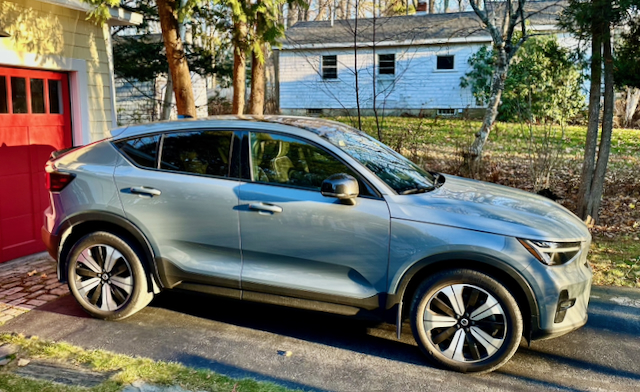 The all-wheel-drive Volvo C40 Recharge Twin Motor offers about 230 miles of warm-weather range and, despite its teddy-bear vibe, 402 horsepower and 495 pound-feet of torque. Volvo calls this color Thunder.
The all-wheel-drive Volvo C40 Recharge Twin Motor offers about 230 miles of warm-weather range and, despite its teddy-bear vibe, 402 horsepower and 495 pound-feet of torque. Volvo calls this color Thunder.
The all-wheel-drive Volvo C40 Recharge Twin Motor offers about 230 miles of warm-weather range and, despite its teddy-bear vibe, 402 horsepower and 495 pound-feet of torque. Volvo calls this color Thunder. Around Thanksgiving last year, after it had become obvious that carmakers’ press fleets were shrinking to the point where I could no longer count on a new ride to review every week, I did something I hadn’t done since 1985: I went to a dealership and bought a daily driver—a battery-powered EV, at that: a Volvo C40 Twin Recharge from Goodwin's in Topsham.
(The daily driver I bought in 1985 was also Swedish—a Saab 900 Turbo, flaming red, ordered through the late, great Howard Stetson of Warren. I picked it up at the factory, drove it to Norway to go salmon-fishing and then back to Trollhättan. Saab drained the leaded European gas out of it, fitted a catalytic converter for unleaded American gas, and put it on a ship to Newark, where I picked it up a few weeks later. Diversion Magazine commissioned a story about this adventure, which kicked off 40 years of automotive articles and reviews. Since this may be my last auto column, it seems important to squeeze the Saab in somehow. One of the kids wrecked that car years later, and then General Motors wrecked Saab. RIP.)
Owning a car—buying it, living with it, paying for using and maintaining it—is very different from a one-week fling with a fresh manufacturer-supplied loaner that arrives detailed and with a full tank. This is especially so for an electric car. I’ve reported on EVs and, somewhat idealistically, touted them as the Way of the Future: Gas cars run out of range too; it’s just that there’s a filling station around the next corner. Pretty soon there’ll be charge points everywhere too—you’ll see!
Well, we will see, won’t we? Friends just returned from a road trip through the Canadian Maritimes in their Tesla and reported no problems at all finding charge points. Dear Leader is failing us in this, too.
We’ve now had the electric Volvo, the digital car, for six months. For December through March, our CMP bill was about $450 each month. A bit staggering, that, but we have heat pumps and an induction kitchen stove, so we spent very little on fuel oil (only for the old-fashioned water heater) and propane (for the pushbutton fireplace) and zero on gasoline. And of course now we have an EV to recharge.
I should say also that since we have yet to drive anywhere more distant than Portland, a round trip of about 170 miles, we’ve not had to top up with a public charger. At a super-fast Level III charge point, this can cost twice as much as charging on the Level II hookup in our garage.
We do have a solar array on the roof, but this winter the panels were snow-covered for weeks and the low-angle winter sun doesn’t favor production of energy anyway. In the past our warm-weather CMP bills were as little as $18; maybe this summer, with the Volvo to plug in once or twice a week, they’ll reach $50 or $60? And remember: no gasoline.
Or anyway very little gasoline. I still have what I now think of as the analog car too, a low-slung roadster. Recently I fired it up for an outing with the Mid Maine Sports Car Club. That car has a drinking problem, and it likes the good stuff. The 93-octane premium at Sunoco stations now runs about $5 a gallon. At that price and at 20 MPG, the 4,500 miles I’ve put on the e-Volvo since Thanksgiving would have cost $1,125 in gasoline for the analog car.
Analog Car also gets about $750 worth of maintenance every year, even though I don’t put 750 miles a year on it these days. (I bought it in a heady moment in 2012, and its price has long been amortized in dollars per mile of rowdy fun.) Since Thanksgiving, the digital Volvo has already had two “tuneups,” but at no cost and with no dealer visits. These were over-the-air software upgrades that took place in the driveway, like downloading a new operating system onto a phone or computer. The mechanical service interval on the car is given in time, not miles: two years. It’s mostly to check brakes and tires, that sort of thing. The Volvo is still under warranty for couple more years, too.
Volvos are not inexpensive, and this one was very lightly used and CPO, certified pre-owned. Yet it had depreciated enough that I could write a check for it. It felt like a good buy at the time and now, six months in and with inflation and the price of gas still climbing, it feels like a very good buy indeed. Even the insurance is reasonably priced. EV sales generally tanked after the present "Administration" took over and resale values of used EVs followed suit; now, thanks to gas prices, they’re beginning to climb again. Have I have timed a market correctly for once?
Being digital, the Volvo talks to me. Siri and Alexa are both along for the ride and they always seems to know where I’m going, how to get there and when I’ll arrive. They also deliver my text messages, email and calls and keep me up on birthdays, our anniversary, the weather, and construction or police activity ahead.
There’s an electronic map scrolling in real time behind the steering wheel. If it’s cold out, the front seats and the wheel warm up automatically. If I start to drift out of my lane, Volvo gently nudges me back. If there’s an obstacle nearby—front, back or alongside, stationary or moving—I’ll hear about it or see it on the screen. No doubt AI-powered upgrades will come along soon, for good or ill.
The Volvo app on my phone tells me some of the same things: How much juice is in the battery, whether I need to top up to reach my destination, and how long that’ll take; also where to top up, if necessary. The app lets me pre-warm the car on cold days. It nags me to lock the doors. It can operate the electric tailgate, flash the lights and blow the horn. And it’ll tell me where the car is, if I get absent-minded or someone else is using (or stealing) it. All this so long as the car and I are both under the umbrella of the Internet, whether I’m at home or in a tent camp in Namibia.
These things are both useful and, to someone my age, off-putting. (The kids expect it.) The analog car, posh as it was in its day, does only one of these things: It ding-ding-dings politely (it’s English) if either bumper appears to be in danger of touching something. For this I’m grateful, because the outward visibility is not so good.
Analog Car does have heated seats and it used to connect with my phone, too, via Bluetooth, but the 64-bit processors in newer phones won’t speak to the car’s now-vintage 32-bit system. The dealer wants $2,500 to upgrade me, but I can live without it. In truth, I could barely hear the phone over the engine anyway, and now I can stream the phone directly into my hearing aids.
Here you will suggest that surely Analog Car is more entertaining to drive, with more power, more feedback, more soul? Digital Car is merely a daily driver, no? A grocery-getter, a utility vehicle for when the weather is bad or it’s time to haul stuff to the dump? But the output of its two motors, one on each axle, is 402 horsepower and 495 pound-feet of torque. Thanks to all-wheel drive and that instant electric torque, my daily driver will blast to 60 MPH near as quickly as my hot British coupé does. Rather, it will whoosh to 60 MPH . . . feeling utterly composed while doing so.
In fact, if it didn’t weigh 1,200 pounds more than Analog Car, the Volvo would leave it for dead (at least up to the Swede’s 112MPH top end). Furthermore, the heavy battery pack under the floor lowers its center of gravity, which, along with the AWD and good European-car dynamics, makes the Volvo handle unexpectedly well. It’s a pleasure to drive—very comfortable and civilized and, as with all EVs, the quiet torque is compelling.
Driving the other car is still an occasion, but now each time I take it out, I think of Jeremy Clarkson’s line about cars that “turn gasoline into noise.” More and more, I can’t help but think of this V-8 roar as the death-bellow of a proud but dying breed marching off into the sunset. I also think of all those mechanical bits under the bonnet, I mean hood, whirling at high RPM in their oil bath, and I wonder when one of them is going to fail. How often does an electric motor break?
Our oldest grandchild will reach driving age in four years. She lives in New Jersey and her parents drive EVs too. I imagine, on their visit to Maine in her 17th summer, taking her out to the garage and firing up the “special” car. And then I half-expect Vera will jump back in alarm, clap her hands to her ears and cry, “Grandad—what’s that awful noise!?”