
Camden Select Board: Parking and police petitions, budget cuts, Montgomery Dam removal grant, seawall/bulkhead projects moratorium
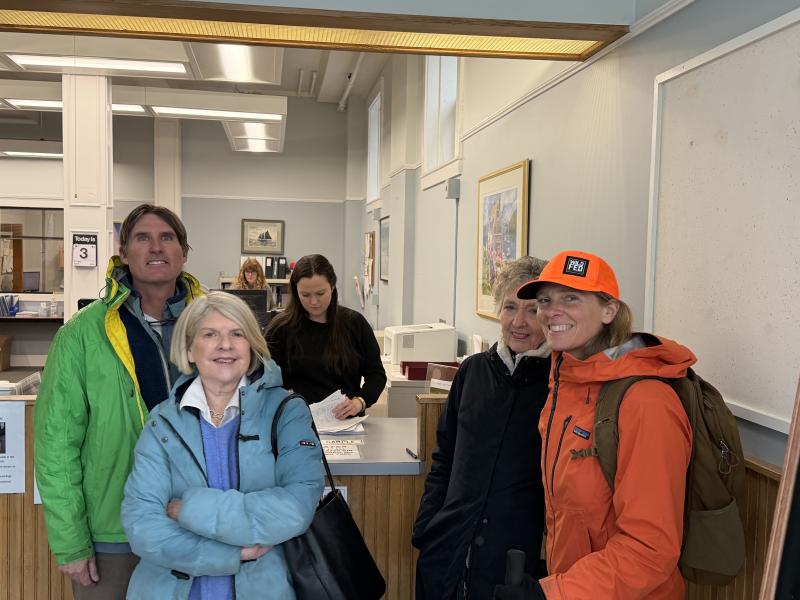 Camden residents Alex Cohen, Betsy Perry, Wendy Andresen and Jessica Ives deliver a petition to add a June 9 Annual Town Meeting warrant article that would ask voters if they wanted to eliminate the town's paid parking program. (Photo courtesy Alex Cohen)
Camden residents Alex Cohen, Betsy Perry, Wendy Andresen and Jessica Ives deliver a petition to add a June 9 Annual Town Meeting warrant article that would ask voters if they wanted to eliminate the town's paid parking program. (Photo courtesy Alex Cohen)
Camden residents Alex Cohen, Betsy Perry, Wendy Andresen and Jessica Ives deliver a petition to add a June 9 Annual Town Meeting warrant article that would ask voters if they wanted to eliminate the town's paid parking program. (Photo courtesy Alex Cohen)CAMDEN — The Select Board in Camden has a weighty agenda to address at its regularly scheduled April 7 meeting, with business that encompasses a $5.9 million grant for the Montgomery Dam removal; two citizen-initiated petitions asking for town meeting warrant inclusions; Budget Committee recommendations; a moratorium on seawall projects; and a proposal to establish a fund, "to improve oral health and access to dental care for Camden residents, including through free or low-cost dental care, grants and scholarships, clinic subsidies, and related activities."
Rodney Lynch, who was a longtime community development director for Rockland, a former town manager, recipient of state awards, and a Vietnam vet, has always cared about his home town of Camden. And he knows how planning works. Well into his retirement, he pivoted to help Rockport stay on track in 2014 after the departure of its planner, implementing four grants and projects for that neighboring town.
With his contributions, is now asking the Town of Camden to approve the Inez Madell Lynch Oral Health and Dental Care Fund, which he wants to establish in honor of Inez Madell Lynch, a member of the Camden High School Class of 1927. And, with additional donations, Lynch hopes to establish a fund for the care and maintenance of the Camden Veterans' Honor Roll on the Village Green, other war and veteran monuments and memorials in Camden, and veteran commemorations; the term "monuments" as used in the agreement excludes individual grave markers or grave sites.
Police and Parking program petitions
Two groups of Camden citizens have spent the last three weeks gathering signatures on petitions that ask the Camden Select Board to place before voters at June Town Meeting two questions: 1) To keep the municipal police department intact and at status quo, and 2) eliminate the new paid parking program.
The latter was hand-delivered to the Camden Town Office April 3 by four Camden residents: Betsy Perry, Wendy Andresen, Alex Cohen and Jessica Ives. Cohen had initiated the petition a week prior and collected 577 signatures.
Petition language reads: "To see that the Town will vote to direct the Select Board to eliminate the paid parking program in Camden and to remove all parking meter kiosks."
A week before the parking petition, another separate group of residents had submitted to the Camden Town Office a petition to place a police department-related article on the town meeting warrant: "To see if the Town will vote to direct the Select Board to employ a Town operated Police Department and a fulltime Chief of Police to manage the Camden Police Dept., and not to contract with the Knox County Sheriff's Dept. or any outside agency for the management of police services."
Camden Town Attorney William Kelly issued a March 28 memo to the Select Board concerning the police petition. In it, he said the petition was clear in its stated purpose, but clarified the purview of the municipal charter, as well as state statutes governing charters and Town Manager Plans.
"In cases where an ordinance, or a proposed Voters' Petition, conflicts with a charter, the ordinance will be invalidated if it frustrates the purpose of the charter or exceeds the municipality's home rule authority," he wrote, citing Maine Supreme Court rulings.
He suggested a middle ground: Place the petition's warrant language on the ballot as a nonbinding referendum to more thoroughly gauge voter sentiment.
"The Select may find this serves to receive feedback from all the voters at Town Meeting without running afoul of what appears to me to be a situation where the Charter and Town Manager Plan preempt the Warrant Article from being considerered by the voters, absent a full Charter revision or amendment process as required by Maine law," wrote Kelly.
Kelly's memo did not reference the parking program petition, as it arrived at the town office after Kelly's memo was issued. The same held for another memo, this one from Sarah J. Jancarik, an attorney with the Maine Municipal Association. MMA is a nonprofit that lobbies for Maine municipalities before the Legislature and offers municipal counseling and training on a variety of topics.
Jancarik had communicated with Select Board Chair Susan Dorr about the process citizen petitions employ as they move through municipal review, assessment and then consideration by a town's presiding body, such as the Select Board.
She offered her own perspective on the police petition, noting that it had been crafted while the Camden Select Board had decided to search for a new police chief.
"In my opinion, a petitioned warrant article cannot force the board to employ anyone or fill a vacancy as those decisions are within the board and potentially the town manager’s purview," she wrote.
Further, if a contract has already been entered into with the county sheriff’s office, it would be unlawful for a town meeting vote to sever that contract and it would present significant legal liability for the town for breach of contract and other issues to do so.
"I think the potential approach here is to wait to receive the petition, have the petition verified and certified and then the board can review it. The board can reasonably refuse to place the petitioned article on a town meeting warrant for the reasons I described above (see also the attached Chapter 5 from the Town Meetings and Elections Manual [also included in the Select Board packet] which goes into more depth on ultra vires (beyond the scope of authority) and unlawful actions proposed by a warrant article) and then address the concerns at a Select Board meeting an assure the residents that the sheriff’s assistance is a temporary but necessary arrangement and that the board has moved forward with attempting to find a new police chief if that is in fact what is happening."
Montgomery Dam removal grant
At the April 7 meeting, the Select Board will be asked to accept a $5.93 million grant from the National Fish and Wildlife Foundation and funded through the National Oceanic and Atmospheric Administration. It is a matching grant, with the expectation that Camden will contribute $375,000 toward the project goals.
That project entails removing the Montgomery Dam, restoring the Megunticook River channel, and installing approximately 500 linear feet of hybrid living shoreline along Harbor Park.
At their 2025 June Town Meeting, Camden citizens voted 1,391 to 995 to remove the Montgomery Dam and spillway at the head of Camden Harbor, with the caveat that the project's fiscal responsibility would not fall on property owners through local taxation.
"The Town is authorized to fund the work only from non-property tax revenue sources, e.g. grants and private donations; and 2) Any portion of the project impacting Harbor Park shall be subject to the approval of the Library Board of Trustees as stipulated in the deed of gift from Mary Louise Curtis Bok to the inhabitants of the Town of Camden...." the town's June Town Meeting Warrant Article 7 read.
The town learned that it received the grant last December.
The grant funding period ends December 1, 2029, with final reports due March 1, 2030.
Moratorium on seawalls and bulkheads
Camden's Planning Office proposing a 180-day moratorium on the permitting and installation of hardened and/or armored coastal shoreline stabilization projects including, seawalls, bulkheads, and riprap revetements and similar projects.
The request is made to the Select Board to place the moratorium before voters at annual Town Meeting, June 9, at the polls.
According to Camden Planning and Development Director Jeremy Martin, the, "measure is intended to provide a necessary pause while we update Chapter 290 Article 290-10.2 (Shoreland Areas) and Article 290-12.1 (Site Plan Applicability) and 290-12.6 (Approval Criteria) to align with state standards and our own municipal resiliency goals to ensure that hardened/armored shoreline projects do not cause serious irreversible harm to Camden’s public natural resources, municipal infrastructure, the property rights of neighboring landowners and the public welfare."
With consultants Richardson and Associates, Camden has conducted an Inner Harbor resiliency study, "which assessed flood risk and outlined strategies to enhance the community’s resilience to rising seas and increasingly intense storm events," wrote Martin, in a memo to the Select Board.
During the process, the town learned that seawalls reflect wave energy and can scour beaches
Survey, who had provided extensive data showing that hardened and/or armored walls or slopes reflect wave and result of end-effect erosion on neighboring property.
"The 180-day moratorium period will be used to update our ordinances while preventing unwise shoreline stabilization projects that may damage abutting property and municipal infrastructure or significantly impact the character of the harbor, and damage unique tidal ecosystems," wrote Martin. "The time is right. In September of 2025 the Maine DEP modernized Chapter 305 and 310 to strictly prioritize nature-based "living shorelines" over hardened armoring. Camden should, at a minimum, keep pace with these state-level changes to prevent the installation of infrastructure that would be deemed non-compliant or maladaptive under future standards."
FY 2026-2027 Budget
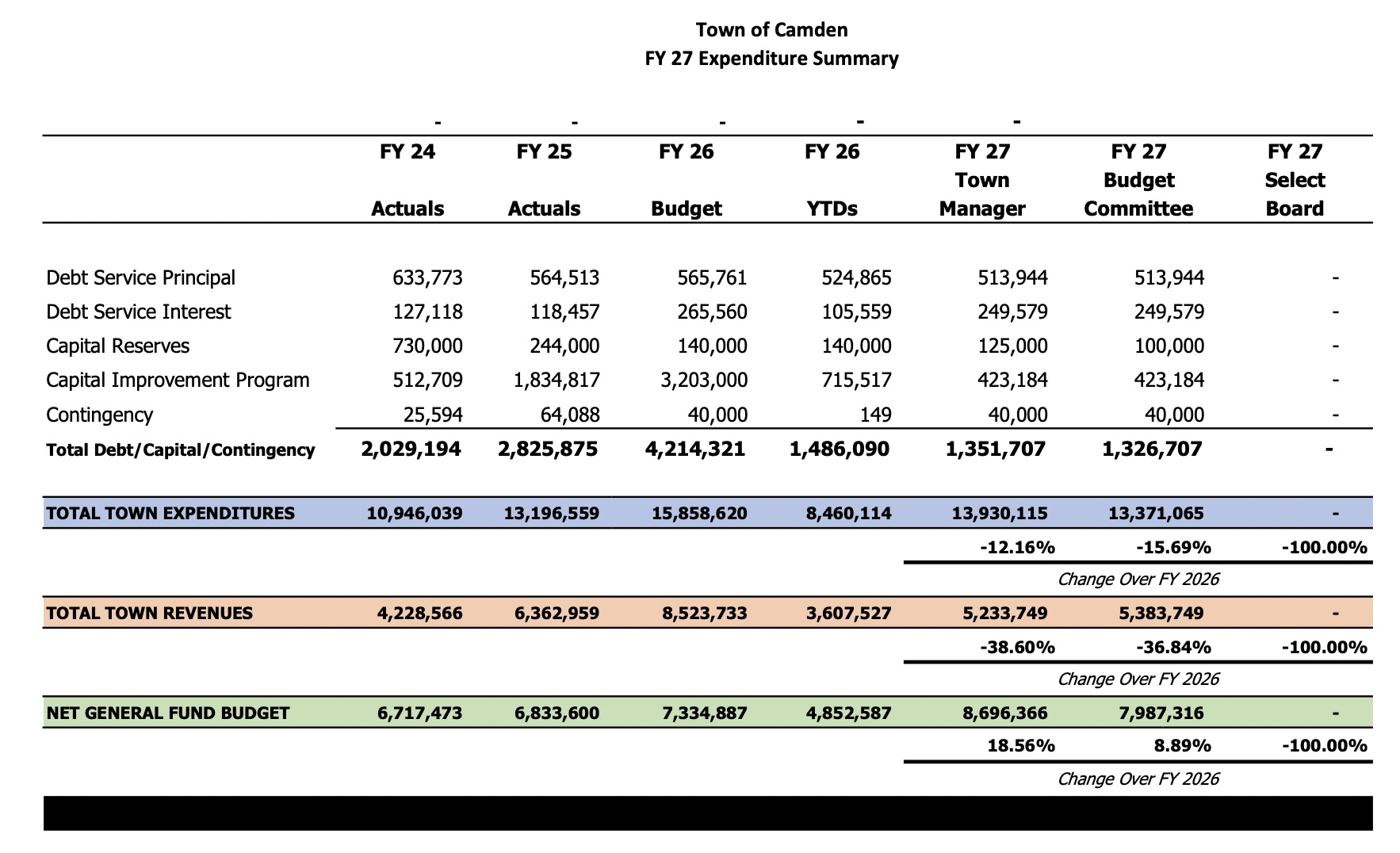
With the Budget Committee's work concluded, tweaks made and recommendations issued, the Camden Select Board now is ready to finalize the proposed 2026-2027 municipal budget, and get it ready for a public hearing.
The proposed budget is available here, and its summary follows:
Reach Editorial Director Lynda Clancy at lyndaclancy@penbaypilot.com; 207-706-6657