Biddeford shooting renews questions about ICE tactics, training
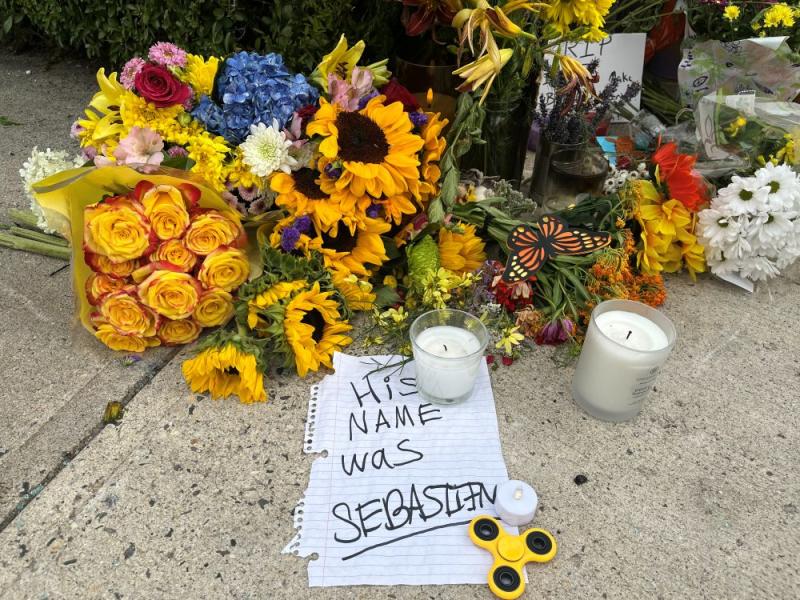 Photo by Josh Keefe.
Photo by Josh Keefe.
Photo by Josh Keefe.The fatal shooting of Johan Sebastián Durán Guerrero in Biddeford earlier this month marked the second time federal immigration agents fired at a moving vehicle in less than a week and the fifth time immigration officials have killed someone driving a vehicle since the Trump administration began ramping up enforcement last January.
His death has reignited questions about the training Immigration and Customs Enforcement officers receive and the tactics they use to carry out deportation efforts across the country — particularly when it comes to firing at cars.
Federal agents are only allowed to shoot at moving vehicles if a person in the vehicle is threatening deadly force by another means or if their operation of the vehicle “threatens to cause death or serious physical injury” to the officer or others, according to the U.S. Department of Homeland Security’s use of force policy.
Discharging a weapon at a vehicle could cause the driver of the car to lose control or fatally injure an innocent bystander, and officers are taught to avoid the practice except in very rare circumstances, policing experts told The Maine Monitor.
Yet the Biddeford shooting was the 20th time federal immigration agents have shot or claimed to have shot at a moving vehicle since the start of last year, according to a database maintained by The Trace.
Immigration agents’ use of traffic stops has become a flashpoint in the national debate over the Trump administration’s deportation tactics. More than half of the cases identified by The Trace where immigration agents have used deadly force since 2025 started as traffic stops; in two thirds of those cases, federal officials have claimed that the victims used or intended to use their vehicles to cause harm.
In several instances bystander footage has challenged the government’s narrative, but the circumstances around each shooting have been difficult to determine in part because ICE agents have yet to fully adopt body cameras. This is despite the agency’s pledge to deploy them nationwide after two deadly shootings in Minneapolis in January.
Following the Maine shooting, the U.S. Department of Homeland Security announced it would stop all non-emergency traffic stops, but that was quickly overturned by President Donald Trump, who called traffic stops one of the department’s “most important and effective Crime Fighting tools.” In an interview on CNN on Sunday, Trump’s border czar Tom Homan said the department’s use of vehicle stops was still under review, but he claimed the agency had made some “immediate changes,” including requiring “at least one body camera onsite to record the entire event.”
In Maine, local, state and federal law enforcement officers have shot at vehicles at least 24 times since 2002, according to a Maine Monitor analysis of deadly force investigation reports issued by the state attorney general’s office. Four incidents resulted in at least one person’s death; another 11 resulted in injuries. No law enforcement officers died in any of the incidents. In 17 cases, the officers’ use of force followed a vehicle pursuit or officers being dragged by a moving vehicle. In all cases, the attorney general determined the use of force was justified.
As state and federal investigations into the Biddeford shooting get underway and many of the details remain murky, the earlier Maine cases show how investigations into use of force often lean heavily on officers’ perception of potential harm. Advocates for police reform said law enforcement training needs to emphasize how dangerous shooting at vehicles can be.
Only if a vehicle is being used as a “ramming device, or mowing people over” should police shoot at a moving vehicle, said Chuck Wexler, executive director of the Police Executive Research Forum, a law enforcement policy organization.
Otherwise, he said, “why threaten or risk the life of someone or an officer?”
‘Continuum of force’
The Department of Homeland Security’s use of force policy, which was last updated in 2023, prohibits shooting at a vehicle unless the officer “has a reasonable belief that the subject of such force poses an imminent threat of death or serious bodily injury” to the officer or others. It calls for officers to consider “the hazards that may be posed to law enforcement and innocent bystanders by an out-of-control conveyance” before shooting a driver.
Maine State Police has a similar policy. It states that “an officer shall not discharge a firearm in the direction of another person or at a moving vehicle unless the use of deadly force is justified.” Under state law, such force is only justified when an officer reasonably believes there’s an imminent risk of a suspect using deadly force against the officer or others, or that the person has indicated a likelihood to “endanger seriously human life or to inflict serious bodily injury unless apprehended without delay.”
Brunswick Police Department Chief and president of the Maine Chiefs of Police Association Scott Stewart said police are taught to de-escalate situations before using any kind of force if possible. He declined to comment on the Biddeford shooting, saying he was unfamiliar with the specifics.
Stewart said officers are trained to think quickly and assess possible risks as they decide how to proceed. They drill this into recruits and current law enforcement officers in part by having officers work through real-life scenarios and then debriefing.
“These situations can unravel extremely fast,” he said.
Proper training is essential, said Noel March, who formerly served in the U.S. Marshals Service and now leads the University of Maine at Augusta’s Maine Community Policing Institute.
Law enforcement officers typically receive training on what’s known as the continuum of force, which covers an escalating series of actions from mere police presence to lethal force, he said.
Since Trump took office last year, ICE has received more than 200,000 job applications and hired 12,000 new agents, a rate of expansion that March said could call the hiring standards into question.
“As a professional law enforcement officer and police trainer, I have concerns about the level of recruitment, selection and training within this rapidly growing agency of Immigration and Customs Enforcement,” March said. “And I’m not alone in that concern.”
David Brouillette, the ICE agent identified as the officer who shot Durán Guerrero, has a history of violent behavior, according to relatives and court records, though he has denied the allegations. If the accusations are true, border czar Homan told CNN on Sunday that he didn’t think Brouillette “should ever have cleared vetting.”
ICE did not respond to a request for comment about its training policies. An ICE spokesperson told The Guardian earlier this month that its agents are trained to use the “minimum amount of force necessary to resolve dangerous situations to prioritize the safety of the public and our officers.” Homan said on CNN that the agency was revisiting its training protocols given the recent shootings.
Maine incidents
The Maine Criminal Justice Academy requires police departments to document and report use of force incidents. When deadly force is applied, an incident reviewing team must look at radio communications, initial approaches and actions to understand the facts and how officers reacted. All deadly force cases are investigated by the attorney general, who can then decide whether to press criminal charges or if the evidence of the case shows officers were acting in defense of themselves or others.
The Monitor reviewed 176 deadly force incidents in Maine since 2002; at least 24 of those involved moving vehicles.
In the use of force investigations involving moving vehicles analyzed by The Monitor, six months typically passed between the incidents and the attorney general’s reports. The investigations focused on whether a weapon was involved, how the driver of the car was acting and if those factors could reasonably lead someone to assume they or others were at risk of harm. Some confrontations played out over minutes while others lasted for hours. Many involved parties exchanging gunfire or police chasing a vehicle.
As with many of the ICE-involved shootings over the past year, officers often reported shooting after a vehicle began driving toward them. In one 2012 incident, a Maine State Police trooper fired at a suspect’s car in an attempt to disable it after a vehicle pursuit when the suspect began backing toward the trooper and several approaching vehicles. The attorney general concluded that the officer reasonably believed deadly force was necessary “to protect himself from the imminent threat of deadly force posed against him.”
Two people died in a single incident on Feb. 10, 2017, when Ambroshia Fagre and Kadhar Bailey were killed by law enforcement officers while in Bailey’s truck. Bailey exchanged gunfire with a law enforcement officer and drove his truck into a Maine State Police vehicle, according to the attorney general’s report, which did not cite any video evidence of the incident. One officer, unaware of Fagre’s presence, fired at the truck, striking Fagre, who later died at the hospital. Another officer approached the truck and fired several shots, killing Bailey, when he saw Bailey reach toward the center of the vehicle.
“While certainly tragic,” Deputy Attorney General Lisa Marchese wrote in the 2018 report, “the unintended death of Ms. Fagre does not affect the legal analysis” of whether the use of deadly force was justified. The attorney general’s review found that both uses of force were justified because the officers “each reasonably believed that unlawful deadly force was imminently threatened against the officer or another,” and deadly force was a reasonable counter to the threat. Fagre’s family filed a wrongful death lawsuit, but it was dismissed by a federal appeals court.
And in 2024, a Caribou police officer injured a man by firing his gun once while the man drove toward him in a utility vehicle. Body camera and surveillance footage showed the man nearly hitting the officer with his vehicle, according to the attorney general’s report, which found the use of deadly force to be justified because the man posed an imminent risk of serious bodily injury or death to the officer.
‘Last resort circumstances’
Officials at the state and federal level are reportedly working together to conduct separate investigations into the Biddeford shooting, though few details have been released.
ICE has said its agents were carrying out a final order of removal in Biddeford when Durán Guerrero left his Pool Street residence in a car. On the day Durán Guerrero was killed, DHS Secretary Markwayne Mullin said Durán Guerrero had “weaponized” his vehicle, but in a later statement, the department described agents as “fearing for public safety” after Durán Guerrero “attempted to flee.” Maine’s U.S. Sen. Angus King has said Durán Guerrero was not the target of the operation, and local immigrant service groups said he was here legally with a work permit.
The car Durán Guerrero was driving had four visible bullet holes in the windshield after the shooting. Video footage shows a Kia sedan circling in the intersection of Pool and Hill Streets, just a block from his apartment, before an agent in a white SUV pins it to the curb.
Wexler, with the Police Executive Research Forum, declined to comment on the specifics of the Biddeford incident, noting a lack of video evidence of the shooting itself. But he said law enforcement should be trained to approach vehicles at an angle and not shoot at them without a clear risk of harm.
It is “standard practice” to approach a vehicle from the side, not stand in front and shoot at the windshield from there, Wexler said. Otherwise, the officers create unnecessary risks for themselves, suspects and bystanders alike, he said, referencing the fatal shooting of Renee Good in her car in January.
“You’ve got an unguided missile at that point,” he said.
Use of force investigations are guided in part by two U.S. Supreme Court cases from the 1980s. In Graham v. Connor, the court established that excessive force claims must be judged from the perspective of a reasonable officer on the scene given the facts known at the time. In Tennessee v. Garner, the court ruled that officers can only use deadly force to prevent a suspect from fleeing if they reasonably believe the suspect poses a significant threat of death or serious physical injury to the officer or others.
Under those two standards, March said, a law enforcement officer would not be justified in shooting at a suspect solely because they fled in a vehicle. The officer must be able to articulate why the circumstances caused them to believe they or members of the public faced an imminent risk of serious injury or death if the officer did not use lethal force. If an officer shoots at a moving vehicle without meeting that standard, March said, they would likely be in violation of policy.
“When our government agents use — under color of law — use lethal force, it must be only in last resort circumstances,” March said. “Our law enforcement officers must have the training, must have the supervision, and must be hired and retained appropriately to carry out this most serious responsibility of public trust. Period.”
Digital editor George Harvey contributed reporting.
This story was originally published by The Maine Monitor, a nonprofit civic news organization. To get regular coverage from The Monitor, sign up for a free Monitor newsletter here.