Midge Ure’s strong return
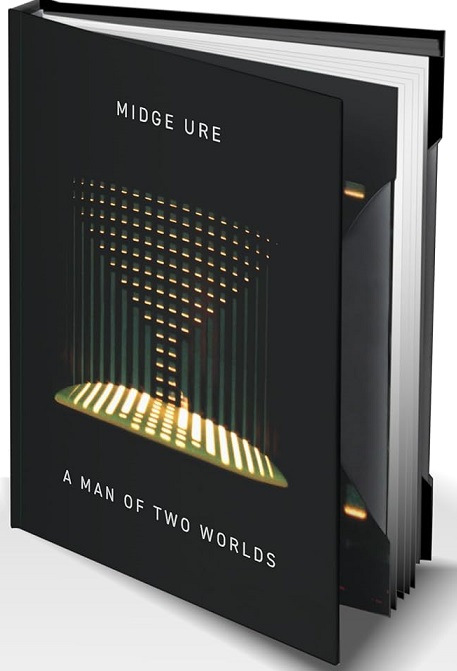 Midge Ure's "A Man of Two Worlds" release.
Midge Ure: A Man of Two Worlds (Chrysalis/MusicFest, 2 CDs, 40:55). This is Midge Ure’s first album of new material in 12 years. It is divided into two parts. The first half, “World One: Music,” consists of eight instrumental pieces, while the second half, “World Two: Songs,” contains eight vocal songs. Reportedly, the concept was partly inspired by the time Ure spent during lockdown listening to instrumental music while presenting “The Space” on Scala Radio.
His sim on the instrumental first disc is to let the melodies speak for themselves. These eight tracks showcase Ure’s skill in crafting meditative, piano-led compositions that evoke serenity and imagination. There are lush melodies and emotional depth, starting with the reflective “A Different View.”
Highlights include “The Space In Between,” which turns a bit dramatic towards the end; “Just Below the Surface,” which expands the musical palette as some of the playing seems to float above the piano; and “The Other Side,” which rises well.
The eight vocal songs on disc two came to Ure as the world reopened. Sharing an atmosphere with the instrumentals, the songs are sparse and meditative, dealing with the frailty of the human condition and touching on the discord that effects today’s world. “Just Words,” despite its uplifting chorus, asks where hope goes when it is gone, followed by strong guitar and the chorus. The song seems like it was inspired by some of the deranged nighttime Truth Social postings by the current White House occupant. Ure sings, “Load up your thoughts, take aim and fire,” adding “Scream your mindless roar, like you’ve done before” and concluding with “We only lose from words you use.”
In the following “World Away,” Ure sings, “Talk like you hear it” in his rebuke to the authoritarians running our lives. He continues, “But you’re too blind to see/This world you hold is more than just your world,” as the synths boom. These are some classic Ultravox-style synths, recalling the band Ure led from 1979 to 1986, after John Foxx left for his solo career.
Ure, of course, is no stranger to socially conscious songs, having co-written and produced the charity single “Do They Know It’s Christmas?” for the superstar Band Aid, which he organized with Bob Geldof. Ure still acts as a trustee for the charity.
Next comes “Shouting to the Moon” with its chilled-out piano and sweeping strings, as it considers the difficulty of compelling the masses towards the right kind of change. He mentions the “stupid noise from smart devices.” The song ends with this lament, “If we cannot cry together soon, all that’s left is crying to the moon.”
The beatless ballad “Somewhere Out There” follows. It sighs, “Picture yourself in a world where they care/Somewhere out there.” Then, Ure calls for action in “The Man Who Stole Your Soul,” with its uplifting music section and aggressive guitars, before it ends softly. Another wonderful, building musical part is featured in the closing “Fan the Flame.”
The discs come in a DVD-sized Mediabook that has a 20-page booklet with lyrics and photos of places and moments. Grade: album A
Morrissey: Make-Up Is a Lie (Sire, CD, 49:48). Recorded in France, this is Morrissey’s 14th solo album. It has 12 songs, several of which are in his usual style.
Highlights include “You’re Right, It’s Time,” in which he is cutting loose from the Internet and seeking love instead; “Notre Dame” – “We tried to kill you” – one of two songs mentioning Paris, the other being the more electronic title track; “Amazonia,” with its strong guitars is a Roxy Music cover, and Roxy Music is mentioned in “Lester Bangs,” about the late rock writer who edited Creem magazine; and finally, the rocker “The Night Pop Dropped.”
An amusing ballad is “Kerching Kerching,” while “Boulevard” is dramatic and “Zoom Zoom the Little Boy” is a list song. “Headache” is a quirky anti-marriage song that repeats “I don’t like you.”
The album was produced by Joe Chiccarelli, his fifth collaboration with Morrissey. Morrissey co-wrote all but “Amazonia,” and four were written with keyboardist Camilia Grey, including the title track, “You’re Right, It’s Time,” “Kerching Kerching” and “Lester Bangs.”
The lyrics in the gatefold sleeve are so small that they are difficult to read even with a magnifying glass. Grade: album B
Midge Ure's "A Man of Two Worlds" release.
About this blog:

My music review column, Playback, first ran in February 1972 in The Herald newspapers of Paddock Publications in Arlington Heights, IL. It moved to The Camden Herald in 1977 and to The Courier Gazette in 1978, where it was joined by my home video reviews in 1993. The columns ran on VillageSoup for awhile, but now have this new home. I worked at the Courier Gazette for 29 years, half that time as Sports Editor. Recently, I was a selectman in Owls Head for nine years.