
UMaine is re-envisioning its future. Faculty concerns are ‘palpable’
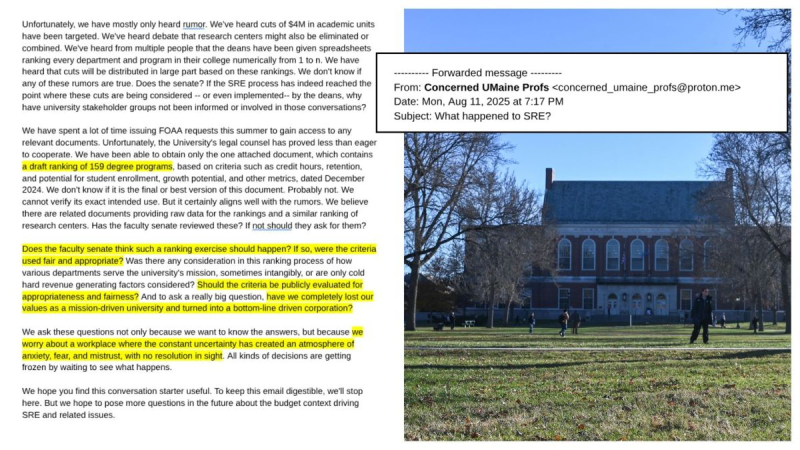 The University of Maine’s Faculty Senate received a series of anonymous emails from “Concerned UMaine Profs” that critique the university’s strategic re-envisioning process to rethink UMaine’s future and address budget pitfalls. Professors who spoke with The Maine Monitor echoed the emails’ sentiments, while university administrators said no changes will be made without faculty input. Photo illustration by Erin Rhoda; Photo by Kristian Moravec.
The University of Maine’s Faculty Senate received a series of anonymous emails from “Concerned UMaine Profs” that critique the university’s strategic re-envisioning process to rethink UMaine’s future and address budget pitfalls. Professors who spoke with The Maine Monitor echoed the emails’ sentiments, while university administrators said no changes will be made without faculty input. Photo illustration by Erin Rhoda; Photo by Kristian Moravec.
The University of Maine’s Faculty Senate received a series of anonymous emails from “Concerned UMaine Profs” that critique the university’s strategic re-envisioning process to rethink UMaine’s future and address budget pitfalls. Professors who spoke with The Maine Monitor echoed the emails’ sentiments, while university administrators said no changes will be made without faculty input. Photo illustration by Erin Rhoda; Photo by Kristian Moravec.The elected body that represents professors at the University of Maine in Orono received an anonymous email on Aug. 11.
The email to the Faculty Senate, which said it was sent by “Concerned UMaine Profs,” criticized how the university was undergoing a process that it had started in 2024 to rethink UMaine’s future and address budget shortfalls. The letter argued ongoing strategic planning had not been transparent and questioned whether the university was focusing too heavily on evaluating academic programs based on the revenue they generate.
Attached was a list, which the sender said was obtained through a records request from the university, that ranked academic programs based on metrics such as student enrollment and growth potential.
“[H]ave we completely lost our values as a mission-driven university and turned into a bottom-line driven corporation?” read the anonymous email, which was shared widely among staff and faculty. The account sent several more emails to the Faculty Senate in August and September, which were obtained by The Maine Monitor.
The university is currently undergoing a years-long process to plan for its future. It started in 2024, gathering input from more than 200 staff, faculty and administrative members across campus.
But seven staff and faculty members told The Monitor that transparency dwindled in 2025, echoing sentiments expressed in the anonymous emails. They worried decisions were being made without their input and that budget challenges were driving the strategic planning.
Those leading the strategic planning — university administrators and some members of faculty — said that the process is not entirely connected to addressing the budget, though fiscal sustainability is an important part of the exercise.
UMaine has hosted meetings on campus, formed various working groups and sent updates related to strategic planning on campus. But in response to concerns about transparency this year, UMaine President Joan Ferrini-Mundy told The Monitor that, in the spring and summer of 2025, the re-envisioning group was doing “background work” — collecting data, developing ideas — and not making any decisions.
This background work also unfolded during a time when faculty were off for the summer, and while the federal administration targeted tens of millions of dollars in research funding at UMaine and other universities across the country.
“We’ve picked back up,” Ferrini-Mundy said. “We’ve been bringing our groups and committees back together, really looking at: What can we do now? What’s next?”
Samantha Warren, a spokesperson for the University of Maine System, said that the program rankings referred to by the anonymous emailer were likely created early on in the planning process but that strategic planning leaders don’t remember them being used in recent conversations.
Today, however, the university has a more updated list of 215 academic programs that are ranked based on similar metrics as a result of the planning process. This data was shared with faculty representatives in September, according to an email from Ferrini-Mundy that Warren provided.
The list shows that about 66 programs, including economics and zoology, are ranked high by the university’s measurements. One hundred and six others, such as microbiology, chemistry and literacy education, fall in the middle. The remaining programs, including some languages, music and forestry, fall to the bottom.
Provost Gabriel Paquette said programs are being evaluated by both quantitative and qualitative data, and the university would make no changes to programs without involving stakeholders across campus.
“We have to weigh all that together and think about all those things in conjunction,” Paquette said. “There’s no secret about that process. I would just try to underscore that point, which is that these are open conversations that are taking place.”
This week, concerns about how the strategic planning process has unfolded sharpened when university administrators asked UMaine colleges and other divisions to figure out this month how to cut 7 percent of their budgets in anticipation of an $18 million budget shortfall in the next fiscal year.
For some staff members, the cuts feel at odds with the strategic planning process, particularly as the request came during a busy point of the semester.
“It shows no actual concern for human beings that do this really hard work, who care for students and, by the way, do an exceptional job of it under already extremely minimal resources,” one staff member in a leadership position told The Monitor. “To think people are going to think clearly and make a strategic decision — I don’t even know how you could be strategic.”
‘Demoralizing and infuriating’
All but one of the seven university staff and faculty members interviewed by The Monitor declined to be named in this story, citing concerns about backlash and their job security.
A second high-ranking staff member on campus, who asked not to be named but participated in the working groups that were formed in the early stage of the re-envisioning process, said discourse was initially open.
But last spring and summer, this staff member said, those leading the process were no longer providing clear updates about whether the administration was making decisions in what was supposed to be the final phase of the re-envisioning process.
According to the university’s original timeline posted online, strategic planning was set to run from 2024 to early 2025. The third and seemingly final phase of the process — called “refining and executing” and meant to run between October 2024 and February 2025 — aimed to engage the community broadly to work on the changes that would have been implemented in the 2026 fiscal year, according to a September snapshot from a web archive.
Some strategic planning leaders in campus meetings noted that this timeline could be flexible. The university has since updated its website to show that the third phase is ongoing.
Warren explained that the timeline for strategic planning cannot be defined by an end date. Paquette described the strategic re-envisioning process — or, SRE — as a “vehicle” for the school to continuously assess how the university can best serve the state.
“I think the SRE, in many ways, will only die out if that energy were to die out, but I don’t see any sign that it’s subsiding,” Paquette said. “SRE was really in some ways — and it remains — sort of a means to an end, and the end is improving the university.”
The high-level UMaine staff person, whom The Monitor is not naming, said the timeline of the strategic planning has been confusing and that it’s unclear what phase of the process the school is in.
The person also argued that it is “completely disingenuous” for those leading the re-envisioning process to claim the exercise is not completely about the budget. The endeavor has been “demoralizing and infuriating,” said the person, who did not know who was behind the anonymous emails but agreed with their takeaways.
“Many faculty felt like they’ve been left in the dark for nearly a year. And the town meeting in October offered very little clarity about how serious the budget deficit really is, and how any decisions will be made to resolve it, address it, close the gap,” the staff member said. “That’s how a lot of people felt, including me.”
The staff member was referring to a town hall meeting for strategic planning in late October where those leading the strategic planning presented preliminary budget figures for the next fiscal year, showing that expenses would exceed revenues.
One person, a faculty member, did respond after The Monitor emailed the Concerned UMaine Profs group, though asked not to be named for this story.
This faculty member said the sentiments expressed in the emails are still relevant today and that the strategic planning has “huge potential consequences” for the school and the state. This person said they shared the list of academic program rankings before strategic planning leaders publicized a more recent list with the campus to show the direction the strategic planning was headed.
“I think there’s an undercurrent of dissatisfaction,” the faculty member said. “I think [the emails] just provided a focus point for people to start talking about it.”
For instance, the emails questioned whether the work faculty and staff did in the strategic planning process was being used. Faculty are also struggling as roles in departments go unfilled through attrition, but positions that have seen turnover in the president’s office are being filled, the emails said.
(Warren said criticism of turnover lacks an understanding of “tenure patterns within higher education for these types of roles and the unique circumstances of the involved individuals here at UMaine.”)
Amanda Klemmer, the president of the Faculty Senate and one of the leaders in the strategic re-envisioning exercise, said the anonymous emails touched on topics that the senate was discussing and echoed concerns that she had already heard from faculty. The emails highlighted how work the senate was doing to address the concerns raised in the emails was not communicated effectively, she said.
“I think that maybe is where some of that breakdown happened, where people didn’t feel as informed as they needed to be to be a part of those solutions,” Klemmer said. “But I do think we’re moving towards that.”
‘Thriving by most measures’
On UMaine’s webpage for the strategic re-envisioning exercise, bold blue letters toward the top read: “What would UMaine look like if we were designing it today?”
Ferrini-Mundy described the question as “energizing” and saw the process as “exciting.”
“In the bigger picture of things, I’m feeling very optimistic about what we’re able to do here at UMaine,” Ferrini-Mundy said.
The president and Warren told The Monitor that the strategic re-envisioning exercise is not entirely connected to budget challenges and that budget issues are not unique to UMaine. Instead, Ferrini-Mundy said the exercise is a chance to re-design UMaine with opportunities to better serve students at the university.
For example, UMaine is pursuing initiatives that include “meta-majors,” or degree pathways that allow students to incorporate studies from different specialties, such as its new computer science and business major, Warren and Paquette said.
“[Strategic re-envisioning] was genuinely launched to be a re-envisioning, knowing that along the way we would have to maintain a way of being sustainable, fiscally,” Ferrini-Mundy said. “At the same time, that’s deeply tied to our relevance. Are we able to serve the state well, and how do we do that well?”
Last year, Ferrini-Mundy authored a paper, published on the UMaine webpage for strategic planning, to make the case for the re-envisioning process.
Ferrini-Mundy’s paper detailed how the university has not raised tuition to keep up with inflation and costs for UMaine; student credit enrollment hours have not increased; compensation costs have risen more than 13 percent between 2022 and 2025; and deferred maintenance on the historic campus exceeds $1 billion.
The school is “thriving by most measures,” however, and is using the strategic re-envisioning process to evolve thoughtfully and carry the institution into the future, Warren said.
“Given the external changes that have emerged in the past year, the launch of the SRE process in 2024 now looks especially prescient, and has been essential to the university navigating those challenges and maintaining opportunities for our students and the state,” Warren wrote in an email to The Monitor.
‘We must be very cautious’
Klemmer said that the re-envisioning process is unfolding like an hourglass. The broader university was involved at the beginning of the process. Then work moved into smaller groups, she explained.
“I think that smaller section, at the very pinch point, maybe lasted a little longer than it should have because of all the federal changes,” Klemmer said. “But now we’re just at that beginning of the widening-out again.”
Klemmer said that individual academic programs will know about any proposed changes — adding, cutting or reorganizing — beforehand. Then they would need to be approved by the Faculty Senate, which would gather feedback from the campus. The Faculty Senate then would have to vote whether to support any changes.
Faculty concerns about the re-envisioning process have been “palpable,” said Michael Grillo, a member of the Associated Faculties of the University of Maine, a union that represents professors on campus.
Grillo emphasized that UMaine must remain inclusive and diverse in the disciplines it offers, rather than cutting programs that are currently low performing. Using evolutionary biology as a metaphor, Grillo said species go extinct when they over-specialize or adapt to serve their current environment, leaving them vulnerable when the environment changes.
“The unintended outcomes that may come from losing pieces — that’s something we must be very cautious of,” Grillo said.
The status quo may seem comforting, but it does not reflect the dynamic nature of education, Paquette said.
“We’re doing that because of the obligations that we have to provide the best education to the residents of this state,” Paquette said. “We can’t just remain stagnant.”
This story was originally published by The Maine Monitor, a nonprofit civic news organization. To get regular coverage from The Monitor, sign up for a free Monitor newsletter here.