
Councilors counter ADA confusion, lack of public transit in support of Rockland parking restriction ordinance
 (Photo by Sarah Thompson)
(Photo by Sarah Thompson)
(Photo by Sarah Thompson)ROCKLAND — “Ultimately, would you rather a building be built with four apartments with parking, or six apartments without?” said Planning Board Member Ed Ledoux, during the Dec. 8, 2025 City Council Meeting. “Worded another way, how many parking spaces is worth one person sleeping in their car? Would you rather someone open a restaurant without parking, or not start their business at all?”
Ledoux supported the Council’s later 5-0 vote to eliminate minimum parking requirements, primarily eliminating parking requirements for commercial parking. Ledoux, however, admitted that the new measure, which goes into effect in 30 days of the Dec. 8 meeting, will add difficulty to Planning Board meetings.
“But I think we are ready to take on that challenge,” he said. “In our remit cite plan review process, we can still talk about traffic impacts...that type of thing. I don’t think this will happen, but if someone shows up with a 12-unit apartment building with zero parking outside of the downtown area, well, we’re going to have to talk about the practical impact of that, as that would be allowed.”
The ordinance amendment, sponsored by Mayor Adam Lachman and Councilor Nate Davis, is described as an effort to promote more efficient and flexible use of limited developable land, and follows previous reductions in parking requirements for residential development. Currently a new four-apartment building, or four-unit building, does not require providing any parking. If you build a 10-unit building, you’re only required to three spots, according to Davis.
“Every residential development I’ve seen since that introduction has offered more parking than required,” said Davis. “Our residential parking requirements have essentially no effect now.”
Councilor Penny York clarified that the City and builders still must comply with federal mandates for ADA parking. This ordinance does not impact that law, she said. York made the clarification in response to public comments during the meeting in reference to disenfranchising people with disabilities by removing parking requirements. (see sidebar for one of those opposing public comments)
“So by sharing that, in a way that’s incorrect, it scares people,” said York. “I wanted to clear that up, so that people knew that this does not impact ADA parking.”
Davis has spoken in the past of his belief that parking requirements are destructive economically, socially, environmentally.
“They are the worst class of land use law bar none, in my view,” he said.
Though one member of the Planning Board voiced support of this ordinance during the Dec. 8 meeting, previous memos submitted to councilors by the Planning Board listed a number of concerns of its own as well as what they are hearing from citizens.
Davis summarized the concerns before voicing his own counter responses to the public transportation reference:
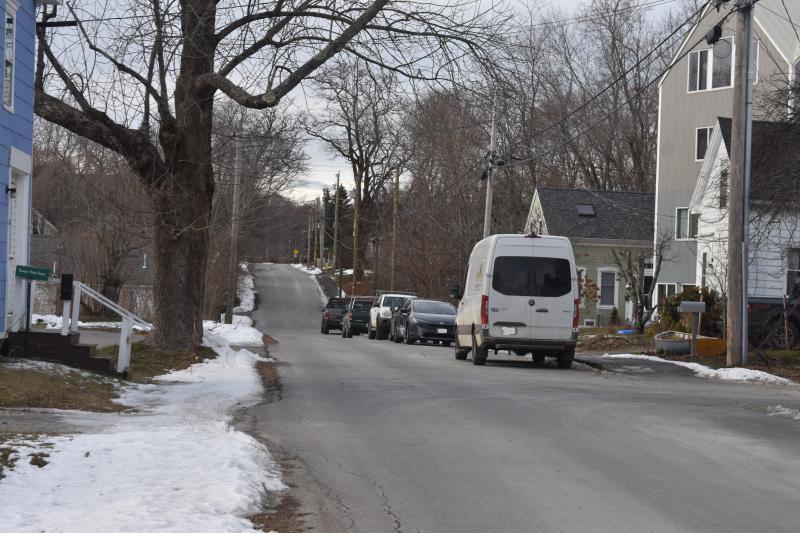
The Planning board agrees that parking requirements for commercial development have been overstated, but they would like to take this on a more case-by-case or zone-by-zone basis tailored to neighborhoods. And among their reasons are that some of the streets are older and narrow, the city sees a large influx of summer residents, Rockland lacks public transportation of any kind and has limited walkability. Our local businesses rely on consistently available parking. Cities such as Portland have eliminated parking requirements, but only after years of public transit expansion. A high percentage of citizen concerns related to parking, and they would like to see the City take a more measured approach.
“With regard to the specifics of the Planning board memo, I say all this with love, great love and respect,” said Davis as he made his counter argument.
“The Planning Board asserted that Rockland lacks public transportation of any kind,” he said. “We have the DASH. Many people, including a family member of mine, rely on the DASH. It is, for better or for worse, regarded primarily as a tool for older and poorer people. We need to change that. Regardless, we clearly do have public transportation. The Midcoast Public Transportation operates not only the DASH, but also a variety of on-demand public transportation services. And I can’t resist mentioning, because of the categorical nature of this assertion of any kind, that of course, we have the ferries and we have the Coach. They’re not intra-city transportation, but they are public transportation. And that doesn’t even touch the Knox County airport – outside of Rockland, but it does offer transportation.”
Davis further spoke of the book The High Cost of Free Parking, by Donald Shoup, a professor and Planning Board member who strongly criticizes parking requirements.
As Ledoux said: “There’s no such thing as free parking. As of now, you set the minimums, that gets rolled into rents or the cost of the development. Everyone has to pay that, even without cars. When you eliminate the parking minimums, and – worse case – someone needs to pay for parking, or if we ever have enough of the need that we would go to, like, a permit system, it’s basically accounting for those externalized costs.”
Ultimately, Ledoux said: “ I think private land owners should have the freedom to decide how much of their private land to devote to parking. They’ll adapt based on their lot size, location and intended use.”
----------------------------------------------------------------------------------------
52 Chapter 19, Sec. 19-301 Eliminating Min Parking Requirements
Councilor Davis & Mayor Lachman
An amendment to the City’s Zoning Ordinance eliminating the minimum parking requirements in an effort to promote more efficient and flexible use of limited developable land.
Passed. Vote: 5-0. Eff. Date: 01/07/2026.
---------------------------------------------------------------------------------------
Reach Sarah Thompson at news@penbaypilot.com