As midterms approach, faith groups are urging Mainers to vote
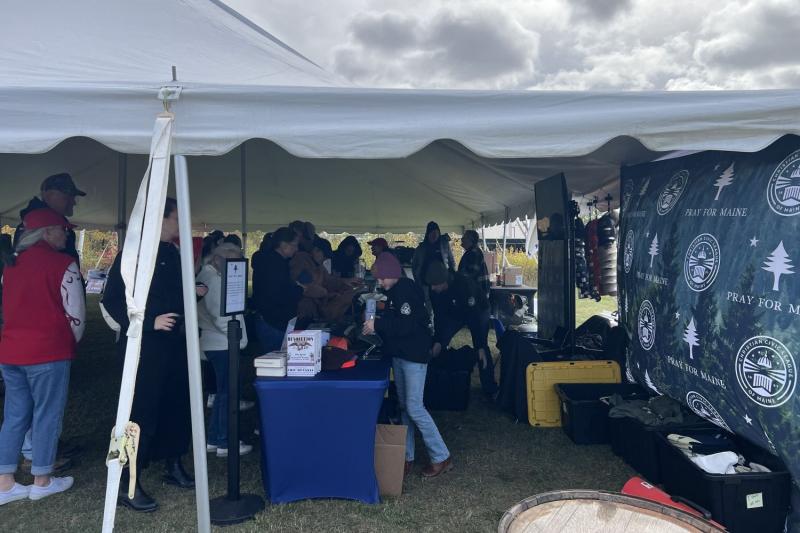 Attendees at a get out the vote event at Crosspoint Church in Bangor stop by a table for the Christian Civic League of Maine. The organization, which co-sponsored two voter engagement events with conservative state organizations, also compiled a voter guide for the 2026 election. Photo by Sean Scott.
Families gathered outside Bangor’s Crosspoint Church last Saturday for a fall festival featuring food trucks, a ball pit, live music and Republican candidates for the state Legislature, who were hoping to make one last pitch to voters ahead of the 2026 midterm elections. Half a dozen conservative organizations staffed booths at the event, including the Maine Republican Party.
With early voting underway and Election Day fast approaching, faith-based groups have been working to engage voters across the political spectrum in Maine. Conservative and progressive organizations alike have distributed voting materials to churches, each emphasizing issue areas that are important to them, such as abortion and voting rights. One conservative faith group has been involved with large get-out-the-vote events, including the one in Bangor, while progressive groups have phone-banked, doorknocked and trained faith leaders to support voters at the polls on Election Day.
The event outside Crosspoint Church in Bangor, called “Turn the Tide,” was hosted by Lead Maine, a political action committee created by Rep. Laurel Libby, R-Auburn, and co-sponsored by the Maine GOP and two conservative political organizations: the Christian Civic League of Maine, a nonprofit lobbying organization that pushes for conservative biblical values, and Maine Civic Action, which runs training sessions for conservative candidates and organizers. The groups sponsored a similar event in Auburn earlier in the month, which Lead Maine reported had 500 attendees.
One of the groups at the event was Maine Girl Dads, which was collecting signatures for a 2027 ballot initiative to bar transgender students from participating in girls’ sports, after a similar effort failed this year.
Nick Adolphsen, executive director of the Christian Civic League, said he hoped the event — and providing information to churches to promote voter engagement — would encourage busy parents to cast their ballots, even if they don’t have time to follow politics closely.
“This is about families. This is about people,” Adolphsen said. “This is about community and gathering together, and at the core of our politics, at the core of the division and the battles that happen in the State House is this philosophy of, how are we supporting our families?”
Beyond co-hosting the events in Bangor and Auburn, the Christian Civic League has encouraged church leaders within its network to speak to their congregations about the importance of voting. It also created a voter guide for state legislative candidates based on a survey of 12 yes-or-no questions, such as whether schools should be “required to notify parents if a student seeks to socially transition at school” or if the candidates support work requirements for able-bodied public benefits recipients.
Recent Pew Research polling found that voters are polarized by race and religion. While white evangelical Protestants and white Catholics are more likely to support Republican congressional candidates by a significant margin in the upcoming election, voters in other religious groups prefer Democratic candidates or are split between the parties, according to a survey of more than 5,000 U.S. adults. According to new research by the Public Religion Research Institute and the Brookings Institution, Black Protestants are the most likely religious group to say they are very excited about voting in the midterms, while white evangelical Protestants, white Catholics and Hispanic Protestants are the least enthusiastic.
Blaine Batchelder, a Stetson resident who attended the Bangor event, goes to Cornerstone Baptist Church and said his faith makes deciding how to vote easy because he will not vote for candidates who support abortion.
Batchelder said he sees faith as increasingly relevant in politics. His own church has allowed candidates to collect signatures on its property, he said, but he doesn’t see the church itself as overtly political.
“We do talk politics because it’s in the Bible,” Batchelder said, “but nothing over the top.”
On the other side of the aisle, progressive faith groups are also reaching voters this month. The Maine Unitarian Universalist State Action Network, a policy organization, is running a get-out-the-vote campaign it calls UU the Vote Maine.
The group’s members have made phone calls, written postcards and doorknocked to encourage people to register or make plans to vote, said Michaela Loisel, co-chair of the network. Unitarian Universalists are called to do social justice work, Loisel said. She sees part of that work as protecting voting access, which she said is under threat given the U.S. Supreme Court’s weakening of the Voting Rights Act and concerns that President Donald Trump may send federal agents to polling locations. The Trump administration has said it doesn’t intend to send immigration enforcement officers to the polls, though officials had raised the possibility earlier in the fall.
Multifaith Justice Maine, a community organizing group housed under the Maine People’s Alliance, a progressive advocacy organization, has also been planning voter engagement efforts for before, during and after Election Day. On Oct. 14, the organization co-hosted a press conference and training with Interfaith Alliance, a national network of faith groups that aims to “challenge Christian nationalism and religious extremism” and is currently running a bus tour called “the vote is sacred.”
The Rev. Jodi Hayashida, director of Multifaith Justice Maine, called the organization’s voter engagement efforts nonpartisan despite the organization’s affiliation with Maine People’s Alliance. Multifaith Justice became an affiliate of the national Interfaith Alliance this year, Hayashida said, and the bus tour was their first joint event.
The bus tour includes 15 states and focuses on areas determined by the Voting Rights Lab to have election risks, including close races and candidates or officials who may oppose certifying election results, said Guthrie Graves-Fitzsimmons, vice president of programs and strategy for Interfaith Alliance. The tour is meant to get faith communities involved in election protection efforts to ensure that every vote is counted, and the event in Maine concluded with a dinner and training session for attendees.
In Maine, Hayashida said, faith leaders associated with Multifaith Justice Maine and the progressive Maine Council of Churches are focused on ensuring the voting process runs smoothly. The Maine Council of Churches, an ecumenical group of seven primarily Protestant denominations, also created its first ever voter empowerment guide and has distributed thousands of voters’ rights cards to churches across the state, said the Rev. Jane Field, the group’s executive director.
While Multifaith Justice Maine’s pre-election work is focused on helping people understand the voting process and make plans to vote, Hayashida said, she is also preparing for Election Day. The organization is training around 70 people to serve as what it calls “poll chaplains” in some communities on Election Day. They will be taught de-escalation tactics and will be at the polls and ready to intervene if they notice anyone threatening or intimidating voters, with a particular eye toward helping immigrants who have gained U.S. citizenship and are legally permitted to vote.
After the election ends, Hayashida said, faith leaders are discussing how to handle a range of outcomes, including a potential disruption to the peaceful transfer of power.
“The moral voice of faith leaders always has a place in national discourse, not because we are a theocracy, but because faith leaders are one group of many groups who are looked to as moral authorities,” Hayashida said. “We have to take that responsibility seriously, even if it’s uncomfortable.”
This story was originally published by The Maine Monitor, a nonprofit civic news organization. To get regular coverage from The Monitor, sign up for a free Monitor newsletter here.