
Maine colleges are spending more and more on legal fees and lobbying
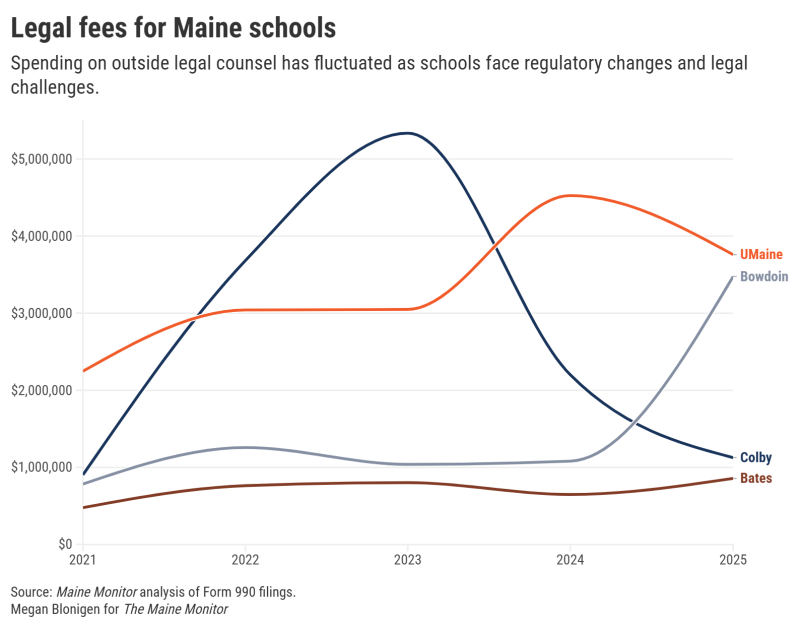 Bowdoin College’s legal fees nearly tripled last year. It’s not the only Maine school that saw a jump. Graphic by Megan Blonigen.
Bowdoin College’s legal fees nearly tripled last year. It’s not the only Maine school that saw a jump. Graphic by Megan Blonigen.
Bowdoin College’s legal fees nearly tripled last year. It’s not the only Maine school that saw a jump. Graphic by Megan Blonigen.
As colleges and universities across Maine confront increasing federal inquiries and regulatory pressure, as well as a number of lawsuits, some have seen federal lobbying costs and legal expenses skyrocket to the highest levels on record, according to a review by The Maine Monitor of schools’ tax returns and lobbying disclosures.
Seeing the sharpest increase last year was Bowdoin College in Brunswick, which is facing a congressional investigation and multiple lawsuits. The college’s legal fees nearly tripled in fiscal year 2025, and the school retained an external lobbying firm in June 2025. The college had not worked with an external firm in the past, and the new retainer marks a major increase in its lobbying investment.
Universities’ payments for outside legal counsel or legal services must be disclosed each fiscal year on their IRS Form 990 filings. Universities also disclose local, state and federal lobbying spending in these filings.
Bowdoin’s legal expenses jumped from nearly $1.1 million to nearly $3.5 million, a 222 percent increase, between July 1, 2024, and June 30, 2025. It is the highest total in legal fees that the school has faced since 2001, the earliest year the financial data is available.
The private college’s legal fees have regularly seen slight increases but jumped more significantly in recent years. Legal expenses nearly doubled in 2022 — surpassing $1 million for the first time — before dropping slightly in 2023 and 2024, and then rebounding to $3.5 million last year.
The college did not answer questions about what specifically caused the increase or how the school prepares for spikes in legal fees.
“As with many colleges and universities, Bowdoin’s expenses fluctuate from year to year as the College responds to changes in the legal and regulatory environment,” wrote Douglas Cook, director of communications for Bowdoin, in a statement.
But it can be a valid investment for universities to pay for lawyers and lobbyists, especially as universities err on the side of caution amid rapidly changing rules in higher education, according to University of Maine School of Law professor Andrew Kaufman.
“A general counsel would rather have to defend the judgment of hiring more people than having to defend, ‘Well, I didn’t think I needed more people, and so I didn’t hire anybody, and, because we didn’t have anybody here to handle this issue or that issue, well, we got clobbered,’” Kaufman said.
Bowdoin has faced a year of heightened federal scrutiny.
Congress launched an investigation into Bowdoin and four other colleges in March 2025 because of what it called the universities’ “lackluster response” to pro-Palestine encampments on campus. Bowdoin Students for Justice in Palestine staged a five-day encampment in February 2025, which the U.S. House Committee on Education and Workforce labeled as antisemitic. The congressional committee demanded disciplinary records from Bowdoin College, Barnard College, Northwestern University, Pomona College and Sarah Lawrence College for students who participated in the protest.
Bowdoin responded by providing the committee with a summary of Bowdoin’s disciplinary response to the 66 students who participated in the encampment, including suspending the student group that organized the protest. The college did not provide additional information that Congress requested about specific student disciplinary cases, citing federal student privacy law. Congress labeled what it deemed the school’s partial compliance as “unacceptable” in a June 2025 letter and threatened to subpoena the college.
“As a university, you may be thinking you’re OK on Monday, and then on Tuesday, somehow someone in the White House or the Department of Education decides that you’re the enemy,” said Boston College political science professor Dave Hopkins. “To know that the policy today is going to be the policy tomorrow — they don’t have that luxury now.”
Months after the investigation launched, Bowdoin upped its spending in another area: federal lobbying. In June 2025, the college retained Cornerstone Government Affairs, a state and federal lobbying firm based in Washington, D.C. Bowdoin spent $130,000 on the firm in 2025.
While Cornerstone Government Affairs is a bipartisan lobbying firm, it has a highly active Republican presence. Its team includes well-connected GOP strategists, including its president, Campbell Kaufman. David Planning, a former White House liaison to Congress during the Trump administration, is assigned to Bowdoin’s lobbying case, according to federal lobbying disclosures. The other two lobbyists assigned to Bowdoin are Todd Webster, who formerly worked with multiple Democratic politicians, and Susan Sweat, who spent a decade as a senior staffer for Republican U.S. Sen. Roger Wicker of Mississippi.
The firm served 386 clients as of 2025 — including several major universities, Google, Palantir, Blackrock, Boeing and Major League Baseball — and spent $55.5 million on lobbying efforts, according to Open Secrets, which tracks lobbying activity. The firm is forecasted to spend more in 2026.
Bowdoin’s lobbying expenditures were not federally disclosed before June 2025 because it did not meet the reporting threshold for federal lobbying expenses. Under the Lobbying Disclosure Act, official reporting is required if a university exceeds $16,000 per quarter for in-house lobbying or $3,500 per quarter to an external firm.
Bowdoin is continuing to incur legal expenses as it faces a major lawsuit alleging its early decision admissions process violates antitrust laws. Four current and former college students filed the lawsuit in August 2025 against 32 institutions, saying the schools used their early decision admissions to artificially decrease competition, charge higher tuition and offer less financial aid. The cost of the litigation in this case will not be reflected until tax returns for fiscal year 2026 are released next summer.
The rising investment in lobbying and legal help comes as state and federal governments are more interested in universities’ actions, Hopkins said. The Trump administration has repeatedly threatened to file lawsuits and freeze federal funding to universities across the country over their admissions practices, alleged civil rights violations, diversity, equity, and inclusion policies, allowing transgender athletes to participate in sports, and more.
The interest has come not just from the Trump administration but from past administrations as well, such as when the Obama administration cracked down on campus sexual assault by enforcing Title IX, the federal law that prohibits discrimination based on sex.
“We’ve seen a trend of governments — federal and state governments — becoming a lot more interested over time in how universities conduct their business,” Hopkins said.
Society has also grown more polarized and litigious, Kaufman, of the University of Maine School of Law, said, and filing lawsuits has become “much, much more common.”
U.S. Supreme Court decisions and the changing political landscape have called into question some fundamental rules for universities, presenting them with new regulations that are harder to navigate, according to Kaufman.
“That’s the kind of uncertainty that would lead universities, and I believe has led universities, to spend more on lobbyists, spend more on outside law firms,” Kaufman said.
Colby College
Colby College in Waterville has also been facing higher legal fees than other private colleges in Maine. It incurred $1.1 million in legal expenses in 2025 — less than Bowdoin but significantly more than other private schools in the state.
Colby’s legal fees were higher in 2022 when they topped $3.6 million — representing a 308-percent increase in one year. Five female athletics coaches filed a complaint against the college in March 2021 with the Maine Human Rights Commission, claiming they were paid unequally compared with male coaches, and that medical support and facilities were not distributed equally between men’s and women’s sports. Colby settled the lawsuit in January 2022.
Colby’s legal expenses jumped again to $5.3 million in 2023 after it refined procedures for addressing complaints of sexual harassment.
Since 2023, Colby has seen declining legal expenses, halving from $2.2 million in 2024 to $1.1 million in 2025.
Similar to Bowdoin, Colby’s lobbying has also expanded. In 2022, Colby retained Washington Navigators, a D.C.-based lobbying firm with about a dozen clients, according to federal lobbying disclosures. Colby was the third-highest-paying client in 2025, paying $80,000 to the firm, up from $40,000 in 2023. Washington Navigators Senior Vice President Grady Bourn, a veteran Republican staffer, works on the Colby lobbying case alongside founding partners Bill Bates and Scott Sudduth.
“The legislative process is complex, players change frequently, and the stakes for organizations navigating federal policy continue to rise,” wrote Colby spokesperson Rosalind Drisko in a statement.
Bates College
Legal fees jumped in fiscal year 2025 for Bates College in Lewiston, rising to $856,000 from just under $648,000 the previous year.
Bates and other colleges have grappled with seesawing rules from the federal government, which reverted back to 2020 Title IX policies in 2025. The changes removed protections for people on the basis of their gender identity and brought back live hearings with cross-examinations during Title IX proceedings.
The previous major jump for Bates was in 2022, when the school’s legal fees increased nearly 60 percent in one year to $762,000. The school then paid $801,000 in 2023.
Around that time, in April 2022, Bates’ former head football coach Malik Hall and his family sued the school after he claimed years of racial discrimination and unsafe living conditions in the housing provided by Bates. Bates agreed to settle a lawsuit with Hall, the school’s first Black head coach, in January 2024, paying an unspecified amount to his children.
University of Maine System
The University of Maine System outspends all of Maine’s private colleges on lawyers. Though the school spent more than $3.7 million on legal expenses in 2025, it is still a slight decrease from 2024 when the school spent more than $4.5 million.
The University of Maine System, encompassing seven public universities, is the largest educational system in the state and Maine’s third-biggest employer. In its Office of General Counsel, the system employs five full-time attorneys and a paralegal who in a typical year manage more than 500 contracts, 200 public records requests and at least a dozen claims with the Maine Human Rights Commission, according to system spokesperson Samantha Warren. The system typically retains outside legal counsel, mostly from Maine-based firms, for litigation needs.
“Consistent with national trends, our legal needs and related expenditures have grown over the last decade due to increased regulations, a more litigious environment, the (appropriate) accessibility of the Maine Human Rights Commission, and more recently, the explosion of AI, which makes it easier to file lawsuits or threaten to do so,” Warren wrote.
The University of Maine System faced a major class action lawsuit in 2024 brought by students whose classes were temporarily moved online during the COVID-19 pandemic. The school settled the lawsuit for more than $2.1 million, avoiding full litigation that would have been “even more costly and time-consuming regardless of the outcome,” Warren wrote.
The settlement cost, legal fees and attorney time associated with that case alone were “the highest in recent memory,” Warren wrote.
The system is facing another case with Calvary Chapel Belfast over the sale of the former Hutchinson Center in Belfast. The school rescinded its decision to sell the center to the church in 2024 after nonprofits who also bid raised concerns about the bidding process. The system reopened the bidding after determining its original criteria for the bids were incorrect, and rescinded its decision to sell the property to Calvary Chapel Belfast. The church sued in response, alleging religious discrimination.
The court rejected the church’s claim in May 2025, and the church appealed the decision. A judge rejected the church’s appeal on July 1, 2026.
Nearly half of legal costs are for patent and intellectual property work, which are often offset by revenue generated by those patents and property, or by grants and contracts, Warren wrote.
In most cases, the school’s legal insurance does not cover legal expenses, and the institution does not predict legal costs will slow.
“Given the highly complex nature of our very large, statewide organization, we expect both significant year-to-year fluctuations in legal activity and increases in our legal costs to continue,” Warren wrote.
The University of Maine System also outspends other schools on lobbying. The system retained Cornerstone Government Affairs in July 2023 and has since spent $50,000 every quarter, totaling $200,000 per year. The system had previously contracted with Strategic Marketing Innovations.
Despite the “rapidly evolving federal landscape,” neither Cornerstone’s scope of work nor costs for the university have changed since they were retained, Warren said.
Universities nationwide have faced climbing legal expenses. Across the Ivy League, legal spending rose 37 percent to more than $333 million in 2025. Ivy League schools also spent $4.1 million on outside lobbying in 2025, a 76 percent increase from the previous fiscal year. Major research universities spent more than $37 million on federal lobbying efforts in 2025, an uptick of more than 31 percent.
Despite the increase in spending on lobbyists and lawyers, schools cannot expect to see certain outcomes, said Theda Skocpol, a Harvard University professor of government and sociology.
“It’s hard to make a deal with people who don’t stick to deals,” Skocpol said.
“I don’t think anybody can imagine that lawyers are going to solve the problem, because they’re not,” she added.
Maine is unique, and university leaders’ personal relationships with elected officials can be just as valuable as more formal networks, said Bowdoin College government professor Michael Franz.
“Bowdoin, which contributes a lot to the state, has been around for a long time. It’s nice to be in a smaller state where the president or the board of trustees or whatever could potentially call up Susan Collins and make a case,” Franz said. “That’s one-to-one lobbying that I’m sure is happening.”
This type of lobbying in higher education is less formal, but universities still need outside parties to advise their advocacy, said Colby government professor Nicholas Jacobs.
“You need the law firm to navigate the particulars. You need the lobbying agencies to find the correct political strategy,” Jacobs said. “But there’s a deeply relational element to a lot of these politics, and sometimes it comes down to those relationships.”
This story was originally published by The Maine Monitor, a nonprofit civic news organization. To get regular coverage from The Monitor, sign up for a free Monitor newsletter here.