
Line-of-Duty death report finalized for firefighters of Robbins Lumber explosion
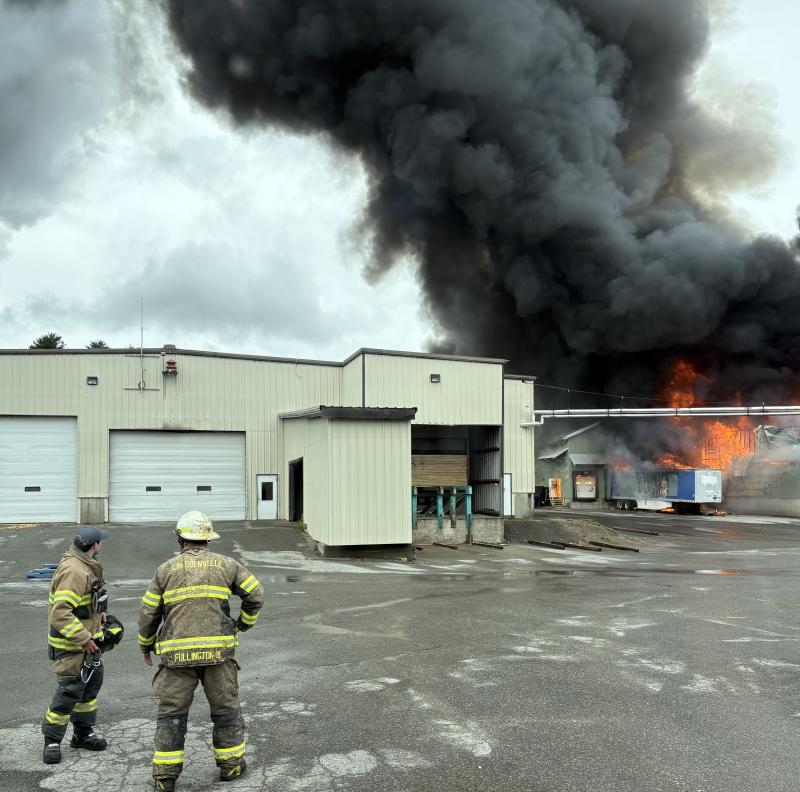 Robbins Lumber Mill fire, May 15, 2026. (Photo by Bennet Cohen)
Robbins Lumber Mill fire, May 15, 2026. (Photo by Bennet Cohen)
Robbins Lumber Mill fire, May 15, 2026. (Photo by Bennet Cohen)The National Institute for Occupational Safety and Health (NIOSH) has released its investigation report regarding the Robbins Lumber Mill Fire in Searsmont, which occurred May 15, 2026. Three people, including two firefighters, died from injuries as a result of an explosion that occurred while firefighters were working to extinguish fire inside of a silo. Many other people were hospitalized, several in critical condition. This report is specific to the firefighters.
Preliminary findings issued in May determined the cause of the incident, but further investigation has continued as to the undetermined ‘why?’.
The Maine State Fire Marshal’s Office and Bureau of Alcohol, Tobacco, Firearms and Explosives attributed the cause and origin to combustible dust at the unloader mechanism at the base of the silo; the increasing heat went undetected by the heat detector mounted near the top of that structure.
Among multiple categories, the 20-page NIOSH report addresses the two silo structures on the property, both of which pulled wood shavings and saw dust through a series of holes and pipes and into bagger machines.
Several times over the years, firefighters have been called to extinguish fires in Bagger #1. For the first time, May 15, the FD was called for Bagger #2. They tried the same tactics on Bagger #2 that they've used on Bagger #1, unaware that Bagger #2 was a different system.
The tactics employed from the control room under the silo of Bagger #2 (including aiming hose water up a blower shaft into the silo) weren’t fixing the problem, and thermal imaging sensors were still indicating flames within the shavings and dust. At that point, firefighters opened the door to the silo itself and deluged the interior with hose water.
Unlike Bagger #1 (a conventional, open-topped silo), Bagger #2 is a closed, oxygen-limited setup where the chemically-treated chips break down differently, producing gases that could act like fuel in the right circumstances. Introducing oxygen to the interior of the silo was a serious hazard, according to investigators’ studies of the manufacturer’s manual. Deluging those shavings with water (hydrogen and oxygen) or foam, was ill-advised.
Though area firefighters go through extensive fire department training, and Robbins Lumber employees have their own trainings, plans, and fire suppression systems, the NIOSH investigation indicated that firefighters and employees were not aware of the extra hazards of sawdust, and the special circumstances required when dealing with sparks and flames in and around Bagger #2.
Although lumberyard employees were outside the silo, answering the firefighters' questions as needed, no one knew to discuss such matters, the report said.
At 11 a.m., after firefighters considered the fire largely under control, an hour after the initial 911 call regarding smoke in Bagger #2, 38 minutes after the first fire truck arrived, and well after the scene had turned quieter, "firefighters around the silo heard a 'whoosh' noise as smoke began to quickly emanate from the airmaterial separator on the top of the silo," said the NIOSH report. "The silo launched into the air followed by a large plume of fire at the bottom as it rose."
The explosion critically injured 11 volunteer firefighters and two EMS providers.
Belmont Asst. Fire Chief Wayne Woodbury succumbed from burn injuries after a month in the hospital. The state medical examiner's report ruled the cause of death of Morrill Fire Firefighter Andrew Cross, who died at the scene, as thermal injuries with smoke inhalation. It would be two more hours before Cross was accounted for.
As part of an Aug. 7, statement on its website, the Robbins Lumber Family said: "First and foremost, our thoughts remain with the families of Assistant Fire Chief Wayne Woodbury and Firefighter Andrew Cross, whose extraordinary service and sacrifice will never be forgotten. We also continue to pray for everyone who was injured that day, including the firefighters, emergency medical personnel, our employees, and our family members whose lives were forever changed."
According to the report, over the past 40 years, NIOSH has investigated several incidents where firefighters directing water into an oxygen-limiting silo unintentionally caused explosions.
Part of the job of NIOSH is to identify factors that can be used to develop improved workplace and firefighting policies.
For future consideration, should a fire break out inside an oxygen-limited silo system, NIOSH recommends keeping the doors closed and taking extra time to develop a multi-professional command center and plan, involving firefighters and knowledgeable employees. And, as long as the doors to the silo remain closed, the fire will remain contained, and can often smolder to its own demise in a matter of weeks.
The report recommends placing special hazard stickers on the silo to alert firefighters and others of potential dangers. It also recommends a new accountability system for tracking firefighters at scenes.
Robbins Lumber said: "No report can fully capture the heartbreak experienced by our community, nor can it lessen the tremendous loss suffered by so many..., We are committed to carefully reviewing its findings and recommendations and working collaboratively with the fire service, industry organizations, safety professionals, and regulatory agencies to improve safety wherever possible."
Reach Sarah Thompson at news@penbaypilot.com