Camden Select Board votes to suspend new paid parking program
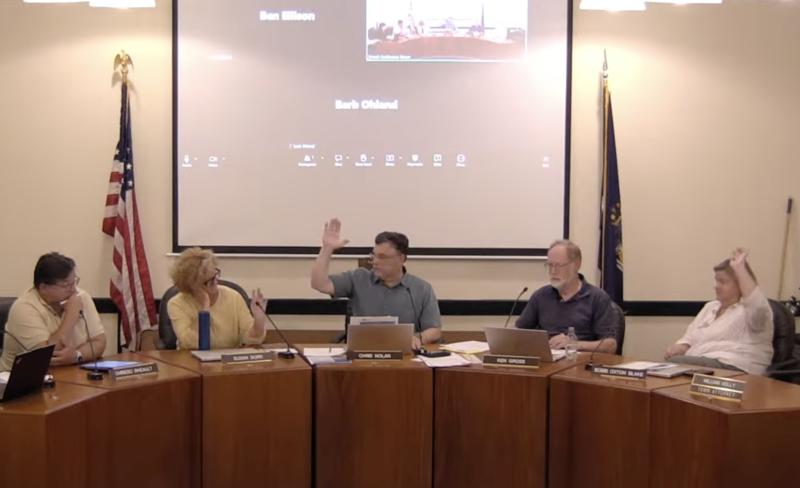 The Camden Select Board voted July 21 to suspend the new paid parking program on downtown streets, reversing a 2024 vote by the then Select Board to install parking meters and implement a pay-to-park system. The Public Landing will remain under paid parking restrictions during the summer season. Voting in favor of the suspension July 21 were Susan Dorr, Bobbi Oxton Blake and Chris Nolan. Opposed were Ken Gross and Chrisso Rheault. In the photo, from left to right: Rheault, Dorr, Nolan, Gross and Oxton Blake.
The Camden Select Board voted July 21 to suspend the new paid parking program on downtown streets, reversing a 2024 vote by the then Select Board to install parking meters and implement a pay-to-park system. The Public Landing will remain under paid parking restrictions during the summer season. Voting in favor of the suspension July 21 were Susan Dorr, Bobbi Oxton Blake and Chris Nolan. Opposed were Ken Gross and Chrisso Rheault. In the photo, from left to right: Rheault, Dorr, Nolan, Gross and Oxton Blake.
The Camden Select Board voted July 21 to suspend the new paid parking program on downtown streets, reversing a 2024 vote by the then Select Board to install parking meters and implement a pay-to-park system. The Public Landing will remain under paid parking restrictions during the summer season. Voting in favor of the suspension July 21 were Susan Dorr, Bobbi Oxton Blake and Chris Nolan. Opposed were Ken Gross and Chrisso Rheault. In the photo, from left to right: Rheault, Dorr, Nolan, Gross and Oxton Blake.CAMDEN — Select Board members in Camden voted 3 to 2 July 21 to suspend its controversial downtown paid parking program. The decision does not apply to the Public Landing paid parking program, but it does neuter the 60 kiosks, which the town owns, on various streets. The kiosks were being covered with their black bags by late morning, July 22.
Select Board members Bobbi Oxton Blake, Susan Dorr and Chris Nolan voted for the program suspension; Chrisso Rheault and Ken Gross opposed the motion.
There is a wrinkle in the latest development of a program that was approved by the Select Board in October 2024 and promoted as a revenue generator for the town: The 2026-2027 municipal budget approved by voters June 9 incorporates $150,000 in anticipated revenue from the paid parking program to help offset the tax burden on Camden taxpayers.
Can the Select Board reverse a budget decision approved by voters, and if so, where will the town find $150,000 to cover the budget gap?
As of Wednesday, July 22, there has been no legal opinion yet offered.
Camden's paid parking program has been on ongoing experiment since Autumn 2025, and with opposition to it engendered two petitions, and debates at Select Board meetings. At the July 21 meeting, and as promised, Board Chair Chris Nolan called the vote on whether to suspend the program.
In 2025, the Board had voted to proceed with installing the paid parking system, and invested $320,474 to purchase equipment and software ($254,480 on the kiosks, card readers and software installment).
It has invested another $65,894 in various other expenses, including enforcement software for the Camden Police Department, as well as mailing costs, signs, postcards, printed ticket cards, and more.
All of those expenditures have been paid, and all transactions associated with the paid parking program sit in a Paid Parking Fund, separate from the general fund.
"The Paid Parking Fund was set up as a special revenue fund, with all expenses paid out of that fund with anticipation that all revenue would replenish the deficit and create a balanced fund, as well as generating excess revenue that can be used to support the General Fund (as allowed by state statute)," said the Town Office, July 22, in an emailed response to questions about the program's financing. "Like the town’s other special revenue funds, it is an accounting plan whereby they are all fed by the town’s cash until they generate revenue and 'pay' it back, as it were."
The kiosks became operational twice since they were installed in Camden: In October 2025, the kiosks open for business for two weeks for a trial run, earning $32,338. In Spring 2026, the kiosks were due for another deployment beginning May 22, but the Select Board voted in early May to wait until June 22.
Since June 22, and as of July 20, Camden had earned $40,235 from the kiosks over a span of one month. The average daily revenue from the parking was estimated at $1,414, per the latest figures supplied by the town office to Select Board Chair Chris Nolan, who delivered those figures to the Select Board Tuesday evening.
Revenue estimates for the entire paid parking program season, which was to end in mid-October, were pegged at $186,000.
In relaying his updated information, Nolan earned criticism from board member Rheault for not sharing revised numbers for the rest of the board to consider before the agenda item conversation ensued.
"I've done a little research that hopefully might help," said Nolan, to the Board and those who gathered in the room for the meeting. "This is data that has been available to us typically in the Select Board packets but I have tried to consolidate it."
"In short, yes, is there income with paid parking," he asked. "With the report I got today, we would probably have $186,000 as the projected revenue for this season [with] paid parking from the meters alone. There are expenses that are associated with the paid parking program. And when you look at the expenses that have happened outside of the initial purchase price of the devices and the software, the expenses, since September, are $65,000 just related to the paid parking equipment and fees."
That season reflects a time span from September 2025 — the program was tested for two weeks last fall — until July 20.
"If you go back to the April 2025 Select Board packet, you would see that the expenses are listed; annual recurring expenses are $123,000," said Nolan. "There are some fixed fees, and there are also some fees that are based on usage. In other words, the more parking spots you sell, there's a little bit of the fees that we have to pay as a town."
For instance, he said, the maintenance contract is fixed. He also said the annual recurring expense of $123,000 included the town's hiring of an extra patrol officer for the season to help with paid parking monitoring.
For revenue, the town had budgeted $50,000 for parking tickets.
"And while that sounds maybe like a lot," Nolan contrasted that number to the period from 2013 to 2020 when Camden earned approximately $16,000 annually from parking ticket fines.
He said the town earned approximately $55,000 per year from Public Landing parking fees.
That is when Rheault said, "I don't mean to interrupt..."
"This is important," said Nolan.
"The problem is that you're giving us a whole bunch of numbers; I don't have information," said Rheault. "Even if you had a spreadsheet that we could see online. You have a ton of numbers that I can't process."
Finance Director Jodi Hanson clarified numbers associated with the town hiring a seasonal patrol officer.
"I also need to add that the cost of enforcement is not part of the special revenue fund that you're talking about," said Hanson, who is currently assuming the duties of the Town Manager while Audra Caler is out on medical leave.
Rheault said he was uncomfortable with Nolan's delivery of financial information.
"I'm almost done," said Nolan. "The data is available in our budgeted items, and that's important to know. And I wanted to make sure that people knew, because we've talked about [that] if we don't do paid parking, there is a gap of $150,000 that we expected in revenue this year, in the paid parking program as part of the budget process."
He added that part of the budget process was the expectation of collecting revenue from more than 4,000 in parking ticket fees.
There was a problem with, "one of the systems," he said, which may have contributed to, "a gap with what we'll be able to achieve."
When asked to elaborate, he said that during the paid parking time period of June 22 to July 14 there were only 135 [tickets issued for nonpayment of park].
"That's because of a piece of equipment failure," he said.
Nolan said revenue collection from the kiosks has, "gotten better the past few days, as far as the amount of money per day."
The town, he said, estimated $186,000 in revenue with expenses in the $65,000 to $80,000 range, based on fees and, "what not for the rest of the season."
That includes the Public Landing, which pulls in approximately $65,000 annually.
"I appreciate that you've done this digging, but sharing with us beforehand would have been far more useful," said Rheault. "By waiting on the discussion, until we all can see the data and process, would be useful."
Nolan agreed, and said there was general concern about understanding the impacts of paid parking, its costs and revenues.
"For us to go into a vote of, what do we do about paid parking for the rest of the season, I'm trying to contextualize as quickly as I could have gotten the information...."
Rheault said: "But you are asking us to make a decision based on information that we haven't had time to process and review, and that the public captain hadn't had a chance to process and review."
Nolan countered that the information was contained in the April 15, 2025 Select Board packet, which, he said, "has the prognostications for costs associated and revenue at that time of the paid parking program."
He said his new figures updated information had been inserted July 16 into the Select Board packet.
Nolan said the Board was to decide on stopping paid parking on the streets: "and just go, maybe, with the Public Landing That's what is on there [agenda] as an action item."
He relayed concerns from others about inadequate public signs for the parking requirements.
"Understanding the impacts financially is one piece, and that's where we have to understand the financial impacts to the budget, but there is the reputation side, too," he said. "Although there is a website and it describes the different pieces, there is there are no signs in town that say you have to pay for parking. So, if we do continue with the program tonight, I would advocate us to improve our execution in our customer service, and the requirement to have signs that say, pay parking."
Rheault said: "It is hugely important to remember that the parking program is not just about revenue. The parking program comes out of several years, and actually decades, of Camden studying how to make parking better in the downtown area. How to turn over spots, how to get people to do longterm parking in the outer areas. Some of us may remember the shuttle bus program in the 1990s [Shuttle buses ran into town from the Rockport town line]. These are things that came out of a lot of studying, and it isn't just about making money. It's about making it so that you can actually easily park in town."
He cited success, noting how the free-parking longterm lots, "like the lot behind the mill, are now full, whereas last summer, they were often empty."
He continued: "There are empty spaces in town for shorter-term parking. That's one of the goals. This will come as no surprise to everyone in the room, that I think that suspending the program now, when we're just starting to figure it out, would be a colossal mistake."
Rheault said signage and communication about the program could be improved, but had faith that the public could learn.
"I think it's also fairly clear that there's a majority of will on the Board to suspend this before we spend a huge amount of time hearing more comments from the public. And I'm not trying to say that I don't want anyone to have their say, but .... before we go through another round, if there's a foregone conclusion, let's move the issue along. But I think it's very ironic that a large group of people who have been saying for so long we should have a public vote on public parking, are now happy to let the board suspend it without a broader community discussion, and without real information being presented, and consumed and analyzed."
Board member Ken Gross said there were two goals: to make money had to have a churn [of parking spaces].
"Foremost, we've made a mistake," said Gross. "We have implemented and invested in paid parking before we put it to a town vote. So we are in the hole lately.... the installation in the cost was roughly $230,000. We have it in our budget, as Jodi has pointed out, $150,000 of revenue that, if we don't have that revenue, we're in the hole another $150,000. So at the beginning of the season, we're $480,000 in the hole."
He said: "I would like to consider letting it run, to get some of that back. You know that I've been against the paid parking program from the beginning, and I will vote against it in November. Part of my assessment is that, yes, there will be a vote on the November ballot. It might be a binding measure. It might be a non binding ballot measure, but we're not discussing that issue tonight, but I am assuming that there will be, you will be offered the chance to vote."
Oxton Blake said: "The flyer that Chris and I put out that we mailed out [the campaign mailing that she and Nolan co-created and distributed prior to the June 9 Town Meeting Select Board elections] on the back was to save the police department and to remove paid parking. There weren't very many stores in town that didn't have one of the flyers to remove paid parking. And I don't think businesses were taken into consideration. And when you think about this, a lot of our business owners don't live in Camden.
"So they weren't the ones voting on this, and it's sort of what we went on. You know what I mean? So we have to bring this to a vote, because it's what we ran on, to do this. And it would be horrible if we didn't. I mean, it would be going back on what we said we were going try to do."
Board member Susan Dorr said the question before the Board was whether to suspend parking at the beginning of a busy summer season or wait until November, "when you say, OK, we're happy to pull the plug then."
Dorr said she was tired of talking about paid parking, "and whatever the board decides is fine. I can't listen to lots more people saying why they don't like paid parking. I think we've heard every reason imaginable. If there is a structure to allow us to recoup some costs, my concern comes down to where we are looking at at the budget, and are there some tweaks that we can make to make it work better for this season? And then we respond accordingly, which will fulfill your mandate, and, perhaps, address the financial concerns."
She suggested to, "let the experiment run, and see if it truly is workable or as egregious as many people seem to think that it is."
Nolan then opened the floor to public comment about the paid parking program.
Main Street business shopkeeper Lori Costigan, who owns Glendarragh Farm Lavender, spoke on behalf of, "over 24 business owners in downtown Camden," and requested, "the system be shelved in favor of a more isolated, quantifiable, easy to use, and easy to enforce initiative with municipal lots, not vehicular streets."
Costigan read from a letter she submitted for the record, and said businesses have lost customers because of the program, and outlined issues with the kiosk performance.
"The officers are left patrolling the innocent, instead of attending other duties, they do well," she wrote. "In our collected experiences of assisting officers and keeping Camden safe, we find ourselves asking if the seasonal chalk patrol was far more effective. As patrons of downtown shops and services, we note increasingly the availability of parking in the late afternoons. This suggests capacity of the pay to use system exceeds utilization and shows a dramatic shift from the congested parking that led to the system in the first place. It suggests the folly of making the entire downtown a revenue stream."
Camden resident Jessica Ives said she did not want to sign up for a resident pass online as an objection to: "volunteering our license and registration information to build out the database of a multinational corporation; i.e., Flowbird. It specializes in urban mobility, which is really just a propaganda term for surveillance and social engineering."
She said Flowbird accepts coins and bills in its standard model: "meaning the town of Camden made an intentional choice to customize this option out. Users must pay by card or phone only, and for additional fee above the advertised rate of $2 an hour. Keep in mind, it's illegal for all businesses on Main Street to discriminate in the same way against legal tender."
She expressed concern for the tracking capabilities of Flowbird: "and, yes, I know I'm being tracked all over the place already, but that doesn't mean I'm OK with it. A lot is being done without my consent, and wherever I can, I educate myself and make the choice to withdraw my consent. Money is valuable, but it is our consent that is our true currency. And this is why invasive corporate surveillance programs have to be sold fraudulently to small town folk as more convenient or a way to raise revenue."
She questioned whether Camden informed its residents, "that their vehicle, and therefore their mobility patterns, their movement, not just in Camden, but anywhere in the world where they have their smartphone open with the flow bird app, would be fed into the AI database of a multinational corporation headquartered in France with data centers in Sweden and Canada."
"Paid parking, in the way that it has been deployed in Camden is not about revenue," said Ives. "It is about tracking. Data, data, data, data, data, data. That's what we keep on hearing. Pay attention."
Ives opposed surveillance technology and referenced Flowbird's tracking of travel and mobility, "so they can better understand how to incentivize and control it. This is social engineering."
She continued: "we and Camden are a real human community. With all of its beauty and all of its, you know, squabbles. Flowbird, on the other hand, is a multinational corporation in the smart, smart city space, along with the likes of Flock, Axon, and Palantier. Flock and Axon deploy surveillance cameras equipped with automatic license plate readers and facial recognition technology. Already deployed in Auburn, Falmouth, South Portland, Lewiston, and York. And Palentir partners with Flock to feed identity and mobility data to entities like the IDF and ice. Flock and Palantir have a formal partnership."
She said: "It's amazing to me to see business owners and individuals in Camden who protest ICE, and then, ironically, support the very surveillance programs ICE depends on. And if ICE and the IDF don't concern you, that's fine. I would just say, wait a few years, maybe a couple of election cycles. You might find yourself on the other side of the corporate surveillance smart city grid. This is not a partisan politics issue. This is not even a parking issue. This is a human issue."
Jonathan Ives, of Camden, said the current Camden parking program is fraudulent and illegal, according to local rule and state law, because: "In the Camden Town Charter, it says, It shall be the duty of the town manager to erect appropriate signs giving notice thereof, and no such regulations shall be effective unless such signs are erected and in place at the time of any alleged offense."
He cited Maine State statute, as well, and its regulations calling for visible notice of paid parking on streets.
Jessica Wheeler, of Camden, asked who would have to remove the kiosks.
"They have to go away," she said. "Who is it going to be? Where is that money coming from? Could you tell me that? Because we spent all this money putting them all over town, painting the lines, doing all that, not doing a very good job of explaining it.... People are very confused. You're going to obviously end this. Where are the funds coming from to get rid of them? .... Camden taxpayers are going to be on the hook for now removing them. We also have a deficit, which will be over $400,000, and that's probably going to hurt all the taxpayers."
She asked the Select Board to to run the program through the season, "so any revenue that comes in will just replenish the funds in that specific special revenue fund."
Bridget Qualey, of Camden, said that the previous day, "I was contemplating whether to go to Hannaford, or come down to town to go to French and Brawn. I drove downtown, and into town, and there were parking places for me to park for 15 minutes, to run it to French and Brawn, get what I needed for supper and go home.
Geoff Scott, of Camden, questioned whether the Select Board could discontinue a revenue-generating operation whose income had been included in a voter-approved budget.
"Once the town approves the money — the budget — does the Select Board have the authority to take it away? looked at the Maine municipal law, and it says a Select Board cannot unilaterally overrule a budget that has been legally passed by voters at a town meeting. I hope that you guys talk about that."
"That's a good question, Geoff," said Nolan. "I'll ask Bill [Kelly, Camden's attorney] that tomorrow. Any vote would be contingent on any legal issues."
Following several other comments from citizens, pro and con, on the parking program, Nolan called a vote.
Rheault cited the difference of opinion in town concerning paid parking on downtown streets.
"The only way to find out the way to make the program work is to let it run," he said. "And the will of the people is very much to have some public vote on this. As I said at the last meeting, I think it would be better to try and do that in June, when we could actually take some time to review the data in the idea of your committee that we discussed."
He cited the petition and said, "let's not make it a vote of the board," advocating for a townwide vote.
Dorr said the argument presented by Jessica Ives, "is very compelling, and I also avoid giving information away without justification. I have not gotten a Camden parking pass but I was not aware of the extent to which this data is being, harvested, so that really gives me pause. Apart from all of the rest of it."
Dorr said the paid parking debate, "is far too divisive in town for us to continue to battle to battle over this. The revenue piece, it will impact people. I own property. I pay taxes. I don't mind paying my taxes. know people for whom that is a challenge and I feel we have a responsibility to do what we can to offset that. I honestly am absolutely heartbroken at the extent to which the is community has been ripped apart. I don't want to continue to be a party to it. If if it is the feeling of the board, and the feeling of the majority of people who have spoken up to pull the plug, I am not going to oppose that because I don't care nough about the revenue side to see this town to be torn apart over this issue."
Gross said a mistake has been been made.
"The question is how do we move ahead, how do we make the town whole? Knowing there will be a vote in November, the advantage of letting it ride will be to collect some data and collect some money. The rollout has been chaotic so the first few works the data is going to be useless because it does not make sense to rely on sketchy data. The hole of the budget does concern me."
After that, Nolan called the vote, and the Board suspended the paid parking program on downtown streets for the 2026 season.
Reach Editorial Director Lynda Clancy at lyndaclancy@penbaypilot.com; 207-706-6657