June Town Meeting: Camden Select Board approves nonbinding police referendum, opposes placing parking article on ballot
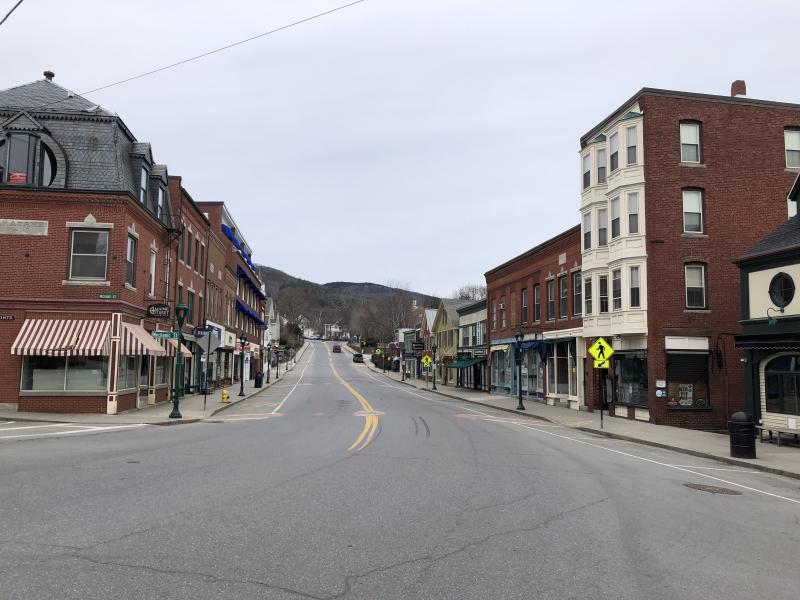 There was a brief time when no one wanted to park in downtown Camden: April 2020, when COVID 19 startled the world into a sudden solitude. (Photo by Lynda Clancy)
There was a brief time when no one wanted to park in downtown Camden: April 2020, when COVID 19 startled the world into a sudden solitude. (Photo by Lynda Clancy)
There was a brief time when no one wanted to park in downtown Camden: April 2020, when COVID 19 startled the world into a sudden solitude. (Photo by Lynda Clancy)CAMDEN — Following a lengthy debate April 21, at a regularly scheduled meeting, the Camden Select Board split on a motion to place a proposed warrant article before voters at the June 9 annual Town Meeting asking whether to eliminate the town's expanded municipal paid parking program. Following another debate at that same meeting, the Board agreed to ask voters their opinions about the future of the Camden Police Department in a nonbinding referendum that will appear as three questions on the ballot.
That advisory referendum will be on the ballot in lieu of a proposed warrant article submitted by citizens via a petition. The petition had asked the Camden Select Board to incorporate an article on the June Town Meeting warrant that would ask voters if they wanted to keep the Camden Police Department under the town's purview, and not contract with the Knox County Sheriff's Office for management services.
Both debates had been involved and at times, testy. The Select Board acknowledged the citizens' right to petition, but argued heavily over the legal interpretations of local rules and state statutes governing town meeting warrants and votes.
Two citizen petitions were submitted to the town office over the last month asking for approval to place articles before voters at the June 9 annual town meeting.
One petition asked the Select Board to include on the warrant the question: "To see if the Town will direct the Select Board to employ Town operated Police Department and a full-time Chief of Police to manage the Camden Police Department, and not contract with the Knox County Sheriff's Department or any outside agency for management of police services."
The other petition asked for similar placement: "To see that the Town will vote to direct the Select Board to eliminate the paid parking program in Camden and to remove all parking meter kiosks."
Both topics have been heavily discussed in Camden over the past year. The future of the police department has been up in the air since January, when then Police Chief Randy Gagne resigned his position overseeing the Camden and Rockport police departments. Soon after, the Select Board approved contracting with the Knox County Sheriff's Office to help administrate the Camden PD, until June 30. After public resistance to the idea of folding some aspects of the PD under the Sheriff's Office, Town Manager Audra Caler said the search was on for a new police chief. In the meantime, citizens began circulating their petition to retain the standalone Camden Police Department.
As for paid parking, another group of citizens initiated their own petition to strike down the new parking program that would incorporate a network of kiosks around the downtown to collect money from designated park spaces. Both petitions were up for discussion by the Select Board to consider the petition requests for town meeting warrant inclusion. As the warrant must go to the printer in advance of the June 9 Town Meeting, the pressure was on Tuesday evening to make a decision on both petition counts.
Select Board April 21 meeting
The board meeting took place in the French Room on Washington Street with an agenda that also included a public hearing on placing a warrant article before voters proposing a 180-day moratorium on construction of seawalls and bulkheads while a governing ordinance would be addressed.
There was little opposition to the measure, and the Select Board voted in favor of including it on the June 9 warrant.
The conversations about the petitions, however, were substantial.
With the police department petition, the Select Board approved Camden Attorney William Kelly's suggestion to put three nonbinding (meaning they are advisory) questions before voters that parsed out points raised in the petitioners' proposed warrant article. But, the petitioners' warrant article itself would not be included.
Kelly noted at the April 21 meeting that he was reiterating what he outlined in a March 28 memo to the Select Board, as a "middle-ground" way to get feedback from the citizenry about the future of the town's police department.
"I do not think you should put the language of the petition in the warrant for all the reasons I said, or on a ballot," he said.
In his memo, Kelly told the Select Board: "It sometimes surprises people that in the role of gatekeepers of the Annual Town Meeting Warrant, it is incumbent on the Select Board to consider the actual wording and legal effect of a Voters' Petition."
The town's charter puts police department management, including appointment and removal of the Police Chief, under purview of the Select Board and Town Manager.
He said if a binding warrant article were placed on the ballot and if approved by voters, he would advise the Board and Town Manager that they would be legally obligated to follow the town's charter and the town manager plan; thus, the article would not be legally enforceable.
At the April 21 meeting, Kelly said: "I referenced multiple provisions in the charter, that when read together, in my opinion, clearly demonstrate that what this warrant article seeks to do is contrary to the charter both specifically and as a whole, with the provisions that I referenced for both the Select Board authority and the Town Manager authority, and of the Town Manager Plan. It is a little complicated, which is why the memo is as complicated as it was."
Instead, he suggested a nonbinding article that included three separate questions that he phrased (see sidebar).
Select Board member Alison McKellar proposed, on the other hand, to place on the ballot the petition's original warrant language to appear as written, with an explanatory note for voters from the Select Board.
Kelly responded: "It is inconsistent to have voters' petition on a ballot that says one thing, and then have a note try to contradict it because the actual language that people will vote on will control. The note will not control. You cannot just say that this is advisory only. It is way too confusing to the public."
McKellar responded: "I think this is less confusing to the public than a lot of things." She asked him: "But your suggested three-part question is OK because it bears no resemblance to what they asked us to put on the ballot?"
Kelly said: "I am not going to argue with you about it. It says what it says, which broke out the three pieces in the proposed petition, as clearly as I could. It was designed in a way to get feedback about the three separate pieces. Again, it was a proposed middle ground for me. You guys decide what you want to do with it."
Ken Gross suggested approving the proposed warrant article as written by the petitioners, and then if his motion would not be approved by the Board, see if there were to be modifications.
"I think we need to respect the people who wrote this petition and who signed this petition," said Gross, making a motion to place the article on the warrant as written. Board member Chris Nolan seconded the motion, with both he and board member Chrisso Rheault clarifying that no explanatory language would accompany it.
In that scenario, Kelly said the question would be a separate ballot item and would not specifically be on the warrant. It would be part of the town meeting vote, he said, but would be stand-alone, with a reference to the voters' petition.
He said, "It would be a disservice to have language that is going to be binding referendum article and have a note that contradicts it."
McKellar did not favor Kelly's proposed nonbinding questions, saying they would not give the Select Board meaningful input, "because there is going to be confusion and I think those questions will not satisfy the desires of the petitioners," she said. "It feels like a lose-lose."
Board Chair Susan Dorr suggested an explanation be added that the petition's suggested warrant article language is a moot point, given that the PD now remains intact, as represented as expenditures in Camden's proposed 2026-2027 budget. That decision to maintain the Camden PD status quo was made following the petition's initial circulation through the town.
She suggested including questions that provide the Select Board an indication of how citizens want law enforcement in Camden to be structured going forward, "which is a really important conversation to have."
She said: "For us to presuppose — if this were binding — that we would not ever have to look at how we would restructure or do policing differently in Camden is just naive. That is not how we live in a changing world, and things are subject to change."
Dorr said the community could open a discussion about how policing will look without placing any questions or articles on the ballot.
"We can just choose to make that part of discussion," she said. "We could ignore this completely but commit to a community conversation about policing going forward."
Nolan countered: "I really think it is compelling if we decide not to put this on the ballot. It once again says we are not allowing you, the voters, the citizens, to have a definitive say."
Any waffling would reflect negatively on the police department and officers' feelings of uncertainty about their jobs, he said.
The Board then turned back to Kelly's suggested nonbinding questions for reconsideration.
Subsequently, the Board voted against Gross' motion to place the warrant article as suggested by the petitioners on the ballot, as a binding vote. That vote was two in favor (Gross and Nolan) and three opposed (Chrisso Rheault, Dorr and McKellar).
With the motion failure, the Board listened to two citizens, discussed the complexity of the issue itself; i.e., the budgetary implications of pursuing a fiscal arrangement with Knox County law enforcement, or with another town, and the future of the town's own police department running at as a full-service agency.
McKellar then made a motion to put Kelly's nonbinding advisory questions before the voters at June Town Meeting. The motion passed 4 to 1 (Gross in opposition).
Paid Parking Program
The conversation about the paid parking program petition had preceded the police department petition, and while the conversation was equally in-depth, it was also longer.
Select Board member Nolan made the initial motion to include the language as written on the petition with Gross making a second on the motion.
But Rheault said it would be a bad plan to put it on the ballot.
McKellar concurred, saying an article on the June Town Meeting warrant would be confusing to voters.
She cited Attorney Kelly's April 3 memo on the matter, which laid out state statute assignment of municipal traffic and parking policies to the Select Board, not the citizenry.
"I feel similarly," said Dorr. "What has troubled me the most about the way this discussion has unfolded. It] is based so largely on individuals expressing that they are going to personally inconvenienced or that the character of the the town will be irreparably changed from the quaint charming place we know and live. Both of those I do not find as substantial reasons for us to make a legislative decision, which lies with all the voters in town. Being faced with significant budget challenges, we are looking for solutions. This is a solution. The suggestion that we are greedy, I will not accept that from any quarter. We are making our best attempt to offset costs that will be carried entirely by taxpayers. This is a chance to offload some of those costs with the hope that we can keep the tax burden from exploding and minimize the tax burden."
Nolan argued in favor of the warrant inclusion.
"We have a requirement to listen and charter says we should put reasonable petitions on the ballot," he said. "What are we afraid of hearing that we didn’t make a decision the town was in favor of back in December. We voted on the dam. At least people had the opportunity to say what they wanted. We should not take that away from them."
He added: "Let the people have a vote so we know which way they want to go. That’s why I think it should be still on the ballot. Our job is to listen and do what the majority of people want."
Gross added: "I agree with Chris. The charter says if the conditions are met, the Select Board shall insert that particular article in the next warrant or call a special town meeting."
He said the petition was unambiguous.
"To live up to standards of democracy, we must honor this petition," said Gross. "We should not deny the right to vote. Our citizens are clamoring for it."
Rheault noted that the development of the parking program had been a substantial public process, with workshops and meetings.
"There have been plenty of opportunities and the program has been modified," he said.
Camden resident Ray Andresen asked Kelly whether future Select Boards would have the right to eliminate the paid parking program.
“Yes, and that is an important part of recognizing that the political process is the method the state Legislature determined is the way to deal with parking, safety and all of those issues under Section 3009 Title 30A,” he said. “You can’t just change legislative process because somebody filed a petition. I am big fan of the process because I been around it a long time. As long as you have the patience and the support politically within a community to have candidates run to support your position, that is how things change, instead of a somewhat emotionally comfortable or supportive petition like this that is unlawful. So if folks have supportive candidates to run, that is how things change.”
With the latest evolution of the program, which is to begin in downtown Camden May 22, all Camden citizens will be allowed to park for free. Revenue will correspondingly drop, a factor that prompted Camden resident Wendy Andresen to question the now anticipated, "$150,000 conservative revenue."
"Is this really making money for the town," she asked.
Resident Jim Elliott said the 577 signators on the petition represented a, "significant number of people."
He noted that a future Select Board could change the program, which happened in Concord, Mass., when that town removed its parking meters in 2023.
"Don’t box yourself in," said Elliot. "Rework it. Call a special town meeting. Deal with it and get it before the voters in some form. You are Select Board, you are trustees."
Stuart Smith advocated for the right of citizens to vote on the issue, saying it was not fair to: "take it away. Especially when it is defined in our charter.”
Gross commented: "We should be delighted that the people of Camden turn out by the 100s simply because they want to vote. The townspeople are the municipal authority."
He added: "I would like to assert that it would be unreasonable to dismiss this petition."
Rheault responded: "I would assert that it would be illegal to propose this petition."
A motion was made to put the petition language on the warrant, which subsequently failed, with Gross and Nolan in favor of, and three (Rheault, Dorr and McKellar) voting against, the measure.
Reach Editorial Director Lynda Clancy at lyndaclancy@penbaypilot.com; 207-706-6657