
Battening down the hatches before Old Man Winter settles in
 Longtime Waldo County photographer Peggy McKenna captured the heart and soul of working Maine during the 1980s and 1990s. Here, she chronicled Ralph Pratt, of Montville, with his impressively and artfully stacked wood. Peggy McKenna died in 2014 and the Penobscot Marine Museum, in Searsport, holds who photography collection. The museum graciously shares McKenna’s work here.
 John French, owner of Coastal Auto Care, in Camden, advises that vehicles get winter physicals before winter descends. (Photo by Sarah Shepherd)
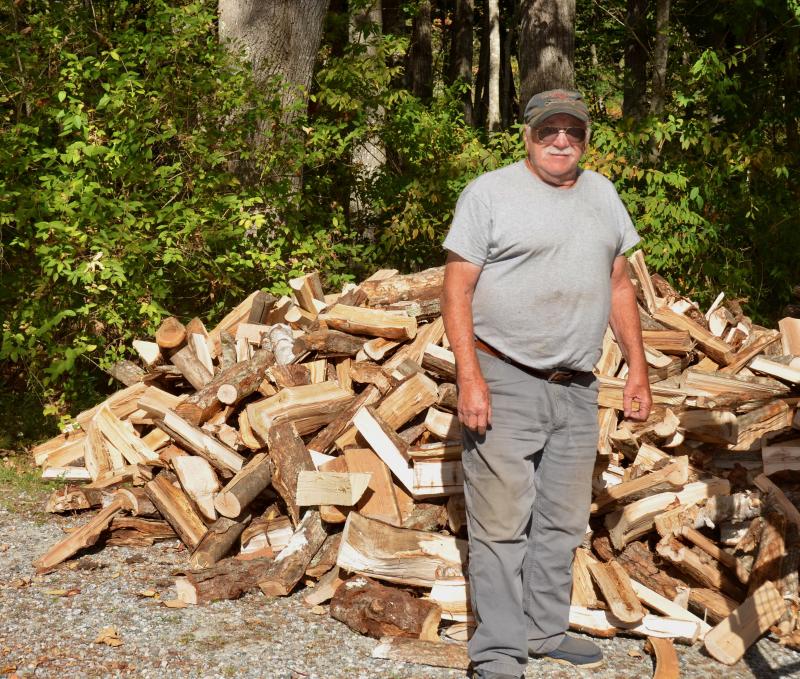 Randy Dennison, of Cushing, has been cutting firewood all his life, just as his father and grandfather did. A family business since the turn of the 19th Century, in Cushing. (Photo by Lynda Clancy)
Longtime Waldo County photographer Peggy McKenna captured the heart and soul of working Maine during the 1980s and 1990s. Here, she chronicled Ralph Pratt, of Montville, with his impressively and artfully stacked wood. Peggy McKenna died in 2014 and the Penobscot Marine Museum, in Searsport, holds who photography collection. The museum graciously shares McKenna’s work here.
John French, owner of Coastal Auto Care, in Camden, advises that vehicles get winter physicals before winter descends. (Photo by Sarah Shepherd)
Randy Dennison, of Cushing, has been cutting firewood all his life, just as his father and grandfather did. A family business since the turn of the 19th Century, in Cushing. (Photo by Lynda Clancy)
Randy Dennison, of Cushing, has been cutting firewood all his life, just as his father and grandfather did. A family business since the turn of the 19th Century, in Cushing. (Photo by Lynda Clancy)
Longtime Waldo County photographer Peggy McKenna captured the heart and soul of working Maine during the 1980s and 1990s. Here, she chronicled Ralph Pratt, of Montville, with his impressively and artfully stacked wood. Peggy McKenna died in 2014 and the Penobscot Marine Museum, in Searsport, holds who photography collection. The museum graciously shares McKenna’s work here.
John French, owner of Coastal Auto Care, in Camden, advises that vehicles get winter physicals before winter descends. (Photo by Sarah Shepherd)
Randy Dennison, of Cushing, has been cutting firewood all his life, just as his father and grandfather did. A family business since the turn of the 19th Century, in Cushing. (Photo by Lynda Clancy)Mainers are natural old salts at winter. They see the cold coming at the end of the prior spring, even well before that. Winter is never really off our minds, a reality that breeds practicality. That is the nature of winter in a state where the weather can be bone-chilling cold, capricous and dangerous. As well as exquisitely beautiful and serene.
Late summer and fall is the preperatory period, while the bounty of the harvest is rich and tasty. Farmers Markets across the Midcoast are a reflection of just how far agriculture has evolved in Maine over the last decades. We have four-season farming, thanks to the Victory Gardeners of the 1940s, Eliot Coleman and crews of the last 40 years, and today's innovative entrepreneurs: tomatoes grown year-round in Madison greenhouses, as well as a variety of greens available thanks to aquaponic systems.
The quantity and variety of produce and locally cultivated dairy and meat has been plentiful, even this year, given the drought. However, farmers have said that hay to feed livestock through the winter is in short supply because the fields dried out and there was no opportunity for a second mowing. Farmers will have to appeal across state lines for hay.
That's but one headache with which to grapple. In the meantime, municipalities have hopefully filled their salt and sand sheds so commuters do not slide off the roads when the going gets rough. And rough it will get. Passable roads are necessary for those who live here through the four seasons; our economic and socials engines — and personal livelihoods — are built on plowed ways and means.
"Make sure your vehicle has a winter physical," said longtime Camden business owner John French, who owns Coastal Auto Care. "It's important to take the time to do your vehicle's maintenance before winter."
Schedule an appointment with your mechanic and have brakes, tires, belts and hoses assessed, antifreeze level checked, and any warning lights diagnosed. Vehicle maintenance is especially important for those traveling longer distances over the holidays.
Snow tires
And, said French, do not delay until December to make an appointment to have your snow tires put on. The optimal time for that task is from late October through the middle of November, in case there is an early snowfall. Mechanic's schedules get booked, sometimes up to six weeks in advance. Be proactive about calling.
Organized and supplied
Confirm with your plow guy that he will be clearing your driveway and confer about his schedule.
Purchase a back-up shovel; your others have likely been through several winters.
If you do not have a generator and are on well water, stash away water for yourself and your animals. Speaking of pets and livestock, tuck away an extra supply of food for them. Have some extra snacks and meals on hand for yourself, as well.
Store workable matches and lighters, heavy duty flashlights and batteries. Check them all now.
Got your wood in?
Mention to a Mainer that you are stacking wood in mid-October and you'll likely be met with a sideways glance and a, "You haven't done that, yet?"
Because to get the firewood ready for winter (that stretch from mid-October through April (or mid-June), the stacking should have been done last June; even better, the August of a year ago, at least 18 months prior.
Vicki Eugley, in Lincolnville, looks a few years down the road for her family's wood supply.
"We have next year’s ready to go," she said, in early October. "I am amazed at how many people do not."
They burn approximately four cords a year to keep their home cozy warm. It is a ritual to get seasonal wood in place during the summer, stacked and ready.
"Heating with wood warms you three times," said Stephen Bunting, of Hope. "Once when you stack it, once when you bring it in, and once when you burn it."
Burning wood for heat, and ambience, is age-old in Maine. It goes without saying that chimneys and wood stoves need to be cleaned and inspected every year, that safety is paramount, and that you do not burn green wood, wet wood, glossy magazines and trash. Burn dried, hard wood.
And there is a hierarchy of trees that are favored. Some trees, like poplar, burn hot and fast in the stove; others, like cherry and apple (don't burn prime cherry trees; get them milled, instead. Cherry is coveted for furniture-making), provide a slow, cozy and fragrant fire.
Do not forget to put a pan of hot water on the top of the stove to circulate moisture through the dry winter months.
Randy Dennison, of Spruce Head, knows how integral firewood is to Mainers and he continues a thriving business started by his grandfather at the turn of the 20th Century. Oil, propane, heat pumps, radiant heat flooring, geothermal, kerosene — they are all fuel sources for winter heat. And wood stoves and wood-burning fireplaces are not prevelant as they used to be; still, there is a strong market for firewood.
Dennison — when he is not leaning down to pet dogs he meets in a customer's dooryard — can spot a tree in a heartbeat that should come down, which ones are at risk of falling toward a house or a car, and how much life they have left in them.
"I've cut trees for 70 years," he said. "I ran a chainsaw when I was 10. It weighed more than I did. An old McCulloch [long since acquired by Husqvarna], at 42 pounds."
Back when Dennison's grandfather, Herbert Smith (born in 1889 and died two days before turning 98), was cutting wood, the price per cord was $3.
"And he did it the hard way," Dennison said. "Cut it with a bucksaw and split it with an ax. If he saw the way I was doing it today, he would say, 'you're a lazy man.'"
What took his grandfather three days to get a cord from downed trees, takes Dennison 20 minutes with a processor. Smith owned half of Cushing in his day, and had a cow farm. No one had money, so they traded land for milk. Back then, an acre of land was a dollar, said Dennison.
Dennison's father, Norman Dennison, took over his grandfather's business, "and then he retired, and I have been doing it for the last 20." While he also set lobster traps and fished.
Best wood to burn?
"Maple," said Dennison. "My father loved birch, but it has thick bark on it. The minute you cut it, you want to split it. And if you get it dry, it is going to burn a long time, and hot. Oak will melt your stove if you're not careful because it burns hotter than the birch."
He recommends acquiring next year's wood early in the spring.
"April, or May," he said. "When my grandfather started doing it, he cut all year long because he had cows to milk in the morning. And when the days got short, he'd go into the woods by candlight so he would not fall down. I don't know if he'd realize, but right now, when you cut the trees when they are dormant, they are in hibernation. I usually cut my wood in October, November, January and February. There's no sap in them. They are all dry. But if I cut it in March, April or May, they are wet."
Then you have to wait 18 months.
"Yep, pretty much," said Dennison.
Buy wood early in the spring and let it sit until at least October. "But don't let it rain on it," he warns.
Paper towels are made from wood, he pointed out.
"One lady had a hot-top driveway," Dennison said. "'Dump it in front of my garage,' she said.
'It's going to rain in a few days,' I said, but I dumped it.
"The next year I went back and she had about eight feet of it sitting on the lawn.
'Why is that wood there,' I said.
'Well,' she said, 'that won't burn.'
"I said, 'you know what happened, don't you? The water ran down here and laid on the hot top, and the wood soaked it up.
'That did that?', she said.
"I said, 'Honey, listen to me. They make paper towels out of wood. So what do you think that dry wood did? If your house catches on fire, what do they put it out with? They put it out with water, because water does not burn. That is why your wood did not burn.'"
Reach Editorial Director Lynda Clancy at lyndaclancy@penbaypilot.com; 207-706-6657