
Two reports, two energy visions for Maine
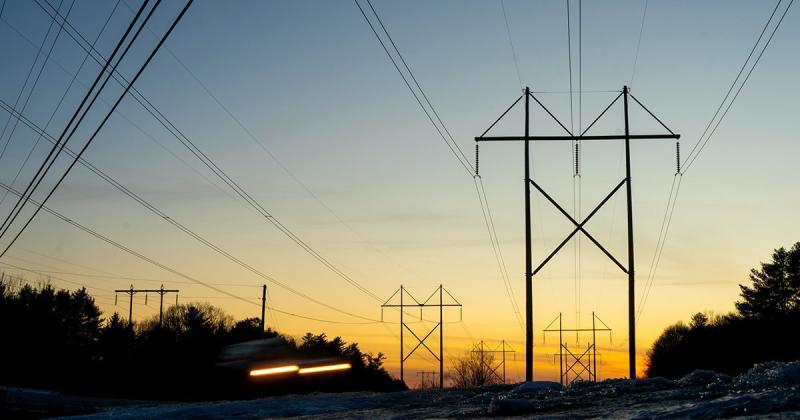 Photo by Gabe Souza.
Photo by Gabe Souza.
Photo by Gabe Souza.Maine and New England must choose between two divergent paths for how to generate electricity in the coming years, according to two noteworthy reports released this winter that come to very different conclusions.
Despite their differences, both reports agree on one thing: New England’s already high electricity costs are bound to rise. The question is which path leads to smaller increases.
This isn’t a message Maine’s political hopefuls want to send during an election year, when affordability is top of mind for many voters. Some gubernatorial candidates have begun talking about how they would slash energy costs and even freeze electric rates.
These are appealing notions, as residents gasp at incoming energy bills driven higher by this winter’s prolonged cold snaps. Maine already saw the nation’s third-highest increase in average retail electricity prices between 2014 and 2024. This year, electricity supply prices are up 20 percent, adding $11 a month for an average household.
But Maine doesn’t directly run power plants. Rather, utility regulators solicit competitive bids from generators, which feed power into a six-state grid overseen by an independent systems operator. Utilities such as Central Maine Power transmit and distribute that power to homes and businesses.
While utilities haven’t produced electricity since state legislators forced them to sell their generating assets more than 25 years ago, the companies sometimes still get blamed when supply costs rise.
Still, the policy decisions made by New England politicians and regulators do create incentives for what sorts of generation get built and where — wind farms or natural gas-fired power plants, for instance. These decisions ultimately affect not only electric rates, but the region’s environmental quality and its contribution to climate change.
That’s why the next governor could have a big say about Maine’s energy future, at a time when the Trump administration is taking unprecedented actions at the national level to gut renewable energy and climate science, while boosting the use of coal, oil and natural gas.
“Affordable energy is very important to voters in general, and especially to Maine voters in winter,” said Ron Schmidt, chair of the political science department at the University of Southern Maine. “The issue may not have the immediacy of grocery prices, but it’s an important issue, and a good choice for candidates to focus on.”
Having said that, Schmidt added that governors can’t just order lower energy prices. Their influence comes through process, such as who they nominate to the Public Utilities Commission, and cooperation from players ranging from private investors to the Legislature.
“Voters may have unrealistic expectations about how much power governors have in making changes to energy markets,” he said.
Maine has had laws and policies aimed at reducing fossil fuel consumption for decades. The effort got a major boost with the election of Gov. Janet Mills, a Democrat, in 2018. Mills initiated the Maine Won’t Wait climate action plan.
Aided by a Democrat-controlled Legislature, her clean energy and carbon reduction goals represented a sharp U-turn from the policies of former Gov. Paul LePage, who opposed any subsidies for wind and solar energy and actively worked to undermine them.
In 2026, Maine again faces two divergent paths, as articulated in two recent energy reports.
One was done for the Maine Department of Energy Resources. This report examines what’s driving the state’s rising electricity rates, largely blaming the price volatility of natural gas used to generate power in the region. It suggests continuing on Maine’s path of embracing renewable energy resources and greater efficiency to blunt those increases.
The other analysis was released by a group of conservative think tanks in New England, including the Maine Policy Institute. It focuses on affordability in New England and lays out the pros and cons of developing more natural gas capacity, more nuclear power plants or a combination of the two. Developing more renewables, it concludes, would be the most expensive and least reliable option of all.
Missing from either of these reports is an all-of-the-above energy policy, the idea of encouraging whatever helps meet the region’s growing demand for electricity.
Instead, they reflect a general ideological split between the two major political parties in the Trump era — Republicans support fossil fuels to achieve “energy dominance.” Democrats embrace renewable energy to reduce dependence on fossil fuels and combat climate change. These form the foundations for energy affordability statements that many of Maine’s political candidates will be making in the coming months.
Candidates have opposing views on energy policy
There is a clear split between the strategies of Democrats and Republicans running for governor. Here are some examples.
Angus King III, a Democrat and son of Sen. Angus King, is promoting a ratepayer “bill of rights” aimed at lowering costs through the use of more cost-effective renewable energy and by boosting efficiency. Among the elements are streamlining regulatory and permitting processes to lower the cost of new solar and wind projects; not subsidizing any data centers that come to Maine and making sure the existing electric grid is used efficiently before allowing expensive upgrades.
“The system has let us down and it’s time to start thinking differently to fix it,” he said last month when announcing his plan.
King is the founder of Peaks Renewables in Clinton, which makes gas from cow manure. He has worked across the country on wind and solar projects.
Bobby Charles, a Republican, calls Maine’s energy crisis, “a self-inflicted wound caused by decades of Democrat political malpractice.” He has introduced a plan aiming to cut energy costs by 30 to 40 percent, largely by putting energy experts in charge, rather than with the current regulatory system Charles says is run by political appointees.
Specifically, Charles would repeal utility deregulation, negotiate to complete out-of-state pipelines that could bring more natural gas to New England and assure uninterrupted operation of Maine’s hydroelectric dams. He would promote “free market solutions” that could include “efficient renewables” and small modular nuclear reactors.
“The time for political experimentation with Maine’s energy grid is over, “ he said in his plan’s release.
Charles is a lawyer and former U.S. assistant secretary of state.
While not all of Maine’s nearly two dozen gubernatorial candidates have well fleshed out positions on energy, many have posted language on their websites and articulated positions for a Portland Press Herald story on affordability strategies last month. Here are some examples.
Shenna Bellows, a Democrat and Maine’s secretary of state: Freeze electric rates, cap utility profits at 6 percent and streamline permitting while the state develops solutions to lower costs.
Jonathan Bush, a Republican and health care tech company founder: Double the availability of natural gas.
Troy Jackson, a Democrat and former state Senate president: Cut utility profits, reinvest in the grid and make Maine energy independent by tapping the state’s clean energy resources.
Owen McCarthy, a Republican and medical tech entrepreneur: End hidden charges on electric bills, import more Canadian power and phase out net energy billing.
Nirav Shah, a Democrat and former Maine CDC director: Oppose more rate hikes and increase weatherization and insulation to lower energy costs.
Rick Bennett, former Republican lawmaker running as an Independent: Put affordability first while moving towards energy independence. Invest in efficiency, reliability and locally controlled power.
Two reports. Two very different visions.
These aspirations are largely in line with priorities outlined in the two reports.
The first report, Factors Driving Electricity Prices in Maine, was done by The Brattle Group, a Boston-based economics and energy consulting firm. Although its analysis is considered non-partisan, the firm’s members overwhelmingly donate to Democrats, according to OpenSecrets.
The leading cause of price hikes in Maine is the region’s dependence on natural gas to generate power, the report says. These supply costs are very volatile and can be influenced by extreme weather or global events. Russia’s invasion of Ukraine, for instance, tripled gas supply prices between 2021 and 2023.
And because there’s not enough pipeline capacity in the region on the coldest days, supply is supplemented with imported, liquefied natural gas, which is even more expensive. This situation isn’t getting better, the report states: “Several emerging trends indicate that the price of natural gas is likely to go up, which will make electricity more costly for customers in Maine.”
Topping the list is a rise in global gas prices after Russia’s invasion of Ukraine. That’s making it more lucrative to ship natural gas from the United States overseas. Exports increase the price of domestic gas, which pushes up electricity prices. Looking ahead, the growth of data centers and their heavy demand for electricity is also expected to increase gas prices, according to the report.
The group suggested ways to manage these rising costs. Renewable energy can help, the report says, to the extent that it displaces gas generation. Load flexibility — in which users shift their energy consumption to better match the supply of electricity — is another strategy, creating so-called virtual power plants. An example is tying together the output of solar panels with the storage capacity of batteries and the ability of smart thermostats to dial back at times of peak demand on the grid.
The second study is called Alternatives to New England’s Energy Affordability Crisis. It was done by the Denver-based nonprofit Always On Energy Research. As its name implies, the firm favors always-on, base-load generation, such as nuclear power and natural gas, over what it calls “weather dependent” generation such as solar and wind.
The report builds on earlier work by the firm that found policies favoring renewable energy to deeply cut carbon emissions and reduce natural gas use would double electric bills by 2050, and increase the risk of blackouts.
As an alternative, the group studied three policy scenarios out to 2050.
A “Nuclear scenario” envisions building 20,400 megawatts of new capacity. That would bring the largest reduction in greenhouse gas emissions, but would be the most costly, according to the report.
A “Natural Gas scenario” would build new power plants and boost pipeline capacity. That’s the lowest cost and could cut emissions by a quarter. A “Happy Medium scenario” would balance costs by blending those two technologies to cut emissions in half.
In presenting these potential solutions, the report asks if any of them are realistic. It notes, for instance, that the quantity of nuclear plants needed would be 13 times more than what was built from 2009 to 2024, and that small modular reactors don’t yet exist commercially. As for natural gas, the region would need more pipeline capacity, while states such as New York continue to block their construction.
“Increasing natural gas pipeline capacity and building new nuclear power plants will be a significant regulatory challenge,” the report noted. “As a result, the main benefit of examining these scenarios is to illustrate the relative benefits of these nuclear and natural gas portfolios compared to the renewable scenario described in our previous report.”
Positive trends or failed policy
Two energy advocates who examined each report at the request of The Maine Monitor came away with differing conclusions that are in line with the findings.
Jeff Marks is executive director of ClimateWork Maine, a network of businesses interested in a sustainable economy.
Setting aside the firm’s pro-fossil fuel bias, Marks said, the Always On Energy Research report makes a useful case for gas and nuclear as bases for generation in the region.
“The study falls apart, however,” Marks said, “in that it ignores trends that wind, solar, and battery capital and operating costs are declining while natural gas price volatility risks an unaffordable future.”
The Brattle Group report aligns with Maine climate goals, such as 100 percent clean energy by 2050, Marks noted.
“However,” he said, “the report could better address affordability burdens across the state and more clearly recognize that uneven state policies over time, such as net metering, transmission and distribution limitations, and lack of nuclear resources may play a role in electricity price increases.”
Jim LaBrecque served as energy adviser to former Gov. Paul LePage. He said the Brattle report relies on outdated energy claims that lack engineering support. The Always On report, he said, is grounded in evidence.
“We didn’t need to spend billions in ratepayer funds to learn what is now becoming clear: Maine’s current energy path is failing,” LaBrecque said. “As broken promises on alternative energy translate into skyrocketing bills, it’s becoming obvious that too many programs are driven by politics rather than sound engineering and economics.”
This story was originally published by The Maine Monitor, a nonprofit civic news organization. To get regular coverage from The Monitor, sign up for a free Monitor newsletter here.